Trying to decide between EV financing vs leasing can feel like comparing apples to e‑apples. Both get you into an electric car with a monthly payment. But the way risk, flexibility, and long‑term cost play out in 2026 is very different, especially now that federal EV tax credits have ended for most U.S. buyers and lessees.
The short answer
How to think about EV financing vs. leasing in 2026
EV finance & leasing by the numbers
EV technology is improving fast, and used EV prices have been more volatile than gas cars. That’s why so many drivers are asking, “Should I lock myself into owning this thing, or let a leasing company take the resale‑value gamble?” The right answer depends on how long you’ll keep the car, how much you drive, and how comfortable you are betting on future EV values.
How EV financing works
When you finance an EV, you’re taking out a loan to buy the car. You make monthly payments (principal plus interest) until the loan is paid off. At the end, you own the car outright and can keep driving with no payment, trade it in, or sell it.
- Typical term: 60–72 months (sometimes up to 84)
- You pay for the entire price of the EV, minus your down payment and any trade‑in value
- You can drive as many miles as you want, there’s no mileage cap
- You’re fully exposed to depreciation: if EV values fall faster than expected, that’s on you
- Once the loan is paid off, you can enjoy years with no monthly payment if you keep the car
Financing and used EVs
How EV leasing works
With an EV lease, you’re essentially renting the car long‑term. You pay for its depreciation during the lease term (usually 24–36 months), plus interest and fees. At the end, you hand the car back, buy it for a preset price (the residual), or sometimes extend the lease.
- Typical term: 24–36 months
- You pay for the value the car loses during your lease, not the whole price
- Lower monthly payments than financing the same new EV are common
- Leases include mileage limits (often 10,000–15,000 miles per year); extra miles cost more
- Wear‑and‑tear charges can apply if you return the car with significant damage
- At lease‑end you can walk away if values drop, or buy the car if it turns out to be a winner
Mind the mileage limits
Side‑by‑side EV finance vs. lease comparison
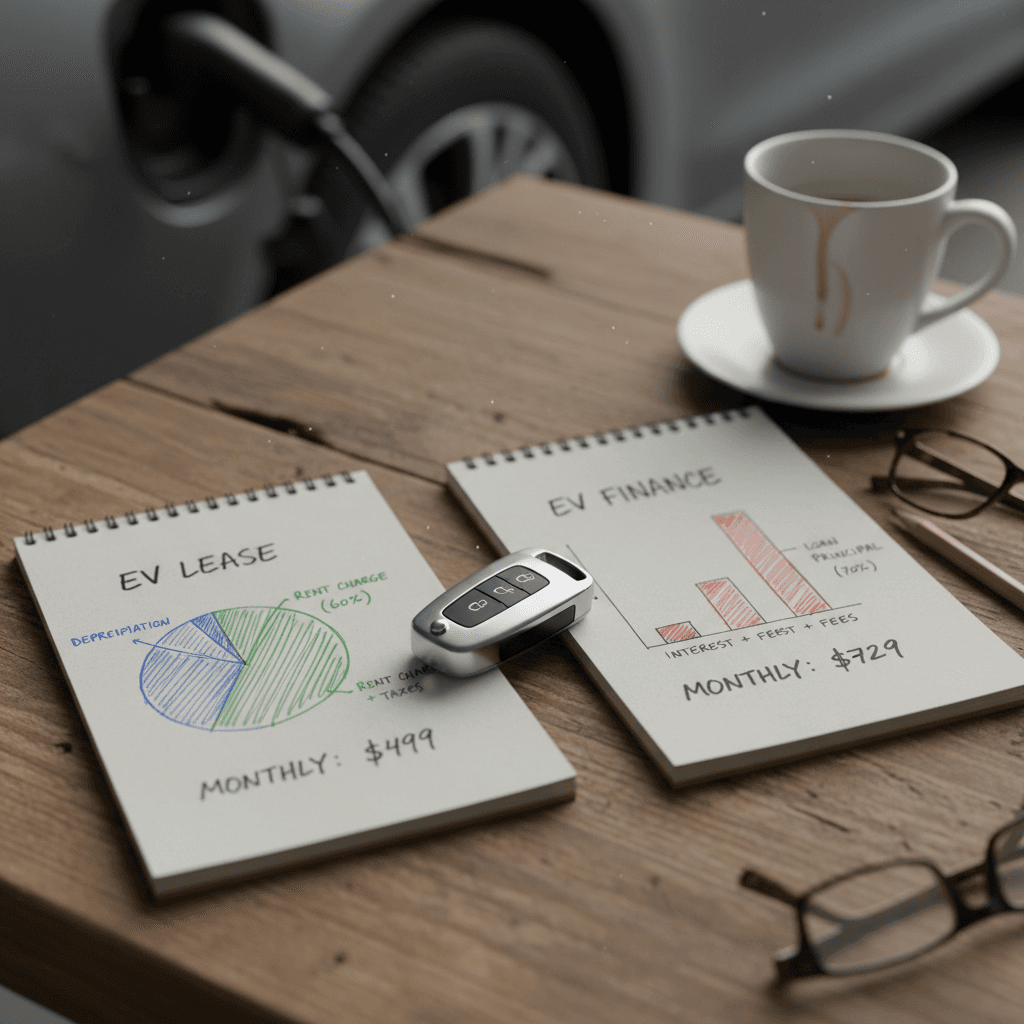
Let’s put some simple numbers on the table. Assume a new EV with a $45,000 price tag, good credit, and a competitive 2026‑style offer:
Example: Financing vs. leasing the same new EV
Illustrative numbers only, actual offers vary by lender, brand, and your credit. Use them to understand the structure, not to quote a deal.
| Finance (Loan) | Lease | ||
|---|---|---|---|
| Term | 60 months | 36 months | |
| Assumed APR / Money Factor | 6.0% APR | Equivalent of ~4.0% APR | |
| Down payment | $4,500 (10%) | $2,500 | |
| Estimated monthly payment | ~$760 | ~$580 | |
| Miles allowed | Unlimited | 12,000/year (example) | |
| Ownership at end | You own the EV, no payment if you keep it | You return it or buy it for preset price | |
| Exposure to resale risk | High, future value is your problem | Low, the lessor eats the risk unless you buy it |
Comparing a typical 60‑month finance deal and a 36‑month lease on a $45,000 electric vehicle.
Why the lease payment is usually lower
Short horizon (3–4 years)
If you like to change cars often, or you’re trying an EV for the first time, a lease keeps your commitment short and your tech fresh. You’re not stuck with an outdated battery or infotainment system in year seven.
Long horizon (7–10 years)
If you’re the type who drives a car until the wheels practically square off, financing wins more often. Yes, the early years cost more per month, but once the loan is gone, you can enjoy years with no payment, something a serial leaser never gets.
When leasing an EV is usually better
There’s a reason EV leasing has surged. Leasing lets you enjoy the latest battery tech and driver‑assist features while sidestepping a lot of the unknowns around long‑term EV values and battery life.
Leasing shines in these EV scenarios
If you recognize yourself in two or more of these, a lease deserves a close look.
You want to test‑drive EV life
If this is your first EV, a 2–3‑year lease is like a long test drive. You’ll learn how charging fits your life without betting a decade of ownership on getting it right the first time.
You value the latest tech
Every few model years, EVs tend to gain range, charging speed, and software features. Leasing keeps you on that treadmill, on purpose. When the lease is up, you move to the next generation.
You’re wary of resale risk
Battery warranties and fast‑moving tech make long‑term values hard to predict. With a lease, the bank sets a residual value. If the EV is worth less than that at lease‑end, it’s their headache, not yours.
You need the lowest payment
All else equal, the lease payment is usually lower than the loan on the same new EV. If monthly cash flow is tight and you’re okay with always having a payment, leasing can be the pressure‑relief valve.
You drive moderate miles
If you’re around 10,000–12,000 miles per year, you’re in most leases’ comfort zone. You avoid big over‑mileage fees while still enjoying the car.
You like to swap cars often
If you naturally change vehicles every 3–4 years, leases line up with your lifestyle. You’re not forcing a long loan term to match a short attention span.
Where leasing new, financing used can pair nicely
When financing an EV is usually better
Leasing sounds attractive until you do the math over a decade. If you’re likely to stay in one vehicle for the long haul, repeated leases can quietly become the most expensive habit in your garage.
Signs you’re better off financing
1. You keep cars 7+ years
If you typically drive your vehicles until at least year seven, and especially past year ten, financing lets you enjoy 3–5 years with no payment once the loan is done. That’s where ownership really wins.
2. You drive a lot of miles
If you’re regularly above 15,000 miles per year, financing avoids mileage penalties. High‑mileage EV drivers also tend to see faster fuel‑cost savings versus gas, which makes owning longer more rewarding.
3. You want full flexibility
With a financed car, you decide when to sell, trade, or road‑trip across the country. There’s no staring at a lease contract wondering what every rock chip and extra 2,000 miles will cost you.
4. You’re buying a used EV at a good price
A solid used EV, especially one with a verified battery‑health report and fair price, can dramatically cut your depreciation risk. That’s Recharged’s wheelhouse: every car includes a Recharged Score so you’re not guessing about battery health.
5. You care about long‑term cost, not just payment
If you’re willing to trade a higher payment today for a lower total cost over 8–10 years, financing is usually your friend.
Watch out for ultra‑long loans
New vs. used EV: why a used, financed EV can be the sweet spot
There’s a third option that often threads the needle between shiny‑new leases and long loans on expensive new metal: financing a used EV that’s already taken the steepest part of its depreciation curve.
The downside of many new‑EV loans
- New EVs still tend to cost more than comparable gas cars.
- Early‑life depreciation can be steep, especially in the first 2–3 years.
- If pricing shifts or a refreshed model arrives, your resale value can suffer.
Why used EVs can make great finance candidates
- Someone else already ate the biggest depreciation hit.
- You can see real‑world range and reliability from early owners.
- A good battery‑health report (like Recharged’s Score) helps you avoid weak packs.
How Recharged fits in
Tax credits and incentives: what still matters after federal credits
Federal EV tax credits of up to $7,500 for new EVs and $4,000 for used EVs have now ended for vehicles delivered after September 30, 2025. That changed the math for both leasing and financing, but it didn’t eliminate incentives entirely.
- Some states still offer rebates or tax breaks for buying or leasing an EV, sometimes with extra support for lower‑income households.
- Utilities in many regions provide bill credits or charger rebates that don’t care whether you leased or financed.
- Dealers and automakers still run lease cash and APR specials to move EV inventory, even without federal help.
- Many 2024–2025 EVs that qualified for the old tax credit saw their pricing and residuals shaped by those incentives, those effects will linger in used EV values for years.
Leasing no longer has a tax‑credit edge
Key questions to ask before you decide
Ask yourself these before signing anything
How long will I likely keep this EV?
If you’re honest answer is 2–3 years, a lease deserves a look. If it’s 7–10 years, or “until it dies”, financing is probably your better long‑term play, especially on a well‑priced used EV.
How many miles do I really drive each year?
Dig into actual numbers from your gas car or past EV, not guesses. High‑mileage drivers risk ugly overage bills on a lease.
How much payment risk can I tolerate?
Leasing lowers your monthly payment and shields you from resale surprises but keeps you in a perpetual‑payment cycle. Financing costs more up front but lets you exit the payment game later.
Do I want the option to customize or tow?
Off‑road tires, roof racks, vinyl wraps, towing trailers, many lease contracts limit modifications or heavy use. With a financed EV, you just have to stay within legal and warranty limits.
Am I comfortable with EV tech aging?
If the idea of driving a 10‑year‑old EV with older charging speeds or range makes you cringe, leasing will feel more natural. If that sounds fine as long as it’s cheap to run, financing is your lane.
Is this my first EV, or my second?
First‑timers often benefit from a short lease to learn their real needs. Seasoned EV drivers who know exactly what works for them areusually in a better position to finance, especially used.
FAQs: EV financing vs. leasing
Frequently asked questions
Bottom line: EV financing vs. leasing, which is better?
There’s no one‑size‑fits‑all winner in the EV financing vs leasing debate. Leasing leans into lower payments, fresher tech, and reduced resale risk, at the cost of always having a payment and watching your miles. Financing leans into long‑term value, flexibility, and equity, at the cost of higher early‑year payments and more exposure to future EV prices.
If you want to dip your toe into EV life or change cars every few years, lean toward a lease. If you’re ready to commit to electric driving for the long haul, a well‑chosen used EV with solid battery health, financed on reasonable terms, can be the financial sweet spot.
Next step with Recharged
Ready to find your next EV?
Browse Vehicles