When people talk about saving money with an electric car, they often throw around one number: EV cost per mile. In 2025, with electricity and gasoline prices both moving, understanding that number is the fastest way to see whether an EV, especially a used one, actually fits your budget.
What this guide covers
EV cost per mile basics in 2025
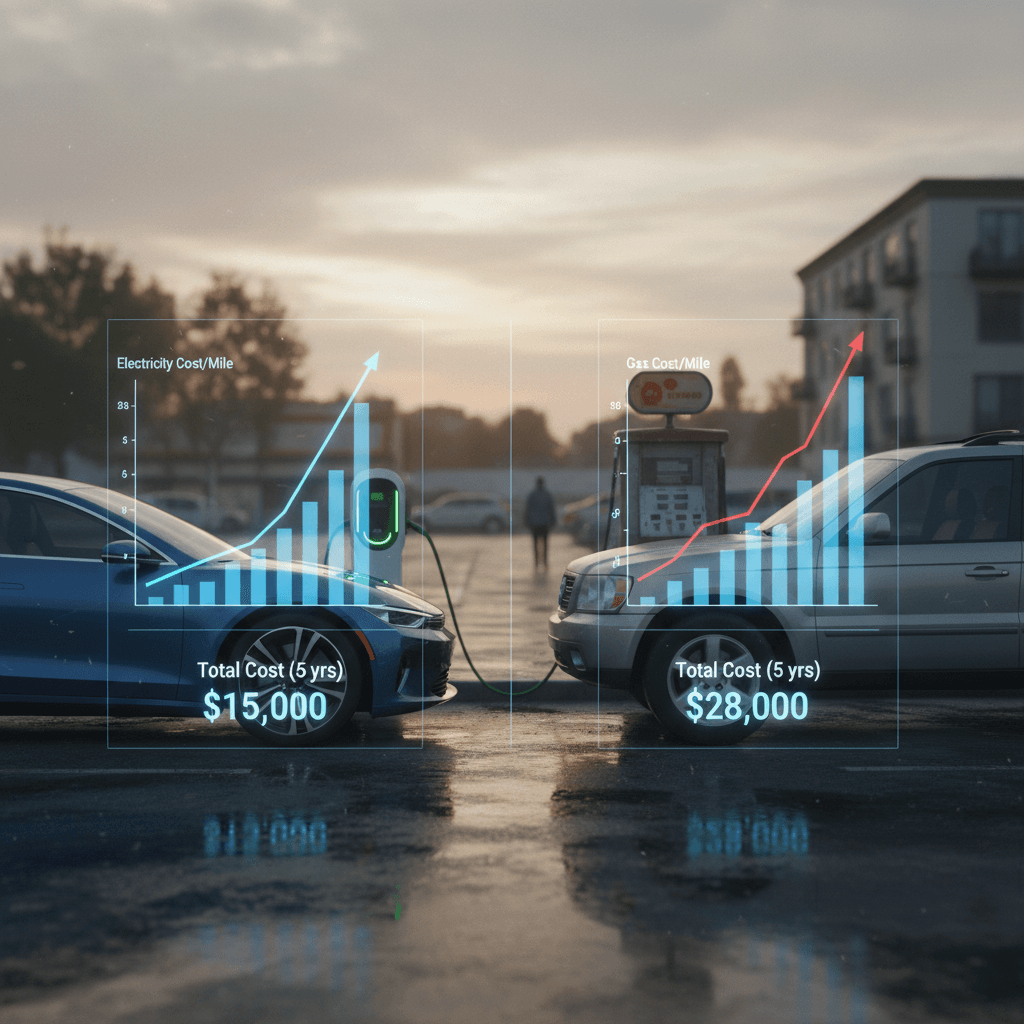
At its simplest, EV cost per mile is just your charging cost divided by the miles you actually drive. For most U.S. drivers charging at home in 2025, that number typically lands around $0.03–$0.06 per mile, depending on electricity rates and how efficient your EV is. That’s usually less than half what a comparable gasoline car costs to run per mile.
Typical 2025 fuel cost per mile (U.S. averages)
The key formula to remember
How to calculate your EV cost per mile
You don’t need a spreadsheet or a PhD in energy markets. To estimate your EV cost per mile, you only need three pieces of information: your car’s efficiency, your electricity price, and how much you rely on home vs public charging.
- Find your efficiency in kWh per 100 miles. You can grab this from the EPA label, your owner’s manual, or your in‑car / app trip computer. Many modern EVs fall between 25–32 kWh/100 mi.
- Look up your electricity rate in $ per kWh. Check your utility bill; the national residential average in 2025 is roughly in the mid‑teens (cents per kWh), though it varies a lot by state.
- Apply the basic formula: Cost per mile = (kWh per 100 miles × price per kWh) ÷ 100.
- If you use public fast charging regularly, blend in that higher rate (often 2–3× your home rate) for a more realistic number. We’ll break this down later.
Sample calculation
Where to find kWh/100 miles
- EPA window sticker (for newer cars)
- Vehicle’s energy or trip screen
- Mobile app trip summaries
- Owner’s manual or OEM website
What if you only see MPGe?
Some materials still show MPGe instead of kWh/100 mi. For cost per mile, kWh/100 mi is far easier. If the car only lists MPGe, check the digital dash or app after a few days of driving to see real‑world efficiency in kWh/mi or kWh/100 mi.
Real-world examples: EV vs gas cost per mile
Let’s put some realistic 2025 numbers on the table so you can compare EV cost per mile to a typical gasoline car. We’ll use national average prices and mainstream vehicles, not hyper‑efficient outliers.
Example: Compact SUV, EV vs gasoline in 2025
Illustrative comparison using U.S. average energy prices and typical efficiency.
| Vehicle type | Energy use | Energy price | Fuel cost per mile |
|---|---|---|---|
| Electric compact SUV | 28 kWh/100 mi | $0.15 per kWh (home) | (28×0.15)/100 = $0.042 |
| Gas compact SUV | 28 mpg | $3.30 per gallon | 3.30/28 = $0.118 |
| Difference | , | , | EV is ~7.6¢ cheaper per mile |
Your exact numbers will vary by state, driving style, and vehicle, but the EV usually comes out ahead on fuel cost per mile.
Translating cents per mile into yearly savings
Of course, fuel is only part of the story. Insurance, purchase price, and depreciation matter too, especially in the new‑car market. Where EVs tend to shine is on running costs (fuel plus routine maintenance), which is why cost per mile is such a valuable lens when you’re cross‑shopping a used EV against a used gas car.
7 factors that change your EV cost per mile
Your personal EV cost per mile can be lower or higher than the averages. These seven variables move the needle the most.
What really drives your EV cost per mile
From your ZIP code to your driving style, small differences add up.
1. Local electricity rates
2. Home vs public charging
3. Driving style & speed
4. Climate & seasons
5. Battery health & usable range
6. Home charging setup
7. Vehicle size & aerodynamics
Beware of one-size-fits-all calculators
Home vs public charging: Cost per mile
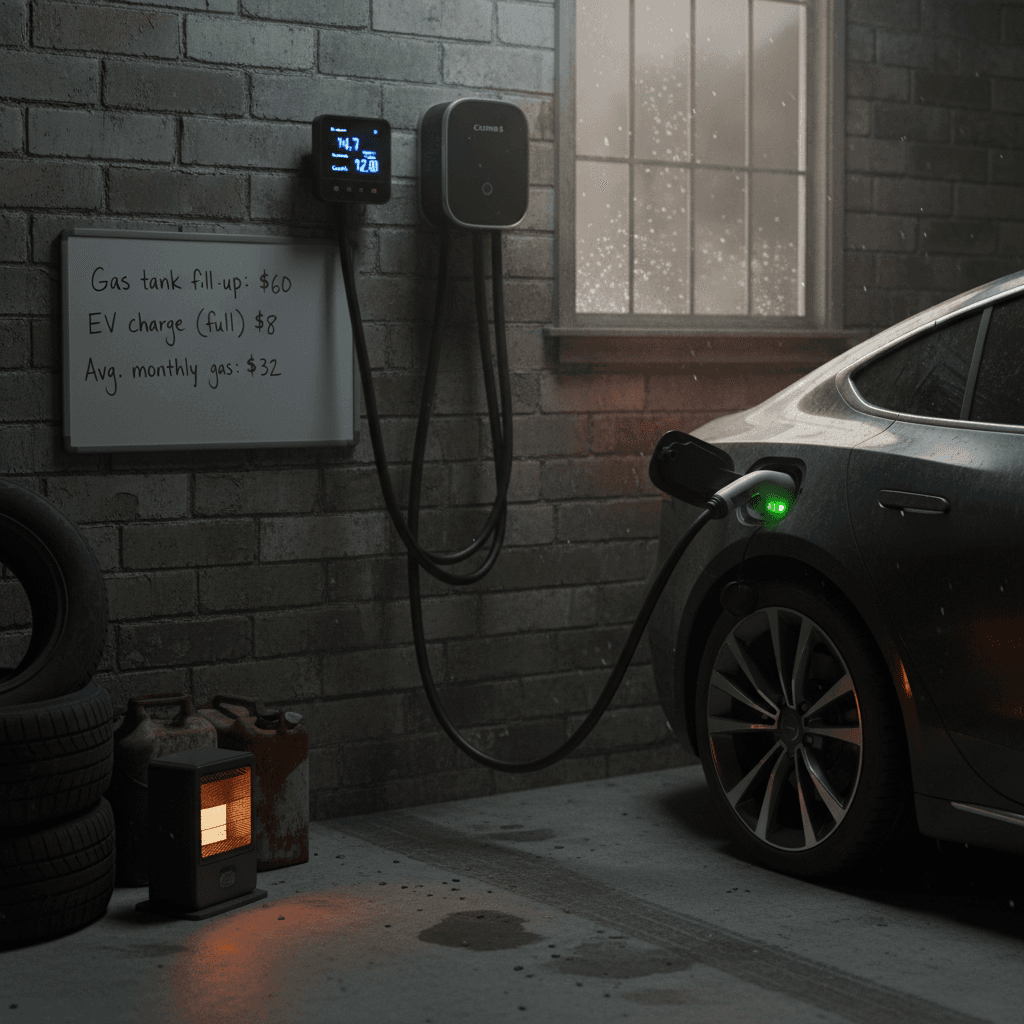
Where you charge is almost as important as what you drive. A driver who charges 90% at home will see a very different EV cost per mile than someone relying mostly on DC fast chargers along the highway.
Illustrative EV cost per mile at different charging mixes
Assumes an EV using 28 kWh/100 miles. Home rate $0.15/kWh, public fast charging $0.40/kWh.
| Charging mix | Effective price per kWh | Resulting cost per mile |
|---|---|---|
| 100% home charging | $0.15 | (28×0.15)/100 = $0.042 |
| 75% home / 25% public | $0.21 | (28×0.21)/100 = $0.0588 |
| 50% home / 50% public | $0.28 | (28×0.28)/100 = $0.0784 |
| 25% home / 75% public | $0.34 | (28×0.34)/100 = $0.0952 |
Your rates will differ, but the pattern is consistent: more home charging usually means a lower EV cost per mile.
When an EV can be as expensive as gas per mile
For used‑EV shoppers, this is exactly why it’s smart to map out your charging plan in advance. If you’ll have reliable access to overnight home or workplace charging, the economic case for a used EV strengthens quickly.
Used EVs: How battery health affects cost per mile
Battery health doesn’t usually change how many kWh it takes to move your EV one mile, efficiency is more about weight, aerodynamics, temperature, and speed. But it does have a direct impact on how you charge, which loops back into cost per mile.
- A healthy battery with strong range lets you charge less often and rely on cheaper home charging.
- If range has dropped significantly, you may feel forced to top up more often at public stations, especially fast chargers, increasing your cost per mile.
- Some older EVs with small original battery packs lose enough range over time that highway legs require extra stops, adding both time and energy to each trip.
Why a battery health report matters
Checklist: Get a low cost per mile on a used EV
7 steps to lock in a low EV cost per mile
1. Confirm your home charging situation
Before you fall in love with a car, make sure you can plug in where you live, whether that’s a 120V outlet in a garage, a 240V circuit for Level 2, or consistent workplace charging.
2. Look up your actual electricity rate
Check your most recent power bill for the total price per kWh including fees. Use that number, not just the headline rate, to estimate your EV cost per mile.
3. Estimate your mix of home vs public charging
If you’ll mostly charge at home, your cost per mile will likely be very low. If you expect to rely on public fast charging, run a separate calculation using common DC fast‑charging prices in your area.
4. Review real-world efficiency for the model
Search owner forums and EPA data to see typical kWh/100 mi for the EV you’re considering. City‑heavy driving, lots of highway miles, or extreme weather may push your number higher than the official rating.
5. Get a verified battery health report
Use a seller that can provide objective battery diagnostics. At Recharged, every vehicle includes a <strong>Recharged Score</strong> with lab‑grade battery health data and fair‑market pricing, so you know what you’re paying for.
6. Run the cost-per-mile math over your annual mileage
Multiply your estimated fuel cost per mile by how many miles you drive in a year. Compare that to your current gas bill or to a similar gas vehicle you’re considering.
7. Don’t forget maintenance and repairs
Factor in lower routine maintenance on EVs, no oil changes and fewer moving parts, but budget for tires and any out‑of‑warranty items. Total cost per mile is fuel plus maintenance, not just electricity.
FAQ: EV cost per mile
Frequently asked questions about EV cost per mile
Bottom line: Is an EV’s cost per mile worth it?
When you strip away the hype, EV cost per mile is one of the clearest advantages electric cars have over gasoline, especially if you can charge at home at typical U.S. electricity rates. For many drivers, fuel savings alone can reach hundreds of dollars per year, and they stack on top of lower routine maintenance.
The nuances matter, though. High local electricity prices, heavy reliance on public fast charging, and buying a used EV with an unknown battery story can all eat into your savings. That’s why it pays to run your own numbers and shop with as much transparency as possible.
Next step if you’re EV‑curious
Ready to find your next EV?
Browse Vehicles