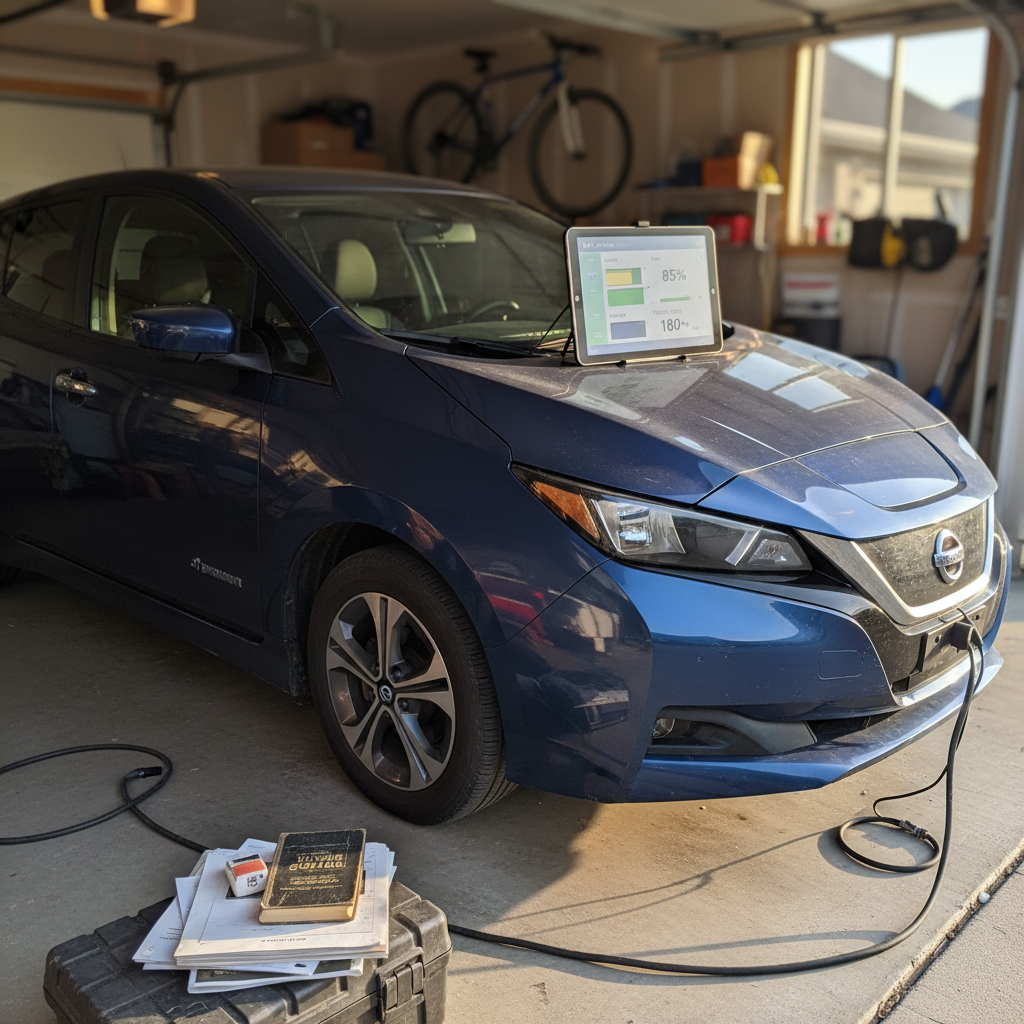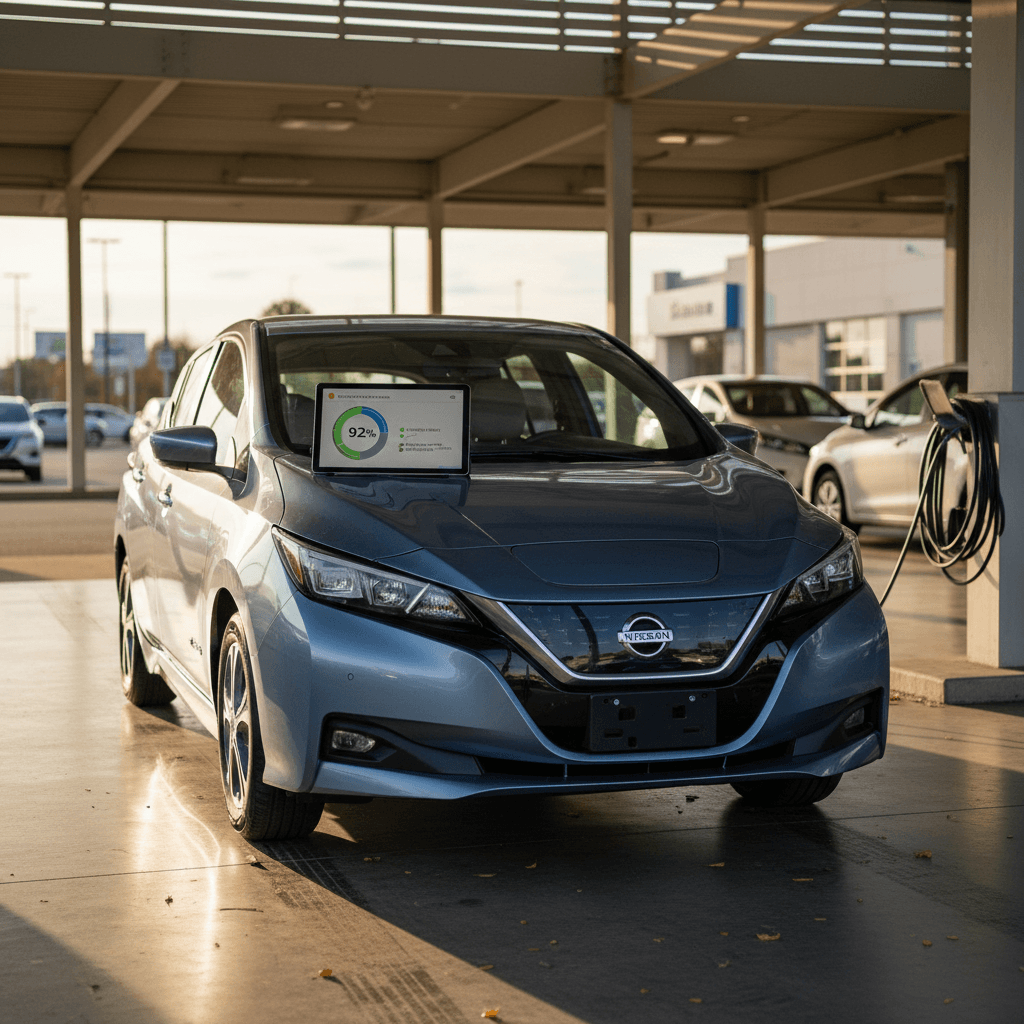
If you’re looking for an affordable way into EV ownership, a certified pre‑owned Nissan Leaf will probably pop up near the top of your search results. Nissan’s small hatchback has been on sale for more than a decade, and there’s now a deep pool of used inventory, some of it carrying factory‑backed CPO coverage, some sold through independent used‑EV specialists like Recharged. The trick is figuring out which path actually gives you the best combination of price, battery health, and peace of mind.
Quick take
Why consider a certified pre-owned Nissan Leaf?
The Leaf is one of the most common used EVs on the market, and that cuts both ways. On the plus side, you get a wide selection of trims, colors, and battery sizes. On the downside, battery degradation and spotty fast‑charging performance on some packs make condition more important than mileage alone. A certified pre‑owned (CPO) Leaf is Nissan’s attempt to reduce that uncertainty by adding inspections and extra warranty coverage on top of whatever remains from the original 8‑year/100,000‑mile EV battery warranty on newer cars.
Top reasons shoppers look at CPO Leafs
Where a factory‑backed certified car can make sense
Added warranty coverage
Multi‑point inspection
Financing & one‑stop shopping
Certification isn’t magic
How Nissan’s CPO program works for the Leaf
Nissan has revised its certified program over time, and details can vary by model year and region, but the basics are consistent. The Leaf must meet age and mileage limits, pass a branded‑title check, and clear a multi‑point inspection. Once it does, it gets additional limited warranty coverage layered on top of any remaining factory coverage.
How CPO coverage stacks on top of factory EV warranties
Approximate coverage for a late‑model Nissan Leaf sold as CPO in the U.S. Always confirm exact terms on the buyer’s order and warranty booklet.
| Coverage area | New Leaf (example) | Certified pre‑owned Leaf (example) | What it means for you |
|---|---|---|---|
| Basic bumper‑to‑bumper | 3 yrs / 36,000 miles | Extended limited warranty (for example, up to 7 years/100,000 miles from in‑service date) | Covers many non‑battery components beyond the original term. |
| Powertrain / EV systems | 5 yrs / 60,000 miles | Usually unchanged; CPO doesn’t restart the powertrain clock | You’re relying on remaining factory coverage; CPO is mostly about the basic warranty. |
| Lithium‑ion battery & capacity loss | 8 yrs / 100,000 miles (from original in‑service date) | CPO does **not** typically extend the 8‑year/100,000‑mile battery coverage | The key protection against severe capacity loss is the original EV battery warranty, not the CPO add‑on. |
| Roadside assistance | Typically 3 yrs / 36,000 miles | Often extended to match the CPO limited warranty term | Helpful if you’re worried about tow coverage or lockouts. |
CPO adds coverage, but the original 8‑year/100,000‑mile EV battery warranty is still the main long‑term protection.
Ask the finance manager to spell it out
Leaf battery basics and real‑world range
With any used Leaf, CPO or not, the battery pack is the story. The Leaf has never used liquid thermal management, so heat and fast‑charging can take a toll over time. Battery size and model year drive range, but so does how the previous owner charged and stored the car.
Common Nissan Leaf battery sizes and EPA range when new
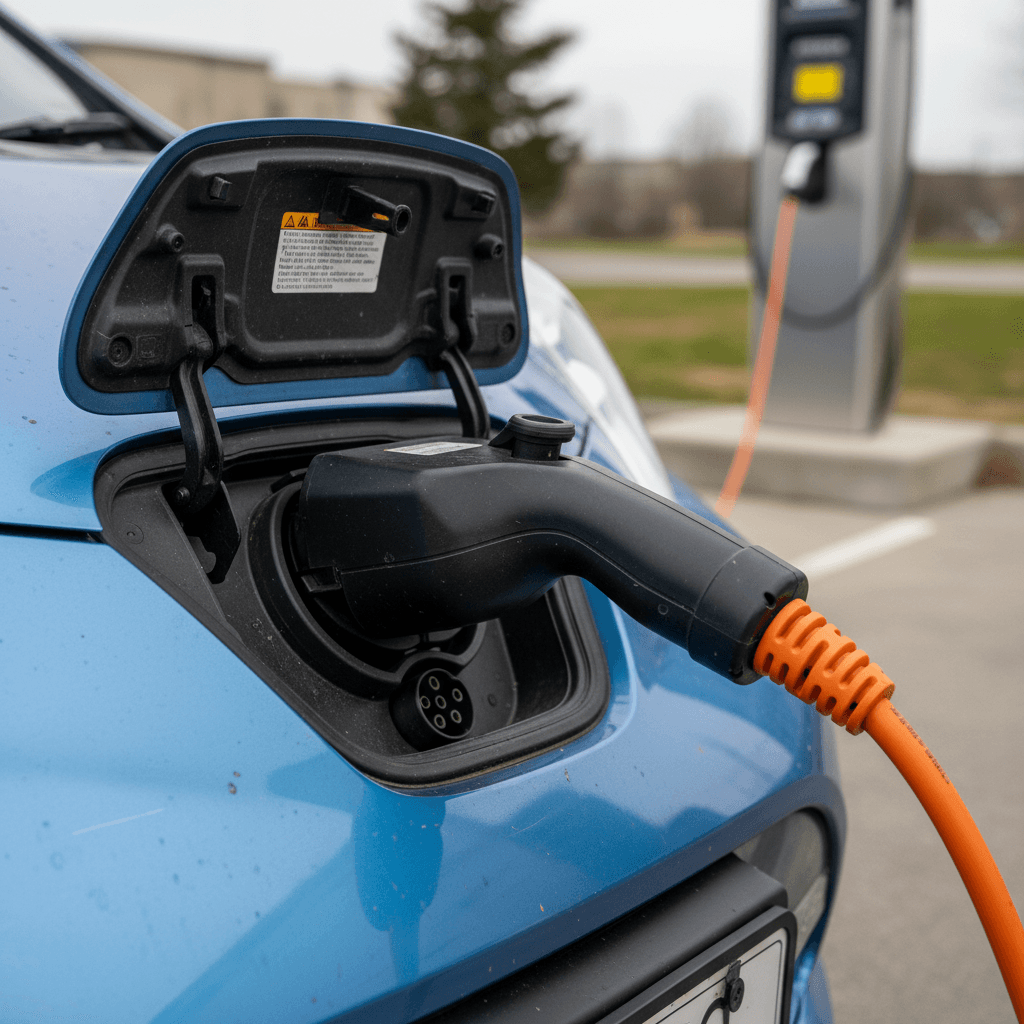
Nissan’s EV battery warranty for late‑model Leafs typically runs 8 years or 100,000 miles from the original in‑service date and includes a capacity guarantee. If the pack drops below a set number of capacity bars on the dash (often nine out of twelve) within that window, Nissan may repair or replace the battery under warranty. CPO status doesn’t reset that clock, it just gives you additional non‑battery coverage.
Don’t rely on bars alone
Pros and cons of a certified pre-owned Nissan Leaf
Advantages of a certified pre‑owned Leaf
- Factory‑backed limited warranty: Extra coverage can be useful if you plan to keep the car for several more years and want help covering certain repairs.
- Dealer-grade reconditioning: CPO standards usually mean no major cosmetic damage, working safety systems, and up‑to‑date software.
- Traditional financing options: If you prefer to finance through a captive finance company with familiar terms, a CPO Leaf at a Nissan store can simplify the deal.
- Roadside assistance and perks: Many CPO programs bundle roadside coverage and sometimes trip‑interruption benefits.
Drawbacks and trade‑offs
- Higher asking prices: CPO Leafs often list above similar non‑certified cars, and that premium doesn’t guarantee a healthier battery.
- Limited battery insight: Dealer inspections may check capacity bars but rarely provide a detailed battery‑health report.
- Mixed inventory quality: Some CPO Leafs are excellent; others are just “good enough” to clear the checklist. You still need to do your homework.
- Upsell pressure: F&I products, extended service contracts, and add‑ons can quickly eat into the value of buying CPO.
Where CPO shines
CPO Nissan Leaf vs regular used Leaf
The biggest misconception in this space is that “certified” always means “best.” For Leafs, that’s not automatically true. A non‑certified used Leaf from a reputable independent seller may have stronger battery diagnostics, lower mileage, or more transparent history than a random CPO car on the nearest lot.
Certified pre-owned Leaf vs. regular used Leaf
How a Nissan‑branded CPO Leaf typically compares with a non‑CPO used Leaf from a dealer or independent seller.
| Factor | CPO Nissan Leaf | Non‑CPO used Leaf | What to watch |
|---|---|---|---|
| Price | Usually higher list price for similar year/miles | Often lower price, especially from independent dealers or private sellers | Compare out‑the‑door prices, not just advertised numbers. |
| Warranty | Factory‑backed limited warranty extension plus remaining EV/battery coverage | Whatever remains of factory EV and battery warranty; sometimes no extra coverage | Ask for in‑writing details on what is and isn’t covered. |
| Battery transparency | Basic gauge checks; detailed reports vary by dealer | Can range from “no info” to full third‑party battery reports | Look for documentation, not just verbal assurances. |
| Condition standards | Must meet CPO cosmetic and mechanical thresholds | Condition varies widely by seller | Always inspect in person or request detailed photos and records. |
| Financing | Traditional captive financing, dealer F&I options | Bank, credit union, online lenders or marketplace financing | Shop rates and total cost of financing, not just monthly payment. |
Certification mainly affects warranty and reconditioning, not the underlying battery chemistry.
CPO Nissan Leaf vs buying a Leaf from Recharged
Factory CPO programs are built around a brand’s dealer network. Recharged is built around used EVs, and that difference shows up in how vehicles are evaluated, priced, and supported. If you’re comparing a certified pre‑owned Nissan Leaf at a franchise dealer with a Leaf listed on Recharged, you’re essentially choosing between a traditional CPO model and a specialist marketplace that lives and dies on EV transparency.
How Recharged approaches used Leafs differently
What changes when the platform is designed for EVs first
Recharged Score battery diagnostics
Fair market pricing & history
EV‑specialist support & delivery
Use CPO as a benchmark, not a default
Key things to check before you buy
However you source your Leaf, the pre‑purchase checklist is fundamentally the same. CPO status doesn’t replace proper due diligence, it just changes who stands behind the paperwork if something breaks.
Used Nissan Leaf pre‑purchase checklist
1. Confirm battery size and remaining warranty
Verify whether the car has a 24, 30, 40, or 62 kWh pack and check the original in‑service date. That tells you how much of the 8‑year/100,000‑mile EV battery warranty is left, regardless of CPO status.
2. Review capacity bars and diagnostics
Check the capacity bars on the dash, then go deeper. Ask for a <strong>battery‑health report or third‑party scan</strong>. On Recharged, this is included in the Recharged Score so you’re not flying blind.
3. Look at real‑world range, not just EPA numbers
EPA range figures assume a new pack. On a test drive, watch how quickly the state of charge drops on your typical roads and speeds. Ask the seller what range they actually see in daily use.
4. Examine fast‑charging behavior
If the car supports DC fast charging, test it or ask for recent fast‑charge logs. Inconsistent charging speeds or sudden drops in available power can hint at cell imbalances or thermal stress.
5. Inspect service history and recalls
Request records for software updates, battery recalls, and routine maintenance. Gaps in history don’t automatically kill a deal, but clean documentation is a good sign of a careful owner or seller.
6. Match the Leaf to your driving pattern
Map your longest regular trips against the car’s realistic range with a margin for winter and highway speeds. A 24 kWh Leaf might be perfect for a 30‑mile commute and useless for a 90‑mile round‑trip.
Watch the earliest Leafs
Pricing: what to expect for a CPO Nissan Leaf
Used EV pricing has been volatile in the last few years, and the Leaf is no exception. In many U.S. markets, a certified pre‑owned Nissan Leaf will carry a meaningful premium over a similar non‑CPO car, with the size of that premium influenced by battery size, remaining warranty, mileage, and local supply.
- Expect late‑model 40 kWh CPO Leafs to price significantly below new EVs but notably above similar non‑certified Leafs with the same mileage.
- 62 kWh Leaf Plus models with strong remaining battery warranty and CPO coverage tend to command the highest prices, especially in regions with limited public charging.
- Older 24 and 30 kWh Leafs are less often certified, and when they are, the certification premium can represent a large share of the car’s total value.
Compare total cost, not just sticker price
Who a certified pre-owned Leaf is right for
Not every shopper needs a certified pre‑owned Nissan Leaf, but there are profiles where it fits well. Think of CPO as one tool in the toolbox rather than the default answer.
When a CPO Leaf makes the most sense
Match the buying format to your risk tolerance
You’re risk‑averse and dealer‑oriented
You want simple trade‑in and paperwork
When a specialist marketplace is better
Frequently asked questions about CPO Nissan Leafs
Certified pre-owned Nissan Leaf FAQ
Bottom line: is a certified pre-owned Nissan Leaf worth it?
A certified pre‑owned Nissan Leaf can be a smart play if you’re focused on late‑model 40 kWh or 62 kWh cars, you value a dealer relationship, and the CPO premium is modest relative to a non‑certified Leaf with similar specs. What certification cannot do is rewrite the Leaf’s battery story. For that, you need real diagnostic data, a clear view of remaining warranty, and a realistic sense of how much range you actually need.
If you’d rather center your search on battery health, transparent pricing, and EV‑savvy support, platforms like Recharged change the equation. Every Leaf on Recharged includes a Recharged Score Report, access to EV specialists who speak this language every day, and the option to handle everything, from trade‑in and financing to nationwide delivery, online or at the Richmond, VA Experience Center. Use CPO Leafs as a reference point, but don’t be afraid to choose the car and buying experience that best match how you really drive.