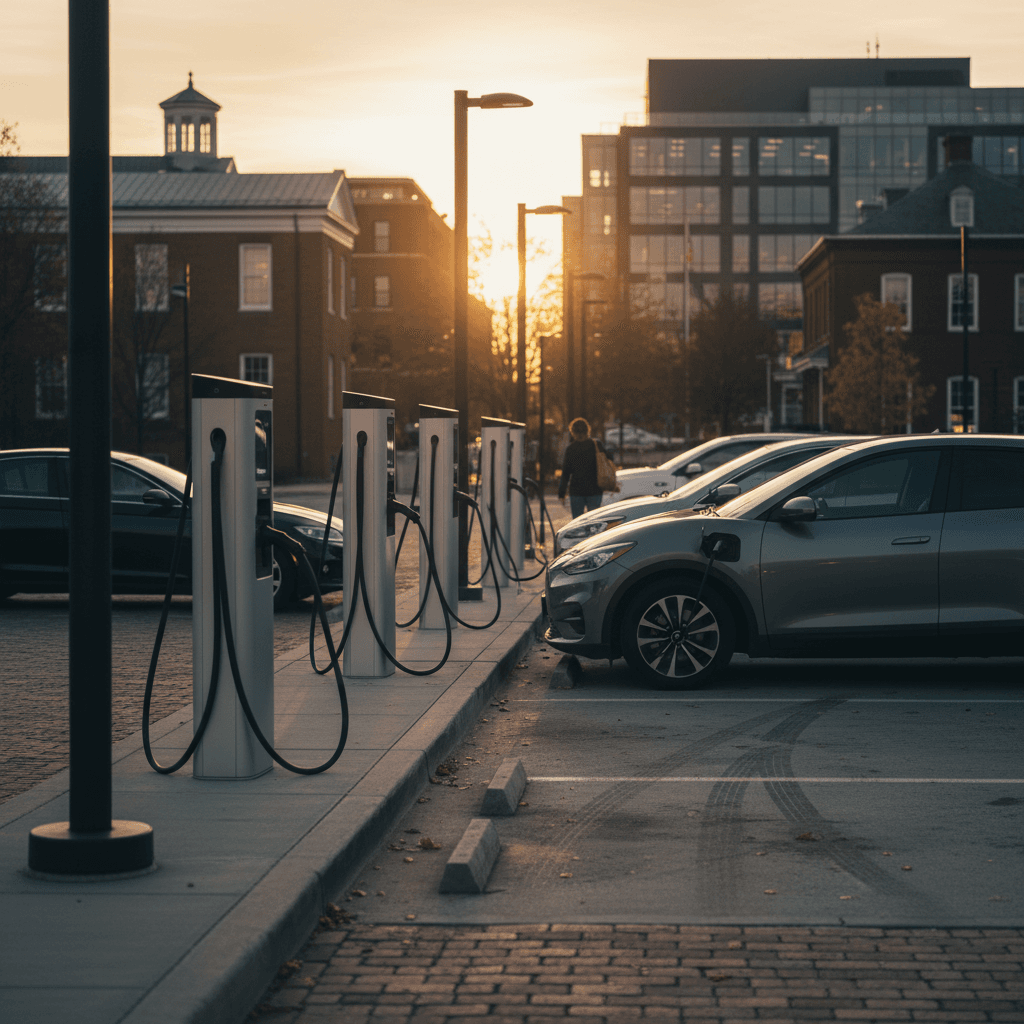
If you drive an electric car in the District, you already know this: EV charging stations in Washington DC don’t feel like the wide-open parking lots you see in the suburbs. You’re juggling rowhouse blocks, federal offices, tourists, and tight curb space, often without a driveway of your own. This guide walks you through where to find chargers, how the city’s curbside pilots work, what you’ll pay, and how to build a simple charging routine that fits DC life.
DC is rapidly expanding charging access
Why EV charging in Washington DC feels different
Lots of EV interest, little private parking
Compared with many cities, a big share of DC residents live in rowhouses and multifamily buildings without private driveways or garages. That means far fewer people can install their own home Level 2 charger, and public and workplace charging have to pick up the slack.
Public space is tight and highly regulated
Between historic districts, narrow streets, and federal property, the city has to be picky about where charging equipment goes. That’s why you see a mix of garage-based fast charging downtown and carefully chosen curbside or parking‑lot locations in neighborhoods instead of chargers on every block.
Think in "charging routines," not single stations
Types of EV charging stations you’ll find in DC
Know your charger types before you plug in
Most public EV charging stations in Washington DC fall into these three categories.
DC fast charging (Level 3)
Best for: Road trips, quick turnarounds, topping up during errands.
- Typically 50–350 kW
- 15–40 minutes from low to ~80% on most EVs
- Found at garages, travel corridors, some grocery and retail lots
Level 2 public charging
Best for: Longer parking sessions, work, dinner, movies, overnight.
- Typically 6–11 kW
- Adds ~20–40 miles of range per hour
- Common in office garages, public lots, curbside pilots
Level 1 & shared outlets
Best for: Emergency or overnight trickle charging.
- Standard 120V outlets
- Adds ~3–5 miles per hour
- Occasional hotel or workplace perk, don’t count on it for daily use
Watch your connector type
Where to find EV charging stations in Washington DC
You’ll find EV charging stations in Washington DC sprinkled through all eight wards, but certain areas are richer in plugs than others. Think in zones: downtown and the federal core, neighborhood main streets, and key commuter corridors just outside the District line.
Common EV charging hotspots around DC
Examples of where DC drivers most often find public EV chargers. Always confirm locations and availability in your preferred app before heading out.
| Area / Corridor | What you’ll find | Typical charger type | Good for |
|---|---|---|---|
| Downtown, Penn Quarter, Metro Center | Garage‑based networks (ChargePoint, EVgo, others), some hotel and office chargers | Mix of DC fast and Level 2 | Commuters, meetings, evening events |
| Union Station & NoMa | Fast chargers in and near major transit hubs, neighborhood lots | DC fast, some Level 2 | Intercity trips, quick top‑ups near rail |
| Navy Yard & Capitol Riverfront | Mixed public/private garage chargers tied to retail and residential | Level 2, some DC fast | Game nights, dining, residents without home charging |
| U Street, Shaw, Logan Circle | Curbside pilots, retail/parking‑lot Level 2 | Mostly Level 2 | Overnight neighborhood parking, evenings out |
| Outer DC & nearby suburbs (Silver Spring, Arlington, Alexandria) | Bigger lots at grocery stores, shopping centers, travel plazas | More DC fast, plus Level 2 | Weekend errands, highway trips, fast top‑ups |
Locations are representative, not exhaustive. Check live maps for current availability.
Think regionally, not just inside the District line
Best apps and maps for finding DC EV chargers
There’s no single perfect app for every EV charging station in Washington DC, but a small toolkit covers almost everything. Combine an official network app or two with a community map and your car’s built‑in navigation.
Four must‑have tools for DC charging
Use at least one network app plus one community map for the best experience.
Network apps (EVgo, Electrify America, Blink, ChargePoint)
Why you need them:
- See real‑time availability and pricing
- Start and stop sessions from your phone
- Sign up for lower member rates
Most downtown and corridor fast chargers are tied to one of these networks.
PlugShare (community map)
Why you need it:
- Driver reviews of specific stations
- Photos so you can actually find the charger
- Useful details (lighting, payment quirks, nearby coffee)
Your car’s built‑in navigation
Why you need it:
- Estimates if you’ll reach the station with a safe buffer
- Keeps your battery warm for faster fast charging (many EVs)
- Often integrates live traffic and routing
Tesla app & Supercharger map
For Tesla drivers and NACS‑equipped non‑Teslas:
- Find compatible Superchargers near DC
- See which stalls support non‑Tesla EVs (if your car has NACS)
- Check congestion before you detour off your route
Create a "favorites" list

Curbside EV charging pilots in DC neighborhoods
In February 2026, DC’s transportation and energy agencies launched a Neighborhood Curbside Electric Vehicle Charging Station Pilot. The goal is to test how curbside Level 2 chargers can serve residents in rowhouse and apartment-heavy neighborhoods that lack driveways and alleys.
- Stations are installed in the public right‑of‑way, usually at standard curbside parking spots.
- Private vendors install, operate, and maintain the hardware under city permits.
- Data from the pilot will help shape a long‑term curbside program, including pricing, signage, and accessibility rules.
- Locations are intentionally spread across wards so pilot results reflect different neighborhood types, not just the downtown core.
Always read the curbside sign
How much EV charging costs in Washington DC
Public charging prices in DC vary by network, speed, and even time of day. You’ll typically pay more per kWh for DC fast charging than for Level 2, but you’re also buying back your time.
Typical DC fast charging costs
- Often billed per kWh or per minute, depending on the site and local rules.
- Fast chargers around the region commonly fall in the rough range of premium gas or higher per “equivalent gallon” if you arrive with a low battery and charge to ~80%.
- Great when you’re on a tight schedule, but too pricey to rely on every day if you have other options.
Typical Level 2 public charging costs
- Many Level 2 stations in garages or lots cost less per kWh than DC fast, especially if you’re paying a flat hourly rate.
- Some workplaces, hotels, or grocery stores offer discounted or free Level 2 as a perk, always check the app or posted signs.
- Because Level 2 is slower, it works best when you’re parked for several hours anyway.
Stretch your charging budget
Etiquette and best practices at DC charging stations
Busy city, finite chargers. A little etiquette goes a long way toward keeping the peace, and keeping everyone moving. DC’s mix of daily commuters, federal workers, and visitors means your charging habits affect a lot of other drivers.
Charging station etiquette for Washington DC
1. Don’t treat fast chargers like parking spaces
At DC fast sites, charge to about 80% and move as soon as you’re done, especially if other cars are waiting. The last 20% is slower and more expensive anyway.
2. Move when your app says you’re full
Most network apps and car apps can send a “charging complete” alert. In a dense city, aim to move your car within 10–15 minutes so others can plug in.
3. Share the curb
At curbside Level 2 stations, respect time limits and “EV charging only” rules. Don’t park there all day if you’re already at a high state of charge.
4. Coil the cable neatly
Leave the cord off the sidewalk so pedestrians, strollers, and wheelchairs have a clear path. It’s good manners and helps keep cables from getting damaged.
5. Communicate if you’re waiting
If you’re hovering for a spot, a quick wave or polite question, "How long do you think you’ll be?", usually works better than pressure or honking.
6. Don’t unplug others unless it’s clearly allowed
Some stations have multiple plugs or allow “opportunity sharing” once a car is fully charged. Others don’t. Unless signage or the app spells it out, leave other cars plugged in.
Safety first, always
Planning regional road trips from Washington DC
One of the perks of living in DC is how quickly you can reach the beach, the mountains, or half a dozen major cities. The flip side: you cross state lines constantly, so your EV charging plan has to think beyond the District’s borders.
Sample charging strategies for common DC getaways
Weekend in Richmond or Virginia Beach
Start with at least 80% charge before you leave DC, grab a fast charge the night before if needed.
Use fast chargers along I‑95 or US‑301 to top up once each way, ideally at stations with food and restrooms.
On longer trips, plan your first stop earlier than you think (around 20–30% state of charge) so you have options if a station is busy.
Day trip to Baltimore or Annapolis
Pre‑condition your battery and navigate to a fast charger in your car’s system if you’ll arrive low.
Look for DC fast charging near your destination, then explore while your car charges.
If you can charge at your destination, garage, workplace, or marina lot, you may not need a stop on the way back.
Heading north: Philly, NYC, beyond
Along I‑95, string together big fast‑charging sites so you’re not depending on a single small station.
Use PlugShare reviews to avoid chronically unreliable sites.
In urban cores, garages often charge both your car and your parking fee, factor both into your budget.
Blue Ridge, Shenandoah, and mountain trips
Fast‑charge before you leave the flatlands so you hit the mountains with a big buffer.
Remember that climbing hills uses more energy; your car’s guess‑o‑meter may be optimistic on the way up.
Use Level 2 at lodging or trailhead lots when available to refill while you’re hiking or overnight.
Let the car do the math
Charging in DC with a used EV: what to watch for
If you’re shopping for a used EV to live in the District, how, and where, you’ll charge should be on the same checklist as price and color. Dense urban charging exposes weak batteries and slow onboard chargers quickly.
Used EV + Washington DC: questions to ask
These charging-related checks can save you a lot of frustration later.
Battery health & real range
In city traffic, a worn battery can mean more frequent top‑ups. Ask for a battery health report and look for independent testing, not just the dash display.
Onboard charger speed
Some older EVs charge slowly on Level 2 (3.3–6.6 kW). In DC, that might mean an all‑evening session instead of a quick dinner‑and‑a‑movie top‑up.
Connector and adapter setup
Confirm which connectors your car supports (CCS, NACS, CHAdeMO) and whether it includes the adapters you’ll need for DC’s most common stations.
Every used EV listed on Recharged includes a Recharged Score Report with verified battery health and pricing aligned to current market data. That’s especially helpful in a city like DC, where public charging and stop‑and‑go traffic can exaggerate the differences between a strong pack and a tired one.
Match the car to your real charging plan
EV charging stations in Washington DC: FAQ
Frequently asked questions about EV charging in Washington DC
Key takeaways for DC EV drivers
Living with an EV in Washington DC is absolutely doable, it just plays by different rules than a suburban driveway-and-two-car-garage life. If you learn the landscape of EV charging stations in Washington DC, build a small toolkit of apps, and pick a car whose battery and connectors fit that world, you can treat charging as a background chore instead of a daily drama. And if you’re considering a used EV, pairing those habits with a verified battery‑health report, like the Recharged Score that comes with every vehicle on Recharged, gives you the confidence to plug into city life for years to come.