If you’re shopping for an electric car in New York City, the first question usually isn’t which model to buy, it’s **where you’ll charge it**. With most people relying on street parking or rental garages, EV charging stations in New York City aren’t just a convenience, they’re a lifeline. The good news: the city, utilities, and private networks have quietly built a surprisingly dense mix of curbside, garage, and fast‑charging options. The catch is that you need a strategy to use them without turning every charge into a scavenger hunt.
Big picture: New York is a charging heavyweight
Why EV charging in New York City is different
Limited home charging
In the suburbs, most EV owners install a Level 2 charger in their garage and rarely think about public stations. In New York City, a huge share of drivers park on the street or in rented garages with no outlets. That pushes daily charging demand onto **curbside chargers, workplace parking, and public garages**.
Dense network, uneven experience
Within city limits you’ll see everything from brand‑new curbside units to older, finicky Level 2 stations. The reliability gap between Tesla’s network and some third‑party providers can be real, so you’ll want redundancy built into your routine, both in apps and in physical locations.
Reality check on public charging
How many EV charging stations are in New York City?
Snapshot of EV charging in New York City (2025)
Those numbers might surprise you. Within New York City, services that aggregate public data report **just over 2,000 public charging ports**, the vast majority at Level 2. A small but growing slice are DC fast chargers clustered at municipal garages, airports, service plazas, and private fast‑charging hubs. In practice, you’ll experience charging not as one big network but as a patchwork: **PlugNYC curbside chargers, municipal garages, private garages, retail parking, and highway fast chargers** just outside city limits.
Types of EV charging stations in NYC
- Level 1 (120V) – Standard household outlet. Realistically useful only if you have a dedicated driveway or garage space, rare inside the five boroughs, but common in some Staten Island, Queens, and outer‑Brooklyn neighborhoods.
- Level 2 (240V) – The workhorse of NYC charging. You’ll see these at curbside PlugNYC poles, municipal garages, private garages, supermarkets, workplaces, and universities.
- DC fast charging (Level 3) – High‑power stations you use like a gas pump. These live in a handful of city‑owned lots, at airports, and at private hubs from networks like Tesla, Electrify America, and EVgo. Ideal for road trips and rideshare drivers on the clock.
Match your charging to your lifestyle
PlugNYC and curbside Level 2 chargers
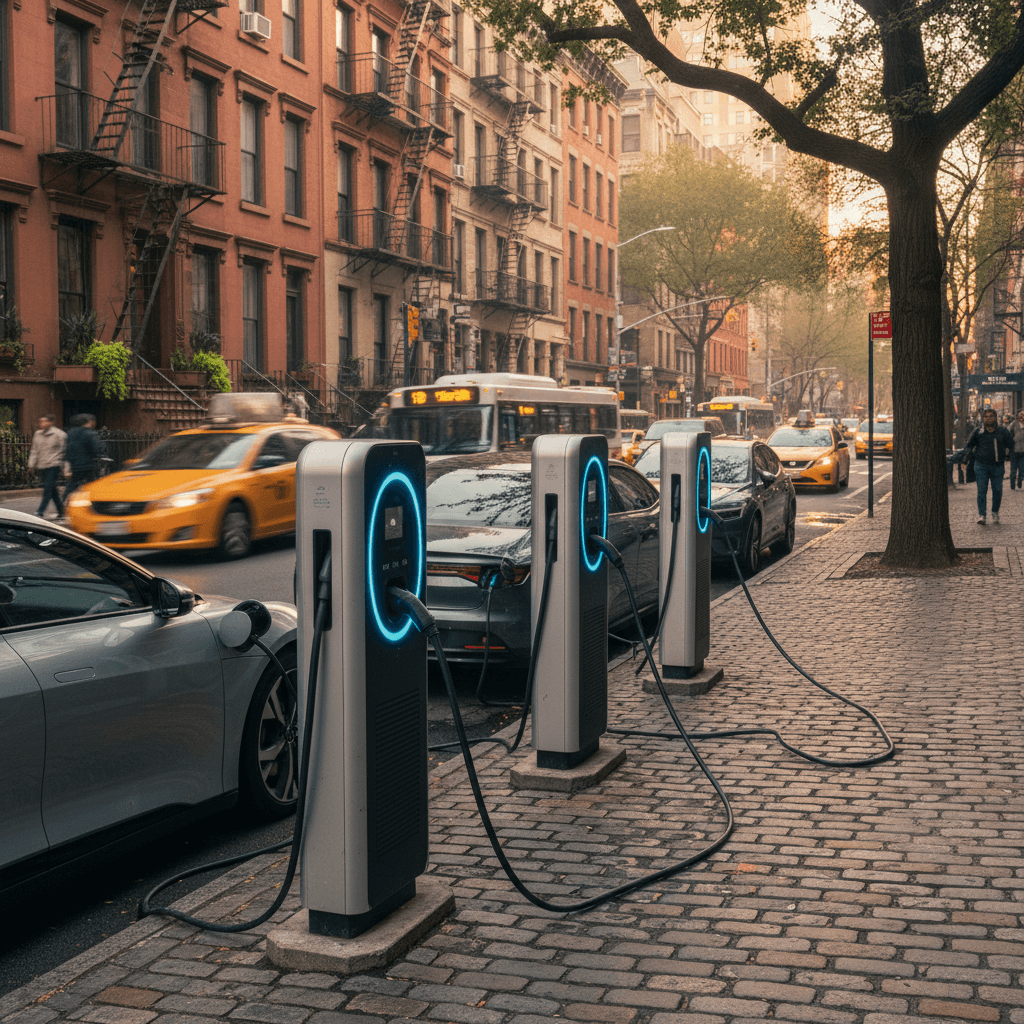
The most uniquely “New York” part of the charging landscape is **PlugNYC**, the DOT‑backed network of curbside Level 2 chargers. They’re built for residents who park on the street and can’t install a home unit. Chargers are mounted on posts with dual cords, and the spaces are reserved for actively charging EVs.
Key facts about PlugNYC curbside charging
What you need to know before you rely on those blue‑and‑white curbside chargers.
| Topic | Details |
|---|---|
| Program scale | Initial pilot installed 98 curbside Level 2 ports across all five boroughs, with a goal of scaling to 1,000 curbside charge points by 2025 and 10,000 by 2030. |
| Connector type | Standard SAE J1772 connector, compatible with most non‑Tesla EVs. Tesla owners can use a J1772 adapter. |
| Operator | FLO manages the hardware and billing; NYC DOT and Con Edison partner on siting and power. |
| Typical use case | Overnight or workday charging for street‑parked cars; not ideal for quick 30‑minute top‑ups. |
| Payment | App‑based or contactless card; billed primarily by time parked and/or energy consumed, depending on location. |
| Enforcement | Spaces are reserved for active charging. If you’ve finished charging but stay parked, you risk tickets or idle fees. |
PlugNYC is a demonstration project that’s expanding over time, so always check current rules and pricing in the app.

How to spot PlugNYC chargers
Municipal garages and lots with EV charging
NYC DOT also operates a growing network of chargers in municipal parking garages and lots. For many apartment dwellers, these are the closest thing to “home” charging: you park, plug into a Level 2 station, and come back hours later with a full battery. Several garages now mix Level 2 and DC fast chargers.
Selected NYC municipal facilities with EV charging
These city‑owned garages and lots include Level 2 and, in some cases, DC fast charging. Always verify availability before you go.
| Facility | Borough | Approx. EV spaces | Notes |
|---|---|---|---|
| Delancey & Essex Municipal Garage | Manhattan | 13 Level 2 + DC fast | Busy Lower East Side location; useful for downtown residents and visitors. |
| Court Square Municipal Garage | Queens | 13 Level 2 + DC fast | Key hub for Long Island City and Queens Boulevard corridor. |
| Queens Borough Hall Garage | Queens | 34 Level 2 | One of the largest concentrations of Level 2 chargers in the city. |
| Bay Ridge Municipal Garage | Brooklyn | 5 Level 2 | Convenient for southwest Brooklyn drivers without driveway parking. |
| Jerome–190th St Garage | Bronx | 5 Level 2 | Serves nearby residential blocks and institutions. |
| Staten Island Courthouse Garage & Lot | Staten Island | 5 Level 2 | Handy for Staten Island Ferry commuters and nearby residents. |
Availability, pricing, and access hours can change, treat this as a starting point, not a live map.
Parking plus charging
DC fast charging hubs and highway access
For road trips, rideshare work, or those nights when you simply forgot to plug in, **DC fast chargers** are your safety valve. Inside the city, DOT has opened several fast‑charging hubs at municipal facilities, and private networks operate others. Just outside city limits, on Long Island, in New Jersey, and along major interstates, you’ll find larger highway‑style plazas.
Where to find DC fast charging around NYC
Think in terms of hubs, not one‑off stations.
City‑owned fast hubs
DOT operates DC fast chargers at locations such as Delancey/Essex (Manhattan), Court Square and Queens Borough Hall (Queens), White Plains Road (Bronx), and Bensonhurst (Brooklyn). These use CCS and CHAdeMO connectors.
Private urban hubs
Networks like EVgo, Electrify America, ChargePoint, and others run fast chargers at shopping centers, parking garages, and big box stores. These are scattered across the boroughs and are essential for non‑Tesla road‑trippers.
Tesla Superchargers
Tesla maintains multiple Supercharger sites in Manhattan and the outer boroughs, plus dense coverage just outside city limits. Many sites now allow non‑Tesla EVs with a compatible adapter; always confirm access rules in advance.
Always confirm connector type and power level
Best apps and tools for finding EV charging in NYC
You can’t live with an EV in New York City without at least one good charging app. In practice, most drivers end up using **two or three** so they can compare pricing, see real‑time availability, and cross‑check reliability before committing to a station.
Core tools for locating EV charging stations in New York City
Use at least one live‑data app plus a backup.
Network apps
ChargePoint, EVgo, Electrify America, FLO, Blink and others each show real‑time status, pricing, and connector types for their own stations. If you rely heavily on one network, start with its app.
Aggregator apps & maps
Tools like PlugShare and ChargeHub compile crowd‑sourced reviews and usage data from many networks, useful for judging reliability and safety at a specific site before you head there.
Official and government tools
The U.S. Department of Energy’s Alternative Fuels Data Center offers a national station locator, and NYC DOT links to chargers in municipal facilities. These are great for planning, but less useful for minute‑to‑minute availability.
Checklist: Setting up your NYC charging app stack
1. Install apps for the networks you’ll use most
Start with ChargePoint, EVgo, Electrify America, FLO (for PlugNYC), and any garage apps your parking provider requires.
2. Add at least one aggregator app
PlugShare or similar tools help you avoid stations with repeated reliability complaints, and help you discover lesser‑known free stations.
3. Load a payment method in advance
Create accounts and add cards at home so you’re not standing at a cold charger trying to verify your email.
4. Favorite your “anchor” locations
Mark a few dependable chargers near home, work, and your regular routes. These should be your first choice whenever possible.
5. Enable notifications
Many apps can alert you when a busy station opens up or when your session ends, useful in high‑demand Manhattan and Brooklyn locations.
Charging strategies for different NYC drivers
Tailored charging plans for common NYC situations
Street‑parking apartment dwellers
Rely on PlugNYC or nearby public garages for **overnight Level 2** charging 1–3 times a week.
Target EVs with **strong range buffers** so you’re not forced to charge on specific nights (e.g., 230+ miles of EPA range).
Use aggregator apps to identify a primary curbside charger and at least one backup within a few blocks.
Consider slightly over‑buying range if you can’t depend on a consistent overnight spot.
Garage parkers (no outlet)
Ask your garage about current or planned **EV charging installations**; some offer reserved EV spots or monthly charging packages.
Plan a **weekly fast‑charge session** at a reliable DC site if your garage can’t provide regular Level 2 access.
If you have workplace charging, treat that as your primary “home” charger and use public stations only as backup.
Choose EVs that are efficient on short city trips so each kilowatt‑hour goes further.
Rideshare & delivery drivers
Map out **multiple fast‑charging hubs** across your typical operating area before you ever accept your first ride in an EV.
Favor vehicles with **fast DC charging curves** and larger packs; the extra range can mean fewer time‑sapping stops.
Try to charge during off‑peak ride times (late morning, early afternoon) when station competition is lower.
Track your actual energy cost per mile and compare it to what you’d spend on gasoline so you can price your time realistically.
Suburban commuters driving into NYC
Install Level 2 at home if possible, then treat city chargers as **emergency backup**, not your day‑to‑day plan.
Look for DC fast chargers just outside the city, on Long Island or in New Jersey, where pricing and stress are often lower.
If your office garage offers charging, confirm whether it’s first‑come‑first‑served or reservable before you lean on it.
For occasional trips, pre‑plan a single fast‑charge stop that fits naturally into your route home.
Costs, rates, and how to avoid fee shock
Charging in New York City can be **surprisingly affordable** compared to gasoline, if you’re smart about when and where you plug in. But it can also be more expensive than you expect, especially at DC fast chargers in premium locations or when you pay both parking and energy.
Typical NYC charging costs
- Curbside Level 2 (PlugNYC): Priced per hour and/or per kWh; usually competitive with or cheaper than fueling a similar gas car for the same miles.
- Municipal Level 2: Per‑kWh charging plus standard garage parking fees.
- DC fast charging: Often the highest per‑kWh price, but still usually cheaper per mile than gasoline.
Ways to keep your costs down
- Prefer **Level 2** for most charging; reserve DC fast for road trips or emergencies.
- Take advantage of **free Level 2 stations** attached to workplaces, shopping centers, or schools when you already plan to be there.
- Check each app for **idle fees** or minimum session charges so you don’t pay extra for forgetting to unplug.
Rule of thumb: per‑mile savings still favor EVs
Common NYC charging pain points (and how to avoid them)
Avoid these frequent headaches at EV charging stations in New York City
1. Blocked or ICE’d spaces
Even reserved EV spaces sometimes have gas cars or non‑charging EVs parked in them. Always have a backup charger mapped out within a short drive or walk.
2. Out‑of‑service hardware
Urban environments are tough on equipment. Rely on recent user check‑ins and reviews, not just the map icon, to decide whether a station is worth the detour.
3. Confusing pricing
Some stations charge by time, some by kWh, some add idle or session fees. Before you plug in, glance at the pricing screen and do a quick mental “cost per hour” or “cost per kWh” check.
4. Short charging cables
Especially at older sites and some Superchargers, cord length and parking orientation matter. When possible, back in and park close to the pedestal so the connector reaches comfortably.
5. App or payment glitches
Network apps occasionally hang or decline cards. Sign up for multiple networks and keep at least two payment options on file so you’re never stranded by a software hiccup.
Don’t rely on extension cables or unapproved adapters
How EV charging in NYC will change by 2030
If you’re thinking about buying a used EV today and keeping it through the decade, you’re right to wonder where NYC’s infrastructure is headed. City plans call for **dramatically expanding access**: thousands of curbside charge points, more fast‑charging hubs, and a higher percentage of municipal parking spots equipped with Level 2 chargers.
- NYC’s long‑term vision includes **up to 10,000 curbside charge points by 2030**, turning on‑street parking into a primary fueling option.
- The city aims to equip a growing share of municipal garage spaces with Level 2 charging, targeting 40% by 2030 in some plans.
- Federal NEVI funding is helping states, including New York, add highway‑oriented DC fast chargers that benefit city drivers heading out of town.
- Major automakers are shifting to the **NACS (Tesla‑style) connector**, which should make long‑distance fast charging more straightforward by the late 2020s.
What this means if you’re buying a used EV now
FAQ: EV charging stations in New York City
Frequently asked questions about EV charging in NYC
Is an EV practical in New York City?
For many New Yorkers, the honest answer is yes, with caveats. If you’re willing to spend a little time up front mapping out **where you’ll plug in**, an EV can be cheaper to run, smoother to drive, and better suited to stop‑and‑go traffic than any gasoline car. Street‑parkers now have curbside Level 2 options, garage parkers can leverage municipal and private charging, and fast‑charging hubs are multiplying for road trips and long workdays.
Where EV ownership can still be challenging is for drivers with **unpredictable schedules and no reliable overnight charging**, especially some rideshare and delivery drivers. In those cases, picking the right car and the right charging strategy becomes mission‑critical. That’s exactly where a marketplace like Recharged is designed to help. Every used EV we list comes with a verified battery health report, transparent pricing, and EV‑specialist guidance, so you can choose a car and a charging plan that actually fit the realities of New York City, not some theoretical national average.