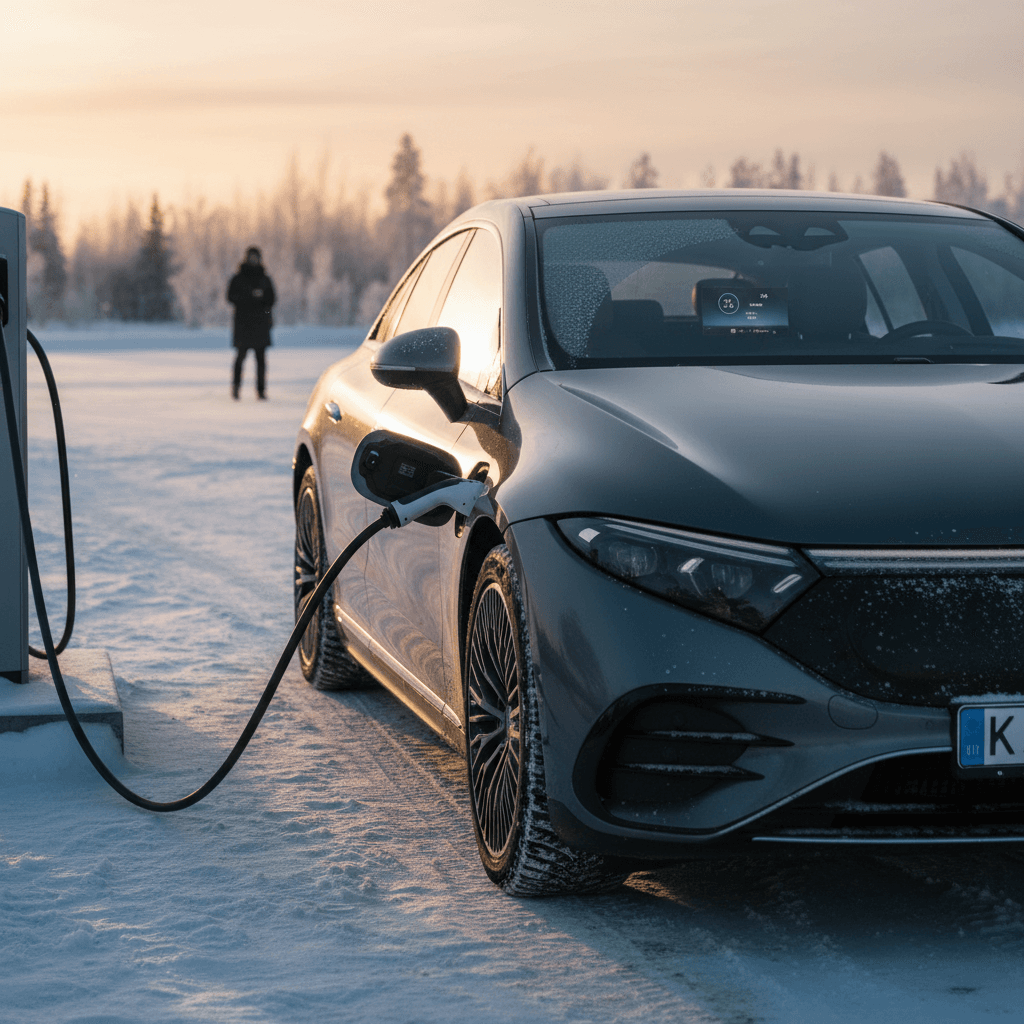
If you’re eyeing a Mercedes EQE, or already own one, you’ve probably noticed the same pattern: in summer it’s a serene, long‑legged cruiser, and in winter the range readout suddenly looks like it’s been through a bad divorce. Understanding the real‑world Mercedes EQE winter range loss percentage isn’t just trivia; it determines whether that ski trip or cold‑morning commute feels relaxing or tight‑fisted.
Quick answer
Mercedes EQE winter range in one look
EQE winter range: the broad strokes
Those numbers are stitched together from independent test data, simulation tools, and owner reports rather than brochure fantasy. WLTP and EPA tests are done in lab conditions; your car in Duluth in January is not a lab. The EQE is reasonably efficient for a big Mercedes, but it still obeys the same physics as every other EV when the mercury drops.
How much range does a Mercedes EQE lose in winter?
Let’s anchor this with some numbers. A typical U.S.‑spec EQE sedan has a usable battery around 90 kWh and delivers roughly 260–300 miles of realistic mixed‑driving range when new in mild weather, depending on trim, wheels, and your right foot. In Recharged’s own testing and road‑trip reviews, we’ve consistently seen that cold weather knocks the same 15–30% off that it does for most modern EVs, especially at freeway speeds. That’s the broad expectation before we drill into details.
Summer vs winter range: EQE sedan & SUV (typical values)
Approximate real‑world ranges for a healthy-battery Mercedes EQE driven sensibly. These are not lab numbers; they’re what you might actually see on the road.
| Model | Conditions | Typical usable range (new) | Approx. loss vs mild weather |
|---|---|---|---|
| EQE 350+ sedan (RWD) | Mild weather, mixed | 270–300 mi | , |
| EQE 350+ sedan (RWD) | Winter, mixed | 210–245 mi | ~15–25% |
| EQE 350 4MATIC sedan | Mild weather, mixed | 250–280 mi | ~5–10% lower than 350+ |
| EQE 350 4MATIC sedan | Winter, mixed | 195–230 mi | ~20–30% |
| EQE SUV 350+ (RWD) | Mild weather, mixed | 240–270 mi | , |
| EQE SUV 350+ (RWD) | Winter, mixed | 185–220 mi | ~20–30% |
| EQE SUV 350 4MATIC | Mild weather, mixed | 220–250 mi | ~10–15% lower than sedan |
| EQE SUV 350 4MATIC | Winter, mixed | 170–210 mi | ~25–35% |
Estimates assume 70–75 mph highways, some city driving, and climate control set for comfort, not martyrdom.
Important caveat
Independent databases that model cold‑weather consumption tell the same story in more clinical terms. For an EQE 350 4MATIC, estimated energy use rises from roughly 152 Wh/km in mild conditions to 208 Wh/km in cold combined driving, about a 37% increase in consumption, which maps to roughly a 27% drop in range for the same usable battery energy. That sits neatly inside what owners actually report.
Why the Mercedes EQE loses range in cold weather
Four main culprits behind EQE winter range loss
None of them are specific to Mercedes, just laid bare by a big, comfy EV in the cold.
1. Cold battery chemistry
In low temperatures, the lithium‑ion cells in your EQE’s ~90 kWh pack can’t move ions as freely. Internal resistance rises, so:
- Usable energy shrinks until the pack warms up.
- Charging and discharging become less efficient.
- Regen is limited early in the drive.
2. Cabin heating and defrost
Unlike an engine car, your EQE can’t freeload waste heat from a V6. The HVAC system has to burn electrical energy to warm:
- Cabin air and seats
- Steering wheel
- Windows and mirrors
A couple of kilowatts of heat over an hour is a huge slice of your total consumption on short trips.
3. Thick air and winter tires
Cold air is denser, increasing aerodynamic drag at highway speeds. Add stickier winter or all‑season tires and slush on the road and you’re paying a rolling‑resistance tax all winter long.
4. Short trips with a cold pack
This is where people see truly ugly numbers. The car spends most of the trip warming the pack and cabin, then you park and let everything cool again. You never get to cruise in the efficient sweet spot.
Good news for EQE owners
Sedan vs SUV and RWD vs 4MATIC in winter
EQE sedan vs EQE SUV
The EQE sedan slices through the air with a slipperier shape than the EQE SUV. In practice, that means:
- Better highway efficiency, especially above ~60 mph.
- A few dozen extra miles of range from the same battery in mild weather.
- Smaller percentage penalty in winter, because aero drag is lower to begin with.
Independent winter tests of the EQE SUV 350 4MATIC have found real motorway consumption around 28–30 kWh/100 km in around‑freezing conditions, which yields roughly 312 km (≈194 mi) from the full 90.6 kWh usable pack, and closer to ~218 km (135 mi) if you only use the 10–80% window many road‑trippers rely on.
RWD vs 4MATIC (AWD)
The rear‑drive EQE 350+ is the efficiency champ. Dual‑motor 4MATIC trims add weight and some driveline losses. In cold weather you’ll typically see:
- RWD (350+): lowest consumption, best range; traction is fine in snow with good tires and a gentle right foot.
- 4MATIC: ~5–15% more energy use, but better traction and launch behavior in snow and slush.
If you live somewhere with serious winters and hills, 4MATIC has real value. Just budget a bit more range loss percentage‑wise, especially on the EQE SUV 4MATIC where aero is already worse.
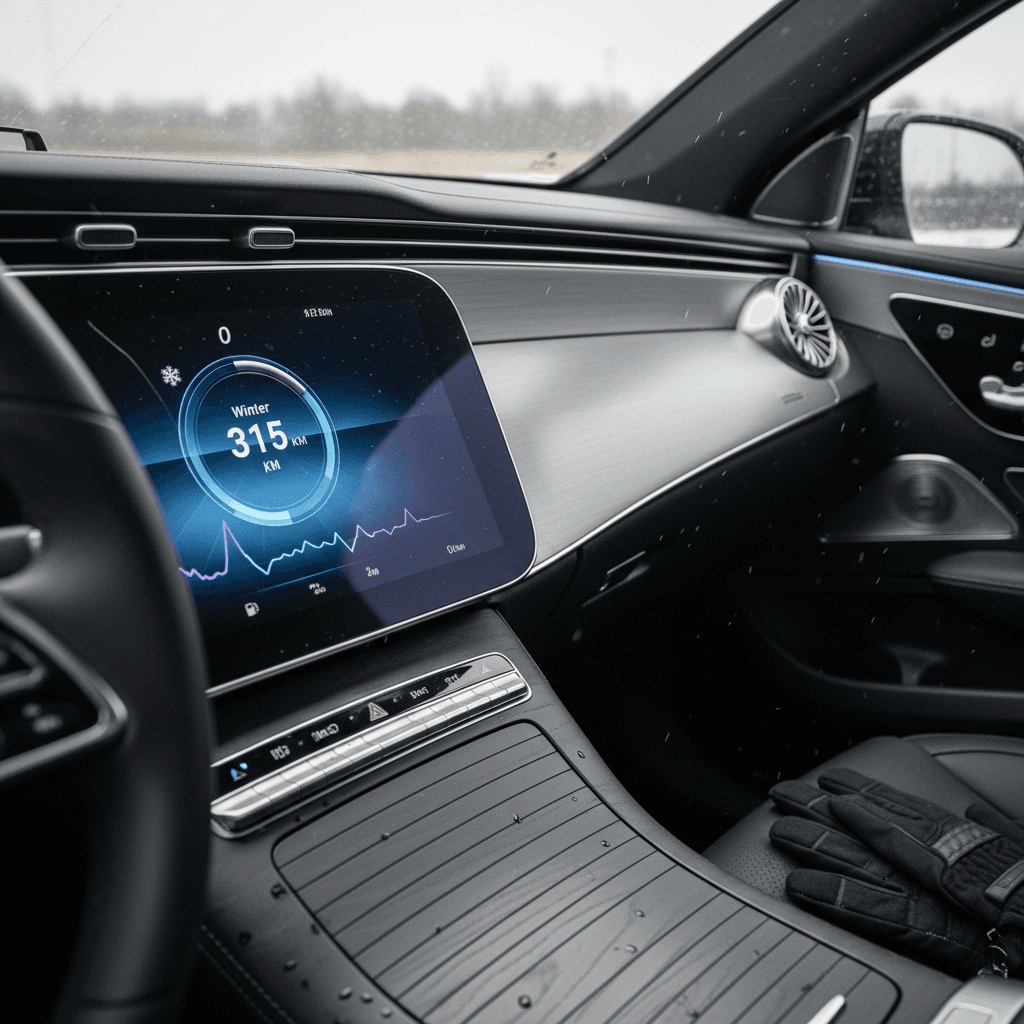
Real owner experiences: winter range in the EQE
Numbers from lab‑style tools are reassuring, but what matters is what people actually see on the ground. Across owner forums and long‑term tests, a pattern emerges:
- Drivers of EQE 350+ sedans in temperate climates often see 280–300 miles in summer drop to roughly 230–260 miles in the winter on similar routes (about 15–25% loss).
- Owners of EQE 350 4MATIC sedans and SUVs commonly report winter highway ranges in the 200–240‑mile band from a full charge, depending on speed and wheels, right in that ~25–30% loss window.
- EQE drivers in harsher climates (upper Midwest, Canada, Scandinavia) routinely speak of “losing about a third” of their practical range in long, sub‑freezing cold snaps, especially when they can’t precondition while plugged in.
Cold weather knocks the same 15–30% off range that it does in other EVs, especially at freeway speeds.
The through‑line here is that the EQE isn’t an outlier. It’s running with the EV pack: better than some older platforms without good heat pumps, not quite as hyper‑efficient as a Tesla Model 3 or Hyundai Ioniq 6. If you plan like every winter drive costs you about a quarter of your summer range, you’ll rarely be surprised.
How to cut EQE winter range loss by up to half
Practical ways to protect your EQE’s winter range
1. Always precondition while plugged in
Use the Mercedes me app or in‑car timers to warm the cabin and battery <strong>before</strong> you unplug. That way, most of the heavy lifting is done with energy from the grid, not from your pack. This alone can claw back 5–10 percentage points of winter loss on daily commutes.
2. Favor seat and wheel heaters over blasting air
Air heating is expensive in kWh terms. Dial the cabin a couple of degrees lower and lean on the <strong>seat and steering‑wheel heaters</strong>, which use less energy but feel just as cozy.
3. Drive the first 10 minutes gently
Until the battery is warm, your EQE will limit regen and run less efficiently. Keep speeds moderate, avoid hard launches, and let the pack come up to temperature before you cruise at full freeway pace.
4. Mind your speed on the highway
At 75–80 mph in cold, dense air, aero drag dominates. Dropping to <strong>65–70 mph</strong> can easily save 10–15% in consumption, which is the difference between making the next DC charger comfortably or arriving at 3% with white knuckles.
5. Check tires and pressures
Winter or all‑season tires are worth the grip, but low pressures and aggressive tread patterns are range killers. Keep pressures at the door‑jamb spec (measured cold) and avoid unnecessarily wide, sticky rubber if you care about winter efficiency.
6. Minimize short, single‑purpose trips
Bundle errands so you’re doing <strong>fewer, longer drives</strong> instead of many 3–5‑mile hops. Anything that lets you warm the pack once and keep it warm will dramatically improve effective winter range.
What “good” winter range looks like
Planning trips in winter with a Mercedes EQE
For daily commuting within, say, 40–60 miles round‑trip, winter range loss is mostly an annoyance on the dash rather than a real constraint. Where it matters is road‑tripping, especially in parts of the U.S. where DC fast chargers are still spaced optimistically far apart.
Winter trip‑planning rules of thumb for EQE drivers
Think in buffers, not brochure miles.
1. Cut EPA/WLTP by ~25%
As a quick mental rule, take whatever range figure you trust in mild weather and reduce it by a quarter for winter highway planning. That becomes your working ‘winter rating.’
2. Add a 15–20% buffer
Don’t plan to arrive at fast chargers with under 10% in winter. Target 15–25% arrival state of charge to give yourself options if a station is busy, out of order, or slower than advertised.
3. Precondition for DC fast charging
Use the built‑in navigation to a DC fast charger so the EQE can warm the pack en route. A warm battery not only charges faster; it also means you leave the station in a far more efficient state.
Recharged’s own EQE road‑trip testing found that in cold conditions, winter highway driving at 70+ mph can drag usable range into the low‑200‑mile zone even on the more efficient trims. The fix isn’t panic; it’s conservative planning: shorter legs between chargers and civilized speeds.
If you’re shopping, test‑drive like it’s February
Shopping used: how winter range and battery health fit together
Winter range loss is mainly about temperature and driving pattern, not a sign your EQE’s battery is dying. But if you’re buying used, you still want to separate normal seasonal loss from genuine degradation.
Winter range loss vs battery degradation: how to tell the difference
What’s normal winter behavior for an EQE, and what suggests a tired pack or other issues.
| Symptom | Likely cause | What to do |
|---|---|---|
| Range drops 20–30% only in cold months, returns in spring | Normal winter effect | Plan around it, use preconditioning and efficient driving. |
| Range has permanently fallen 10–15% vs new across all seasons | Mild, expected degradation after several years | Check detailed battery health if available; this is usually not a deal‑breaker. |
| Car shows unusually low range year‑round vs similar EQEs, even on warm days | Possible high degradation, mis‑calibrated BMS, or very inefficient driving pattern | Ask for a battery health report and review lifetime consumption; consider a professional inspection. |
| Huge swing (40%+) on short winter trips but okay on longer drives | Short‑trip penalty with a cold pack | Bundle errands, precondition, and avoid reading too much into tiny hops. |
Use this as a lens when you shop for a used Mercedes EQE, especially in colder states.
How Recharged helps on the used side
FAQ: Mercedes EQE winter range loss percentage
Common questions about EQE winter range
Bottom line: winter range and the Mercedes EQE
The Mercedes EQE is not some fragile creature that wilts at the first hint of frost. It’s a big, comfortable, tech‑heavy electric E‑Class that happens to obey the same laws of physics as every other EV on the road. In real life that means a Mercedes EQE winter range loss percentage in the 15–35% band for most people, with the exact number dictated by speed, trip length, temperature, and how smartly you use the car’s thermal tools.
If you treat the brochure numbers as summer best‑case, shave off a quarter for winter, and build in a little charging buffer, the EQE is a relaxed, long‑legged partner year‑round rather than a source of range anxiety. And if you’re shopping used, that’s where Recharged comes in: every EQE we list includes a Recharged Score Report with verified battery health, fair pricing, and EV‑specialist guidance, so you know whether the winter range you see is simply seasonal, or a sign you should swipe to the next listing.