If you drive an electric car, you’ve probably typed “EV charging stations near me” into your phone at least once, with one eye on the road and the other on your state of charge. The good news: in 2025 there are more chargers, better apps, and smarter maps than ever. The catch is knowing which tools to trust, what the icons on screen actually mean, and how to avoid rolling up to a broken or busy charger.
Quick take
Why “EV charging stations near me” matters more in 2025
Public EV charging by the numbers
Those big numbers don’t always help when your battery is at 8% and you’re unfamiliar with the area. Public charging is still unevenly distributed, and reliability remains a pain point, analysts estimate that roughly a third of first attempts at public charging still fail on some networks. That’s why knowing how to quickly find reliable chargers near you is now a core EV ownership skill, right up there with knowing how to parallel park.
Don’t rely on a single app
How to find EV charging stations near you (apps & maps)
Best tools to find EV charging stations near you
Mix EV-specific apps with mainstream maps for the clearest picture.
EV community apps
PlugShare, ChargeHub, Open Charge Map and others crowd‑source charger data from real drivers.
- See photos and detailed check‑ins.
- Filter by connector type, power level, network, price, and amenities.
- Great for road trips and unfamiliar areas.
Network-specific apps
Apps from ChargePoint, Electrify America, EVgo, Blink and others control their own stations.
- Start and stop sessions from your phone.
- Show real‑time availability and pricing for that network.
- Often required to activate a charger.
Google & Apple Maps
Most drivers already use these, and they now surface EV charging stations near you directly in search results.
- Good for a quick look at nearby options.
- Best when combined with EV‑specific apps for details.
- Some in‑car systems can integrate real‑time data.
In day‑to‑day driving, a simple search for “EV charging stations near me” in Google Maps will usually surface Level 2 and DC fast chargers within a few miles. But Google and Apple don’t always list every location, and they may not show whether individual ports are working, occupied, or compatible with your connector. That’s where EV-focused apps and network tools come in.
Quick playbook: Find a charger in 60 seconds
1. Start with your go-to map
Open Google or Apple Maps and search for “EV charging stations near me.” This gives you a fast overview of what’s around you geographically.
2. Filter by distance and rating
Zoom to your immediate vicinity and favor stations with multiple chargers and decent reviews. Bigger sites reduce your odds of waiting.
3. Cross-check with an EV app
Pop open PlugShare, ChargeHub, or your favorite EV app. Confirm that the station appears there, check recent check‑ins, and verify connector type and power level.
4. Verify in the network app
If the station belongs to ChargePoint, Electrify America, EVgo, Blink, or another major network, open that network’s app to confirm live status and pricing.
5. Navigate and call ahead if needed
Start navigation, but if you’re nervous about reliability, especially in rural areas, call the listed business (hotel, dealership, or store) to confirm the charger is accessible.
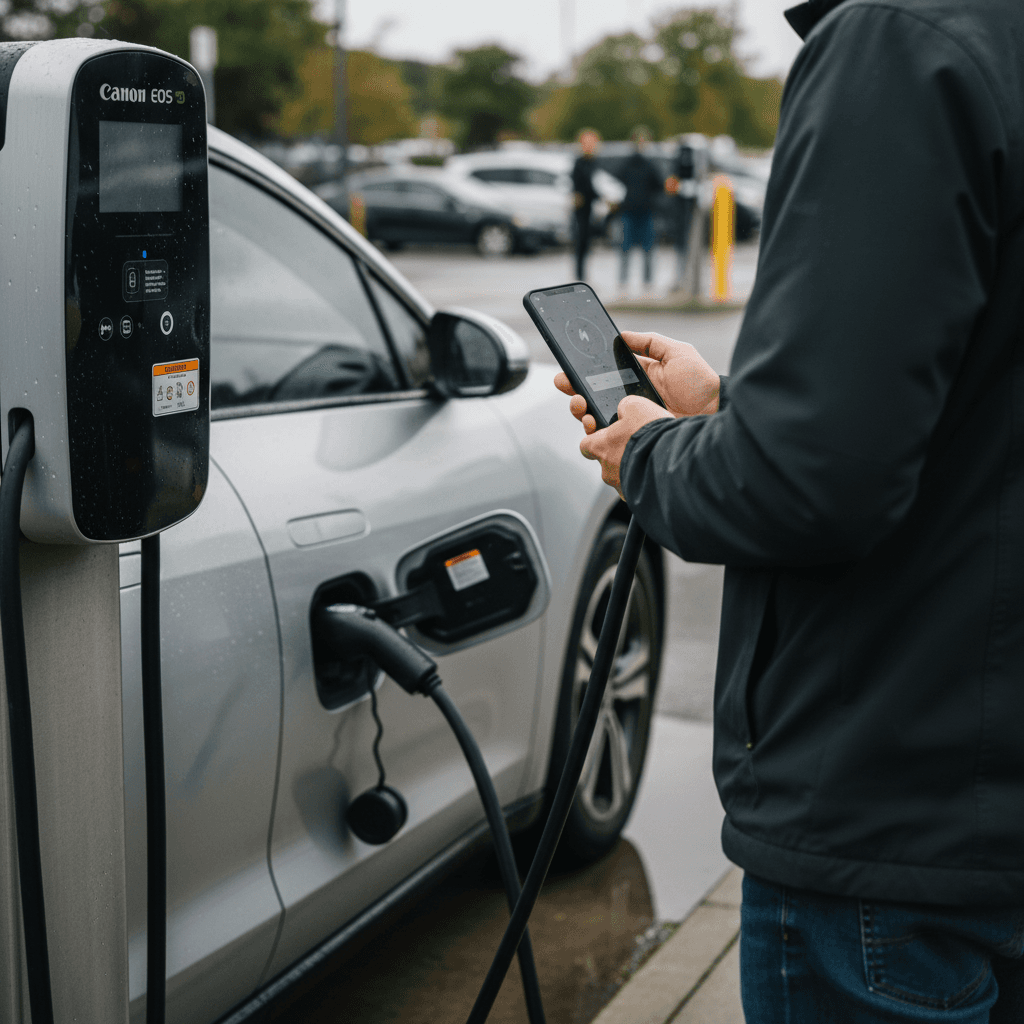
Save your personal “charging favorites”
Understanding charger types and speeds
Level 1 & Level 2 (AC)
- Level 1: Standard 120V household outlet. Adds only a few miles of range per hour. Useful for emergencies or overnight at a friend’s house.
- Level 2: 240V, typically 6–19 kW. Adds roughly 20–40 miles of range per hour depending on your car.
- Best for: Workplaces, hotels, parking garages, shopping centers, and home charging.
DC Fast Charging (often called Level 3)
- Power: Typically 50–350 kW, depending on the site and your vehicle.
- Speed: Many EVs go from about 20% to 80% in 25–45 minutes.
- Best for: Highway road trips or when you need a big top‑up quickly.
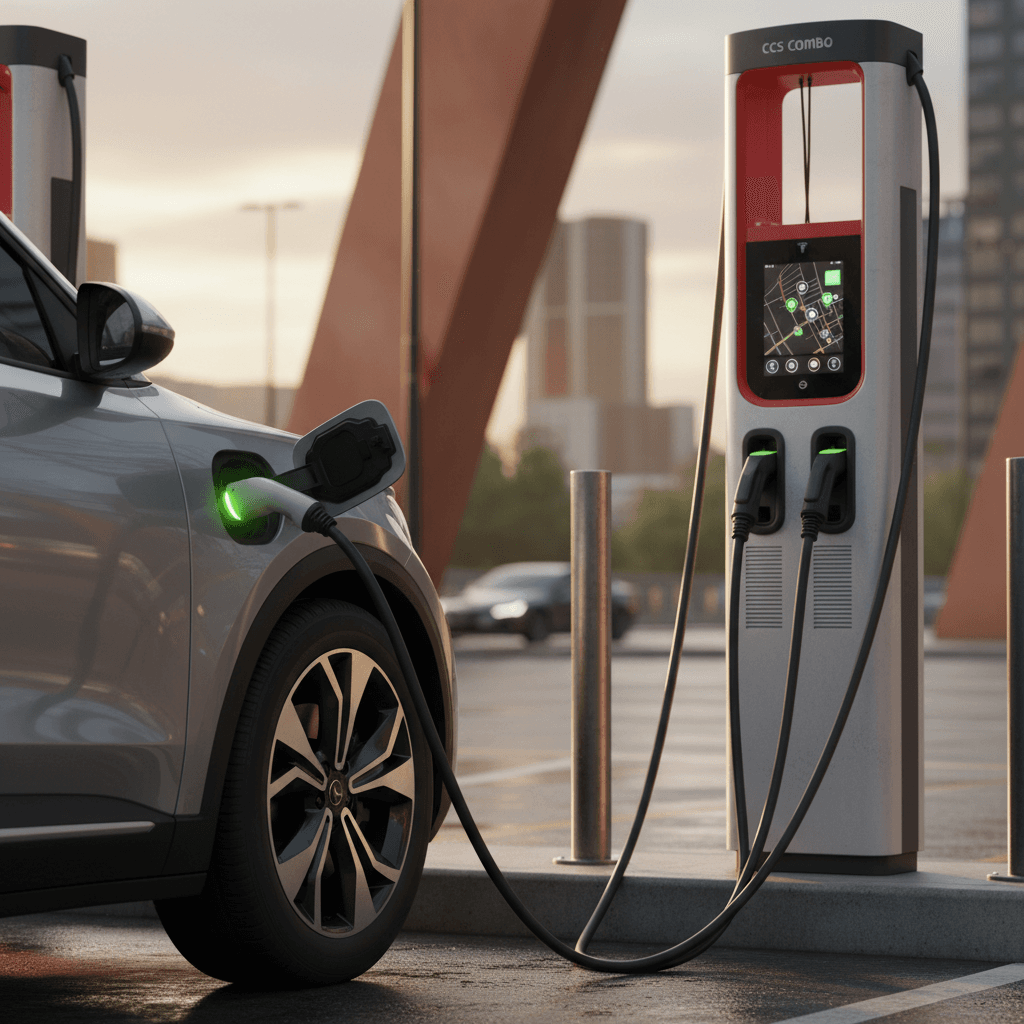
- Connectors: CCS, NACS (Tesla’s standard), and a shrinking number of CHAdeMO ports.
Why power level matters
Quick comparison: Which charger should you look for?
Use this to translate app icons and power numbers into real‑world charging expectations.
| Charger type | Typical power | Where you’ll see it | Good use case | Rough time for ~100 miles |
|---|---|---|---|---|
| Level 1 (AC) | 1–2 kW | Homes, old parking lots | Emergency or overnight at low mileage | 8–20 hours |
| Level 2 (AC) | 6–19 kW | Hotels, offices, public garages, many stores | Top‑ups during work, shopping, or overnight stays | 2–5 hours |
| DC Fast – standard | 50–150 kW | Most highway sites, town hubs | Road trips, urgent top‑ups | 25–60 minutes |
| DC Fast – high power | 200–350 kW | Newer highway sites, some urban hubs | Fastest possible road‑trip charging (if your car supports it) | 15–30 minutes |
Actual charging speeds depend on your battery size, state‑of‑charge, temperature, and how busy the site is.
Major public EV charging networks to know
When you search for “EV charging stations near me,” you’re really looking at a patchwork of different networks, some national, some regional, some owned by utilities or retailers. Knowing the major players helps you interpret what you see on the map and decide which apps to download first.
Key U.S. public charging networks
You’ll see these names most often when you zoom into a charger near you.
Tesla Supercharger & Destination
The most mature fast‑charging network, now opening many locations to non‑Tesla drivers via NACS.
- Excellent coverage on major highways and growing urban presence.
- High power levels and simple user experience.
- Requires the Tesla app and compatible connector or adapter for non‑Teslas.
Electrify America & EVgo
Large DC fast‑charging networks that serve almost all modern EVs.
- Common along interstates, near big‑box retail, and in city centers.
- Often feature 150–350 kW chargers.
- Network apps show real‑time status, pricing, and session history.
ChargePoint & Blink
Massive networks of Level 2 and DC fast chargers hosted by workplaces, apartments, cities, and retailers.
- Great for destination charging where you’ll park for hours.
- Stations may be free, pay‑per‑use, or tied to private access.
- Apps are essential for activating many stations and managing RFID cards.
Retail & utility networks
Grocery chains, gas stations, utilities, and startups are all building charging hubs.
- Think Pilot/Flying J truck stops, convenience stores, and utility‑branded sites.
- Often co‑branded with major networks for roaming (e.g., EVgo inside a grocery chain).
- A good way to combine charging with errands or meals.
Roaming is getting easier
Using Tesla Superchargers & NACS with non-Tesla EVs
One of the biggest changes behind the scenes of your “EV charging stations near me” search is the shift to the North American Charging Standard (NACS), originally Tesla’s connector. Most major automakers have announced NACS support on new models by 2025–2026, and many offer adapters so existing CCS‑equipped vehicles can use certain Tesla Superchargers.
What this means when you search nearby
- You’ll see more Superchargers flagged as open to non‑Tesla EVs in apps like Tesla’s own app, PlugShare, or ChargeHub.
- Some sites support only Tesla vehicles; others support both Tesla and non‑Tesla via NACS.
- Filters in EV apps increasingly let you show only stations your connector can use.
Checklist before using a Supercharger
- Confirm your car supports NACS directly or via a certified adapter.
- Use the Tesla app to confirm non‑Tesla support at that specific site.
- Check pricing, non‑Tesla rates can differ from Tesla‑owner rates.
- Review recent check‑ins for any compatibility or speed complaints.
Watch for compatibility notes
Plan ahead, not panicked: building a charging strategy
Searching for “EV charging stations near me” when you’re already low is stressful. A better approach is to treat public charging the way experienced drivers treat gas: you know where your go‑to stations are and roughly when you’ll need them. That’s especially important if you’re buying a used EV and still learning its real‑world range.
Build a simple charging game plan
Map your daily patterns
Identify where you regularly spend more than 30–60 minutes, work, gym, kids’ activities, favorite grocery store. Mark nearby Level 2 chargers at those locations as favorites in your apps.
Know your “safe buffer”
Decide on a minimum state of charge you don’t want to dip below, often 10–20%. Start searching for chargers before you hit that buffer, not after.
Pre‑plan longer trips
For road trips, use PlugShare, ChargeHub, or your in‑car route planner to drop fast‑charging stops every 80–150 miles, depending on your battery size and weather.
Have a backup for each stop
For every planned fast‑charging stop, star at least one backup within 10–15 miles in case your first choice is busy or offline.
Pay attention to hours & access
Some chargers are behind gates, in paid parking, or at businesses that close overnight. Check access notes and recent user comments before you commit.
Weather changes everything
Public charging etiquette and safety 101
Once you arrive at one of those “EV charging stations near me,” how you behave matters, for your safety, your wallet, and everyone else trying to charge. Public charging is still a shared, sometimes scarce resource.
- Only park in a charging spot if you’re actively charging, and move your car when you’re done.
- Avoid unplugging others unless the site explicitly allows it and the other car is clearly finished.
- Don’t treat a DC fast charger like an all‑day parking spot, once you’re above ~80%, speeds drop and you’re tying up the stall.
- Keep cables off the ground and plug them back into their holsters to avoid damage.
- At night, favor well‑lit, busy locations and stay aware of your surroundings. If a site feels sketchy, move on.
Safety first at unfamiliar sites
Troubleshooting common public charging issues
Even with more chargers coming online, glitches happen, failed authorizations, broken cables, or cars that won’t start a session. Having a simple troubleshooting checklist can turn a potential tow into a minor delay.
If the charger won’t start
- Stop, unplug, and re‑plug the connector firmly until it clicks.
- Restart the app or payment card tap and follow on‑screen prompts slowly.
- Try a different stall at the same site; some ports fail while others work fine.
- Check your EV’s dash for error messages and follow any instructions.
If the session keeps dropping
- Inspect the connector and cable for visible damage or severe wear.
- Move to another stall or another station if errors repeat.
- Log the issue in PlugShare or a similar app so other drivers are warned.
- Contact the network’s support line, numbers are usually printed on the charger, both for help and to request a refund if needed.
Keep support numbers handy
How Recharged helps you think about charging when buying used
If you’re shopping the used market, charging isn’t just a convenience question, it’s part of understanding whether a specific EV fits your life. That’s why every vehicle on Recharged comes with a Recharged Score Report that includes verified battery health and real‑world range insights, so your future “EV charging stations near me” searches are based on what the car can actually do today, not what it could do when it was new.
Match the car to your charging reality
- If you mostly rely on public charging, we’ll help you focus on EVs that support reliable fast‑charging speeds and have strong battery health.
- If you have, or plan to add, home Level 2 charging, we can highlight models that shine with overnight top‑ups and lower public‑charging dependence.
- Our EV‑specialist team can walk through your daily routes and local infrastructure so you know what to expect.
Simple, transparent buying experience
- Browse and buy 100% online, or visit our Experience Center in Richmond, VA.
- Explore financing, trade‑in, or consignment options in one place.
- Get nationwide delivery and support from EV specialists who live this stuff every day.
Buying with charging in mind
Ready to find your next EV?
Browse VehiclesFAQ: Finding EV charging stations near you
Frequently asked questions
The more you drive an EV, the less you’ll find yourself frantically searching for “EV charging stations near me.” With a few trusted apps, a basic understanding of charger types, and a simple charging game plan, public charging becomes just another errand, not an adventure. And if you’re choosing a used EV, factoring in your local infrastructure and daily routes, backed by transparent battery health data from Recharged, means every search for a nearby charger starts from a place of confidence, not anxiety.