If you drive an electric car in the Triad, you’re in better shape than you might think. EV charging stations in Greensboro have quietly multiplied over the past few years, from a handful of Level 2 posts at dealerships to a web of fast chargers at shopping centers, campuses, and travel plazas. The trick now isn’t finding power, it’s knowing where to plug in, how fast, and for how much.
Quick snapshot
Why Greensboro is becoming an EV‑friendly city
North Carolina has been on an EV infrastructure tear, and Greensboro is one of the beneficiaries. The state counts more than a thousand public charging locations, with Greensboro accounting for dozens of those sites, plus a larger cluster if you widen the circle to High Point, Burlington, and Winston‑Salem. Between university sustainability programs, utility investments, and national networks racing to fill in I‑40 and I‑85, Greensboro has quietly become a very livable place for EV drivers.
- Strategic location on I‑40 and I‑85 makes the city a natural fast‑charging hub.
- Multiple universities (UNCG, N.C. A&T) have added on‑campus charging to serve students and staff.
- Dealers and shopping centers along Wendover Avenue and Gate City Boulevard use chargers as a traffic magnet.
- Utility programs from Duke Energy and national players like Electrify America and Mercedes‑Benz High‑Power Charging are seeding hardware around town.
Local reality check
Greensboro EV charging stations by the numbers
Greensboro charging at a glance
Different data sources disagree on exact counts, it’s a moving target, but the pattern is clear: Greensboro has more chargers than most residents will ever use, with new stations still appearing at big‑box retail, travel centers, and multifamily housing.
Major EV charging networks in Greensboro
Who actually powers your charge?
Get to know the logos you’ll see around Greensboro parking lots.
ChargePoint
Where you’ll see it: Workplace lots, parking decks, campuses (UNCG, N.C. A&T), dealerships, and some downtown garages.
Best for: Everyday Level 2 charging while you work, shop, or sleep.
Electrify America
Where you’ll see it: Walmart Supercenter on W. Elmsley Dr and other highway‑adjacent big‑box sites in the Triad.
Best for: High‑speed CCS fast charging on road trips or when you’re in a hurry.
High‑power & automaker hubs
Where you’ll see it: Mercedes‑Benz High‑Power Charging at Friendly Center, Tesla Superchargers near interstates, and other branded hubs.
Best for: Maximum kW, minimal time, especially if your EV can take high‑power DC.
On top of these, you’ll run into EV Connect, Blink, EVgo, and a handful of un‑networked or hotel‑run stations. The practical takeaway: download at least two apps, typically ChargePoint plus a DC specialist like Electrify America or Tesla, so you’re never locked out by a membership wall.
Fast‑charging hubs for road trips
If you’re trying to juice up in 20–40 minutes instead of two hours, Greensboro’s DC fast‑charging grid is what matters. Several sites stand out for speed, stall count, and amenities.
Notable DC fast‑charging locations around Greensboro
These hubs cover most use cases: a quick highway top‑off, a shopping stop, or a coffee‑and‑email break while your battery rockets back to 80%.
| Location | Max power | Connectors | Notes |
|---|---|---|---|
| Walmart Supercenter – 121 W. Elmsley Dr (Electrify America) | Up to 350 kW | CCS, CHAdeMO | Major I‑85 hub with multiple high‑power stalls, ideal for road‑trippers. |
| Friendly Center – 3110 Kathleen Ave (Mercedes‑Benz HPC) | Up to 400 kW | CCS | 10 fast chargers in a busy upscale shopping center; open to all brands via CCS. |
| Greensboro, NC Supercharger – Hornaday Rd | Up to 150–250 kW | Tesla (NACS) | Tesla‑only for now, but many 2025+ non‑Tesla EVs will support NACS with an adapter. |
| Sheetz & travel plazas around the Triad | Up to 150–250 kW | Tesla, CCS, CHAdeMO at some sites | Good for quick hits along I‑40 / I‑85 with restrooms and snacks. |
| Dealership clusters on W. Wendover Ave | Up to 50 kW | CCS, CHAdeMO, J1772 | Honda, Nissan, and others host mixed DC/Level 2 chargers, great if you’re already in the area. |
Always verify live availability and pricing in your charging app before you set out; details can change quickly.
Watch your car’s limits
Downtown and neighborhood charging options
Not every charge needs to be a caffeine‑fueled sprint. Downtown decks, neighborhood shopping centers, and hotels have layered in slower but cheaper, and often free, Level 2 stations that fit grocery runs or dinner reservations.
Downtown & urban cores
- Parking decks: Several city and private decks host ChargePoint Level 2 stations. Ideal if you’re working downtown or catching a show.
- Hotels: Chains near the Coliseum and downtown often list J‑1772 chargers on PlugShare or ChargeHub; these are clutch for overnight guests.
- Restaurants & breweries: A few spots around South Elm and nearby corridors offer Level 2 as a perk, slow but pleasant charging while you linger.
Neighborhood & retail corridors
- Wendover Avenue auto row: Multiple dealers provide Level 2 and 50 kW DC to attract service customers.
- Grocery and big‑box centers: Look for ChargePoint or Blink pedestals near the front row of parking.
- Apartment communities: Newer properties in the Triad increasingly advertise EV parking with J‑1772 plugs; you’ll see these ripple out from Gate City Blvd and major arterials.
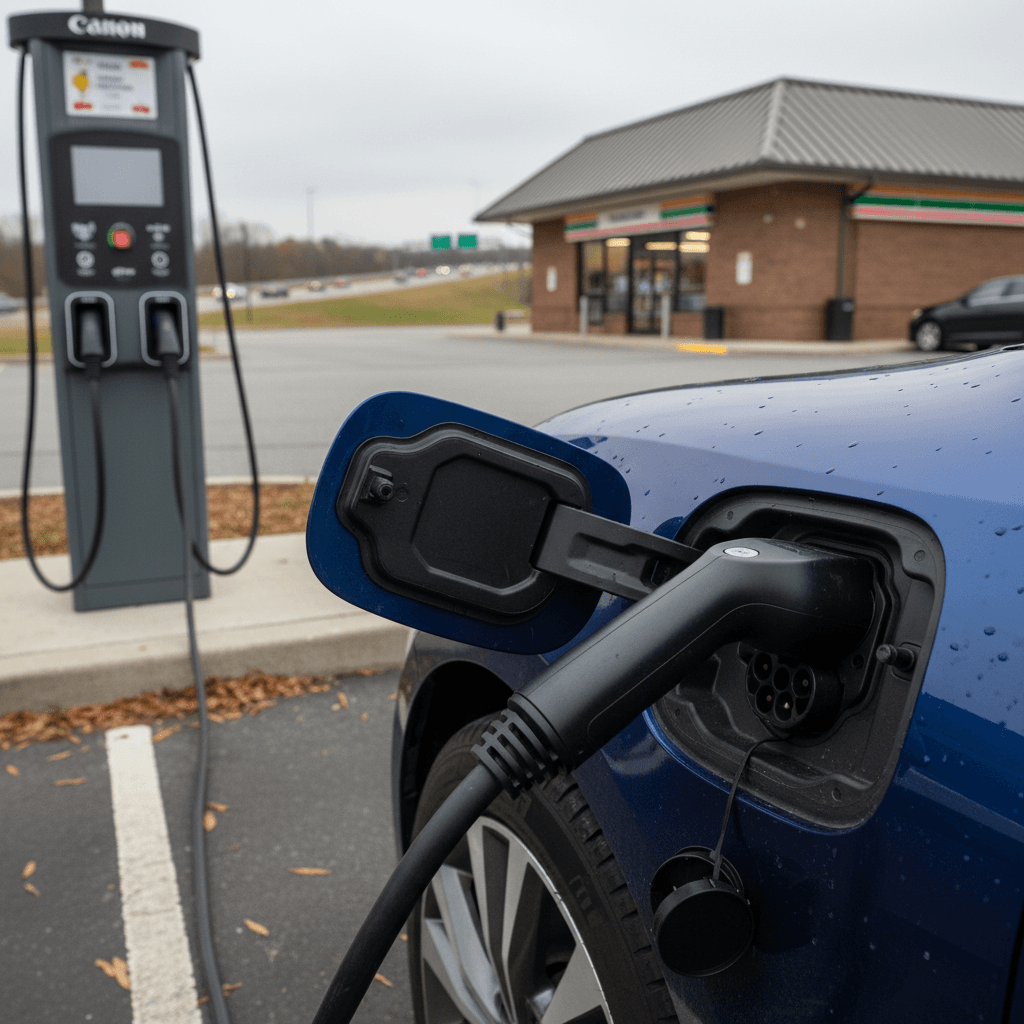
Campus EV charging: UNCG & N.C. A&T
Greensboro’s universities are quietly powering a lot of local charging. If you’re a student, faculty member, or visiting family, campus chargers can make life very easy, just remember they usually sit behind parking rules.
Where to plug in on campus
Policies and numbers can shift, so always confirm on the university website or in your charging app.
UNC Greensboro (UNCG)
UNCG has steadily expanded its on‑campus charging, recently adding NovaCHARGE Level 2 stations through Duke Energy’s Park & Plug program. Altogether, the campus hosts a couple dozen Level 2 ports across multiple lots.
- Accessed via the Shell Recharge / NovaCHARGE platform.
- Standard parking rules and fees still apply.
- Great for students and staff who park for several hours at a time.
North Carolina A&T State University
N.C. A&T now offers ChargePoint Level 2 stations in the Obermeyer parking deck, with published hourly pricing and time‑limit enforcement to keep cars moving.
- Discounted rates for permit holders for the first few hours.
- Higher rates if you overstay, discouraging all‑day squatting.
- Good option for visitors attending events or tours.
Don’t ignore the fine print
Costs: how much it really costs to charge in Greensboro
Charging costs in Greensboro swing from free to more expensive than home power, depending on where, and how fast, you plug in. You’re essentially paying for two things: electricity and convenience.
Typical Greensboro EV charging costs (2026 snapshot)
These are ballpark figures; individual sites set their own rates and may layer in parking fees.
| Scenario | Typical price | What you get |
|---|---|---|
| Home Level 2 (Duke Energy residential) | ≈ $0.12–$0.15 per kWh effective | Cheapest per mile; a 60 kWh charge might cost $7–$9. |
| Public Level 2 (ChargePoint, campuses, workplaces) | Free to ≈ $1.00 per hour or ≈ $0.15–$0.25 per kWh | Perfect for topping off while you’re doing something else; slower but gentle on the battery. |
| DC fast charging – standard | ≈ $0.30–$0.45 per kWh | Common at Electrify America, EVgo, dealer DC sites; good mix of speed and cost. |
| DC fast charging – high‑power hubs | ≈ $0.40–$0.50+ per kWh | Premium 200–400 kW sites like Mercedes‑Benz HPC; you’re paying to get back on the road quickly. |
Always check your app or station signage before starting a session, many networks update pricing as utility rates change.
Think in cost per mile, not per kWh
Best apps, maps, and planning tools
The difference between a relaxed EV drive and a white‑knuckle one is often your app drawer. Greensboro’s hardware is solid; your job is seeing it before you need it.
Core tools every Greensboro EV driver should have
1. ChargePoint
Covers the dense forest of Level 2 stations plus some DC fast chargers around the city. Great for workplaces, campuses, and parking decks.
2. Electrify America
The go‑to app for high‑speed CCS charging at the Walmart Supercenter and along major interstates. Shows real‑time stall status and prices.
3. PlugShare or ChargeHub
Crowd‑sourced maps that show every network in one place, plus photos, check‑ins, and brutally honest user comments.
4. Tesla app (if you have NACS access)
For Tesla drivers, and, increasingly, non‑Tesla owners with NACS or official adapters, this unlocks the Supercharger map.
5. Your navigation system
Most newer EVs can route via chargers natively. Turn this on; it takes the guesswork out of hills, weather, and battery buffers on longer trips.
Old‑school backup
Home and apartment charging options in Greensboro
For most Greensboro drivers, public chargers are the side dish, not the entrée. The real quality‑of‑life upgrade comes from being able to plug in where you sleep.
Single‑family homes
- Level 1 (120V outlet): Good for plug‑in hybrids and very short commutes, think 3–5 miles of range per hour.
- Level 2 (240V circuit): The sweet spot for most EV owners. A 32–40 amp wall unit or plug‑in charger can add 25–35 miles of range per hour.
- Duke Energy programs: Duke’s North Carolina initiatives, like charger rentals and managed‑charging pilots, can soften upfront costs and help you charge during off‑peak hours.
Renters & apartment dwellers
- Ask about charging: Newer buildings increasingly advertise J‑1772 parking as an amenity.
- Portable Level 2: If your complex allows it and has a 240V outlet (for example in shared garages), a portable EVSE can be a flexible solution.
- Rely strategically on public Level 2: Many drivers without home charging treat campus or workplace stations as their “virtual garage.”
Don’t DIY 240V if you’re not qualified
How to choose the right station for your EV
Walk up to a Greensboro charging site and you may see a forest of acronyms, CCS, NACS, J‑1772, CHAdeMO, plus three different price structures. The good news: you only need to match a few basics to your car.
Match your car to the right plug
Once you decode your connector and charging speed, the rest is just coffee selection.
Connector type
- J‑1772: Standard Level 2 plug for most non‑Tesla EVs.
- CCS: Common DC fast connector for many current EVs.
- NACS (Tesla style): Used by Tesla and quickly becoming standard on 2025+ EVs.
- CHAdeMO: Older fast‑charge standard, mainly on first‑wave Nissan LEAFs.
Charging speed
- Level 2 (AC): 6–19 kW, ideal for overnight or multi‑hour stops.
- DC fast (50 kW): Solid for a lunch‑length stop.
- High‑power DC (150–400 kW): Best for interstate hops if your car supports it.
Use‑case & cost
- Daily life: Favor home or free/cheap Level 2.
- Weekend errands: Sneak in Level 2 at grocery or retail stops.
- Road trips: Budget for DC fast sites along I‑40, I‑85, and US‑421.
When in doubt, let the car decide
Buying a used EV? How Greensboro’s charging helps
A city’s charging map should be part of your used‑EV shopping checklist. The good news for Greensboro shoppers is that local infrastructure supports everything from early Nissan LEAFs with CHAdeMO ports to the latest CCS and NACS‑equipped crossovers.
At Recharged, every used EV comes with a Recharged Score Report, including verified battery health and a realistic range estimate. That matters when you’re planning to rely on a mix of home charging and public stations around the Triad. A healthy battery plus a city full of Level 2 and DC fast options is the difference between a car you love and one that turns every errand into an experiment.
Smart shopping move
Greensboro EV charging FAQ
Frequently asked questions about EV charging in Greensboro
The bottom line on EV charging in Greensboro
For a mid‑sized Southern city, Greensboro punches above its weight on EV infrastructure. The combination of campus chargers, workplace Level 2, highway‑grade DC hubs, and an expanding network of free or low‑cost stations makes daily life with an EV remarkably straightforward, especially if you can plug in at home.
If you’re already driving electric, the key is to build a simple routine: home or workplace charging for the mundane miles, and a short list of trusted DC sites for road‑trip days. If you’re still shopping, Greensboro’s charging map means you can focus on finding a used EV with a healthy battery and the right connector for your lifestyle. That’s where Recharged comes in, with verified battery health, fair pricing, and nationwide delivery so you can buy the right EV first, and let Greensboro’s chargers handle the rest.