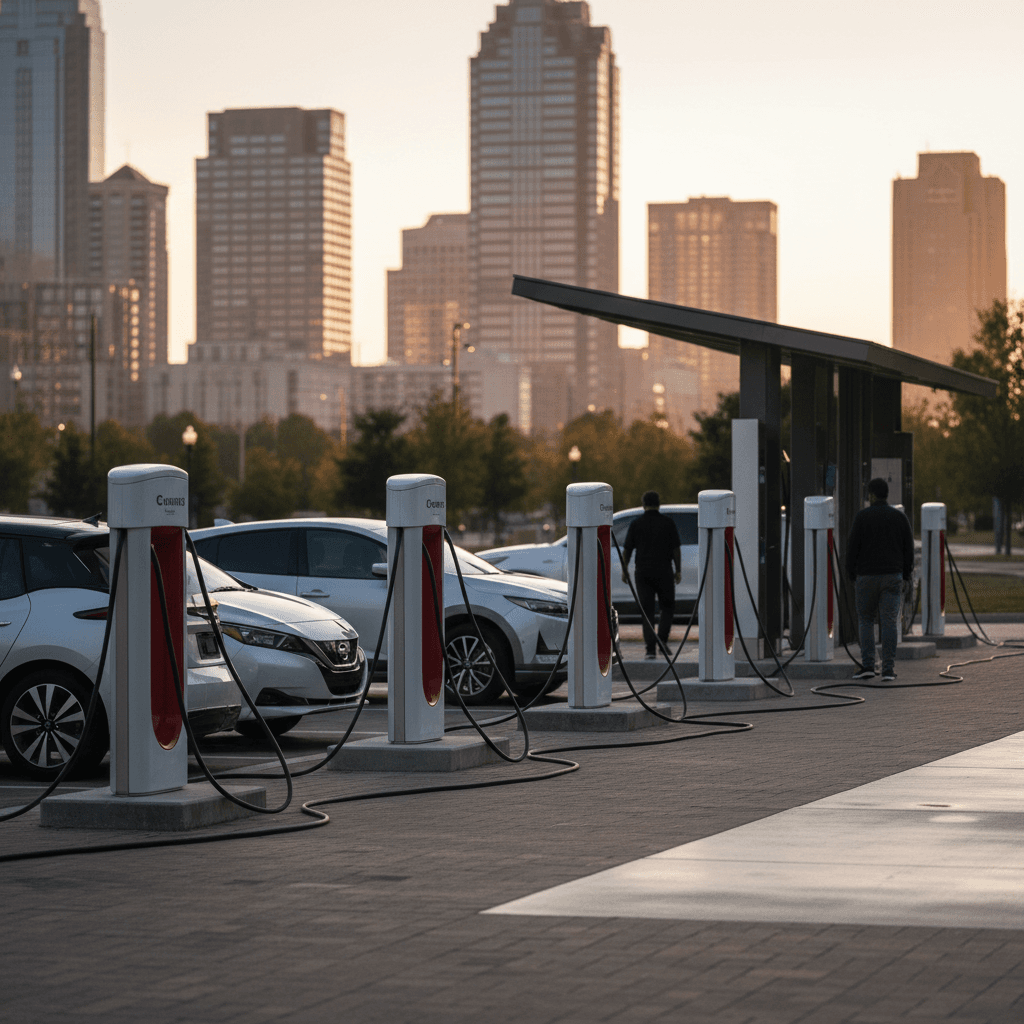
If you drive an electric car in the Queen City, you’ve probably searched for **EV charging stations in Charlotte, NC** before heading Uptown, to SouthPark, or out toward the lake. The good news: Charlotte is one of North Carolina’s best-served EV markets, with hundreds of public plugs and growing support from utilities and the city. The catch is knowing which chargers are where, how fast they are, and which ones actually fit your car and your lifestyle.
Charlotte’s EV charging snapshot
Why EV charging in Charlotte matters now
North Carolina has leaned into electrification, pairing state climate goals with utility-backed programs and federal infrastructure dollars. Charlotte sits at the center of that push. The metro’s EV registrations have climbed quickly over the last few years, and public charging has followed, especially in and around Uptown, SouthPark, the University area, and the airport corridor.
At the same time, public charging across the U.S. is still catching up to demand. Reliability can be uneven, and the experience varies from network to network. That’s why understanding **how Charlotte’s charging network is laid out**, where the DC fast chargers are, and what backup options you have is just as important as knowing where the nearest plug shows up in your app.
Don’t rely on a single charger
How many EV charging stations does Charlotte have?
Charlotte EV charging by the numbers
Those numbers put Charlotte near the top of the pack for North Carolina. Coverage is strongest in and around the city center and along the I‑77 and I‑85 corridors, with thinner options as you head toward more rural counties. For most daily driving inside Mecklenburg County, though, you can reasonably expect to find a Level 2 charger within a few miles of where you’re going.
Use local data, not just national apps
Types of EV chargers you’ll find in Charlotte
Most **EV charging stations in Charlotte** fall into three categories: Level 1, Level 2, and DC fast charging. Understanding the difference helps you choose the right spot for your schedule and your car.
Charging levels in Charlotte, explained
Match the charger to how long you’ll be parked, and how much range you need.
Level 1 (120V)
Standard household outlet. Adds roughly 3–5 miles of range per hour.
- Best for: Overnight charging at home if you drive less than 30–40 miles a day.
- Rare as public infrastructure, mostly a home solution.
Level 2 (240V)
Workhorse of Charlotte’s network. Adds about 20–40 miles of range per hour, depending on your car.
- Found at: Parking decks, hotels, office parks, retail centers, municipal lots.
- Use when: You’ll be parked for 1–4 hours or all day.
DC fast charging
High‑power public chargers that can add 150–200+ miles in 30–45 minutes on many newer EVs.
- Found along: I‑77, I‑85, I‑485, and near major retail hubs.
- Best when: You’re road‑tripping or recovering from a low‑battery situation.
Watch your connector type
Major EV charging networks in Charlotte
Several national and regional networks operate **EV charging stations across Charlotte**, from downtown decks to suburban shopping centers. Most chargers you’ll see fall under one of these umbrellas:
Key charging networks in Charlotte
Not an exhaustive list, but a look at the providers you’re most likely to see around town.
| Network | What you’ll see in Charlotte | Typical charger types | How you pay |
|---|---|---|---|
| ChargePoint | Common at office parks, hospitals, and parking garages | Mostly Level 2, some DC fast | Tap card or app; many sites are host‑priced |
| EVgo | Clustered near retail corridors and major roads | DC fast plus some Level 2 | App or RFID card; session or membership pricing |
| Electrify America | Strategic highway and mall locations (Uptown, University, SouthPark) | High‑power DC fast (often 150–350 kW) | App, credit card, or membership |
| Tesla Supercharger | High‑uptime DC fast at travel hubs and popular corridors | NACS fast charging; some sites open to non‑Tesla with adapter or app authorization | Tesla app; pricing varies by site and time |
| Duke Energy / utility-hosted | Workplace and fleet-focused sites with some public access | Primarily Level 2; some DC fast at businesses | Varies, often free or simple pay-by-app via host |
Always confirm current locations, pricing, and connector types in each network’s app before you drive.
Pro move: Carry multiple apps
Where to find EV charging stations in Charlotte, by area
Uptown & adjacent neighborhoods
Uptown has one of the highest concentrations of EV charging stations in Charlotte, thanks to a mix of city-owned decks, office garages, and mixed‑use projects.
- Parking decks: City-managed garages and private decks often host multiple Level 2 ports, sometimes free or discounted while you’re parked.
- Hotels & convention venues: Many mid‑ and upscale hotels around the Spectrum Center and convention center now offer guest charging.
- South End: Newer apartment and office developments along the Rail Trail have been adding resident and visitor chargers in garages.
SouthPark, Ballantyne & south Charlotte
Head south and you’ll find a dense cluster of chargers anchored by retail and office campuses.
- SouthPark: Mall and lifestyle centers feature Level 2 and some DC fast options, good for combining a top‑up with shopping or dinner.
- Ballantyne: Office parks increasingly include workplace charging; public access varies by garage.
- Park Road & Sharon Road corridors: Look for chargers at grocery‑anchored centers and newer multifamily projects.
University area & north corridors
The UNC Charlotte/University City district continues to add public charging, much of it tied to retail centers and multifamily housing.
- University City Blvd & I‑85: Several DC fast hubs sit near big-box retail and chain restaurants.
- Harris Blvd & I‑77: A key node for commuters; check for fast charging near exits.
- Huntersville & Lake Norman: Fewer chargers overall, but growing clusters at shopping areas and marinas.
CLT Airport & logistics corridors
Charlotte Douglas International Airport and the surrounding warehouse/industrial belts have become important charging zones.
- Airport parking: Expect a mix of Level 2 and some DC fast options in long‑term and daily decks.
- Hotels & park‑and‑fly: Many offer guest-only Level 2 charging, call ahead to confirm availability.
- Logistics corridors: Fleet-oriented DC fast chargers are beginning to appear along I‑485 and freight routes, often with limited public access.
Time your charges with your plans
Planning longer trips from Charlotte
Whether you’re heading to Asheville, Raleigh, Atlanta, or the coast, interstates around Charlotte are steadily filling in with DC fast chargers. But spacing between stations, and the number of working plugs at each stop, can still be hit or miss, especially away from the major metros.
Route-planning checklist for Charlotte EV drivers
1. Start with at least two apps
Use tools like A Better Routeplanner, PlugShare, or your automaker’s built‑in nav alongside a network app such as Electrify America or EVgo. Cross‑checking helps you avoid phantom or out‑of‑service locations.
2. Prioritize highway-adjacent DC fast hubs
Look for multi‑stall sites directly off I‑77, I‑85, and I‑40 where possible. Bigger sites are more likely to have at least one working plug when you arrive.
3. Keep a buffer in rural stretches
Once you’re off the Charlotte–Triad–Triangle and Charlotte–Atlanta corridors, chargers thin out. Aim to arrive at your next stop with at least 15–20% battery, not 1–2%.
4. Understand your car’s charging curve
Most EVs charge fastest between about 10% and 60–70% state of charge. On trips, it’s often quicker to make two shorter fast‑charge stops than one long session to 100%.
5. Carry backup payment options
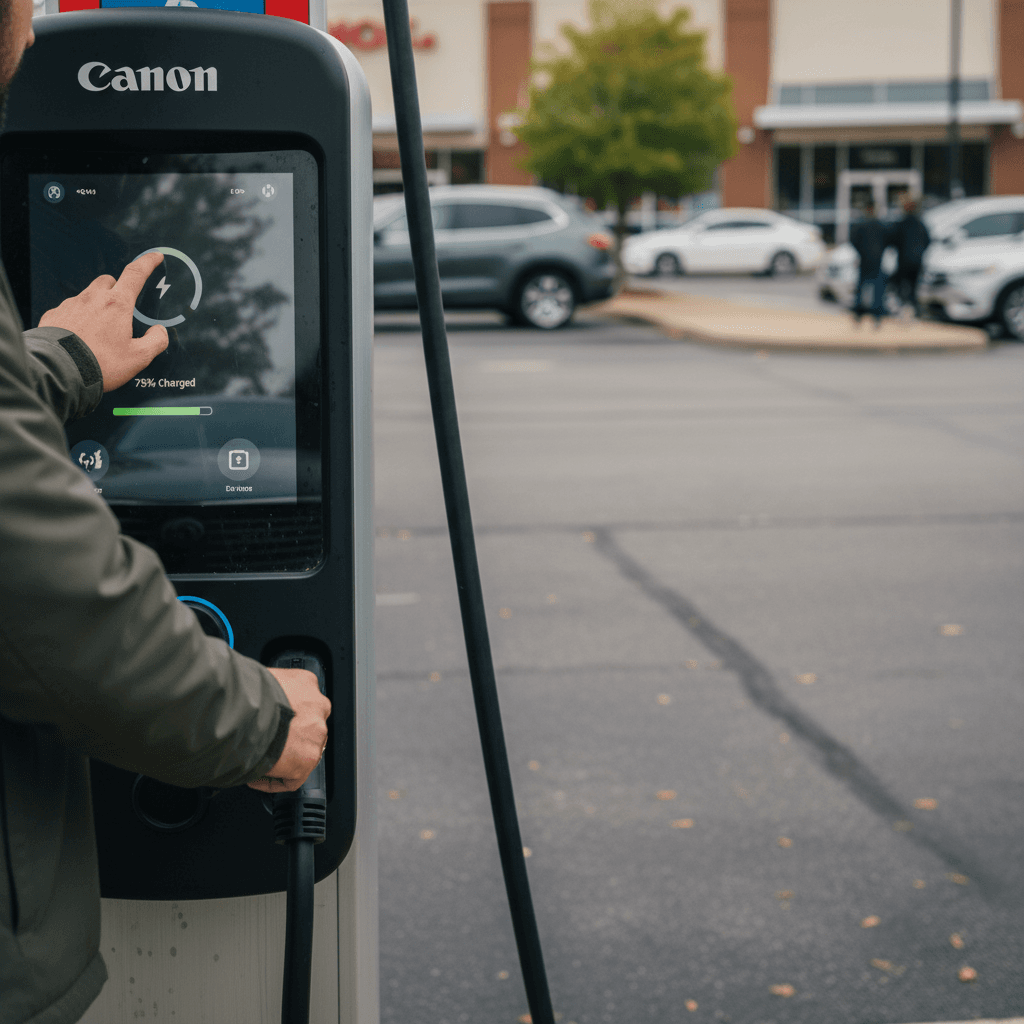
Even when the app says tap to charge, readers can glitch. Having a credit card that works directly at the pedestal, and multiple network accounts, can save a tow.
6. Factor in weather and elevation
Cold snaps in the mountains or heavy summer AC use can cut your real‑world range. Add extra margin when planning winter ski or summer beach runs.
Beware charger deserts outside metros
What EV charging costs in Charlotte
Charging prices in Charlotte vary widely depending on who owns the station, how fast it is, and whether the host is treating it as an amenity or a profit center. You’ll see everything from **free Level 2 parking‑deck plugs** to **high‑power DC fast chargers priced by the minute or kilowatt‑hour**.
Typical charging costs around Charlotte
Always confirm rates in your app before plugging in, these are common patterns, not guarantees.
Workplace & municipal Level 2
- Price: Often free or low flat fee while parked.
- Where: City facilities, universities, corporate campuses.
- Best for: Regular commuters who can leave the car for several hours.
Retail & destination Level 2
- Price: Free to a few dollars per hour.
- Where: Malls, grocery stores, restaurants, hotels.
- Best for: Topping up 20–60 miles during errands or dining.
High‑speed DC fast charging
- Price: Typically more than home charging per kWh, think of it like convenience‑store gas pricing.
- Where: Near interstate exits, big retail nodes, and highway-adjacent plazas.
- Best for: Road trips or emergency recovery when you’re low on range.
Compare to your home electric rate
Home charging options in Charlotte and Duke Energy programs
For most Charlotte drivers, **home charging** is the backbone of EV ownership. You plug in at night, wake up with a full battery, and use public stations as a backup or for trips. Duke Energy and state regulators have been building programs to make that as painless as possible.
Key Duke Energy EV programs in North Carolina
Exact eligibility and details can change, but these are the types of offerings Charlotte-area customers have seen.
| Program type | What it typically does | Why it matters in Charlotte |
|---|---|---|
| Charger rental (Charger Solution) | Lets residential and business customers lease a Level 2 or DC fast charger for a monthly fee that covers hardware and maintenance. | Reduces the upfront cost of installing a dedicated home or workplace charger. |
| Charger prep credits | Offsets part of the cost of upgrading electrical panels or running wiring needed for Level 2. | Makes it easier to add a 240V circuit in older homes across older Charlotte neighborhoods. |
| Managed charging / subscription pilots | Allows customers to charge at home for a fixed fee while utility controls charging times. | Encourages off‑peak charging and can cut your effective per‑kWh cost if you’re flexible. |
Check Duke Energy’s EV program page for current terms, participating hardware, and enrollment windows.
Level 2 at home is a game‑changer
If you’re shopping for a used EV, factor home charging into your decision. In a townhome or single‑family home, adding a wall‑mounted Level 2 unit is usually straightforward for a licensed electrician. In condos or apartments, you may need HOA approval or a landlord willing to participate in Duke Energy or third‑party programs.
Charging tips for used‑EV buyers in Charlotte
Charlotte’s charging network makes daily EV life increasingly practical, but the **specific car you buy** and its battery health will determine how enjoyable that experience actually is. That’s especially true in the used market, where range and fast‑charging performance can vary widely from one example to the next.
How to evaluate charging as you shop for a used EV
Look beyond listed range and price tags.
1. Check real battery health
Battery degradation affects how quickly you’ll need to find those Charlotte chargers, and how long you’ll sit there. With Recharged, every vehicle includes a Recharged Score Report that verifies battery health and estimated range so you’re not guessing.
2. Understand your fast‑charging capability
Two EVs with the same size battery can charge very differently. Ask for the car’s maximum DC fast‑charging rate (in kW) and whether any software updates or recalls affect it.
More local questions to ask
Bring Charlotte’s charging reality into your test drive and paperwork.
3. Map your personal charging footprint
Before you buy, mark your home, workplace, and regular destinations on a map along with known EV charging stations in Charlotte. Does your typical week work mostly on home and workplace charging, with public stations as backup?
4. Factor charging into total cost of ownership
Balance the cost of installing home charging (if needed) with your expected use of paid fast charging. A slightly higher purchase price on an EV with better range and charging performance can pencil out cheaper over a few Charlotte summers and holiday road trips.
How Recharged can help Charlotte buyers
Ready to find your next EV?
Browse VehiclesFrequently asked questions about EV charging in Charlotte, NC
Charlotte EV charging FAQs
Bottom line: EV charging in Charlotte
Charlotte is better positioned for EV charging than many cities its size, with a deep bench of Level 2 options, a growing network of DC fast chargers, and utility programs aimed at getting more plugs into garages, parking decks, and workplaces. But like the rest of the country, it’s still a work in progress: reliability varies, rural gaps remain, and not every charger will fit every car or budget.
If you already own an EV here, the smartest move is to **treat home charging as your foundation** and learn the public network as a flexible backup. If you’re shopping for a used EV, factor Charlotte’s charging map into your decision up front, battery health, connector type, and your housing situation matter just as much as sticker price. Recharged can help you match the right used EV to the way you actually drive around the Queen City, complete with transparent battery data and guidance on what charging will really look like for you day to day.