If you’re staring at a map and wondering how to transport an EV long distance, across the state, across the country, or to a buyer on the other coast, you’re right to pause. Electric vehicles are not just gas cars with a plug. The wrong towing method can quietly damage the motor or battery and turn a simple move into a four‑figure repair.
Good news
Why transporting an EV long distance is different
In a gas car, you can often tow with the transmission in neutral because the gearbox disconnects the engine from the wheels. Most modern EVs don’t work that way. They typically use a single‑speed reduction gear that keeps the electric motor mechanically linked to the drive wheels, even when the car is “off.” When those wheels turn, the motor turns too, often generating power the system isn’t expecting.
- Motor overspeed: Towing at highway speeds with the drive wheels on the ground can spin the motor faster than it was designed to handle.
- Unintended power generation: Spinning the motor can feed power back into the high‑voltage system while the computers are asleep, which can damage inverters or other electronics.
- Warranty risk: Most owner’s manuals explicitly say to use a flatbed and may deny coverage if the car was towed incorrectly.
Flat towing is almost never safe
Step 1: Decide whether to drive or ship your EV
Before you start pricing trailers or calling transport companies, step back and decide whether you actually need to ship the car at all. In many cases, driving the EV yourself is the safest and most cost‑effective option, especially if you have flexible timing and enjoy a good road trip.
Driving vs. shipping your EV long distance
Use this quick comparison to decide which path makes sense for you.
Drive the EV yourself
- Best for: 300–1,200 mile moves, modern EV with DC fast‑charging, flexible schedule.
- Pros: Cheapest, no transport coordination, you learn the car’s real‑world range.
- Cons: Trip planning time, charging stops, extra mileage and tire wear.
Ship or trailer the EV
- Best for: Cross‑country moves, tight timelines, older EVs with short range, winter routes.
- Pros: No extra miles on the car, less time and hassle for you.
- Cons: Higher cost, scheduling windows, need to prep the car correctly.
Quick checklist: When it makes sense to drive
Your route has solid fast‑charging coverage
Use apps like PlugShare, A Better Routeplanner, or manufacturer nav to confirm you can DC fast‑charge at least every 100–150 miles on your path.
Your EV’s highway range covers the gaps
If your usable range in real conditions is at least 180–220 miles, most interstate routes in the U.S. are now drivable with planning.
You can add 1–3 hours per travel day
Charging stops add time. If you’re on a rigid schedule or moving with pets and kids who are done after six hours, shipping might be the better call.
Weather and terrain are reasonable
Long winter stretches, mountain passes, or desert heat all eat into range. If your move is happening in rough conditions, consider trailering or shipping.
Layer in a fun handoff
Safe ways to transport an EV long distance
Once you’ve decided you’re not going to just drive the car, you’ve got three main safe choices for long‑distance EV transport: a commercial carrier, a flatbed tow truck for regional moves, or a trailer you tow yourself.
EV transport options at a glance
Option 1: Professional auto transport (open or enclosed carrier)
For most long moves, selling an EV to an out‑of‑state buyer, relocating for work, buying a used EV across the country, hiring an auto transport company is the simplest and safest solution.
- Your EV is winched or driven onto a multi‑car trailer and secured at the wheels or frame tie‑downs.
- All four wheels are off the ground, so there’s no risk of spinning the motor or generating power.
- You don’t add miles or road wear, and the car usually stays in “Park” for the entire trip.
How Recharged helps here
Option 2: Regional flatbed tow
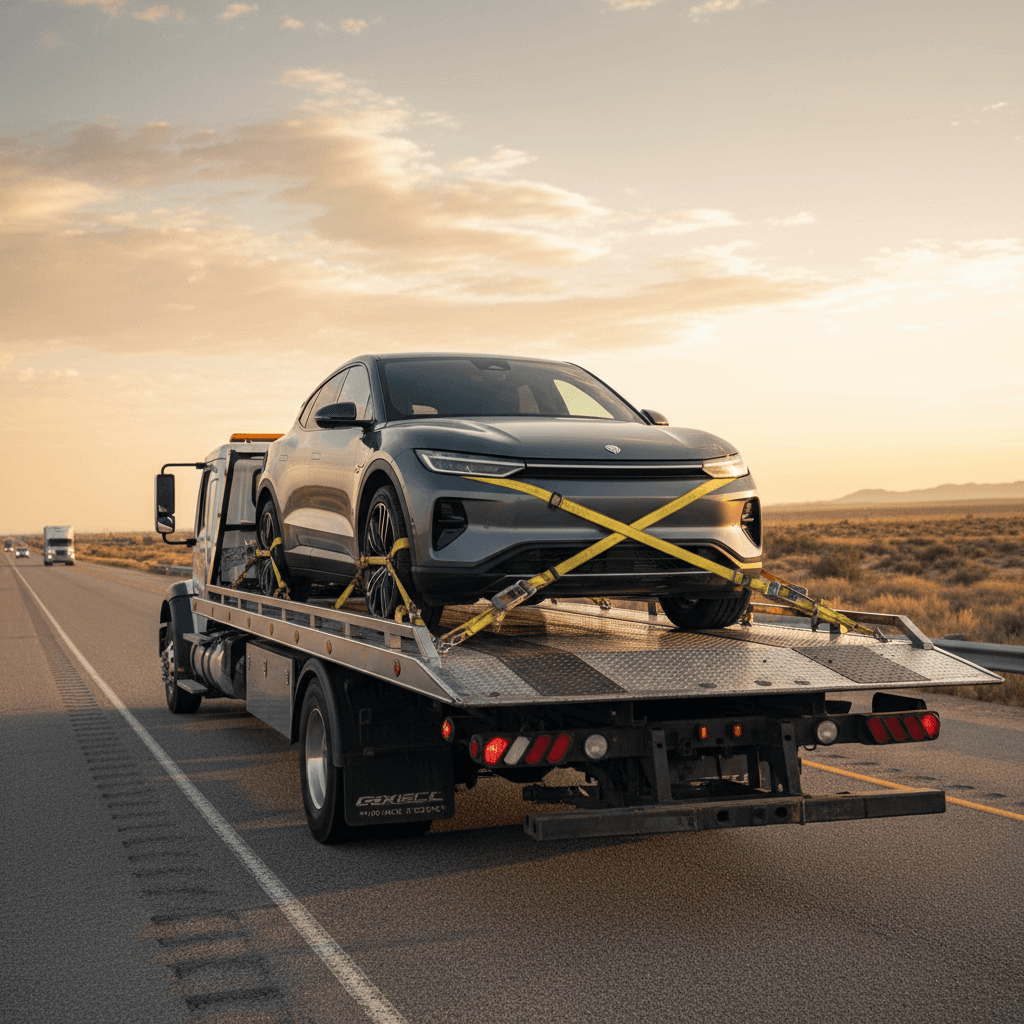
If you’re moving an EV a few hundred miles, say from one metro area to another, a dedicated flatbed tow truck can be a good middle ground. Many manufacturers and roadside programs specify flatbed only for EVs.
- Ask for a flatbed when you call, don’t assume the nearest truck is safe for an EV.
- Confirm the operator knows how to access your car’s transport or tow mode and where the approved tie‑down points are.
- Use wheel straps or manufacturer‑approved hooks, never suspension arms, coolant lines, or battery pack structures.
Avoid “sling” and hook‑and‑chain tows
Option 3: Trailer the EV yourself
If you already own a capable truck or SUV and you’re comfortable towing, you can rent or buy a car hauler and move the EV yourself. This is common for folks relocating, RV owners, and track‑day enthusiasts trailering performance EVs.
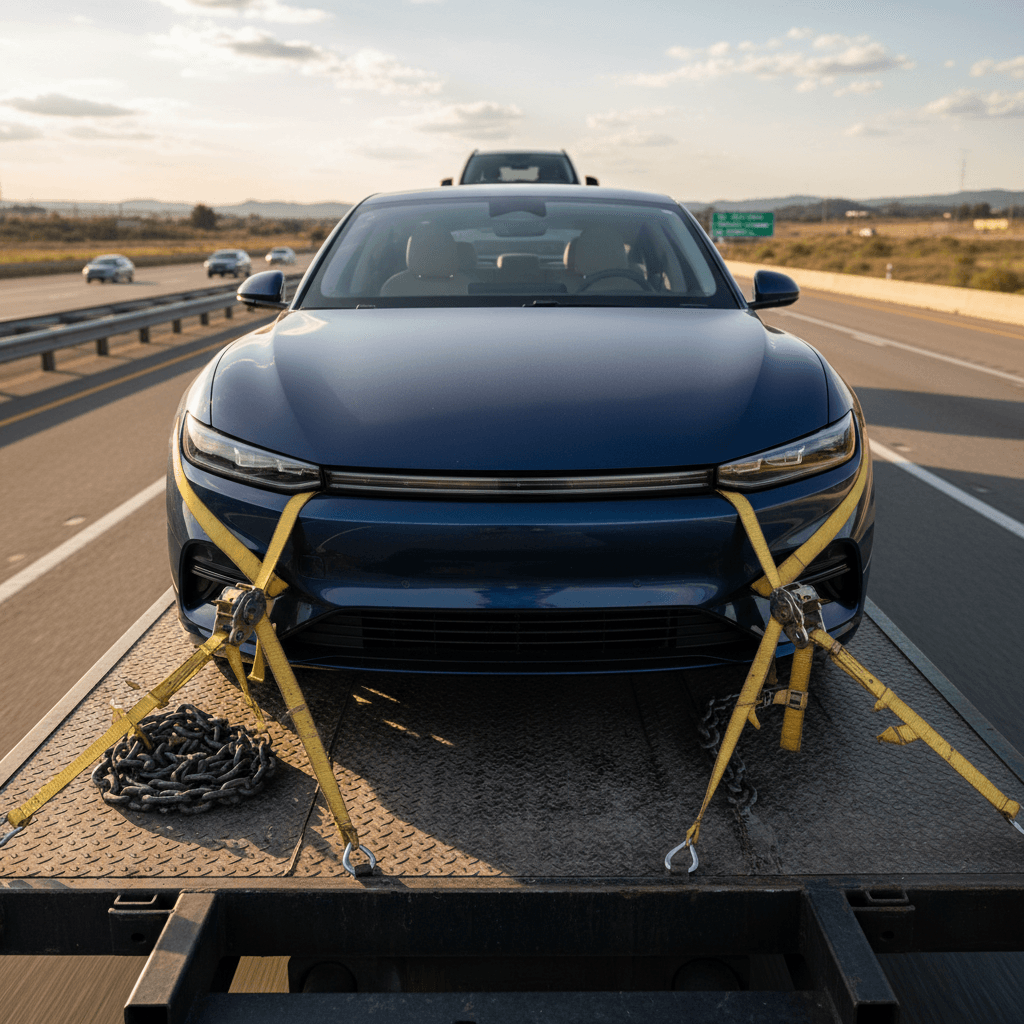
Choosing the right trailer to transport an EV
Match the trailer and tow vehicle to your EV’s weight and size.
| Trailer type | Best for | Key specs to verify | Watch out for |
|---|---|---|---|
| Open car hauler | Short to medium moves, mild weather | Dual‑axle, brakes on both axles, rated above EV’s curb weight plus 10–20%. | Road grime, rock chips, weather exposure. |
| Enclosed car trailer | Long, multi‑day moves, harsh weather, high‑value EVs | Interior height/width for SUVs, rear door opening size, tie‑down points. | Higher cost, heavier, requires stronger tow vehicle. |
| Toy hauler / RV garage | Bringing a small EV to a vacation home or track | Ramp angle manageable for ground clearance, rated floor and axle load. | Interior fumes if you try to charge inside, limited ventilation. |
Check your EV’s curb weight and your tow vehicle’s ratings before you book or rent.
Mind tongue weight and payload
What about tow dollies and RV “dinghy” towing?
If you’ve been RVing for a while, you may be used to flat towing a small gas car behind your motorhome with all four wheels on the ground. With EVs, that playbook mostly goes in the shredder.
Tow dollies
Tow dollies lift two wheels off the ground and leave the other two rolling. They’re fine for many front‑wheel‑drive gas cars. For EVs, they’re usually not recommended unless the manual clearly says otherwise.
- If the drive axle stays on the ground, you can still overspeed the motor.
- Even if you put the drive axle on the dolly, some EVs use multiple motors.
- Stability systems may complain after long stretches with unusual wheel speeds.
Four‑down RV towing
Right now, there are no mainstream EVs approved by their manufacturers for true flat towing behind an RV. You’ll see creative setups online, but they often fly in the face of factory guidance and warranty coverage.
If you want an RV “toad,” a small hybrid or gas car is still the safer choice today.
Always read the fine print
How to prepare your EV for long-distance transport
Whether you’re shipping your EV with a carrier, sending it to a buyer, or pulling it behind your own truck on a trailer, a little prep work goes a long way. You’re trying to protect three things: the battery, the body and interior, and your documentation in case something goes wrong.
Pre‑transport checklist for your EV
1. Set an appropriate state of charge
Aim for around <strong>40–60% battery</strong> at pickup unless the carrier requests otherwise. That’s healthy for the pack and leaves enough buffer for loading, unloading, and short drives.
2. Turn off scheduled charging and climate
Disable any scheduled preconditioning or charging that might kick on while the car is sitting on a trailer or truck. You don’t want systems waking up unexpectedly.
3. Secure loose accessories
Remove home charging cables, adapters, toll tags, roof racks, and loose interior items you don’t want to lose or have bouncing around during the trip.
4. Note existing damage
Walk around the car and take dated photos of all sides, wheels, and the interior. This is standard practice in the transport world and helps if you need to file a claim.
5. Provide a working key or card
Carriers will need to unlock, shift into transport mode, and sometimes move the car a few feet. Make sure they have a key and any PIN‑to‑drive information they need.
6. Share special instructions
If your EV has air suspension, low‑rider settings, or a quirky charge‑port release, write simple notes. Don’t assume the driver has memorized your owner’s manual.
Best battery state of charge (SoC) for storage and transport
Lithium‑ion batteries are happiest in the middle of their range when they’re going to sit for days. A common recommendation is to store an EV around 40–60% SoC if it’ll be parked for a while, and most manufacturers advise avoiding 100% for long storage.
- If your car will be in transit for less than a week and not used en route, 40–60% is ideal.
- For very long shipments or if the car may need to sit in a lot for a while, 60–70% gives a little extra buffer.
- Ask the carrier not to leave the car plugged into a random outlet unless you’ve discussed it. Slow charging in extreme heat can be hard on a pack if it’s already full.
Use storage mode if available
Working with a professional EV carrier
Auto transport is an entire industry, and not every carrier has caught up with the nuances of EVs. When you request quotes, ask a few pointed questions to separate the pros from the “we’ll figure it out” crowd.
Questions to ask any transport company moving your EV
If they can’t answer these confidently, keep shopping.
“How do you normally handle EVs?”
“Are you insured for EVs?”
“Can I see your inspection form?”
Recharged can coordinate shipping
Costs and timing for long-distance EV transport
Pricing to transport an EV long distance isn’t wildly different from shipping any other vehicle. What changes is who is willing to handle the car correctly and how quickly you need it to move.
Typical costs and timing to transport an EV
These are ballpark figures for planning, not quotes.
| Scenario | Distance | Typical method | Rough cost | Timing |
|---|---|---|---|---|
| In‑state move | 100–300 miles | Dedicated flatbed or short‑haul carrier | $300–$800 | 1–3 days |
| Regional hop | 300–800 miles | Open carrier or flatbed | $600–$1,200 | 3–7 days |
| Cross‑country | 800–2,000+ miles | Open or enclosed multi‑car carrier | $900–$2,200+ | 5–14 days |
| DIY trailer rental | Any, within reason | Your tow vehicle + rented trailer | $100–$200/day + fuel | Your schedule |
Actual prices vary by route, season, fuel costs, and vehicle size.
Book early for best options
Long-distance transport when buying a used EV
Long‑distance transport is baked into modern used‑car buying. You might fall in love with a low‑mile EV three states away or get the best deal on a configuration that’s nowhere near your ZIP code. That’s normal, and manageable, if you add a few guardrails.
Before you pay for transport
- Get a third‑party battery health report or a Recharged Score‑style evaluation, not just a generic inspection.
- Ask for detailed photos or video of the underbody and charge port area.
- Confirm the car comes with all promised charging equipment and adapters.
While the car is in transit
- Track the shipment if the carrier provides GPS updates.
- Make sure the driver has two contact numbers in case of an issue on the road.
- Plan where you’ll charge first once it arrives, especially if SoC will be low at delivery.
Leaning on experts saves headaches
Common mistakes to avoid when moving an EV
- Letting anyone tow it with wheels on the ground. Unless your manual explicitly allows it, insist on a flatbed or trailer, no exceptions.
- Shipping at 100% state of charge. A full battery sitting in heat for days isn’t ideal. Dial it back to the middle of the pack before pickup.
- Leaving apps and key cards in the car. Remove anything a stranger could use to access your accounts or home address.
- Skipping photos at pickup and delivery. A five‑minute walk‑around with your phone is the best insurance you can have.
- Assuming every carrier “gets” EVs. Ask specific questions about tow modes, tie‑downs, and charging so you know they’ve done this before.
Frequently asked questions about long-distance EV transport
Long-distance EV transport FAQ
Moving an EV long distance doesn’t have to be nerve‑racking. Treat the battery and drivetrain with the respect they deserve, no wheels on the ground unless your manual says otherwise, pick the transport method that fits your budget and timing, and prep the car like you’re sending it on a solo trip. Whether you’re trailering it yourself, hiring a carrier, or buying and shipping through a digital marketplace like Recharged, a little planning up front means your EV arrives ready for its new life instead of its first repair bill.