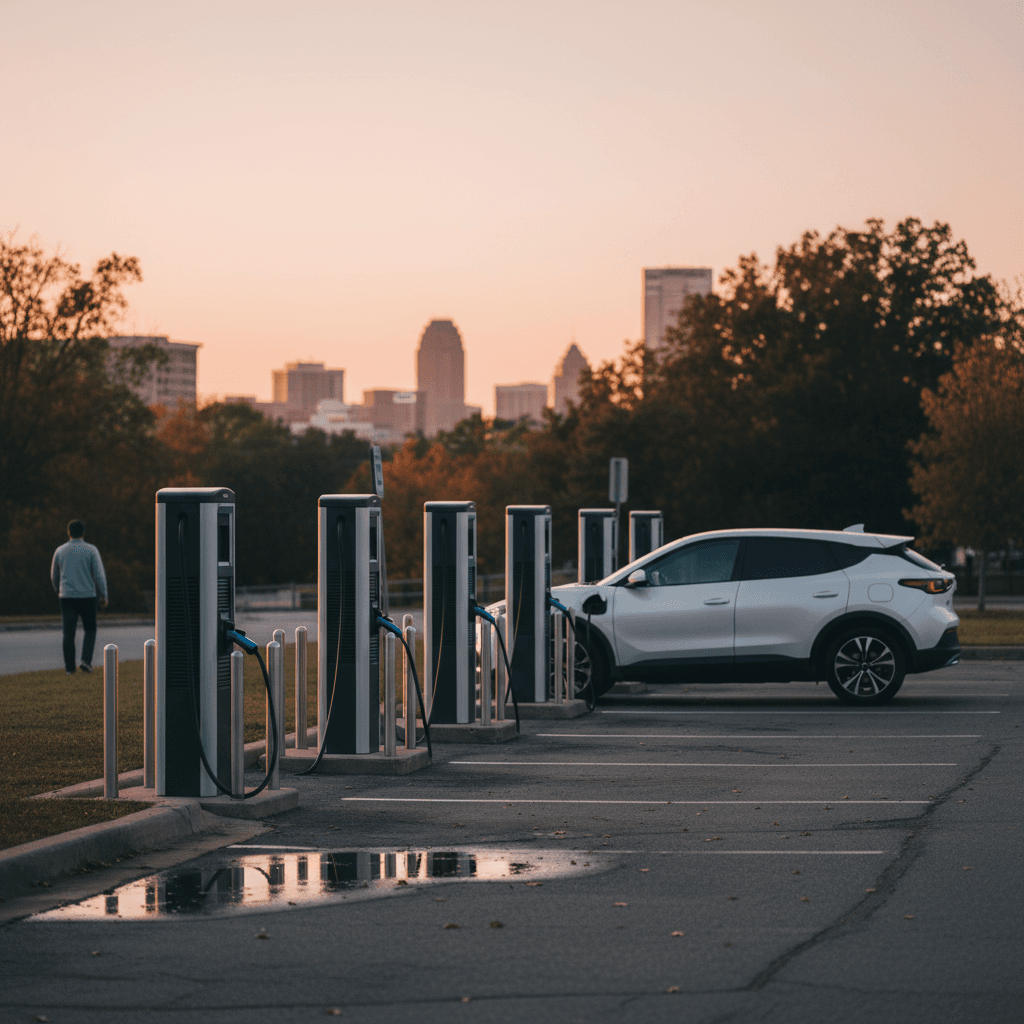
Driving an electric car in Atlanta in 2026 is a strangely modern, Southern experience. On one hand, you’ve got fast chargers tucked along I‑75 and I‑20, sleek stations popping up in Midtown decks, and entire suburbs like Brookhaven winning awards for their EV infrastructure. On the other, there are still pockets of the city where “EV charging stations Atlanta” might as well be a wish, not a search term. This guide is here to help you live in the real Atlanta that exists between those two realities.
Atlanta is quietly catching up
Why EV charging in Atlanta feels different
Atlanta isn’t Los Angeles, and it isn’t rural Georgia either. It’s a sprawling metro with heavy commuter traffic, dense intown neighborhoods, and long stretches of interstate where you can burn range fast. That mix shapes how EV charging stations in Atlanta are being built: fewer gigantic super-hubs, more chargers where you already park, grocery stores, mixed‑use garages, workplaces, and transit‑adjacent lots.
Most Atlanta EV drivers still do the bulk of their charging at home on Level 2, but public charging availability has improved quickly. New DC fast chargers are coming online along key corridors, and hundreds of free Level 2 ports are planned for underserved areas across the 20‑county region. If you learn where those clusters are, and which apps to trust, you can largely retire your range anxiety inside the Perimeter.
Atlanta EV charging at a glance (2024–2026)
How many EV charging stations are in and around Atlanta?
Depending on which database you check today, Georgia shows roughly 2,300 public charging stations, up from about 1,600 in mid‑2023. Metro Atlanta (Fulton, DeKalb, Cobb, Gwinnett, and neighbors) captures a heavy share of those sites, with hundreds of Level 2 ports and dozens of DC fast‑charging sites clustered in the urban core and along the interstates.
At the same time, Atlanta is still surrounded by classic "charging deserts", areas, especially south and west of the city, where you’ll go many miles between plugs. That gap is exactly what regional planners and federal NEVI funds are trying to close, but for now it means you need to be deliberate about your route whenever you’re leaving the metro with 20% state of charge and big ambitions.
Don’t rely on old charger counts
Where Atlanta EV chargers are clustered (by neighborhood)
Charging demand in Atlanta isn’t politely spread across every ZIP code. It follows money, density, and dwell time, where people park for an hour or more. That means lots of plugs in office districts and shopping corridors, and fewer options where housing is cheaper and transit is weaker.
Hotspots for EV charging stations in Atlanta
Where you’re most likely to find a plug without trying too hard
Midtown & Downtown
High‑rise offices, hotels, and event venues mean strong demand for daytime and evening charging.
- Garage Level 2 chargers near Peachtree, Civic Center, and Arts Center.
- DC fast chargers at or near major parking structures.
- Reliable option if you commute or attend events downtown.
Buckhead & Perimeter
Shopping and business districts like Lenox, Phipps, and Perimeter Mall attract networks such as ChargePoint and Electrify America.
- Level 2 in garage decks and hotel lots.
- Fast charging near major retail and office parks.
- Good for topping up while you shop or grab dinner.
Intown east & north suburbs
Places like Virginia‑Highland, Decatur, Sandy Springs, and Brookhaven are steadily adding chargers.
- Brookhaven alone has nearly 20 public stations and a pro‑EV zoning code.
- Look for chargers in city parks, civic buildings, and mixed‑use projects.
Mind the gaps south and west

Major EV charging networks in Atlanta
If you zoom in on a map of EV charging stations in Atlanta, you’ll see the same logos repeating: a mix of national networks and a few homegrown or utility‑backed players. Understanding who’s behind a station tells you a lot about price, reliability, and how to start a session.
Common EV charging networks you’ll see around Atlanta
These are the names that will dominate your map when you search for EV charging stations in Atlanta.
| Network | Typical locations | Charger types | How you pay |
|---|---|---|---|
| ChargePoint | Office parks, parking decks, campuses | Mostly Level 2, some DC fast | ChargePoint app or RFID card; sometimes free via host |
| Electrify America | Highways, big box retail along I‑75/I‑85/I‑20 | DC fast (up to 350 kW) + some Level 2 | App, card, or tap‑to‑pay credit card |
| EVgo | Urban lots, grocery stores, some intown decks | DC fast plus a few Level 2 | EVgo app, RFID, or credit card |
| Tesla Supercharger / Destination | Interstates, hotels, shopping centers | DC fast Superchargers + Level 2 destination | Tesla app; many sites now support non‑Tesla EVs |
| Georgia Power / Municipal | Public buildings, libraries, parks | Mostly Level 2 | Mix of utility apps, third‑party apps, or free time‑limited parking |
Not every network is everywhere; most drivers end up with 2–3 go‑to apps and RFID cards.
Carry at least two apps
How to find EV charging stations in Atlanta
Finding a charger in Atlanta isn’t hard anymore. Finding a working charger that fits your schedule? That takes a bit of strategy. The good news: a few apps cover almost everything you’ll need inside the Perimeter and on the interstates that slice through it.
Best tools for finding EV charging stations in Atlanta
Combine a live‑data app with your car’s built‑in navigation for the least drama
PlugShare & A Better Routeplanner
Best for planning
- Crowd‑sourced photos, uptime reports, and recent check‑ins.
- See which stations have been broken for weeks.
- ABRP can model your car, load, and weather to route efficiently through Atlanta traffic.
Network‑specific apps
Best for billing and live status
- Electrify America, EVgo, ChargePoint, and Tesla show real‑time availability.
- Start/stop sessions, see prices before you plug in.
- Useful push alerts when a session ends or a stall faults out.
Your car’s navigation
Best for simple daily use
- Most EVs now integrate live charger data.
- Route you to compatible plugs with battery preconditioning for fast charging.
- Great for last‑minute decisions in heavy Atlanta traffic.
Quick checklist before you drive to a charger
1. Filter by connector type
Make sure you’re seeing chargers that match your car, CCS, NACS (Tesla), or J1772 for Level 2. Many Atlanta stations support multiple standards, but not all.
2. Check recent check‑ins or reviews
Look for reports from the last few days. In busy parts of Atlanta, a station with no check‑ins for weeks is a red flag.
3. Confirm parking details
Downtown or Midtown decks may require paid parking or validation. Factor that into your charging cost and timing.
4. Look at power rating and stall count
A lone 50 kW charger behind a strip mall is a very different experience from an 8‑stall 150 kW site at a Pilot off I‑75.
5. Have a Plan B within a few miles
Especially on road trips, always know your backup site along I‑20, I‑75, or I‑85 in case your first choice is down or full.
What you’ll pay to charge in Atlanta
Charging costs in Atlanta swing widely depending on where, when, and how you plug in. Home Level 2 charging on Georgia Power’s residential rates is still usually the cheapest way to fuel an EV. Public DC fast charging sits on the other end of the spectrum, convenient, but priced like airport food.
Home & workplace charging
- Home Level 2 on standard residential rates often works out to the equivalent of paying well under $2 per “gallon” of gasoline, depending on your car’s efficiency.
- Georgia Power occasionally offers EV‑friendly rate plans and rebates on home chargers, which can improve the math further.
- Workplace & apartment chargers in Atlanta might be free, flat‑fee, or billed per kWh, ask your property manager or employer.
Public Level 2 & DC fast
- Public Level 2 at libraries, parks, and some garages may be free or priced roughly in line with your home rate plus a small fee.
- DC fast charging on networks like Electrify America or EVgo can be competitive with or more expensive than gasoline for inefficient EVs, but you’re paying for time, not ultimate thrift.
- Some sites layer on idle fees after a grace period, especially in busy downtown and interstate locations.
Watch idle fees and time limits
Trip-planning: EV road trips through and from Atlanta
Atlanta sits at the crossroads of the Southeast: I‑75, I‑85, and I‑20 all converge here. That’s fantastic if you’re driving an EV with a decent battery and good fast‑charging support. It’s less fantastic if you plan like it’s 2015 and assume a charger at every exit. The big truck‑stop networks are building out high‑power chargers along I‑75 and other corridors, but coverage is still patchy west and south of the city.
Key EV road‑trip corridors from Atlanta
What to expect when you leave town in any direction.
| Route | Typical charging pattern | Atlanta‑driver tip |
|---|---|---|
| I‑75 north toward Chattanooga | Strong DC fast coverage at major exits; growing truck‑stop networks. | Start the day with 80–90% in Atlanta, then use one or two high‑power stops to keep the battery in its fast‑charging sweet spot. |
| I‑85 northeast toward Greenville/Charlotte | Good mix of Electrify America, EVgo, and Tesla along the corridor. | Plan stops around meal breaks, most fast chargers are near food and retail, not isolated exits. |
| I‑75/I‑16 south toward Macon/Savannah | Coverage improving but still has gaps between clusters. | Leave Atlanta with a big buffer and always know your backup site in case a rural charger is down. |
| I‑20 west toward Birmingham | Decent coverage close to Atlanta, sparser as you head deeper into Alabama. | Top off in the metro before you cross into weaker networks; don’t pass a solid fast‑charging site at low state of charge. |
Always verify current locations and power levels in a live app before you go.
Road‑trip prep for Atlanta EV drivers
1. Start with a full or near‑full battery
Use home or cheap Level 2 in the city the night before. Public fast charging in Atlanta is best used for topping up, not starting cold from 10%.
2. Precondition before fast charging
If your EV supports it, let the navigation know you’re headed to a DC fast charger so the battery is warm and ready when you arrive.
3. Avoid leaving the metro below 60–70%
Once you’re south or west of Atlanta, gaps widen. Give yourself margin instead of white‑knuckle stretches between isolated chargers.
4. Prioritize sites with multiple stalls
A four‑ or eight‑stall site at a truck stop is much more forgiving than a lonely 50 kW charger behind an aging strip mall.
Apartment, condo, and workplace charging in Atlanta
If you own a house in Brookhaven or Decatur, life is easy: install a Level 2 charger, plug in every night, ignore gas stations forever. But a huge share of Atlantans rent or live in condos, and that’s where the charging story gets tricky. Many older buildings have limited electrical capacity or complicated ownership structures that slow down charger installs.
The good news is that several programs, including equity‑focused initiatives like EMPOWER and local utility rebates, are helping workplaces and multifamily properties add chargers for employees and residents. Newer developments in places like Brookhaven, Sandy Springs, and parts of Midtown are increasingly "EV‑ready" by code, with parking wiring that makes adding future chargers much easier.
Brookhaven as a preview
If you live in an Atlanta apartment or condo
1. Ask about existing charging, or future plans
Many properties don’t advertise chargers well. Ask your leasing or HOA office directly about EV outlets or timelines to add them.
2. Talk to your employer
Workplace charging can effectively replace home charging if you commute by car. Programs like EMPOWER help employers design and fund these installs.
3. Use public Level 2 as your "overnight"
If you’re near a deck or lot with reliable Level 2, a weekly overnight session can keep you topped up without constant fast charging.
4. Consider your charging reality before you buy
If you’re shopping for a used EV in Atlanta and lack home charging, prioritize models with strong DC fast‑charging support and networks that serve your side of town.
Incentives, rebates, and local programs
Atlanta doesn’t hand out free EVs at the airport, but there are meaningful incentives for charging infrastructure, especially if you own a home, run a business, or manage a multifamily property.
Key EV charging incentives relevant to Atlanta drivers
Most benefits flow through Georgia Power or federal programs
Home charger rebates
Georgia Power residential customers can often get rebates, recently up to around $150, for installing a qualifying Level 2 home charger or buying one through the utility’s marketplace.
Rebate amounts and eligibility change, so check Georgia Power’s site before you buy hardware.
Business & multifamily rebates
For workplaces, fleets, and multifamily properties, Georgia Power offers project‑based rebates on new Level 2 and DC fast chargers, often covering up to 50% of project costs, capped annually.
You’ll need to document installation costs, charger details, and photos, and apply within a set window.
Federal tax credits & grants
Federal incentives can offset part of commercial charging infrastructure costs, especially in census tracts targeted for clean‑energy investment. Many large public chargers around Atlanta’s highways are riding this funding wave.
For personal tax questions, talk to a tax professional, rules change frequently.
Track your receipts
Buying a used EV in Atlanta: how charging fits in
If you’re shopping for a used EV in Atlanta, the best time to think about charging is before you sign. Where you live, where you work, and how often you leave the metro should all shape which EV you choose and what you’re willing to pay.
Questions to ask yourself
- Home setup: Do you have a driveway or garage you control, or are you at the mercy of a landlord or HOA?
- Commute pattern: Are you mostly ITP with short hops, or are you racking up miles on I‑20, I‑75, and GA‑400 every week?
- Road‑trip expectations: Are Atlanta–Savannah weekends a once‑a‑year thing, or a monthly ritual?
How Recharged can help
Every used EV on Recharged comes with a Recharged Score Report that includes verified battery health and charging capability details. That matters in Atlanta, where:
- A healthier battery means fewer surprise stops between Atlanta and the coast.
- Knowing your maximum DC fast‑charge rate helps you pick good stations along I‑75 or I‑85.
- Our EV specialists can talk through your exact home, work, and travel scenario and suggest models that fit the city’s charging reality.
You can finance, trade in, or sell your current vehicle through Recharged, and have your next EV delivered anywhere in the Atlanta area.
Think in miles, not just kWh
FAQ: EV charging stations in Atlanta
Frequently asked questions about EV charging in Atlanta
Bottom line: EV charging in Atlanta
Atlanta’s EV charging scene in 2026 is a work in progress, but it’s good enough that thousands of households have quietly made the switch already. If you live near the city core or the booming northern suburbs and you can install home or workplace Level 2, owning an EV here is genuinely easy. If you’re in one of the remaining charging deserts, you’ll need to be more intentional about where you park, what you drive, and how often you leave the metro.
The upside is that the trajectory is clear: more chargers, more power, and more neighborhoods catching up. Whether you’re mapping your first EV commute, planning an Atlanta‑to‑beach road trip, or shopping a used EV with help from Recharged, understanding how EV charging stations in Atlanta really work today will save you time, money, and a lot of white‑knuckle miles on I‑285.