Electric vehicles have fewer moving parts than gas cars, and regenerative braking means you’ll use your pads and rotors less. But the EV brake fluid change schedule is still a critical part of safe ownership, and it’s one a lot of EV drivers ignore because they assume “low maintenance” means “no maintenance.”
Quick Answer
Why EVs Still Need Brake Fluid Service
Even in a modern EV with powerful regenerative braking, the friction brakes are still your last line of defense. Brake fluid is what transmits the force from your foot on the pedal to the calipers at each wheel. It’s a hydraulic system, and in nearly all EVs it uses the same type of glycol-based fluid as gas cars.
- Brake fluid is hygroscopic: it absorbs moisture from the air over time.
- More water in the fluid lowers its boiling point, increasing the risk of fade under hard braking.
- Moisture also promotes internal corrosion in brake lines, calipers, and ABS/ESC modules.
- Electronic stability and brake-by-wire systems in EVs are sensitive to contaminated or aerated fluid.
Safety Over Mileage
Typical EV Brake Fluid Change Schedule by Brand
Every manufacturer publishes its own EV brake fluid interval, but a clear pattern emerges: initial inspection at 2–3 years, then replacement every 2–4 years depending on test results and climate. Always confirm the recommendation for your specific model and year in the owner’s manual, but this summary will get you in the right ballpark.
Common EV Brake Fluid Change Schedules
Approximate factory recommendations for popular EV brands (U.S. market). Always verify against your owner’s manual.
| Brand (Typical EV Models) | First Check/Change | Ongoing Interval | Notes |
|---|---|---|---|
| Tesla (Model 3/Y/S/X) | Inspect at 2 years | Every 2–3 years or as test indicates | Service centers often test moisture content rather than blindly replacing. |
| Hyundai / Kia (Ioniq, EV6, Kona) | 2 years | Every 2 years | Often listed as "brake fluid replacement" at fixed time, regardless of mileage. |
| Nissan (Leaf, Ariya) | 2 years | Every 2–3 years | Intervals can vary slightly by model year. |
| Volkswagen / Audi (ID.4, Q4 e-tron) | 3 years | Every 2 years | European brands often specify 3 years first, then 2‑year intervals. |
| Ford (Mustang Mach‑E, F‑150 Lightning) | 3 years | Every 2–3 years | Dealer may test fluid but will recommend replacement on schedule. |
| GM (Bolt, Cadillac Lyriq) | 2–3 years | Every 2–3 years | Intervals vary; check manual or service schedule. |
Intervals are time-based; fluid may need replacing sooner in harsh climates or high‑load driving.
Check the Manual, Not the Myths
How Regenerative Braking Changes Brake Wear
Regenerative braking absolutely reduces pad and rotor wear. Many EV owners go 60,000–100,000 miles before their first pad replacement. But regen does almost nothing to slow the clock on brake fluid aging, and it can even introduce a new set of issues if you’re not careful.
What Regen Helps, and What It Doesn’t
Regenerative braking changes how often brakes are used, but not the chemistry of the fluid.
Benefits of Regenerative Braking
- Much less friction brake use in normal driving.
- Longer life for pads and rotors, sometimes 2–3× typical ICE car intervals.
- Less brake dust on wheels and in the air.
- Lower routine maintenance costs over the life of the EV.
What Regen Doesn’t Change
- Brake fluid still absorbs moisture over time.
- Corrosion can still form inside lines and calipers.
- ABS and stability control still depend on clean, bubble‑free fluid.
- Emergency stopping still relies on friction brakes doing 100% of the work.
The “Rusty Brakes” Problem
Signs Your EV May Need Brake Fluid Service Early
You shouldn’t wait for obvious problems before thinking about your EV’s brake fluid, but certain symptoms are red flags that the system may need inspection, and likely a flush, sooner than the calendar suggests.
Early Warning Signs of Brake Fluid Issues
Spongy or Soft Brake Pedal
If the pedal feels softer or travels farther than it used to before the brakes bite, that can indicate <strong>air or moisture</strong> in the lines reducing hydraulic efficiency.
Pedal Feel Changes After Long Downhill
If you live near steep grades and notice the pedal getting softer or the stopping distance increasing after prolonged braking, the fluid may be <strong>overheating due to low boiling point</strong>.
ABS or Stability Control Warning Lights
Modern EVs watch brake pressure sensors closely. Contaminated fluid can cause ABS, ESC, or brake system warning lights that require a scan tool and may ultimately call for fluid replacement.
Visible Contamination in Reservoir
With the car cool and level, look at the reservoir under the hood. If the fluid is <strong>dark, cloudy, or sludgy</strong>, it’s time for a flush, even if you’re under the official time interval.
Corrosion Around Brake Components
Rust on lines, calipers, or fittings, especially near unions, can indicate moisture intrusion. A shop should inspect the system and likely perform a flush.
Test Strips and Boiling Point Tests
EV Brake Fluid Change Costs and What You’re Paying For
Compared with tires or high‑voltage components, brake fluid service is cheap insurance. But prices, and what you actually get, can vary a lot between quick‑lube chains, independent shops, and EV‑specialist dealers.
Typical EV Brake Fluid Service Snapshot
What’s Usually Included
- Fresh DOT 3 or DOT 4 brake fluid (brand and spec vary by OEM).
- Use of a pressure or vacuum bleeder to remove old fluid and air.
- Bleeding at all four corners until clean fluid flows.
- Basic inspection of lines, hoses, calipers, and pads.
- Road test to confirm pedal feel and ABS operation.
Questions to Ask the Shop
- “Are you following the factory bleeding procedure for my specific EV?”
- “What fluid spec are you using, does it match my manual?”
- “Will you provide test results (moisture/boiling point) if you have them?”
- “Is this a true flush, or just topping off the reservoir?”
A cheap “brake service” coupon that only tops off fluid is not a proper interval service.
DIY vs. Dealer EV Brake Fluid Changes
On older, purely mechanical brake systems, a competent DIYer with a pressure bleeder could safely flush fluid at home. With modern EVs, the calculus changes. Electronic parking brakes, brake‑by‑wire systems, and sophisticated stability control all mean you need to be more careful about how the system is bled and reset.
EV Brake Fluid Change: DIY or Professional?
Deciding whether to handle it yourself or leave it to an EV‑savvy shop.
When DIY Can Make Sense
- You’re experienced with brake work and own a quality pressure bleeder.
- Your EV uses a relatively conventional hydraulic system (check service manual).
- You have access to factory repair information for the correct bleeding procedure.
- You understand how to safely lift and support an EV.
When to Use a Pro
- Your EV has integrated brake‑by‑wire (common in newer models).
- An electronic parking brake or ABS pump needs to be cycled via scan tool.
- You lack experience with braking systems or can’t confirm the proper procedure.
- You want a stamped service record for warranty or resale value.
Warranty and Safety First
Brake Fluid Checklist for Used EV Buyers
When you’re shopping used, you don’t control how the last owner treated the car. But you can absolutely control how much of that risk you take on. Alongside battery health and tire condition, brake fluid history is a smart thing to evaluate before you buy.
Used EV Brake Fluid & System Checklist
1. Review the Service History
Ask for invoices or a digital service record. Look for <strong>brake fluid changes every 2–3 years</strong>. A missing record isn’t a dealbreaker, but it should factor into your negotiation.
2. Confirm Current Interval Status
Compare the last recorded fluid change (or vehicle build date) to today. If it’s been more than 3 years with no record, budget for a flush immediately after purchase.
3. Inspect Pedal Feel and Braking Behavior
On your test drive, do a few firm, straight‑line stops from moderate speed. The pedal should feel consistent, with no pulling, vibration, or softening on repeated stops.
4. Look at the Reservoir and Hardware
Pop the hood and visually inspect the brake fluid reservoir and visible lines. Cloudy, dark fluid or heavy corrosion is a sign the system has been neglected.
5. Ask for a Pre‑Purchase Inspection
A trusted shop, or a specialist marketplace like <strong>Recharged</strong>, can put the EV on a lift, measure pad thickness, check for leaks, and test brake fluid condition as part of a pre‑purchase inspection.
6. Factor Maintenance into the Price
If the brake system clearly needs work (fluid, pads, rotors, or caliper service), use that as leverage to <strong>negotiate the selling price</strong> or request the work be done before delivery.
How Recharged Handles Brake Health
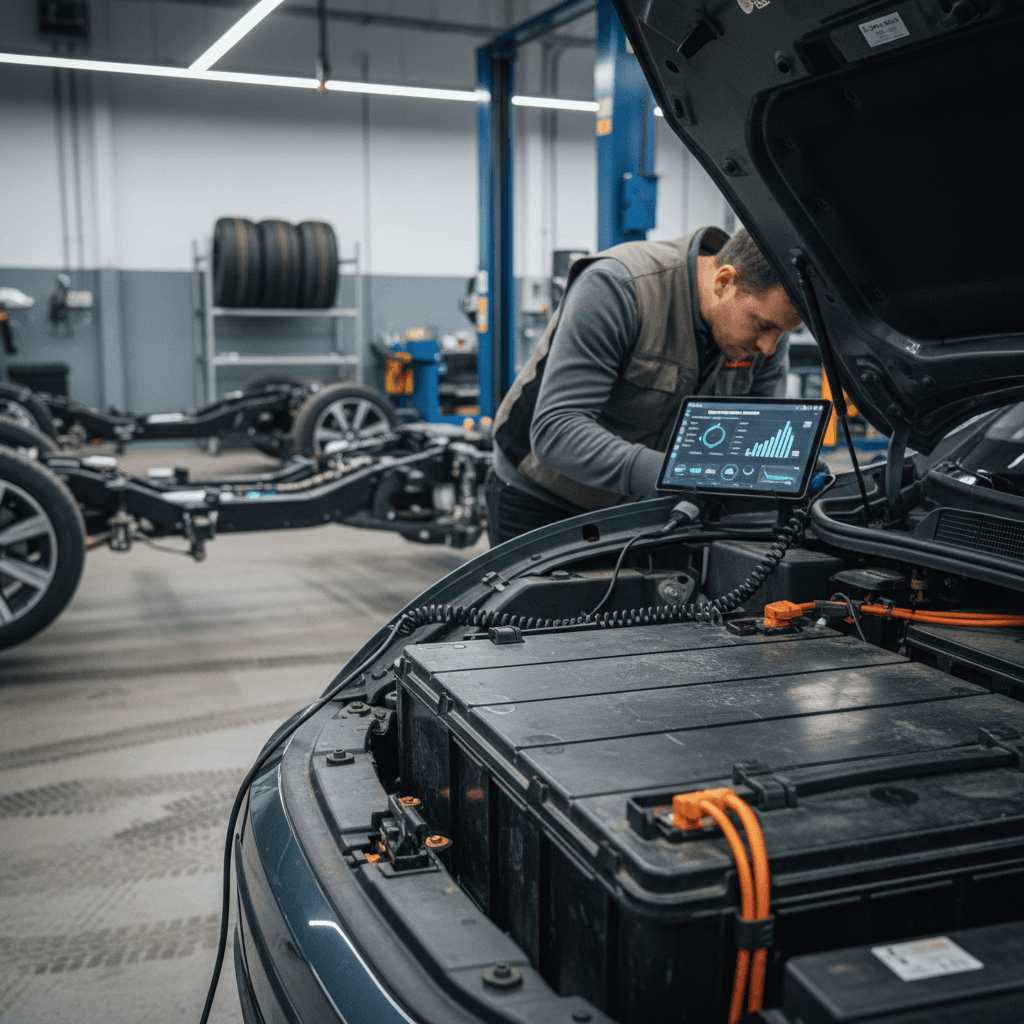
EV Brake Fluid Change Schedule FAQ
Common Questions About EV Brake Fluid Changes
Key Takeaways and EV Ownership Strategy
EVs earn their reputation for low maintenance honestly, but that doesn’t mean you can forget about the basics. A sensible EV brake fluid change schedule, usually every 2–3 years, costs relatively little and protects some of the most safety‑critical hardware on the car. Regenerative braking buys you time on pads and rotors, not on fluid chemistry.
If you already own an EV, check your owner’s manual and service history, then put a reminder on your calendar for the next brake fluid interval. If you’re shopping used, fold brake maintenance into your evaluation right alongside battery health and tires. With Recharged’s battery‑forward inspections and Recharged Score Report, plus a close look at brake service records, you can approach used EV ownership with eyes wide open, and both safety and long‑term costs under control.