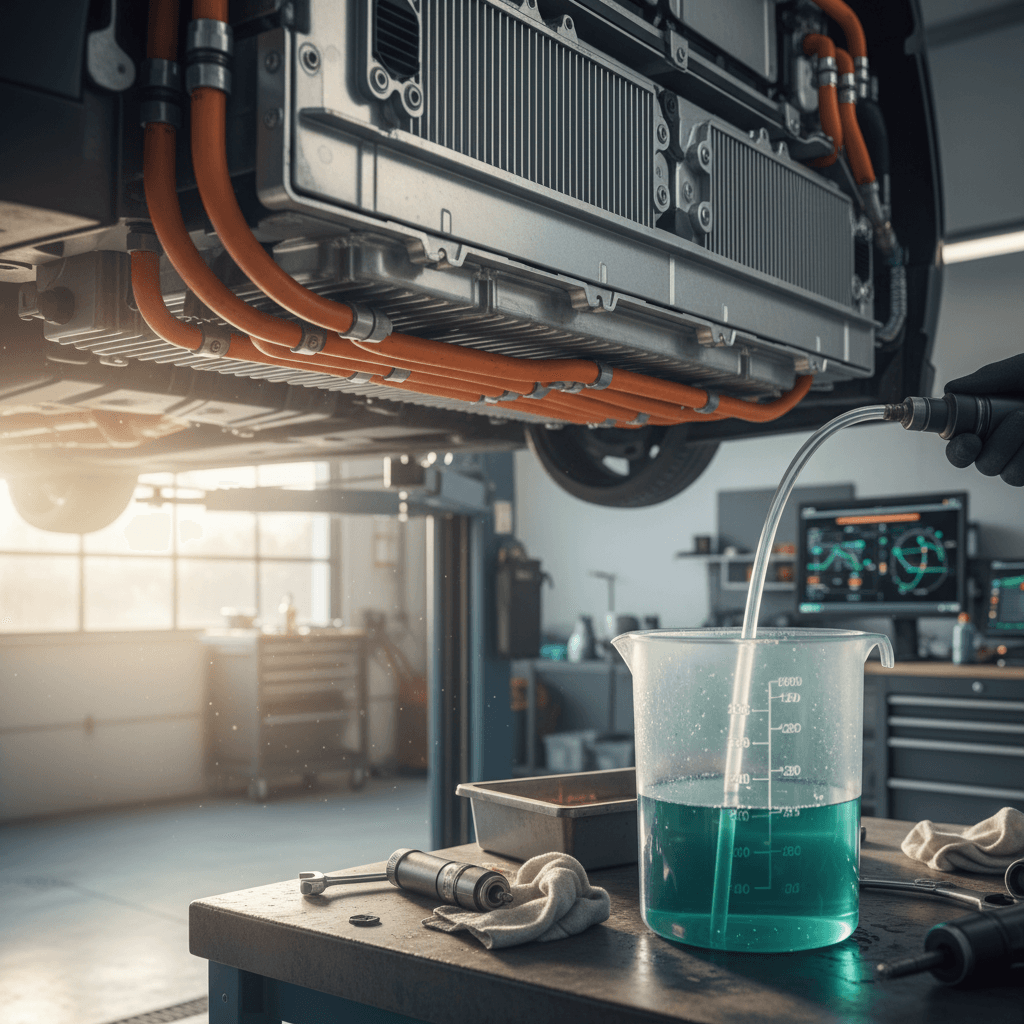
Somewhere between the battery pack and the climate-control vents, your EV is quietly running a chemistry experiment. At the center of it is EV battery coolant, a clear, unglamorous fluid that has more to do with range, longevity, and safety than all the drive modes put together. Understand it, and you understand a big part of what makes modern electric cars possible.
Quick definition
EV battery coolant basics
Think of your EV’s battery as a long-distance runner: it performs best in a narrow temperature window. EV battery coolant is the hydration and ice bath rolled into one. It absorbs heat from the battery and other components, moves it to a radiator or chiller, and sometimes brings heat back in cold weather so the pack isn’t sluggish.
Why EV battery coolant matters
Three jobs, one invisible fluid
Performance
Battery cells are happiest around room temperature. Coolant keeps output consistent so your EV can deliver full power without overheating, or throttling back.
Safety
High temperatures and hotspots are the enemy. Good thermal management reduces the risk of thermal runaway and protects critical electronics.
Longevity & value
Keeping cell temperatures even and controlled slows degradation, which means better range today and a healthier pack when it’s time to sell.
EV battery coolant by the numbers
Owner insight
How EV battery coolant works
Under the floorpan, your EV’s thermal management system looks like a small plumbing project attached to a science lab. A pump circulates coolant through channels or plates that sit against the battery modules, inverter, on-board charger, and sometimes the motor. That heat is then dumped to the outside world via a radiator or a dedicated chiller tied into the A/C loop.
1. Liquid cooling (most common)
Most current EVs, think Tesla Model 3/Y, Chevy Bolt, Hyundai Ioniq 5, use a water–glycol coolant that flows through plates or serpentine tubes next to the cells. It’s efficient, compact, and allows precise temperature control across the pack.
- Excellent heat transfer
- Works for heating and cooling
- Can share loops with cabin A/C or power electronics
2. Emerging approaches
To push fast charging and durability, some future systems layer in:
- Refrigerant cooling: Running A/C refrigerant directly in the pack for higher cooling capacity.
- Immersion cooling: Submerging cells in a dielectric fluid for ultra-uniform temperatures.
- Hybrid systems: Liquid coolant plus phase-change materials or nanofluids to shave a few extra degrees.
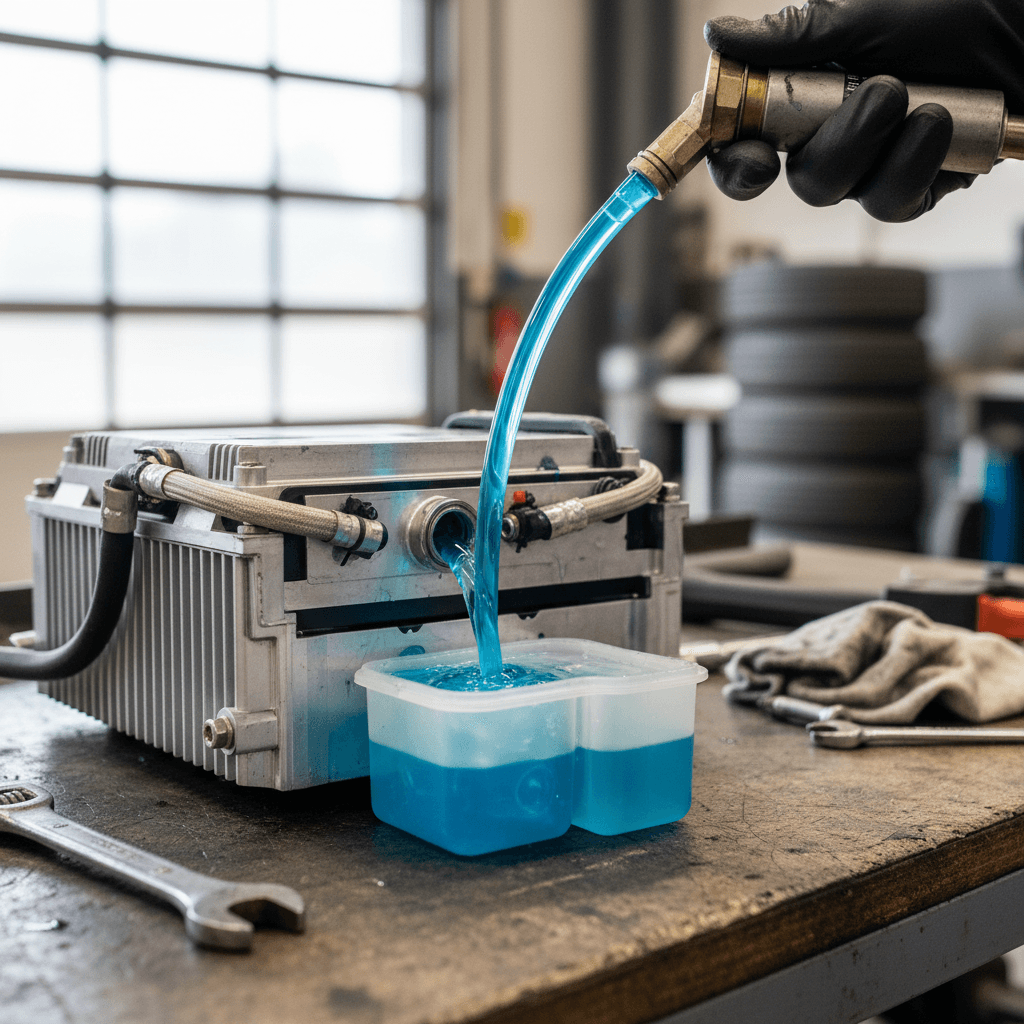
The weak link: leaks
Types of EV battery coolant
Pop the hood on a modern EV and you’ll usually find coolant reservoirs full of clear, green, pink, or orange liquid. Broadly, EVs use glycol-based coolants (like familiar engine antifreeze) tailored for battery use, plus a few exotic variants in research and high-end applications.
Common EV battery coolant types
What’s running through your EV’s veins? Here’s a high-level look.
| Coolant type | Typical chemistry | Where it’s used | Pros | Cons |
|---|---|---|---|---|
| Water–glycol mix | Ethylene or propylene glycol + water + additives | Most mainstream EVs and plug‑in hybrids | Good heat transfer, freeze protection, well-understood | Toxic if ingested, can corrode if wrong formula is used |
| Waterless glycol | High‑boiling glycol with no water | Specialized or aftermarket systems | Very high boiling point, less corrosion risk | More expensive, not widely OEM‑approved |
| Dielectric immersion fluids | Non‑conductive synthetic oils | Prototype and niche high‑performance packs | Direct contact with cells, superb temperature uniformity | Complex design, specialized service and recycling |
| Refrigerant (A/C loop) | R‑series refrigerants | Some packs use it directly or via chiller | Extremely strong cooling and fast response | Higher system complexity, challenging to service at home |
Always follow your owner’s manual, using the wrong coolant can damage seals, corrode components, or void warranties.
Don’t mix coolants
Coolant service intervals and costs
Here’s the first surprise: compared with oil changes, EV coolant service is slow jazz. Many systems are sealed and designed to go years between changes. But that doesn’t mean you can forget about them entirely.
- Most manufacturers suggest coolant inspections every 1–2 years during regular service visits.
- Coolant replacement intervals typically fall between 80,000 and 150,000 miles or around 5–10 years, depending on brand and system design.
- Some brands advertise “lifetime” coolant, while others specify time-based intervals even if you drive very little.
- Even when coolant doesn’t wear out quickly, leaks, contamination, or pH changes can shorten component life if ignored.
Typical EV battery coolant service guidance
Always confirm the exact schedule in your owner’s manual.
| Brand example | First inspection | Coolant change guidance | Notes |
|---|---|---|---|
| Mainstream EV brands | 30k–50k miles | 100k–150k miles or ~5–10 years | Inspection often bundled with general EV service |
| Some luxury brands | Annual check | ~124k miles or time‑based | More aggressive testing, especially for high‑power models |
| “Lifetime” coolant claims | Regular visual checks | Change only if tests show issues | Experts still recommend periodic lab testing on older vehicles |
| Tesla & similar | Routine service visits | Often time‑based (e.g., every few years) | Details vary by model and year; always check the current guidance |
Intervals vary widely by manufacturer, model year, and climate, treat this as a ballpark orientation, not a substitute for the maintenance schedule.
What it costs
Warning signs of EV battery coolant issues
An EV can’t sweat, so it complains in other ways. The tricky part is that battery coolant problems often start silently and only become obvious when they’re advanced. Here are the cues worth learning.
Common signs something’s wrong
If you notice any of these, don’t ignore them
1. Overheating or derated power
Warning lights, “reduced power” messages, or rapid loss of fast‑charging speed can be signs the system is struggling to control heat.
2. Visible leaks or low reservoir
Puddles under the car, damp staining on undertrays, or a coolant tank drifting toward the MIN mark are all red flags.
3. Sweet, chemical smell
Glycol coolant often smells slightly sweet. Catching that in a garage or after a drive can indicate a leak, even if you don’t see fluid yet.
4. Strange noises from pumps
Gurgling or trickling sounds from the front or battery area can be normal at startup, but if they’re new, loud, or persistent, have the system checked.
Coolant inside the pack = serious
Safety, toxicity, and handling tips
Battery coolant isn’t radioactive, but it demands respect. Most EVs rely on ethylene or propylene glycol blends, similar to engine antifreeze, which are toxic if swallowed and irritating to skin and eyes. Overheated coolant in a battery fire can decompose into nasty vapors. The good news: with basic precautions, routine ownership is straightforward.
- Avoid skin contact. Wear gloves and eye protection if you ever handle coolant.
- Never taste or siphon coolant, ethylene glycol is highly toxic and can be fatal if ingested.
- Keep pets away from spills; the sweet smell can attract them.
- Clean small drips with absorbent pads and dispose of them as hazardous waste, not in household trash.
- Use only the exact coolant spec listed in the manual, wrong chemistry can attack seals, gaskets, or coatings.
- Don’t open the cooling system when the vehicle is hot or charging; it may be under pressure.
- Leave bleeding and vacuum-filling the system to qualified EV technicians, air pockets in a battery loop are not a DIY experiment.
Good news for everyday owners
What battery coolant means when buying a used EV
When you’re shopping used, you can’t see electrons, but you can absolutely audit how they’ve been cooled. A clean bill of health on the battery cooling system is one of those under-the-radar details that separates a smart buy from a future headache.
Questions to ask the seller
- Has the battery coolant ever been serviced? Ask for invoices showing coolant changes or leak repairs.
- Any history of coolant-related recalls or TSBs? Many manufacturers have updated parts or procedures.
- Has the car ever had flood or crash damage? That’s when seals, plates, and connectors can be compromised.
How Recharged helps
Every EV sold through Recharged includes a Recharged Score Report with verified battery health and inspection data. Our specialists review thermal management faults, coolant system alerts, and recall status, so you’re not buying a car that’s quietly cooking its battery.
If you’re trading in or selling, a clean coolant system and documented service history can support a stronger valuation.
Red flags during a pre-purchase inspection
Owner checklist: Taking care of your EV coolant
Simple habits to protect a very expensive battery
1. Learn where your reservoirs are
Find the battery coolant tank(s) under the hood and note the MIN/MAX marks. Check only when the car is cold and parked on level ground.
2. Do a quick visual inspection a few times a year
Look for cracking hoses, damp fittings, or white/green residue. These are often early signs of leaks.
3. Pay attention to new smells or noises
A persistent sweet smell in the garage or new gurgling sounds during charging are cues to schedule an inspection, not background ambience.
4. Stick to scheduled service
If your manual says test or replace coolant at a certain mileage or year, treat it as non‑negotiable. It’s small money to protect a big component.
5. Use specialists for cooling work
If a shop is used to oil changes but not isolation checks and high‑voltage safety, they’re not the right place for battery coolant service.
6. Keep records
Save invoices for coolant checks or replacements. They help future buyers, and appraisal tools like the Recharged Score, understand how the pack’s been treated.
EV battery coolant FAQ
Frequently asked questions about EV battery coolant
The bottom line on EV battery coolant
Battery coolant is the part of your EV you’ll almost never see, and the one part you absolutely want doing its job perfectly. When the chemistry and plumbing are right, your pack stays cool, your fast‑charging works as advertised, and your range fades gently instead of plunging. When things go wrong, the warning signs are subtle at first and expensive later.
Treat the cooling system with the respect you’d give an engine in a performance car: check levels now and then, listen for new noises, follow the maintenance schedule, and use professionals who understand high‑voltage systems. And if you’re stepping into the used‑EV world, lean on tools like the Recharged Score Report, financing options, and EV‑specialist support to find a car whose coolant, and battery, have led uneventful, well‑managed lives.