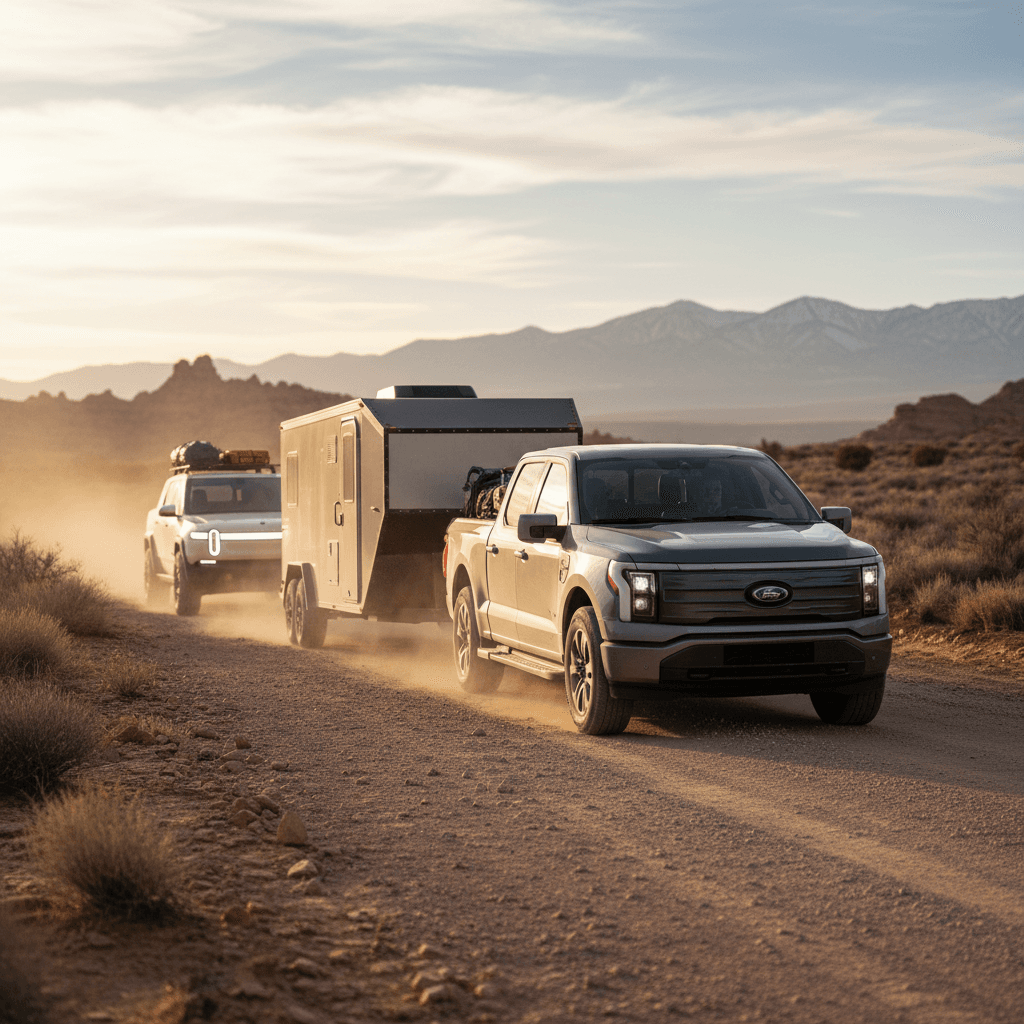
If you’re shopping for an electric pickup, you’ve probably noticed something missing from the glossy marketing: honest **real‑world electric truck towing range**. On paper, today’s EV trucks look like towing beasts. Hook up a real trailer at real highway speeds, though, and the numbers change fast. This guide walks through what actually happens to range when you tow, how different models behave, and how to decide if an electric truck fits the way you haul.
EPA range vs. towing reality
Why real‑world electric truck towing range matters
With a gas truck, you’re used to range dropping when you tow. You shrug, stop for fuel more often, and move on. With an EV truck, that same drop feels more dramatic for three reasons: there are fewer fast chargers than gas stations, recharging takes longer than refueling, and you often can’t use your preferred charger if it’s behind tight parking or short cables. That’s why understanding **real‑world towing range** is key before you commit to an electric pickup.
- Trip planning becomes non‑negotiable on long hauls
- Charge stops are dictated by trailer‑friendly stations, not just state lines
- Payload, tongue weight, and passengers all eat into effective range
- Buying the wrong configuration (battery, wheels, tires) can cut usable towing range in half
Don’t just divide EPA range by two
How much range do you actually lose when towing?
Typical real‑world towing range loss for EV trucks
Those headline numbers sound scary if you’re used to 300–400 miles between fill‑ups. The flip side is that electric drivetrains are incredibly **stable and controllable under load**. Instant torque, regenerative braking, and sophisticated stability controls make towing feel calmer and more precise than in many gas trucks, as long as you plan around the shorter legs.
Real‑world towing results by electric truck
Let’s look at how leading electric pickups perform when you bolt on a real trailer. These aren’t perfect apples‑to‑apples tests, but they give you a concrete feel for what “half range while towing” actually looks like brand by brand.
Real‑world electric truck towing range snapshots
Approximate results from independent tests and manufacturer guidance. Actual range will vary widely with speed, trailer, weather, terrain, and truck configuration.
| Truck & setup (approx.) | EPA or claimed empty range | Trailer & conditions | Observed or expected towing range | % of empty range |
|---|---|---|---|---|
| Rivian R1T Quad Motor, Large pack, 20" AT tires | ~314–328 mi highway in ideal spec; real highway test around 220–280 mi depending on tires | ~6,100‑lb, tandem‑axle camping trailer at ~70 mph | ~110 mi between charges | ~35–50% depending on which empty baseline you compare |
| Chevy Silverado EV WT (Work Truck), big battery | EPA ~450–490+ mi; some highway tests exceeding 480–500 mi empty | Manufacturer guidance towing 5,000‑lb trailer at highway speeds | ~50% range drop expected (~225–250 mi) | ~50% |
| Ford F‑150 Lightning Extended Range | EPA 300–320 mi depending on trim and wheels | Manufacturer and owner reports towing large travel trailers or car haulers at mixed 60–70 mph speeds | Commonly 120–170 mi per charge | ~40–55% |
| GMC Hummer EV pickup | EPA ~329 mi; real highway tests often below that due to weight and tires | Heavy enclosed trailer or large toy hauler at highway speeds | Frequently under 150 mi | Often ~40–50% |
| Smaller, aerodynamic utility trailer on any full‑size EV truck | Varies by truck | ~2,000‑3,000‑lb, low‑roof, narrow trailer at 60 mph | Often 60–70% of empty range | ~60–70% |
Use these as directional guides, not promises. When in doubt, **plan conservatively** and build in a buffer.
Think in percentage, not miles
Key factors that crush or extend towing range
Six biggest levers on real‑world towing range
You can’t control all of them, but understanding each one helps you plan smarter.
1. Trailer shape & size
2. Trailer weight & payload
3. Speed
4. Terrain & elevation
5. Weather & temperature
6. Truck setup & tires
Easy way to estimate your towing range
Planning trips around real‑world towing range
Towing with an EV isn’t impossible, in many ways it’s a nicer experience, but it’s less forgiving of winging it. The solution is to reframe how you think about trip planning.
Step‑by‑step: planning an EV towing trip
1. Start with a realistic range estimate
Use your **empty highway range** as the baseline, then apply a 40–60% factor depending on your trailer. If your Lightning reliably does 260 miles at 70 mph empty and you’re pulling a tall camper, assume 110–140 miles per leg, not 260.
2. Map chargers that work with a trailer
Look for **pull‑through or back‑in spots with room to maneuver**. Apps like A Better Routeplanner and PlugShare reviews can help, and many newer Superchargers and DC stations are adding trailer‑friendly stalls, but plenty still aren’t.
3. Aim to arrive with a buffer
Instead of running the pack near 0%, plan to arrive at each charger with **15–20% remaining**. Towing magnifies small headwinds, detours, or elevation changes, and your buffer is your safety margin.
4. Charge in the fast zone
On road trips, you usually don’t need to charge to 100%. Most EV trucks charge fastest between **10–60% or 10–80%**. Multiple shorter sessions in that window can be quicker than fewer very long ones.
5. Plan food and rest around charging
Think of charging stops as **forced breaks**, for you and your passengers. Time your meals and bathroom breaks with your fastest charging window so the wait feels like less of a chore.
6. Do a shakedown run before the big trip
If you’re new to EV towing, take a **shorter practice trip** with your full setup. Note your energy use at your typical speed, in both directions, so your big trip plan is built on real numbers from your truck, trailer, and driving style.
Trailer access can matter more than kW
Daily use vs heavy towing: which electric truck fits you?
Occasional towers: EV trucks are in their element
If you tow a boat to the lake a few times a year or haul a small utility trailer around town, a modern electric pickup is often **easier and cheaper to live with** than a gas truck.
- Silent, smooth power and instant torque for merging and ramp pulls.
- Strong regen braking and stability controls that keep the trailer settled.
- Plenty of range for most weekend trips without leaning on DC fast charging at all.
For this group, the main decision is picking the right truck and battery size, not whether EV towing is viable at all.
Serious RVers and heavy haulers: it depends
If your life revolves around **long‑distance towing**, a big fifth‑wheel, multi‑state horse shows, or heavy equipment, you’re in the current edge case for EV trucks.
- Expect frequent charging, often every 100–150 miles with large campers.
- Routes will be dictated by charger locations and trailer access.
- You’ll want the largest battery, the most efficient wheel/tire package, and the best DC fast‑charging capability you can get.
For some of these use cases, a plug‑in hybrid or a two‑truck strategy (electric daily, gas HD tow rig) still makes more sense today.
Where electric trucks shine today
Used electric trucks and towing: what to watch for
If you’re looking at a used F‑150 Lightning, Rivian R1T, or Silverado EV, the towing story gets another layer: history. How the previous owner used and charged that truck can matter just as much as the spec sheet.
Checklist for evaluating a used EV truck for towing
Beyond the usual used‑truck inspection, you’re trying to understand battery health, charging behavior, and how hard a life the truck has lived.
Battery health & fast‑charge history
Suspension, brakes & hitch hardware
Real efficiency numbers
Transparent history & documentation
How Recharged can help with used EV trucks
Frequently asked questions about electric truck towing range
EV truck towing range: common questions
Bottom line: is an electric truck right for your towing?
In the **real world**, electric truck towing range isn’t magic, and it isn’t a mystery. Big trailers at highway speeds will usually cut you down to roughly half your normal highway range. The question is whether that reality fits how you actually tow: how far, how often, and with what kind of trailer.
If you’re mostly commuting and running errands with occasional weekend towing, a well‑chosen EV truck can be a huge upgrade over gas, quiet, quick, and cheap to run, with more than enough range. If your life is built around long‑distance RV travel or heavy commercial towing, you’ll need to think harder, choose your configuration carefully, and plan around the current charging network.
Either way, going in with **clear expectations about real‑world towing range** will make you far happier with whatever you buy. And if you’re considering a used electric truck, Recharged can help you decode battery health, match the right truck to your towing needs, and deliver it to your driveway ready for its next chapter of work.