If you’re eyeing a sleek Hyundai IONIQ 6 or already have one in the driveway, its depreciation rate directly affects what you’ll get back when you sell or trade it. The good news: compared with some early EVs, the IONIQ 6 is shaping up as a relatively solid value play, but the details matter a lot by trim, mileage, and when you buy.
Why depreciation matters
Hyundai IONIQ 6 depreciation at a glance
Snapshot of Hyundai IONIQ 6 depreciation
Different sources model depreciation slightly differently, but they broadly agree on the pattern: the Hyundai IONIQ 6 takes its biggest hit in the first 2–3 years, then the curve flattens out. That’s similar to other midsize EVs, but more favorable than some early‑generation electric sedans that lost value far more quickly.
How fast does the Hyundai IONIQ 6 depreciate?
To understand the Hyundai IONIQ 6 depreciation rate, it helps to zoom in on the first five years, when most of the value loss happens.
Illustrative 5‑year Hyundai IONIQ 6 depreciation curve
Approximate model of how a mid‑trim Hyundai IONIQ 6 might depreciate, assuming mid‑$40Ks MSRP and average mileage. Numbers are rounded for simplicity and will vary by configuration and market conditions.
| Vehicle age | Estimated value | Value retained vs. MSRP | Approx. depreciation that year |
|---|---|---|---|
| Year 1 | $31,000 | ~70% | ‑$14,000 from new |
| Year 2 | $27,000 | ~60% | ‑$4,000 |
| Year 3 | $24,000 | ~53% | ‑$3,000 |
| Year 4 | $21,500 | ~48% | ‑$2,500 |
| Year 5 | $19,000–$21,000 | ~40–45% | ‑$2,000–$2,500 |
This table is for directional understanding, not a guaranteed resale quote.
Read this table the right way
Third‑party data underscores that pattern. One major valuation site’s five‑year projection for an IONIQ 6 shows residual values in the low‑$20Ks after five years for a car that started in the mid‑$40Ks, in line with roughly a 55–60% drop in value over that period. Another cost‑to‑own model pegs total five‑year depreciation in the mid‑teens (in thousands of dollars) for a 2023 IONIQ 6, which matches what we’d expect given its MSRP and segment.
Key factors that shape IONIQ 6 depreciation
What actually moves IONIQ 6 resale prices
Beyond age and miles, these are the levers that matter most.
Battery health & warranty
Charging ecosystem & incentives
Interest rates & EV demand
Private owners vs. fleets
EVs coming out of fleets or rentals often have higher mileage and less‑documented charging histories, and they tend to sell at a discount. A one‑owner IONIQ 6 with clean records, lower mileage, and careful home‑charging habits will typically hold its value better.
Market timing
Macro conditions matter. In late 2025, for example, U.S. EV sales dipped after federal purchase credits expired and several brands cut new‑EV pricing. When that happens, used values can slip as buyers cross‑shop discounted new models. Those swings don’t last forever, but they do show up in short‑term depreciation.
How Recharged helps you read the market
IONIQ 6 vs other EVs and gas sedans
Depreciation only makes sense in context. The IONIQ 6 competes with midsize EVs like the Tesla Model 3 and Hyundai’s own IONIQ 5, as well as traditional midsize gas sedans.
How the IONIQ 6 stacks up on 5‑year depreciation (high‑level view)
Approximate 5‑year value retention for comparable models, assuming typical mileage and mainstream trims. These are directional comparisons, not appraisal values.
| Model | Type | Estimated 5‑yr value retained | Notes |
|---|---|---|---|
| Hyundai IONIQ 6 | Electric sedan | ~40–45% | Similar or slightly better than average for non‑luxury EVs; segment still evolving. |
| Hyundai IONIQ 5 | Electric crossover | ~45–50% | Boxier body style and crossover demand can support resale slightly better than a sedan. |
| Tesla Model 3 | Electric sedan | ~45–50% | Historically strong, but aggressive new‑car price cuts can drag used values down. |
| Honda Accord / Toyota Camry | Gas sedan | ~45–55% | Mature, high‑volume segment; depreciation is relatively predictable. |
| Early‑gen EV sedans (Leaf, Bolt) | Older EVs | ~25–35% | Small batteries and less range typically mean steeper depreciation over 5 years. |
Ranges represent common outcomes in a balanced market, not best‑ or worst‑case scenarios.
Where the IONIQ 6 shines
How trim, battery, and options affect resale value
Not every IONIQ 6 depreciates the same way. Trim level, battery size, and key options can nudge your depreciation rate up or down.
Depreciation by configuration: what usually holds value best
Think about your future buyer when you spec, or shop for, a car.
Battery size & range
Trim level & features
RWD vs AWD
Factory options that tend to pay you back
New vs used IONIQ 6: where depreciation helps you
Buying a new IONIQ 6
When you buy new, you’re paying for the entire depreciation curve ahead of you. On an IONIQ 6 with a sticker in the high‑$30Ks to low‑$50Ks, that can mean losing $14,000 or more in the first year or two once incentives, rebates, and real‑world transaction prices are factored in.
New can still make sense if you need a specific build, want every mile of warranty coverage, or qualify for attractive financing. But from a pure depreciation standpoint, new buyers are accepting the largest hit.
Buying a used IONIQ 6
Pick up a 1–3‑year‑old IONIQ 6 and you’re letting the first owner absorb the steepest drop. At that point, you’re often paying roughly 60–70% of the original MSRP for a car that still has years of battery and drivetrain warranty coverage left.
That’s the sweet spot Recharged focuses on: late‑model EVs with verified battery health, transparent pricing, and nationwide delivery, so you can shop depreciation‑friendly IONIQ 6 listings without being limited to your local lot.
How Recharged leans into depreciation for you
How battery health really affects IONIQ 6 resale
For EVs, perceived battery health can move resale prices more than almost any other single factor. Two otherwise identical IONIQ 6 sedans, same year, same trim, can fetch very different numbers depending on how their packs have aged.
- State of health (SoH): A healthy pack that still delivers close to its original usable capacity reassures buyers; noticeable degradation pushes prices down.
- Charging history: A car that spent most of its life on Level 2 home charging usually inspires more confidence than one that fast‑charged daily on DC stations.
- Climate exposure: EVs that lived their lives in very hot regions and sat outside frequently may show more degradation than garage‑kept cars in milder climates.
- Warranty remaining: Hyundai’s battery warranty (typically 8 years/100,000 miles in the U.S. for EV batteries) is a strong floor for value. Being within that window can lift resale and reduce buyer anxiety.
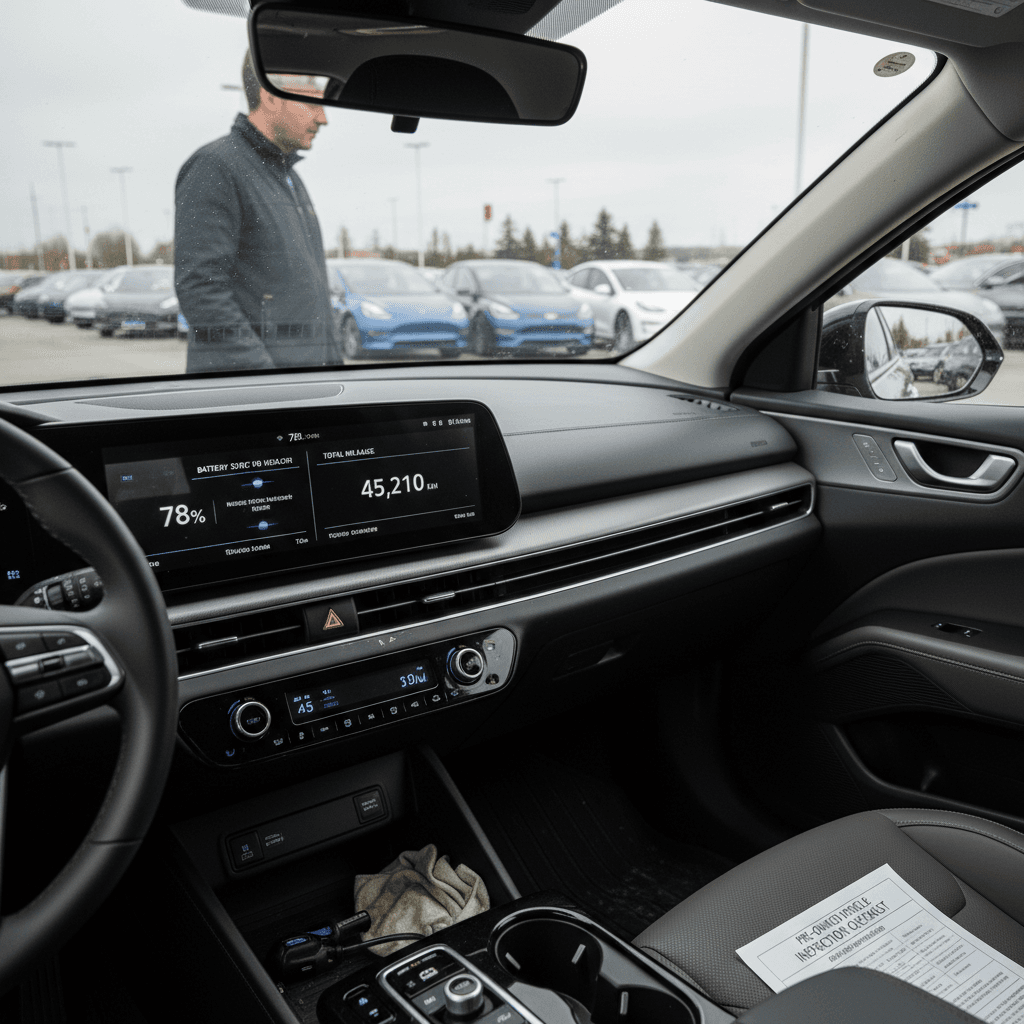
Don’t guess on battery health
Practical tips to minimize your IONIQ 6 depreciation
7 smart moves to protect your IONIQ 6’s value
1. Buy at the right point on the curve
If you’re value‑focused, consider a 1–3‑year‑old Hyundai IONIQ 6. You skip the steepest early drop but still get modern tech, strong range, and warranty coverage. This is exactly the slice of the market Recharged curates.
2. Keep mileage in line with averages
Depreciation models assume roughly 12,000–15,000 miles per year. If you consistently drive far above that, you’ll slide below guidebook values faster; keeping mileage closer to average protects resale.
3. Be gentle with fast charging
Use DC fast charging when you need it, but lean on Level 2 at home or work for day‑to‑day driving. That helps maintain long‑term battery health, which in turn supports a higher resale price.
4. Follow software and service updates
EVs get better through over‑the‑air updates and occasional service campaigns. Keeping your IONIQ 6 up‑to‑date, with records to prove it, reassures future buyers and appraisers.
5. Document everything
Keep a folder (digital is fine) with charge‑history screenshots, service invoices, tire rotations, and any warranty work. Comprehensive records are a simple way to stand out when it’s time to sell or trade.
6. Avoid heavy customization
Wraps, extreme wheel/tire setups, and aftermarket suspension changes may narrow your buyer pool. If you plan to resell, stick close to stock or keep any mods reversible.
7. Sell through channels that understand EVs
Traditional auction lanes and some local dealers still undervalue EVs because they don’t know how to read battery data. Platforms like Recharged that specialize in used EVs are better equipped to price your IONIQ 6 accurately and transparently.
Turn depreciation into leverage
Ready to find your next EV?
Browse VehiclesHyundai IONIQ 6 depreciation FAQ
Frequently asked questions about IONIQ 6 depreciation
Bottom line: should you worry about IONIQ 6 depreciation?
Like any new EV, the Hyundai IONIQ 6 does depreciate faster in the early years than a well‑known gas sedan, and market swings around incentives, interest rates, and new‑EV pricing can amplify those moves. But zoom out, and its 5‑year depreciation story looks surprisingly normal for a stylish midsize sedan with strong safety scores and competitive range.
If you’re buying new, go in with clear eyes about the first 2–3 years of value loss and focus on the configuration you’ll be happy to keep. If you’re buying used, depreciation is your friend: a 1–3‑year‑old IONIQ 6 with verified battery health can deliver a lot of car for the money, with a much gentler depreciation curve ahead of you.
Either way, using real battery‑health data and transparent market pricing, like you get with every Recharged Score Report, turns depreciation from something to fear into something you can actively manage. That’s how you make a Hyundai IONIQ 6 not just fun to drive, but financially smart to own.