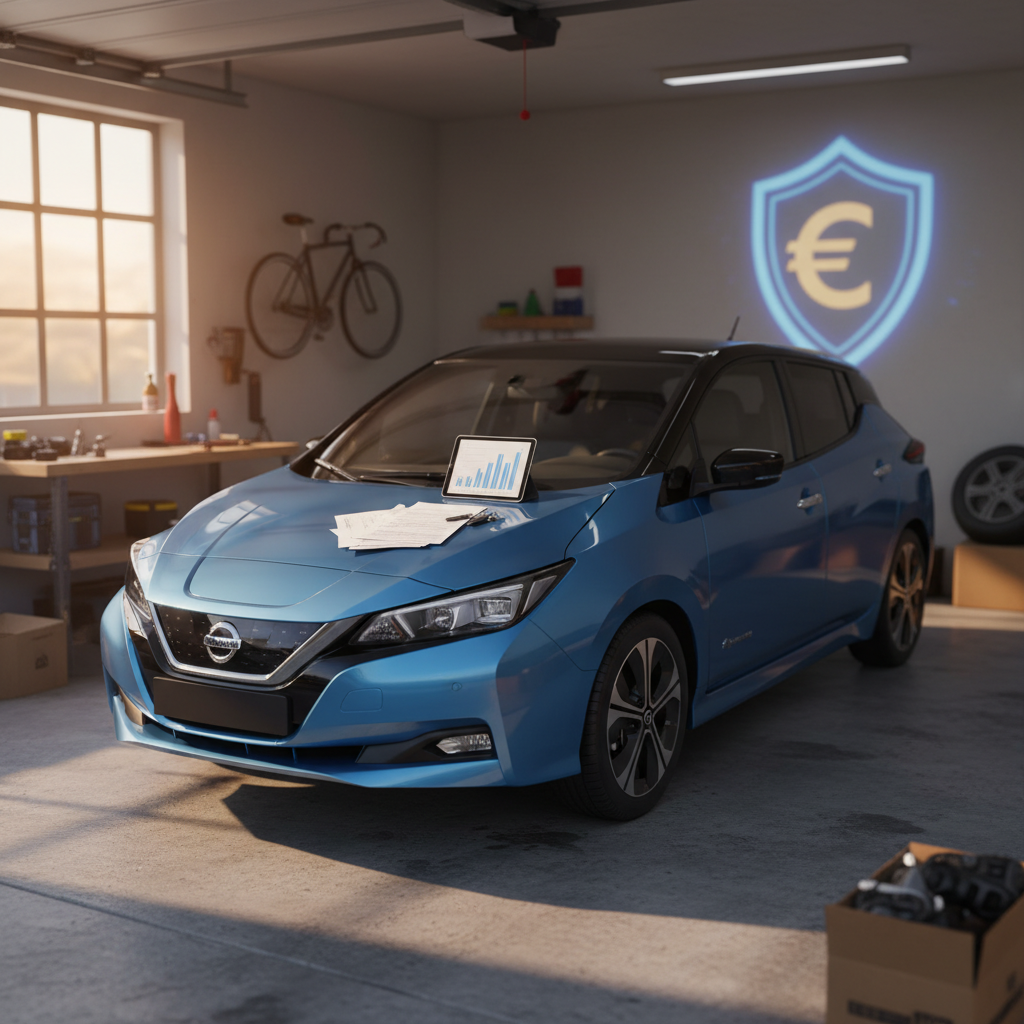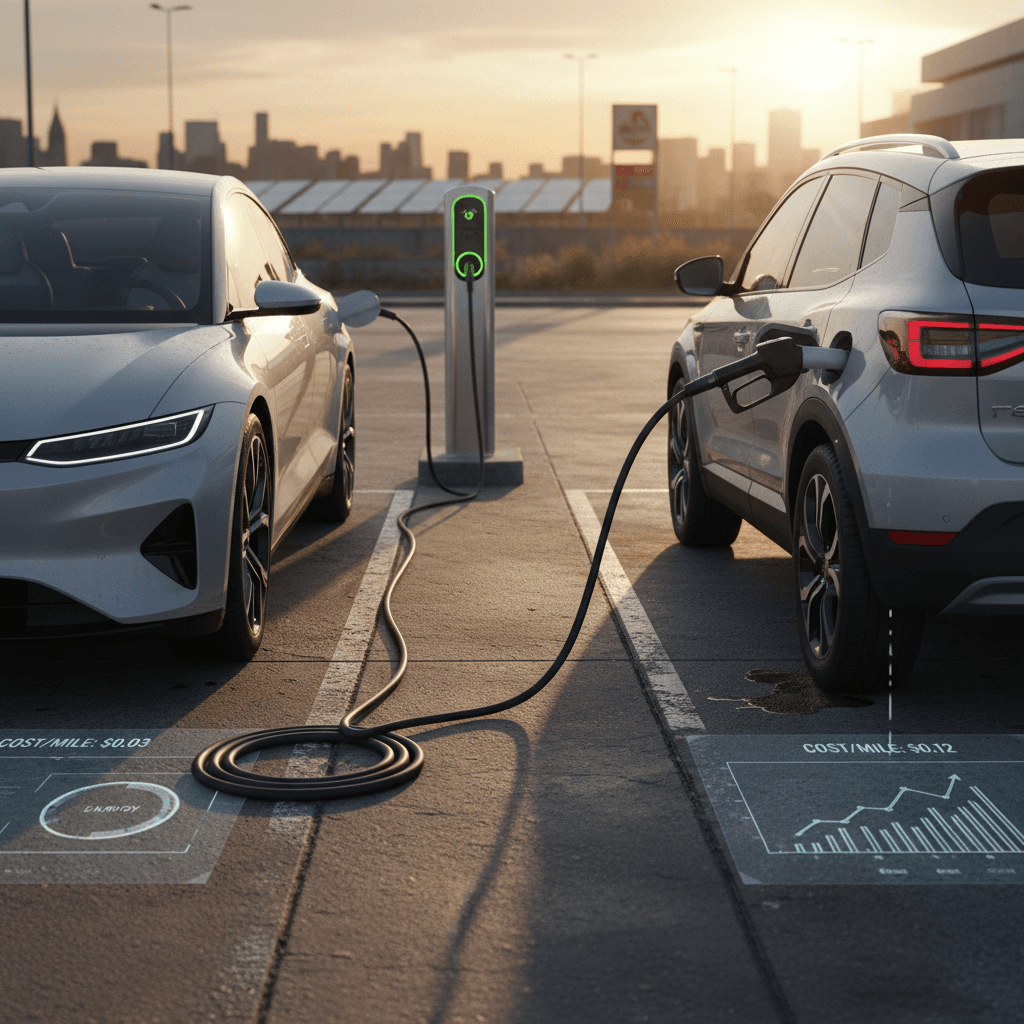
You hear it all the time: electric cars are “more efficient” than petrol cars. But what does that actually mean for you in 2025, on your energy bill, at the pump, and over years of ownership? When you compare electric car vs petrol car efficiency, you’re really looking at three things: how well they turn energy into motion, how much each mile costs, and how much pollution they produce along the way.
What this guide covers
How efficient are electric cars vs petrol cars?
EV vs petrol efficiency at a glance
At the most basic level, a petrol car turns the chemical energy in gasoline into motion through an internal combustion engine. An electric car uses electricity stored in a battery to spin an electric motor. The motor is inherently more efficient than an engine, and it can also recover energy when you slow down through regenerative braking.
Quick rule of thumb
Energy efficiency explained: from fuel to wheels
To really compare electric vs petrol efficiency, you want to look at how much of the original energy actually reaches the wheels. Engineers call this “tank‑to‑wheel” or “battery‑to‑wheel” efficiency.
Petrol car energy flow
- You start with 100% of the energy in the fuel.
- 68–72% is lost inside the engine as heat.
- Another few percent disappears in the transmission and drivetrain.
- By the time power reaches the wheels, only about 16–25% of the fuel’s energy actually moves the car.
Every time you hit the brakes, you also throw away energy as heat.
Electric car energy flow
- You start with 100% of the electrical energy coming from the grid or charger.
- Some is lost while charging the battery (~10%).
- More is lost in the inverter, motor and drivetrain.
- Roughly 65–75% of that original energy reaches the wheels.
- When you slow down, regenerative braking recovers a chunk of energy that would be wasted in a petrol car.
The result is roughly 3× the tank‑to‑wheel efficiency of a typical petrol car.
Don’t forget electricity generation
MPG vs MPGe: making sense of the numbers
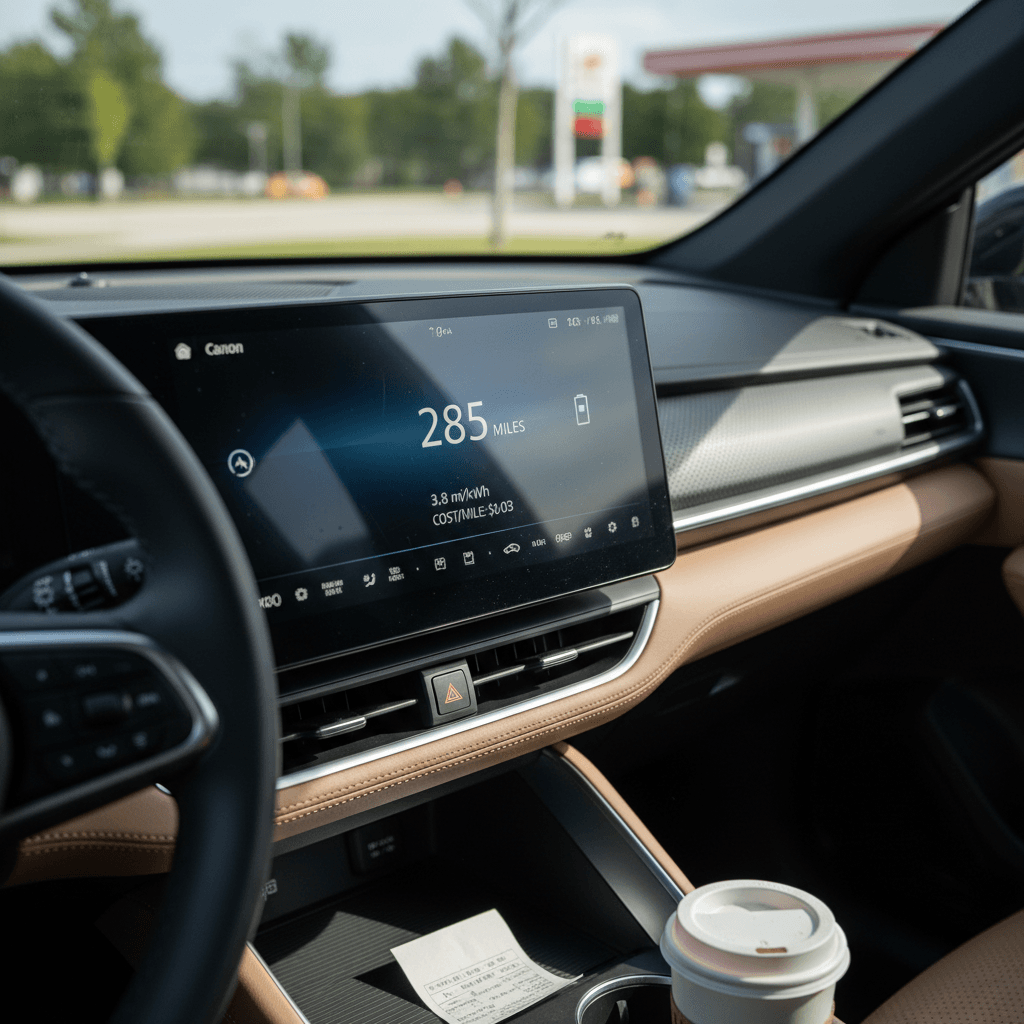
Petrol cars use miles per gallon (MPG). Electric cars use kilowatt‑hours per 100 miles or an EPA rating called MPGe (miles per gallon equivalent). MPGe converts electricity into an equivalent amount of energy as a gallon of petrol so you can compare apples to apples.
Typical 2025 efficiency figures by vehicle type
Approximate real-world efficiency for comparable petrol and electric models in the U.S.
| Category | Example petrol car | Real-world MPG | Example electric car | EPA MPGe |
|---|---|---|---|---|
| Compact sedan | Hyundai Sonata | 30 mpg | Hyundai Ioniq 6 | ~140 MPGe |
| Compact hatchback | Nissan Versa | 32 mpg | Nissan Leaf | ~120 MPGe |
| Mid-size SUV | Ford Escape | 28 mpg | Ford Mustang Mach‑E | ~100 MPGe |
| Luxury SUV | Audi Q5 (petrol) | 23 mpg | Audi Q4 e‑tron | ~95 MPGe |
| Full‑size pickup | Ford F‑150 (gas) | 20 mpg | F‑150 Lightning | ~70 MPGe |
Actual numbers vary by model and driving style, but the pattern is consistent: EVs travel more miles on the same amount of energy.
Notice how the MPGe numbers are three to five times the MPG numbers. That doesn’t mean an EV magically reduces your energy bill by five times, electricity and gasoline are priced differently, but it does tell you how much further an EV goes on the same amount of raw energy.
How to use MPGe when shopping used
Real-world cost per mile: 2025 numbers
Efficiency is exciting in theory, but what you really care about is this: how much does it cost to drive a mile? In late 2025, U.S. averages look like this for everyday drivers who go about 12,000–12,500 miles a year.
Average 2025 fuel costs: electric vs petrol
Based on common models and national price averages
Home‑charged EV
- Typical cost: about 5–6¢ per mile for many popular EVs when you mostly charge at home.
- Example: Hyundai Ioniq 6 or Nissan Leaf at around 4.8–5.3¢/mi.
- Annual energy cost around $600–$750 at ~12,200 miles.
Petrol car
- Typical cost: around 9–16¢ per mile, depending on vehicle size and efficiency.
- Example: compact sedans near 11–12¢/mi; pickups up to 16–17¢/mi.
- Annual fuel cost often $1,100–$2,000+ for the same mileage.
Public & fast charging
- Level 2 public chargers: often competitive with petrol at roughly 10–15¢/mi.
- DC fast charging: can cost similar to or more than petrol for frequent use.
- Still efficient in energy terms, just less of a money‑saver.
Average EV savings
- Across all 50 states in mid‑2025, analysis shows EV drivers save roughly 6–9¢ per mile on fuel compared with petrol, depending on local prices.
- At 12,000 miles a year, that’s $700–$1,100 in annual fuel savings.
Efficiency that shows up in your budget
Emissions and climate impact: efficiency beyond your wallet
When you burn petrol, the CO₂ comes out of the tailpipe right where you’re driving. With an EV, the emissions mostly happen at power plants, if the electricity isn’t fully renewable yet. Because EVs use energy so efficiently, they usually come out ahead on total emissions over their lifetime, even after you account for battery manufacturing.
Petrol car emissions profile
- Direct tailpipe CO₂ and pollutants for every mile you drive.
- Higher local air pollution in cities and near busy roads.
- Engines are most efficient on the highway; stop‑and‑go traffic is very wasteful.
Even the most efficient petrol cars emit CO₂ every time you drive, no matter how clean the fuel is refined.
EV emissions profile
- No exhaust pipe – zero tailpipe emissions where you drive.
- Upfront emissions from battery and vehicle manufacturing.
- Ongoing emissions depend on your electricity mix (coal vs renewables).
- Most studies show EVs break even on total emissions within the first 10–20,000 miles and end up producing about half the lifetime emissions of a similar petrol car.
As the grid adds more renewables, an EV automatically gets cleaner over time.
Why efficiency matters for emissions
Where petrol cars still compete, or win
Petrol cars are less efficient, but that doesn’t mean they’re obsolete. There are still situations where a petrol car can be simpler, cheaper upfront, or even more practical, especially if you’re not ready to change habits.
Efficiency isn’t everything: petrol strengths in context
Where petrol cars can still make sense in 2025
Refuelling speed & reach
A petrol car can be filled in minutes almost anywhere. If you often drive long distances in areas with sparse charging, refuelling convenience can offset some of the EV efficiency advantage.
Lower upfront price
New EVs still tend to cost more than comparable petrol cars, and federal tax credits are changing. If your budget is tight and you can’t shop used, a petrol car can be easier to afford even if it’s less efficient to run.
Known technology
Every mechanic can service a petrol car, and some owners simply prefer technology they already understand, even if it’s not the most energy‑efficient choice.
Where petrol’s “advantage” hides a cost
Efficiency over the vehicle lifespan: battery vs engine
A common worry is that EV batteries lose efficiency as they age, while petrol cars can simply be kept running with maintenance. Both are partly true, but the story is more nuanced if you’re looking at a used car.
Electric car over time
- Batteries typically lose range slowly, often around 1–2% per year depending on use and climate.
- Some capacity loss means slightly higher kWh per mile as the car ages, but the motor remains very efficient.
- No oil changes, fewer wear items in the drivetrain.
- With a good battery, an older EV can still be significantly more energy‑efficient than a newer petrol car.
Petrol car over time
- Engines and transmissions wear, and efficiency tends to degrade if maintenance is skipped.
- Fuel economy can drop as components age, tires are mismatched, or sensors fail.
- More moving parts mean more opportunities for efficiency‑robbing problems.
In other words, neither vehicle type stays brand‑new efficient, but EVs start much more efficient and usually stay ahead for their entire life.
How Recharged helps with used EV efficiency
Ready to find your next EV?
Browse VehiclesHow to choose: electric vs petrol based on your driving
The “right” choice isn’t the same for everyone. The key is to match the strengths of each drivetrain to how you actually live and drive, then let efficiency and cost per mile tip the scales.
City commuter
- Daily round‑trip under 60 miles.
- Access to home or workplace charging.
- Stop‑and‑go traffic where regenerative braking shines.
Here, an EV’s efficiency advantage is enormous. You use less energy, spend less per mile, and reduce local pollution where you live.
Suburban family driver
- Mix of school runs, errands, weekend trips.
- Occasional long‑distance travel.
An EV handles daily driving very efficiently, and public fast charging covers the occasional road trip. Efficiency plus lower maintenance often outweigh the higher upfront cost, especially with a quality used EV.
High‑mileage road warrior
- Regular 300+‑mile days in mixed regions.
- Limited access to reliable fast charging.
Petrol can still win on convenience here, but if you have strong charging coverage on your routes, a long‑range EV can dramatically cut your per‑mile energy costs.
Checklist: is an electric car more efficient for you?
Quick decision checklist
1. Know your annual mileage
If you drive more than about 10,000 miles a year, the efficiency and lower fuel cost of an EV have more time to pay off. High‑mileage drivers tend to benefit most from EV efficiency.
2. Check your charging options
Can you plug in at home overnight or at work during the day? Home charging unlocks the full cost‑per‑mile advantage of an EV. If you’ll rely almost entirely on DC fast charging, the efficiency benefit remains, but the cost gap narrows.
3. Look up local energy prices
Compare your kWh rate with local petrol prices. Even in states with higher electricity costs, EVs often still win on per‑mile energy cost, but it’s worth running the numbers for your zip code.
4. Think about how long you’ll keep the car
If you plan to sell in a couple of years, a cheaper petrol car might feel safer. If you’ll keep it for 5–10 years, the efficiency and lower maintenance of an EV usually make it cheaper overall, especially if you buy used and let someone else take the early depreciation.
5. Consider your environment and values
If lower emissions and quieter city streets matter to you, EV efficiency isn’t just about money. Using far less energy per mile also means less pollution over the life of the vehicle.
6. Compare real models side by side
Don’t just compare “EV vs petrol” in the abstract. Put specific models next to each other, range, MPGe, MPG, battery health, and price. A marketplace like Recharged can help you line up used EVs alongside what you’d spend to run a petrol car over the same time.
Common questions about EV vs petrol efficiency
Frequently asked questions
The bottom line on electric vs petrol efficiency
If you strip away the hype and focus on the numbers, electric cars are simply better at turning energy into miles. They waste less, they cost less to “fuel” in most of the U.S., and they cut lifetime emissions compared with petrol cars, especially as the grid gets cleaner. Petrol still offers quick refuelling and lower upfront prices in some cases, but it can’t escape the physics of a hot, inefficient engine under the hood.
That’s why more shoppers are running the math on efficiency instead of just looking at the sticker on the windshield. If you’re considering a used EV, a marketplace like Recharged can help you compare real‑world battery health, range, and ownership costs against petrol options, so you choose the car that’s not just efficient on paper, but efficient for your life and budget.