You’re not imagining it: used EV prices have been on a roller coaster, and the Volvo EX30 showed up just in time for the wild part of the ride. If you’re wondering how fast the Volvo EX30 depreciates, and whether it’s a smart buy or lease, that’s the right question to be asking before you sign anything.
Key context
Volvo EX30 depreciation at a glance
Early Volvo EX30 depreciation snapshot (US forecast)
Those ranges line up with Recharged’s own Volvo EX30 resale value forecast, plus early real‑world data from tools like Kelley Blue Book. A used 2025 EX30 Single Motor Plus with typical miles is already showing about a 23% hit after roughly a year on the road, which puts it squarely in the EV mainstream for depreciation.
Don’t over‑read 6‑month price drops
So…how fast does the Volvo EX30 actually depreciate?
Let’s anchor this to real numbers. Take a typical EX30 build, a Single Motor Extended Range Plus with an MSRP in the mid‑$40,000s including destination and a few options. Here’s how depreciation likely looks over the first five years if you drive a normal 10,000–12,000 miles per year:
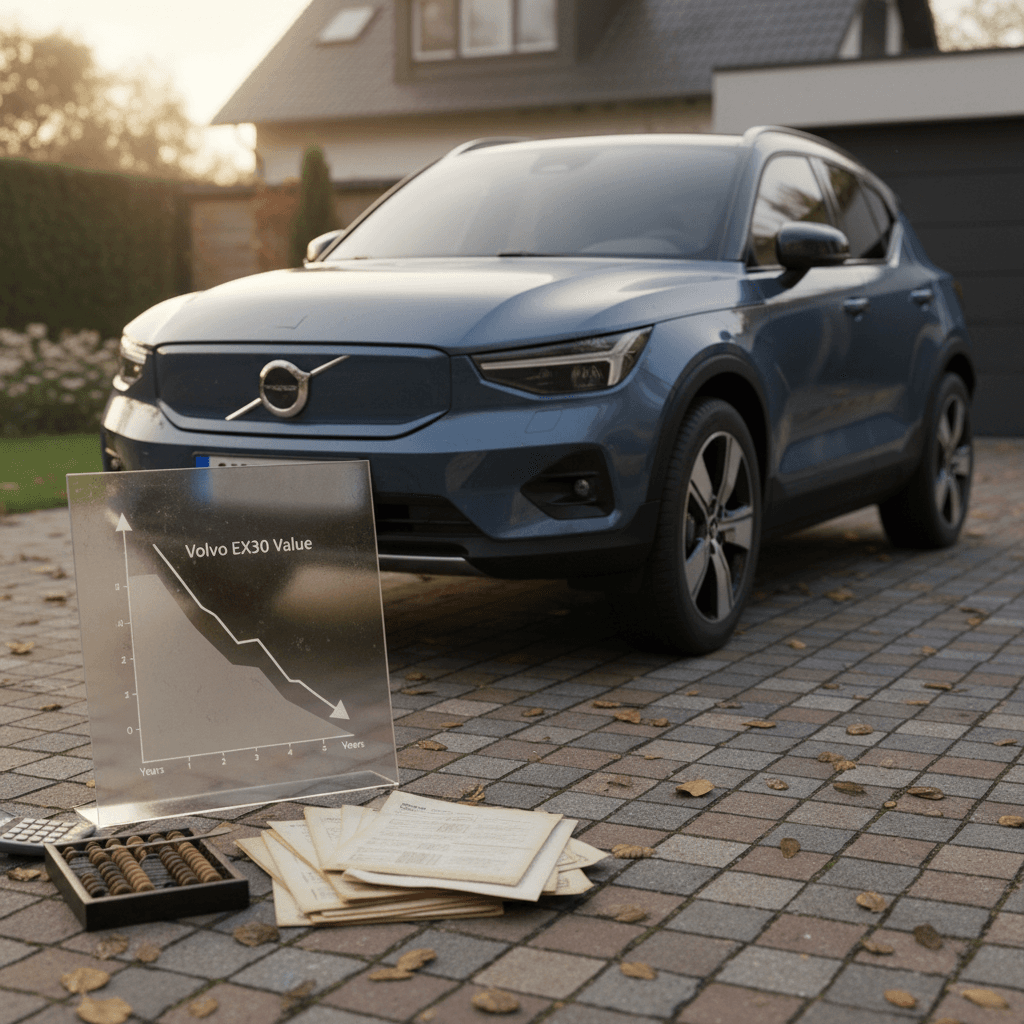
Illustrative Volvo EX30 depreciation curve (US, typical build)
These are rounded, scenario‑based examples using current forecast models and early used sales, not guarantees for any specific vehicle.
| Age | Approx. retained value | Estimated market value | What that means in dollars |
|---|---|---|---|
| 1 year | ~75–80% | $34,000–$36,000 | Around $9k–$11k of depreciation from a $45k starting point. |
| 3 years | ~40–45% | $18,000–$21,000 | Typical premium EV territory; big incentives or rapid price cuts could push lower. |
| 5 years | ~35–40% | $15,000–$18,000 | Roughly 50–55% total depreciation over five years, assuming solid battery health. |
Assumes a mid‑$40k EX30, average mileage, no major accidents, and healthy battery.
How to sanity‑check these numbers
One interesting twist: some early 2025 EX30s in the U.S. were effectively discounted via aggressive leases and dealer incentives. If your car started at a truly paid price closer to, say, $40,000 than the paper MSRP of $46,000, your true depreciation percentage may be kinder than the headline numbers suggest.
Why early EX30 depreciation looks choppy
The EX30 isn’t living in a vacuum. It landed in the U.S. market right as EV pricing, tariffs, and incentives were rewriting the rules. That’s why owners and shoppers are seeing some eye‑watering month‑to‑month swings, especially in Europe and the UK, and online chatter about “insane depreciation.”
Three big forces behind current EX30 price swings
These have more to do with policy and strategy than with the car itself.
Aggressive EV price wars
Tariffs & trade drama
Model‑cycle whiplash
About that ‘discontinued in the US’ news
How Volvo EX30 depreciation compares to other EVs
Against the wider EV market
Recent large‑sample studies of used EVs show battery‑electric vehicles losing around 55–60% of their value in the first five years, on average. That’s materially faster than the overall car market and faster than hybrids or trucks, but it’s the water every EV swims in.
With forecast models clustering around roughly 50–55% depreciation at 5 years, the EX30 looks to land near the middle of the EV pack, better than some boutique or low‑demand models, not quite in Tesla Model 3 territory for value retention.
Against direct rivals
Think of the EX30’s competitive set as small premium EV crossovers: things like the Genesis GV60, Mercedes EQA/GLA‑based EVs, and BMW iX1/iX2 where available. In that crowd, the EX30’s combination of pricing, performance, and Scandinavian design gives it a fighting chance on resale.
Early forecast models actually put the EX30 near the top of its size/price class for 5‑year retention, in part because Volvo hasn’t flooded the market with inventory the way some brands did with early EVs.
The quiet advantage: right‑sized battery

7 factors that move Volvo EX30 resale up or down
- 1. Battery health: The single biggest swing factor. A healthy pack with modest degradation can be worth thousands more than a similar EX30 that’s been fast‑charged hard and driven 20,000+ miles a year.
- 2. Trim and drivetrain: Single‑motor Extended Range trims usually pencil out best. Twin Motor Performance cars may depreciate slightly faster in percentage terms because performance buyers chase the newest, quickest toys.
- 3. Color and spec: Safe colors and popular option mixes help. Oddball specs, like a bare‑bones Core in a polarizing color, can be a tougher sell when the car is no longer new and shiny.
- 4. Mileage and use pattern: Ten thousand easy miles per year looks a lot better than 25,000 miles of ride‑share duty. EV shoppers are savvy; they’ll ask how the car was used.
- 5. Accident and repair history: Structural repairs, battery‑adjacent damage, or repeated software gremlins will drag value down more sharply than they might on an older gas Volvo XC60.
- 6. Charging experience: The EX30’s ability to use public CCS and (via adapter) Tesla’s Supercharger network matters for resale. Buyers will favor cars that play nicely with the dominant networks over the long haul.
- 7. Macro EV sentiment: Headlines about EV slowdowns or big fleet sell‑offs (think rental companies dumping EVs) spook some buyers, even when those stories have nothing to do with Volvo. Sentiment can move prices in the short term.
How Recharged bakes this into pricing
Lease or buy an EX30? What depreciation means for you
If you strip away the spreadsheet fog, depreciation is just this: who eats the value loss, and when? For a Volvo EX30, the answer looks very different depending on whether you lease or buy.
EX30 depreciation: lease vs. buy trade‑offs
Leasing: depreciation is someone else’s problem (mostly)
On a lease, the bank sets a residual value, what they think the EX30 will be worth at lease‑end. Your payment basically covers the forecast depreciation plus interest and fees. If the car tanks more than expected, it’s not your issue as long as you hand it back.
But watch out for padded money factors
Early EX30 leases in the U.S. sometimes carried shockingly high payments relative to MSRP. That’s often a sign that the lender is nervous about future value, and they’re making you pre‑pay a lot of that risk in the monthly.
Buying: more risk, more upside
If you buy and values soften, the pain is real, you own the asset. But if tariffs, limited supply or cult status make the EX30 desirable on the used market, you capture that upside when you sell or trade in.
Short‑term ownership: 2–3 years
If you think you’ll bail out of the EX30 within 36 months, a well‑structured lease can be a nice hedge against uncertain depreciation, especially in a market that’s still figuring out what the car is worth.
Long‑term ownership: 6–8+ years
If your plan is to drive the EX30 until the wheels (or the upholstery) give up, depreciation matters mostly on paper. What matters more is battery health, running costs, and whether the car still fits your life.
Used EX30 sweet spot
The value hunter’s play is often a <strong>2–4‑year‑old EX30</strong> that’s already taken the steepest part of the curve but still has strong range and warranty life. That’s exactly the slice of the market Recharged focuses on.
Financing an EX30 through Recharged
How to protect your Volvo EX30’s resale value
You can’t control tariffs or Volvo’s product strategy, but you can absolutely influence where your EX30 lands inside those broad 3‑ and 5‑year depreciation bands. A few practical moves go a long way.
7 practical ways to slow your EX30’s depreciation
1. Baby the battery
Favor home Level 2 charging, avoid baking the car at 100% charge, and use DC fast charging as a tool, not a lifestyle. A healthier battery later means higher trade‑in offers.
2. Track battery health over time
Use periodic diagnostics, like the battery health checks behind the Recharged Score, to keep an eye on degradation. A documented history is increasingly a selling point for used EVs.
3. Stay ahead on software and recalls
Keep the EX30 fully updated and address any service campaigns promptly. Buyers pay a premium for cars that feel ‘tight’ and up to date, especially when software drives so much of the experience.
4. Keep excellent records
Log every service visit, tire change and alignment. Neat records plus clean Carfax/AutoCheck reports make your car stand out in a crowded used‑EV search result page.
5. Protect the interior
The EX30’s airy, minimalist cabin is a big part of its appeal. Simple stuff, seat covers for kids, regular cleaning of sustainable materials, helps it age gracefully instead of looking tired at year four.
6. Avoid oddball mods
Aftermarket wheels, suspension drops, and dubious “performance” tweaks don’t help resale on a compact premium EV. If you must modify, keep factory parts and be ready to return the car to stock before selling.
7. Time your exit
If you plan to move on, aim to sell or trade before a big model‑cycle change, a known facelift, or just before your battery warranty nears expiration. Buyers get nervous when coverage is about to run out.
Volvo EX30 depreciation: frequently asked questions
Volvo EX30 depreciation FAQ
Should you worry about Volvo EX30 depreciation?
If you’re the kind of person who trades cars every 18 months, yes, you should absolutely care how fast the Volvo EX30 depreciates. In a choppy EV market, first‑owner depreciation on a brand‑new EX30 can feel brutal. But if you’re willing to buy thoughtfully, hold the car a bit longer, or step into a gently used example that’s already taken the worst of the hit, the EX30 starts to look like what it is: a well‑designed, right‑sized premium EV with middle‑of‑the‑pack depreciation and plenty of upside if you protect the battery and keep it clean.
That’s exactly where a marketplace like Recharged shines. Instead of guessing from a few photos and a vague Carfax, you get verified battery health, fair‑market pricing, and expert EV guidance from first click to delivery. If you love the EX30’s character but hate the idea of overpaying for depreciation, start your search with cars that have already done the expensive part of the curve, and let the numbers, not the hype, do the talking.