If you’ve heard that electric cars are “low‑maintenance,” you’re not wrong, but that doesn’t mean **no** maintenance. A smart electric car maintenance schedule keeps your battery healthy, tires wearing evenly, and braking system in top shape so you avoid big repair bills later. This complete guide walks through what to check, how often, and how EV maintenance compares to a gas car.
Key takeaway
Why electric car maintenance still matters
Battery‑electric vehicles have far fewer moving parts than a gasoline car. There’s no engine oil, spark plugs, timing belt, or exhaust system. But **skipping maintenance altogether** is still a recipe for higher costs. EVs are heavier and quicker off the line, which is hard on tires. Brake systems still need periodic care even with regenerative braking. Coolant protects high‑voltage components, and cabin air filters keep your HVAC efficient.
EV maintenance at a glance (typical 2025 data)
How EV maintenance differs from gas-car service
What EVs eliminate
- No oil changes, oil filters, or engine air filters.
- No spark plugs, ignition coils, timing belts, or fuel injectors.
- No exhaust system parts like mufflers, catalytic converters, or O2 sensors.
- Far fewer fluids overall: no transmission fluid on many single‑speed gearboxes.
What EVs still need
- Tire rotations, balancing, and alignments, often more frequently due to extra weight and torque.
- Brake inspections and fluid replacement, even with regen.
- Coolant service for the battery, power electronics, and sometimes cabin heater.
- Cabin air filter changes to keep HVAC performance and defogging strong.
- Periodic battery health checks and software updates.
Start with the owner’s manual
Electric car maintenance schedule at a glance
Typical electric car maintenance schedule
Always confirm intervals in your specific owner’s manual; the ranges below reflect common 2024–2025 EV recommendations for average U.S. driving.
| System / Item | Typical interval | Who usually does it | Notes |
|---|---|---|---|
| Tire rotation & inspection | 6,000–7,500 miles or ~6 months | Owner / tire shop | EVs often chew through tires faster, don’t stretch this. |
| Wheel alignment check | Every 12 months or after big pothole/curb strike | Tire shop | Helpful to prevent uneven tire wear on heavier EVs. |
| Brake system visual check | At each tire rotation | Owner / shop | Look for uneven pad wear, rust, leaks, and listen for noises. |
| Brake fluid test & replacement | Every 2–4 years | EV‑experienced shop | Moisture in brake fluid can corrode parts; interval varies by brand. |
| Cabin air filter | 15,000–30,000 miles or 1–2 years | Owner / shop | Shorten the interval in dusty or urban environments. |
| HVAC / HEPA filter (if equipped) | 2–3 years | Dealer / specialist | Large filters in some EVs protect occupants and electronics. |
| Battery coolant (where serviceable) | 3–5 years or 30k–60k miles | Dealer / EV specialist | Some newer packs are "lifetime fill"; others still specify intervals. |
| Wiper blades and washer fluid | Inspect every 6 months; replace ~12–24 months | Owner | Critical for safe ADAS and camera performance. |
| High‑voltage system inspection | Every 2–3 years or per OEM | Dealer / EV specialist | Checks for coolant leaks, connector condition, and software updates. |
| 12‑volt / low‑voltage battery | Test annually after year 4–5 | Shop / dealer | A weak 12‑V battery can strand an otherwise healthy EV. |
Service intervals are shown in miles and/or time, whichever comes first.
Monthly and quarterly checks you can do yourself
You don’t need to be a mechanic to keep tabs on your EV between formal services. A five‑minute walkaround and a quick look at the car’s apps can prevent most surprises.
- Check tire pressures (monthly) and before long road trips. Many EVs let you see pressures on the central screen, set them to the placard inside the driver’s door, not the sidewall number.
- Inspect tread wear (every 3 months). Look for more wear on inner or outer shoulders, which hints at an alignment issue, and make sure tread depth remains above your state’s minimum (2/32" in most states, but more is safer).
- Listen for new noises. Clunks over bumps, loud humming, or grinding while braking are early warnings that something needs attention.
- Top up washer fluid and confirm wipers clear the windshield cleanly.
- Open your EV’s app and check for any stored warnings or overdue maintenance reminders. Many brands now surface inspections and recalls directly in the app.
Don’t ignore tire wear on an EV
What to service every 12 months or 10,000–15,000 miles
Most EV owners should plan on at least an annual checkup around **10,000–15,000 miles**, even if the manufacturer’s schedule looks minimal. Think of this as a safety and wear‑and‑tear inspection rather than an engine service.
Core annual EV maintenance tasks
These are the pillars of a healthy electric car maintenance schedule.
Tire rotation & inspection
Rotate front to back (or per your pattern) to even out wear. On many EVs this happens every 6,000–7,500 miles, which works out to roughly once or twice a year for typical drivers.
Ask the shop to note tread depth on each corner so you can track trends over time.
Brake system check
Have a technician inspect pads, rotors, calipers, hoses, and parking brake operation. Even with regenerative braking, pads can seize or rust if you hardly use the friction brakes.
Many shops include a basic brake fluid moisture test in this visit.
Cabin air filter & HVAC
At least once every 1–2 years, replace the cabin air filter and have the HVAC system checked for odd odors or reduced airflow.
This protects passengers and helps defog windows quickly in bad weather.
Good news for your calendar
Maintenance every 2–5 years: fluids, coolant, and more
Stretch out the timeline and a few additional items join the list. Most are still simpler than an engine service, but they’re easy to forget if you don’t put them on a calendar.
2–5+ year electric car maintenance items
Brake fluid replacement (2–4 years)
Brake fluid absorbs moisture over time, which can corrode internal parts and reduce braking performance in hard stops. Many manufacturers now suggest a test and possible replacement every 2–4 years; if you live in a humid climate or tow frequently, stay toward the shorter end of that range.
Battery coolant service (3–5 years where applicable)
Liquid‑cooled packs and inverters rely on specialized coolant. Some new EVs label their coolant as lifetime or long‑life; others still specify a 3–5 year or 30,000–60,000‑mile interval. This is not a DIY job, use a shop that understands high‑voltage safety.
HVAC / HEPA filters (every 2–3 years)
If your EV has a dedicated HEPA or large cabin filter for “bioweapon defense” or similar modes, expect a 2–3 year replacement interval. A clogged filter makes the blower work harder and can reduce range slightly in extreme hot or cold weather.
12‑volt battery replacement (about 4–7 years)
Even though the main traction battery does the heavy lifting, your car still relies on a low‑voltage battery to boot computers and release the parking brake. Plan on testing it annually after year four and replacing it at the first sign of weakness.
Suspension & steering inspection (every 2–3 years)
The extra weight of a battery pack can stress bushings, ball joints, and tie‑rod ends. Every few years, or if you notice clunks or wandering, have a shop check these components on a lift.
High‑voltage safety is non‑negotiable
Caring for high‑mileage and used EVs
By 2025, a growing number of EVs are crossing 80,000, 100,000, or even 150,000 miles, especially in the used market. At that point, the car’s service history matters more than the original maintenance schedule. This is where **structured inspections and battery health data** really pay off.
High‑mileage EV focus areas
What to ask about when buying or owning a used electric car.
Battery health and charging history
- Check for recent state‑of‑health (SoH) estimates or diagnostics.
- Ask how often the car was fast‑charged vs. Level 2 home charging.
- Look for signs of rapid capacity loss or uneven cell temperatures in scan reports.
Tools like the Recharged Score put this data in plain English when you shop for a used EV.
Tires, suspension, and alignment
- Uneven tire wear often reveals alignment problems or worn suspension bushings.
- Pay attention to tramlining (following grooves in the road) or steering vibrations.
- Budget for fresh tires sooner on performance‑oriented EVs.
When you buy through Recharged, every vehicle includes a **Recharged Score Report** with verified battery health and a detailed condition summary. That effectively lets you “see” how the previous owner stuck to (or skipped) their maintenance schedule before you ever sign paperwork.
What electric car maintenance typically costs
Because EVs need fewer services, their cost curve looks different: more of your budget goes to tires and occasional brake work, and less to fluids and engine parts. On average, many recent analyses put EV maintenance and repairs at about **30–50% lower** than comparable gas vehicles over typical ownership, before fuel savings are even counted.
Typical routine maintenance costs: EV vs gas car
Illustrative U.S. figures for mainstream compact or midsize vehicles using typical 2024–2025 shop rates.
| Service item | Typical EV cost | Typical gas‑car cost | Notes |
|---|---|---|---|
| Oil change & filter | N/A | $60–$120 | EVs don’t need engine oil changes. |
| Basic annual inspection | $80–$180 | Often bundled with oil change | Some EVs need only inspection plus tire service. |
| Tire rotation | $30–$80 (often free with tire purchase) | $30–$80 | Identical for EVs and gas cars; may be needed slightly more often on EVs. |
| Brake fluid flush | $100–$180 | $100–$180 | Same job on both, but intervals can differ. |
| Brake pads & rotors (axle set) | $300–$700 | $300–$800 | EVs often go much longer between pad changes thanks to regeneration. |
| Cabin air / HEPA filter | $40–$200 depending on filter size | $40–$150 | Some EVs have very large filters for advanced HVAC systems. |
| Battery coolant service | $150–$400 where applicable | Engine coolant $120–$300 | Intervals and whether it’s serviceable vary widely. |
Actual costs vary by brand, region, and whether you use the dealer or an independent shop.
Where EVs quietly save you money
DIY vs dealer: who should service your EV?
What’s reasonable to do yourself
- Tires and wheels: Checking pressures, swapping to winter wheels if you have a full set, and visually inspecting tread.
- Cabin filters: On many models these are behind the glovebox and take 20–40 minutes to change with basic tools.
- Wiper blades and washer fluid: Easy jobs that cost less if you skip dealer labor rates.
- Basic inspections: Listening for noises, checking for leaks or loose plastic shields, and scanning for warning lights in the app.
When to use a pro, ideally an EV specialist
- High‑voltage or coolant work: Anything that touches battery coolant, orange cables, or inverter hardware.
- Advanced brake service: Caliper overhauls, ABS faults, or parking brake issues integrated with software.
- Software and recalls: OTA updates happen automatically, but complex module updates and recalls still go through the dealer network.
- Structured inspections on used EVs: Especially before a purchase; tools like the Recharged Score bundle this into one report when you shop with Recharged.
Common EV maintenance mistakes to avoid
- Assuming “no oil changes” means zero maintenance and skipping annual inspections entirely.
- Ignoring abnormal tire wear because the car still feels fine on the highway.
- Letting brake systems sit without ever using friction brakes; light rust can turn into stuck calipers on vehicles that are driven infrequently.
- Delaying brake‑fluid service indefinitely, moisture can still build up in EV brake systems.
- Letting a weak 12‑volt battery linger until one cold morning when the car simply won’t wake up.
- Using a non‑EV‑savvy shop for high‑voltage or coolant work, increasing the risk of improper procedures.
Don’t chase cheap if the shop doesn’t know EVs
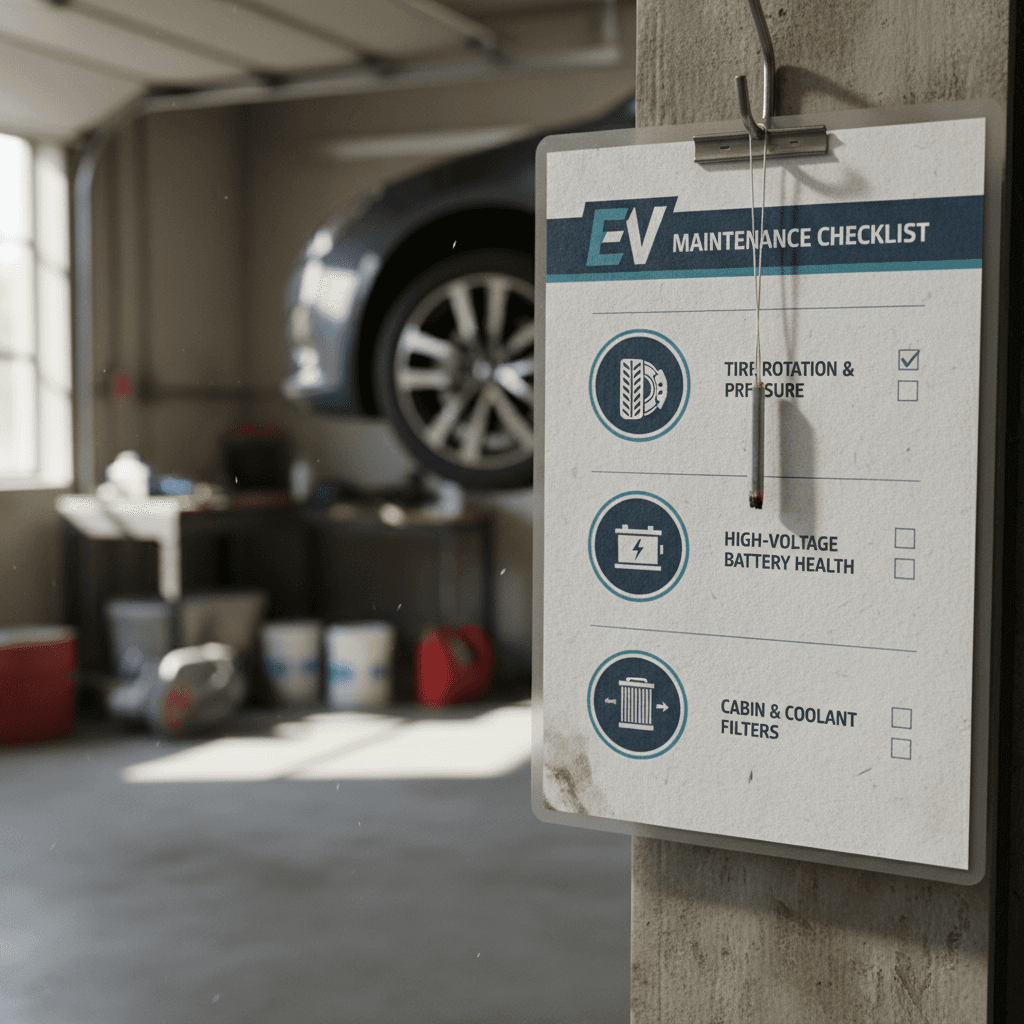
Printable electric car maintenance checklist
Your electric car maintenance schedule, simplified
Every month
Check tire pressures, windshield washer fluid, and for any new warning lights or alerts in your EV’s app. Do a quick walkaround for damage or leaks.
Every 6 months or ~6,000–7,500 miles
Rotate tires, visually inspect tread and sidewalls, and have a shop look over brakes and suspension while the car is on a lift.
Every 12 months or 10,000–15,000 miles
Schedule a general inspection that checks brakes, suspension, steering components, cooling systems, and any open software recalls or campaigns.
Every 1–2 years
Replace the cabin air filter, especially if you drive in dusty, polluted, or high‑pollen areas. Inspect wipers and replace as needed.
Every 2–4 years
Test and, if needed, replace brake fluid. Have the 12‑volt battery load‑tested, especially once it’s more than four years old.
Every 3–5 years (model‑dependent)
Verify whether your battery coolant or other long‑life fluids need service. Follow the exact timing in your owner’s manual for these items.
Before and after buying a used EV
Review battery health data, scan for trouble codes, and ask for prior service records. If you’re buying through Recharged, read the Recharged Score Report to see all of this translated into a simple letter grade.
Electric car maintenance schedule: FAQ
Frequently asked questions about EV maintenance schedules
The bottom line on EV maintenance schedules
Electric cars really do simplify ownership: no oil changes, fewer moving parts, and a maintenance schedule that looks almost boring compared with a gas car’s. But the work that remains, especially around tires, brakes, and cooling systems, still matters. Staying on top of a straightforward **electric car maintenance schedule** is how you turn low theoretical costs into real‑world savings, safety, and predictable range.
If you’re already driving an EV, use this guide alongside your owner’s manual and set calendar reminders for the major intervals. If you’re shopping for a used one, look for transparent battery health and service history instead of rolling the dice. At Recharged, every vehicle includes a Recharged Score Report, expert EV support, and flexible options like financing, trade‑in, and nationwide delivery, so you can spend less time worrying about maintenance and more time enjoying electric miles.