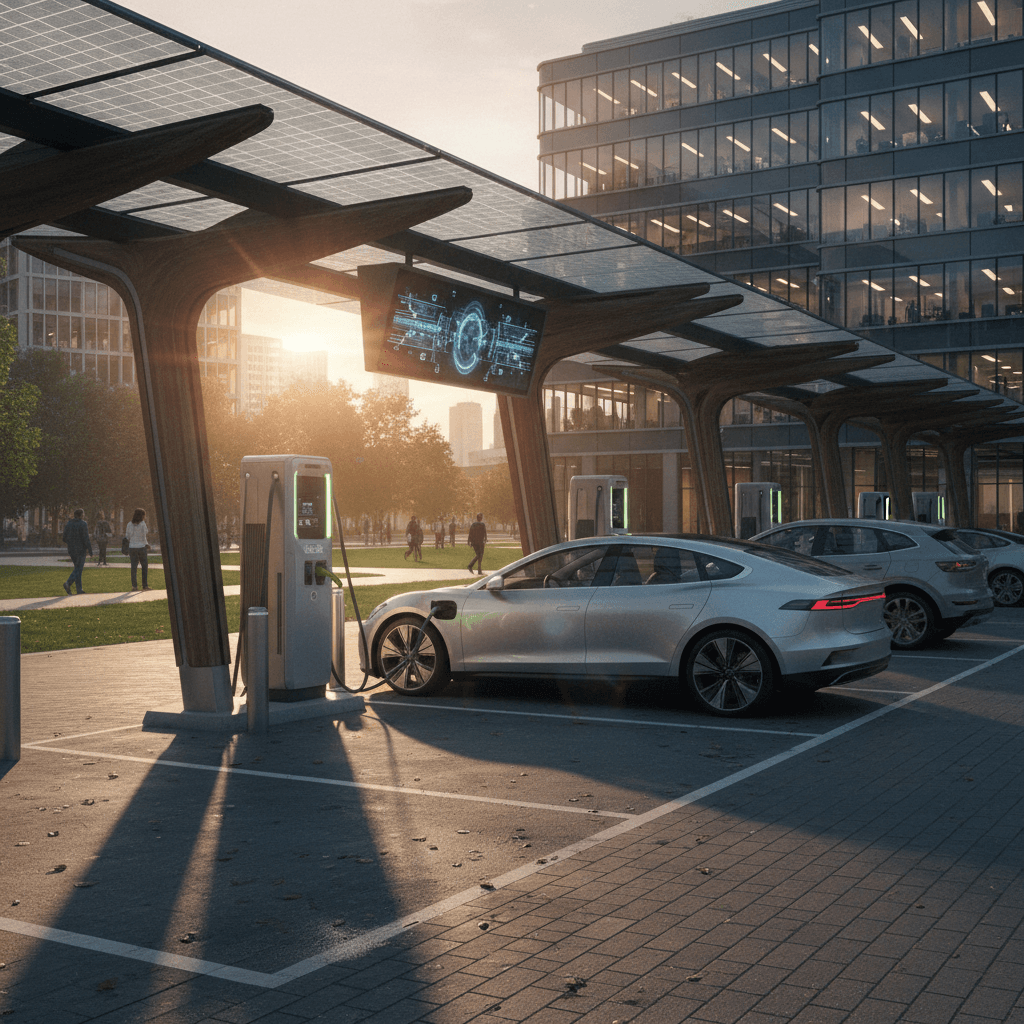
If your commute eats a big chunk of your battery every day, electric car charging at work options can make EV ownership go from “barely workable” to “effortless.” The good news: there are more ways to charge at the office than just hoping for a shiny new charging station to appear in the lot.
Workplace charging is already common, and growing
Why workplace EV charging matters
From an EV owner’s point of view, work is the perfect time to charge. Your car sits for 6–9 hours in the same spot; you don’t care if charging is fast so long as you leave with more range than you arrived with. For many drivers, especially apartment dwellers, workplace charging is the missing piece that makes daily electric driving practical.
- It turns your parking lot into a “second home charger,” without touching your electric panel at home.
- It smooths out your week, top up at work and save public DC fast charging for road trips and emergencies.
- It helps keep your battery healthier by relying more on slower AC charging instead of constant DC fast charging.
- It’s a tangible employee perk that costs your employer far less than free lunches or gym memberships.
Think like a commuter, not a road‑tripper
Your main electric car charging at work options
In the real world, workplace EV charging runs the gamut, from a lone outdoor outlet on a light pole to a full-blown bank of networked Level 2 stations. Here are the main electric car charging at work options you’re likely to encounter or propose.
Four common ways to charge at work
From “good enough” to fully managed systems
1. Level 1 charging from a wall outlet
This is the low-tech, high‑utility option. Your employer designates 120V outlets in the garage or lot and allows EV drivers to plug in with their portable charger.
- Adds roughly 3–5 miles of range per hour.
- Great for short commutes or cars that sit all day.
- Low hardware cost, but requires basic electrical review.
2. Shared Level 2 charging stations
Dedicated 240V stations (typically 6–11 kW) in priority spots, often with RFID cards or an app.
- Adds 20–40 miles of range per hour.
- Best balance for most offices with multiple EV drivers.
- Can be set to paid, free, or discounted pricing.
3. “Bring‑your‑own” Level 2 on 240V circuits
Facilities install a few 240V receptacles (like NEMA 14‑50). Drivers plug in their own portable Level 2 chargers.
- Cheaper than wall‑mounted smart stations.
- Gives flexibility if drivers change or move.
- Needs clear rules around cable management and safety.
4. Managed workplace charging program
Networked Level 2 stations with software that handles access, wait‑lists, pricing, and usage data.
- Scales as EV adoption grows.
- Lets employers recover electricity costs easily.
- Supports reporting for sustainability goals and incentives.
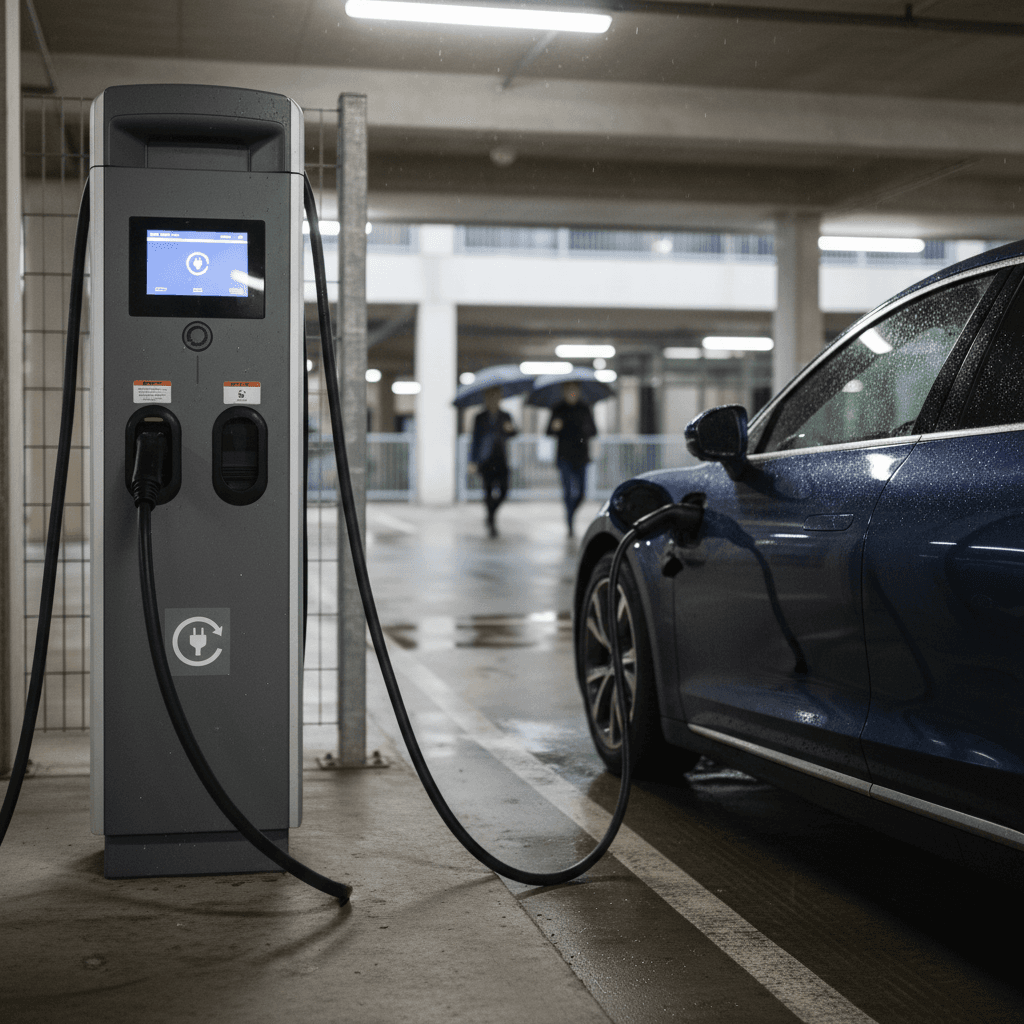
Always get explicit permission
Level 1 vs. Level 2 workplace charging
When people talk about electric car charging at work options, the real debate is usually Level 1 vs. Level 2. Both have their place. Which one works for you depends on your commute, battery size, and how many EVs share the lot.
Level 1 vs. Level 2 charging at work
How the two main workplace EV charging options compare for daily commuting.
| Feature | Level 1 (120V) | Level 2 (240V) |
|---|---|---|
| Typical power | 1.2–1.4 kW | 6–11 kW |
| Miles added per hour* | 3–5 mi/hr | 20–40 mi/hr |
| Hardware cost to employer | Very low | Moderate to high |
| Ideal use case | Short commute, car parked all day | Longer commute, more drivers per port |
| Impact on battery health | Very gentle | Still gentle vs DC fast |
| Best for | Pilots & small offices | Growing EV fleets |
Use this to gut‑check whether your commute really needs Level 2, or if simple Level 1 will do.
What those miles per hour really mean
How much range you can really add at work
Let’s turn the abstractions into real‑world commuting. Assume you park for eight hours and your car’s onboard AC charger can accept at least 7 kW (most modern EVs do).
Typical range you can add during a workday
If your round‑trip commute is under ~40 miles and you can plug into a 120V outlet at the office every day, you may barely think about public charging. If you’re doing 60–90 miles per day or sharing ports with a lot of other EV drivers, workplace Level 2 becomes the more realistic option.
Mix home, work, and public charging
Costs: who pays for workplace charging and how?
The electricity to charge your car at work is cheap; the hardware and installation are not. That’s why companies get sensitive about “free charging,” even though the numbers are usually smaller than people imagine.
What it actually costs the employer
- Electricity: Adding ~30 kWh (about 100 miles) to your car might cost the company $3–$6 at typical commercial rates.
- Hardware: A single networked Level 2 station can run $1,000–$2,500 before installation.
- Installation: Trenching, panels, and permits can easily double hardware cost, especially in older buildings.
- Software & support: Managed systems charge monthly fees but simplify access, billing, and reporting.
Common pricing models you’ll see
- Free but limited: First‑come, first‑served, sometimes with time limits to encourage turnover.
- Discounted: Drivers pay a low per‑kWh or per‑hour rate that roughly covers electricity.
- Cost‑recovery: Full electrify‑yourself pricing that matches local public Level 2 rates.
- Stipends or credits: A monthly charging credit or free hours as part of a green‑commute program.
Incentives can sweeten the deal
Workplace charging etiquette and best practices
An office charging lot can feel like grade school recess if no one sets expectations. Whether you’re using a plain outlet or a bank of smart chargers, a little etiquette keeps everyone’s blood pressure, and Slack threads, down.
Simple rules for being a good charging neighbor
Only plug in when you actually need range
Treat charging spots like you treat conference rooms, don’t reserve them “just in case.” If you can easily make it home without plugging in, leave the space for someone who can’t.
Move your car when you’re done
If your car will be full by lunch, set a reminder and move it. Many networks can send push alerts when you hit a target percentage; use them.
Label your cable and know your spot
If you bring your own Level 2 cable, put your name on it and keep it tidy. Nothing torpedoes a new program faster than tripping hazards and mystery cords.
Follow any posted rules to the letter
If facilities took the time to post policies (time limits, pricing, EV‑only hours), follow them. Those rules exist so the program doesn’t get shut down as soon as the lot gets busy.
Don’t daisy‑chain power strips or sketchy adapters
Use only approved outlets and EVSE. Home‑brew setups are a quick way to trigger a breaker, or a facilities investigation.
Communicate with other EV drivers
A simple shared chat channel or email list makes it easy to coordinate swapping spots or reporting issues without dragging the whole company into it.
Safety beats convenience every time
How to ask your employer for EV charging
No chargers at the office yet? Don’t just ask for “a charger.” Show up with a clear, modest, and numbers‑backed proposal. You’re not begging for a perk; you’re helping solve a facilities and HR problem they haven’t gotten to yet.
Make a compelling case for workplace charging
Talk in terms your employer already cares about: safety, cost, retention, and sustainability.
1. Show there’s real demand
Quietly gauge interest first.
- Ask around: how many current or near‑future EV drivers?
- Bring a short list of names and models.
- Highlight commuters without home charging (apartments, condos).
2. Tie it to sustainability goals
Most larger employers now publish ESG or sustainability reports.
- Workplace charging directly cuts Scope 3 commuting emissions.
- It supports hybrid‑work and green‑commute goals.
- Some cities give recognition or certification for green workplaces.
3. Start small and scalable
Suggest a phased approach.
- Phase 1: a few Level 1 or shared Level 2 spots for a pilot.
- Phase 2: expand to a managed Level 2 system if usage grows.
- Offer to help draft simple guidelines and collect feedback.
What to actually say in your request
Frame your email or chat message like this:
- Open with the benefit: “A few EV charging spaces could help employees with longer commutes, support our sustainability goals, and cost less than many other perks.”
- Offer options: Propose both a low‑cost Level 1 pilot and a more robust Level 2 solution.
- Mention incentives: Note that tax credits and local programs may offset installation costs.
- Volunteer to help: Offer to be the point person for gathering interest and sharing rules with other drivers.
Who to loop in
- Facilities or operations: They own electrical infrastructure and parking.
- HR or people team: They care about retention, benefits, and commute programs.
- Sustainability or ESG lead: If your company has one, they’re a natural ally.
- Security or property manager: Especially in shared buildings or leased offices.
CC’ing the right people signals this is a thoughtful facilities question, not a personal favor.
Bring examples, not ultimatums
Choosing the right work charging strategy for you
There’s no single “right” way to handle electric car charging at work options. The best setup depends on your commute, your home situation, and how much control you have over your office parking.
Pick the scenario that looks most like your life
Apartment dweller, limited home charging
Prioritize workplace Level 2 if your commute is 40+ miles round‑trip.
If your employer allows only Level 1, plug in daily and watch your state of charge early on to confirm it’s enough.
Lobby for a small number of shared Level 2 ports and offer to help manage a sign‑up system.
Suburban homeowner with home Level 2
Use home charging for most needs; treat work charging as a nice‑to‑have, not essential.
If work offers free Level 2, be considerate, don’t monopolize spots just to save a few dollars.
Rely on workplace charging more in winter or on heavy‑driving days, when range drops.
Heavy‑mileage commuter or sales driver
Push for access to at least one reliable Level 2 port at work.
Combine work charging with strategic DC fast charging on your route, rather than constantly relying on highway stations.
Monitor your battery health over time and favor AC charging (home or work) whenever possible.
Planning to buy a used EV
Before you buy, map out whether work charging plus your home situation will comfortably cover your daily miles.
Consider a used EV with a bit more range than you strictly need if you’re heavily dependent on workplace charging.
Look for a battery‑health report, like Recharged’s <strong>Recharged Score</strong>, so you know you’re not starting with a compromised pack.
Workplace EV charging FAQs
Common questions about electric car charging at work
Bottom line: make work part of your charging mix
Workplace charging doesn’t have to mean a gleaming bank of high‑tech chargers. For many drivers, a few thoughtfully managed outlets or basic Level 2 stations are enough to make daily EV life completely stress‑free. When you understand your electric car charging at work options, from Level 1 wall plugs to fully managed networks, you can choose the combination of home, work, and public charging that fits your actual commute instead of your fears.
If you’re still on the fence about going electric, workplace charging is one more lever that can tip the math in your favor, especially if you’re eyeing a used EV. At Recharged, every car comes with a Recharged Score battery‑health report and expert EV guidance, so you can buy confidently and build a charging routine that works at home, at work, and everywhere in between.