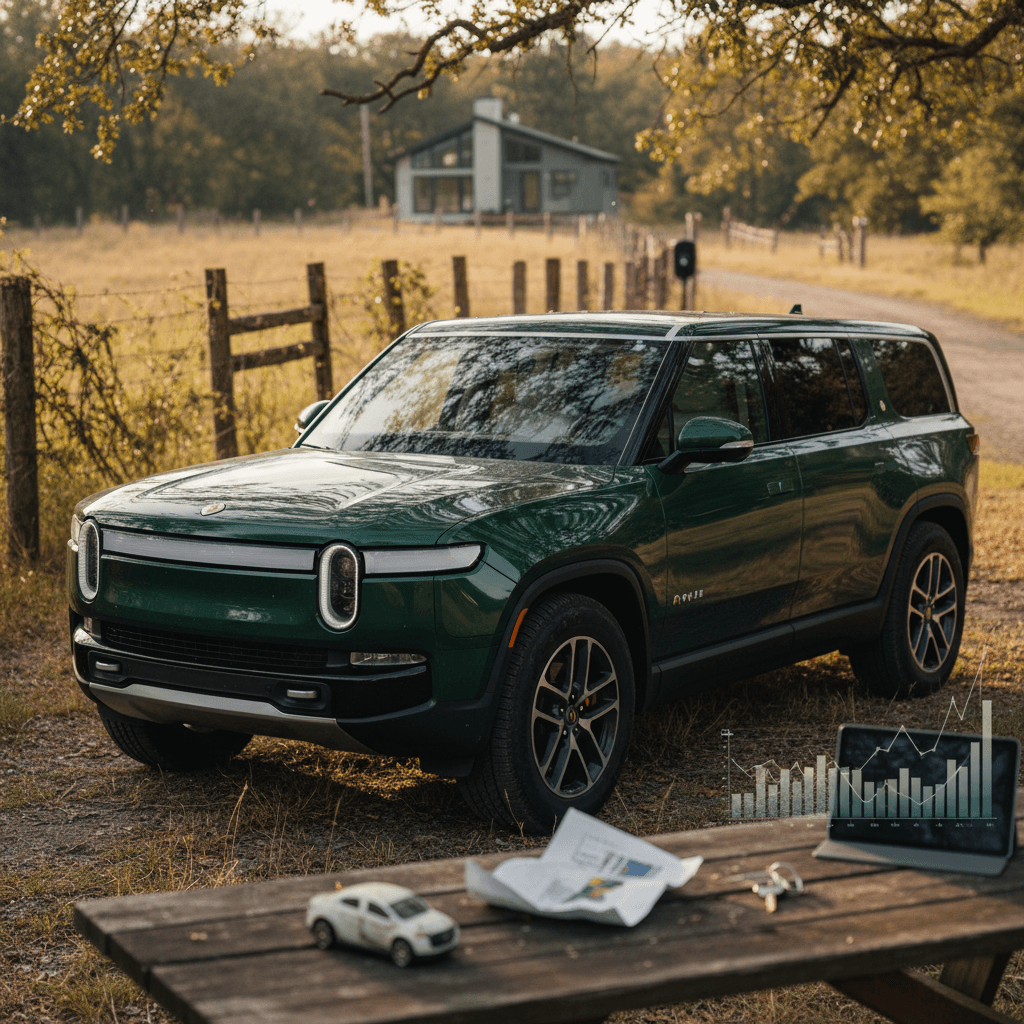
If you want a three-row electric SUV that can haul the family to school on Friday and then crawl up a fire road to a campsite on Saturday, the 2024 Rivian R1S is probably on your short list. This 2024 Rivian R1S review focuses less on launch hype and more on how the big Rivian actually performs, charges, and holds value, especially if you’re thinking about buying or selling one on the used market.
Key takeaway
2024 Rivian R1S overview: what this SUV is really for
2024 Rivian R1S key numbers at a glance
The R1S is Rivian’s adventure-focused, three-row SUV, mechanically twin to the R1T pickup but with an enclosed body and more family-friendly packaging. Every 2024 R1S is all‑wheel drive, rides on an adjustable air suspension, and pairs serious off‑road capability with the kind of design and tech you’d expect from a luxury EV. Pricing for 2024 models landed roughly in the mid‑$70,000s for a Dual-Motor Standard Pack and pushed into the mid‑$90,000s for Dual-Motor Max Pack and special configurations.
For shoppers, the big questions are simple: how far will it really go on a charge, how does it drive, how much will it cost to own, and what happens to value after a couple of years? We’ll walk through each of those with an ownership and used-EV lens, not just a spec-sheet comparison.
Powertrain, trims and performance: Dual vs Performance vs Max
2024 R1S powertrain options
Every version is quick; some are just quicker and longer-legged than others.
Dual-Motor AWD
Standard setup with two in‑house Rivian motors (one per axle).
- ~533 hp, ~610 lb‑ft of torque
- 0–60 mph around 4.5 seconds
- Available with Standard, Standard+, Large and Max battery packs
Dual-Motor Performance
Software and hardware tweaks amp output significantly.
- Up to ~665 hp and 829 lb‑ft in Sport mode
- 0–60 mph in the low 3‑second range
- Offered with Large or Max battery packs
Adventure-ready chassis
Every 2024 R1S shares the same basic hardware.
- Adaptive air suspension with adjustable height
- Multiple drive modes (All‑Purpose, Sport, Off‑Road, Tow)
- Electronic torque vectoring and strong regenerative braking
Even the base Dual-Motor R1S is quicker than most gas-powered three-row SUVs. Step up to the Performance tune and you’re in full sports‑car territory, especially in Sport mode where Rivian unlocks maximum torque. In everyday driving, you’ll spend more time managing your right foot than wishing for extra power.
Performance vs range tradeoff
Range, battery and charging: how far the 2024 R1S really goes
2024 Rivian R1S battery packs and range
Official estimates vary by wheel/tire choice and configuration, but this is the general ladder for 2024 R1S models.
| Battery pack | Approx. usable capacity | Estimated EPA range (R1S) | Typical real-world highway range* |
|---|---|---|---|
| Standard | ~106 kWh | Around 260 miles | 200–220 miles |
| Standard+ | ~121 kWh | Around 315 miles | 240–260 miles |
| Large | ~131 kWh | Up to low‑to‑mid 350 miles | 270–300 miles |
| Max | ~149 kWh | Up to 400 miles (Dual-Motor Max) | 300–330 miles |
Expect less range with larger wheels, roof racks, aggressive driving and cold weather.
On paper, the 2024 Rivian R1S offers one of the strongest range stories in the three‑row EV class. Dual-Motor trims with the Large pack can crest the mid‑300‑mile mark, and the Dual-Motor Max R1S is rated at up to 400 miles of range, a benchmark that puts it among the longest‑range electric SUVs sold in the U.S.
All battery packs support DC fast charging at a bit over 200 kW at peak, with Rivian quoting the ability to add roughly 140 miles in about 20 minutes on a strong DC fast charger. At home, the onboard charger tops out at 11.5 kW, good for roughly 16–25 miles of range per hour on a 240‑volt Level 2 EVSE.
Real‑world range reality check
How to get the best range from a 2024 R1S
1. Watch your speed
Aerodynamic drag ramps up quickly above 70 mph. On long highway stretches, dropping from 78 to 70 mph can add meaningful range and reduce how often you need to DC fast charge.
2. Precondition before you leave
Use the Rivian app or Scheduled Drive feature to warm or cool the cabin while plugged in. Bringing the battery and cabin up to temperature ahead of time preserves range once you hit the road.
3. Use Rivian’s built‑in trip planner
The native navigation system factors in elevation, temperature and your driving history to suggest charging stops. It will also precondition the battery before fast‑charge stops, which improves charging speed but will temporarily lower range, so don’t be surprised if the estimate dips before you plug in.
4. Mind wheels, tires and racks
Big 22‑inch wheels and aggressive all‑terrain tires look the part, but they can cost you tens of miles of range. Roof boxes, ski racks and overloaded cargo areas also increase drag and weight.
Charging network note
Ride, handling and off-road: where the R1S shines
On-road manners
The 2024 R1S is a heavy vehicle, well over three tons depending on spec, but the adaptive air suspension and low center of gravity keep it composed. In All‑Purpose and Comfort settings, the ride is generally smooth, with only the sharpest impacts making it into the cabin. Sport mode stiffens the chassis and drops ride height, giving the R1S a planted, almost wagon‑like feel in corners.
Steering is accurate and nicely weighted, if a bit light on feedback. The instant torque makes passing easy, and strong regenerative braking means you’ll mostly drive with one pedal in town once you acclimate.
Off-road capability
This is where the R1S separates itself from most luxury EV crossovers. With up to 14.9 inches of ground clearance at maximum ride height, short front and rear overhangs, and software‑controlled traction modes, the R1S can handle trails that would stop many gas SUVs.
- Selectable Off‑Road modes for loose surfaces, rocks and sand
- Adjustable suspension height for water crossings and rutted trails
- Multiple camera views and a low‑range-style Crawl mode in some settings
If you camp or mountain bike, the R1S is one of the few EVs that can credibly replace a body‑on‑frame SUV for weekend adventures.
Off‑road caution
Interior, tech and practicality: family duty in a luxury EV
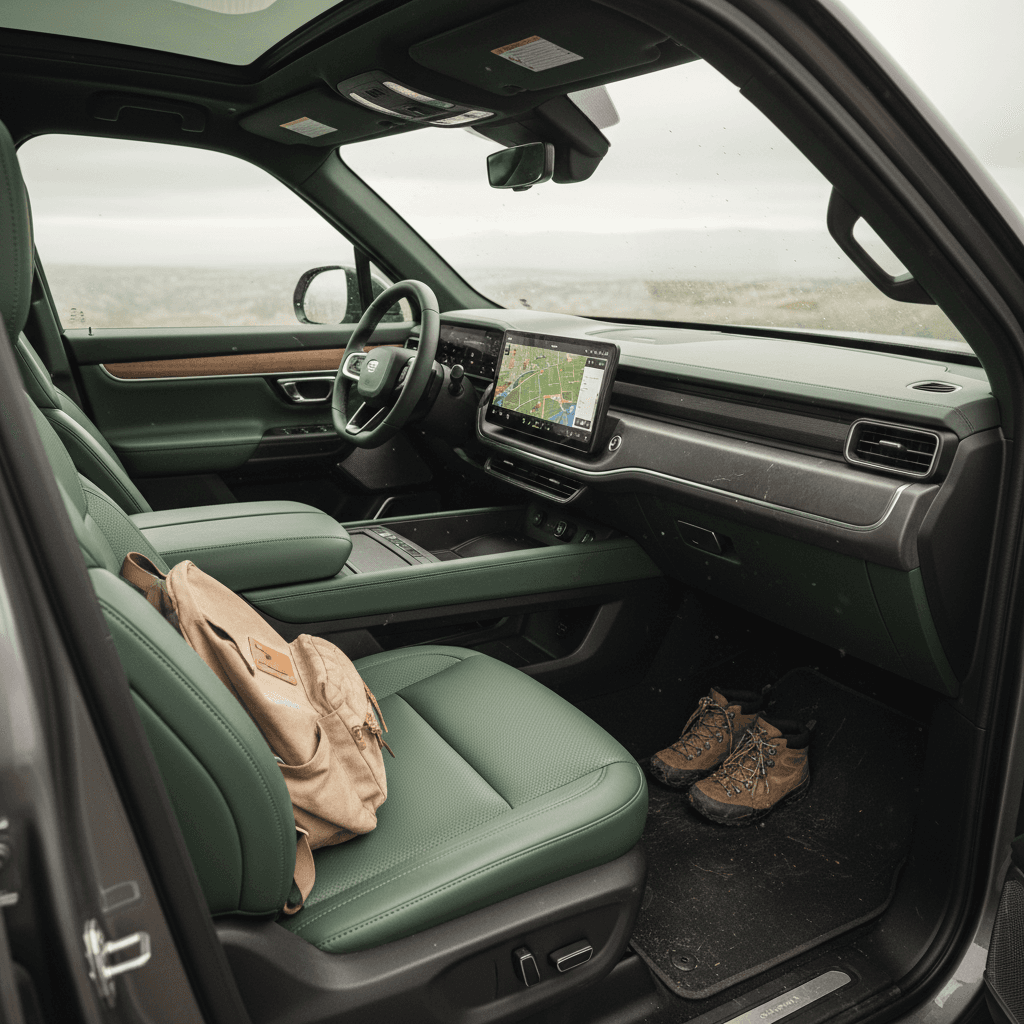
Inside, the 2024 Rivian R1S plays a different game than German luxury SUVs. Materials skew modern and outdoorsy, think open‑pore wood, metal accents and durable fabrics, rather than glossy veneers. The dashboard is dominated by two large screens: a central touchscreen for climate, drive modes and media, and a smaller display in front of the driver for speed and key info.
- Standard three-row seating for up to seven passengers
- Generous legroom in the first two rows; adults can use the third row for shorter trips
- Flat floor and sliding second row make access easier than many gas SUVs
- Huge cargo area with the third row folded, plus a deep rear well and a useful front trunk (frunk)
- Plenty of USB‑C ports and household outlets for camping or tailgating
Tech is a major R1S selling point. Rivian’s UI is handsome and snappy, over‑the‑air updates add features like improved drive modes and cold‑weather behavior, and the Assist driver‑assistance suite offers lane‑centering cruise control that feels competitive with established brands. The flip side is that almost everything is screen‑based, including vents and seat adjustments, which can be a love‑it‑or‑hate‑it experience.
Family‑friendly touches
Ownership costs, reliability and depreciation
New, the 2024 R1S was an expensive proposition; on the used market, that’s starting to work in buyers’ favor. Early Rivian products, including the R1T pickup, have seen meaningful depreciation in their first 2–3 years, which lines up with broader EV-market trends: high initial prices, fast tech improvements, and uncertainty about long‑term battery performance all pressure resale values.
2024 R1S ownership snapshot
Where the costs show up, and where they don’t.
Energy & maintenance
Electricity costs are usually lower per mile than gas, especially if you can charge at home on off‑peak rates. There’s no engine oil, spark plugs or exhaust to service, and brake wear is typically low thanks to regen.
Service & reliability
Rivian is still scaling its service network. How quickly you can get an appointment and parts will depend on your region. OTA updates fix many software issues, but collision and body repairs can be slow and expensive.
Depreciation
Like many newer EVs, the R1S is likely to lose a sizable chunk of value in its first few years, then level off. That hurts early buyers, but it makes a lightly used 2024 R1S far more attainable than its original MSRP.
Brand‑new brand reality
Buying a used 2024 Rivian R1S: what to watch for
A used 2024 R1S can be one of the best values in the three‑row EV space: you get serious range, towing and off‑road credentials for less than original MSRP. But you’re also buying an early‑generation product from a still‑young automaker. Here’s how to shop smart.
Used 2024 Rivian R1S buyer checklist
1. Verify battery health, not just range estimate
Don’t rely on the dash‑displayed range alone. Ask for a recent battery‑health report or diagnostic. Tools like the Recharged Score give you a quantified look at pack health, fast‑charge history and expected long‑term performance.
2. Review software and update history
Confirm the R1S is running current software and that OTA updates are working properly. Many drivability and charging improvements come from software; an out‑of‑date truck can feel very different from an updated one.
3. Inspect suspension, tires and underbody
Adventure‑oriented owners may have used their R1S off‑road. Look for uneven tire wear, suspension noises over bumps, scrapes on the skid plates and damage near jack points or battery protection structures.
4. Test fast charging before you buy
If possible, meet the seller near a DC fast charger and run a test session from 10–60% state of charge. You’ll learn a lot about real‑world charging speeds, connector fit and whether preconditioning behavior feels normal.
5. Confirm warranty and service history
Ask for digital or printed records showing warranty repairs, recalls and maintenance. Confirm the in‑service date so you know exactly how much basic and battery warranty coverage remains.
6. Consider financing and trade‑in together
If you’re moving from another EV or a gas SUV, it may be easier to bundle valuation, payoff and financing. Platforms like Recharged can appraise your trade‑in, help you compare offers, and structure financing around a used R1S with no showroom visit.
How Recharged can help with a used R1S
How the 2024 R1S compares to other three-row EV SUVs
2024 Rivian R1S vs key three-row EV rivals
High‑level comparison of where the R1S stands among family‑size electric SUVs.
| Model | Rows / seats | Max EPA range | Towing capacity | Character |
|---|---|---|---|---|
| Rivian R1S | 3 rows / 7 seats | Up to ~400 miles | 7,700 lb | Adventure‑oriented, off‑road capable, very quick |
| Kia EV9 | 3 rows / up to 7 | Up to ~304 miles | 5,000 lb | More value‑oriented, great tech, less rugged |
| Tesla Model X | 3 rows / up to 7 | Around mid‑300 miles | 5,000 lb | Strong efficiency and Supercharger access, less ground clearance |
| Mercedes EQS SUV | 3 rows / up to 7 | Around low‑to‑mid‑300 miles | 3,500–4,000 lb | Ultra‑luxury, softer off‑road capability |
| Volvo EX90 (upcoming / limited) | 3 rows / 7 | Target mid‑300 miles | Up to ~4,850 lb | Safety‑first, Scandinavian luxury, limited availability at launch |
Exact specs vary by trim; this table focuses on typical higher‑range configurations for each model.
Compared to the pack, the 2024 R1S stands out for its combination of range, off‑road talent and performance. The Kia EV9 and upcoming Volvo EX90 skew toward mainstream family and safety buyers; the Model X leans hard into efficiency and the Tesla ecosystem. If your life includes rutted trails, snow‑covered access roads or towing a camper into the woods, the R1S is arguably the most capable of the bunch.
Who the 2024 Rivian R1S is (and isn’t) for
Is the 2024 R1S a good fit for you?
Match the SUV to your real daily and weekend use, not just the spec sheet.
Great match if…
- You want a single vehicle that can handle commuting, school runs and real off‑road or overlanding trips.
- You value design and tech, but don’t want a traditional luxury‑brand look or dealership experience.
- You regularly tow, or you road‑trip to places that are hard to reach in a typical crossover.
- You’re comfortable owning an early‑generation EV from a newer automaker and can live with some software evolution.
Probably not ideal if…
- You mostly drive short, in‑town trips and don’t need off‑road clearance or 7,700‑lb towing.
- You prioritize maximum efficiency over performance, compact and midsize EV crossovers use far less energy.
- You live far from a Rivian service center and don’t want to rely on mobile service or long drives for repairs.
- You prefer a traditional dealer network with loaner fleets and extensive parts inventory.
2024 Rivian R1S FAQ
Frequently asked questions about the 2024 Rivian R1S
Bottom line: is the 2024 Rivian R1S a smart buy?
Viewed through an ownership lens, the 2024 Rivian R1S is one of the most compelling all‑electric SUVs you can buy, or pick up used. It combines serious off‑road hardware, long‑distance range, three‑row practicality and a distinctive cabin in a way no other EV quite matches. The tradeoffs are real: a high sticker when new, still‑evolving service infrastructure, and depreciation that’s steeper than many gas SUVs.
If you want a do‑everything family EV that can handle Costco runs, road trips and trailheads, and you’re comfortable being an early adopter, the 2024 R1S deserves to be at the top of your list. And if you’re exploring a used one, working with a specialist like Recharged, where every EV comes with a Recharged Score battery report, fair‑market pricing, financing options and nationwide delivery, can tilt the odds in your favor by making the invisible parts of EV shopping fully transparent.