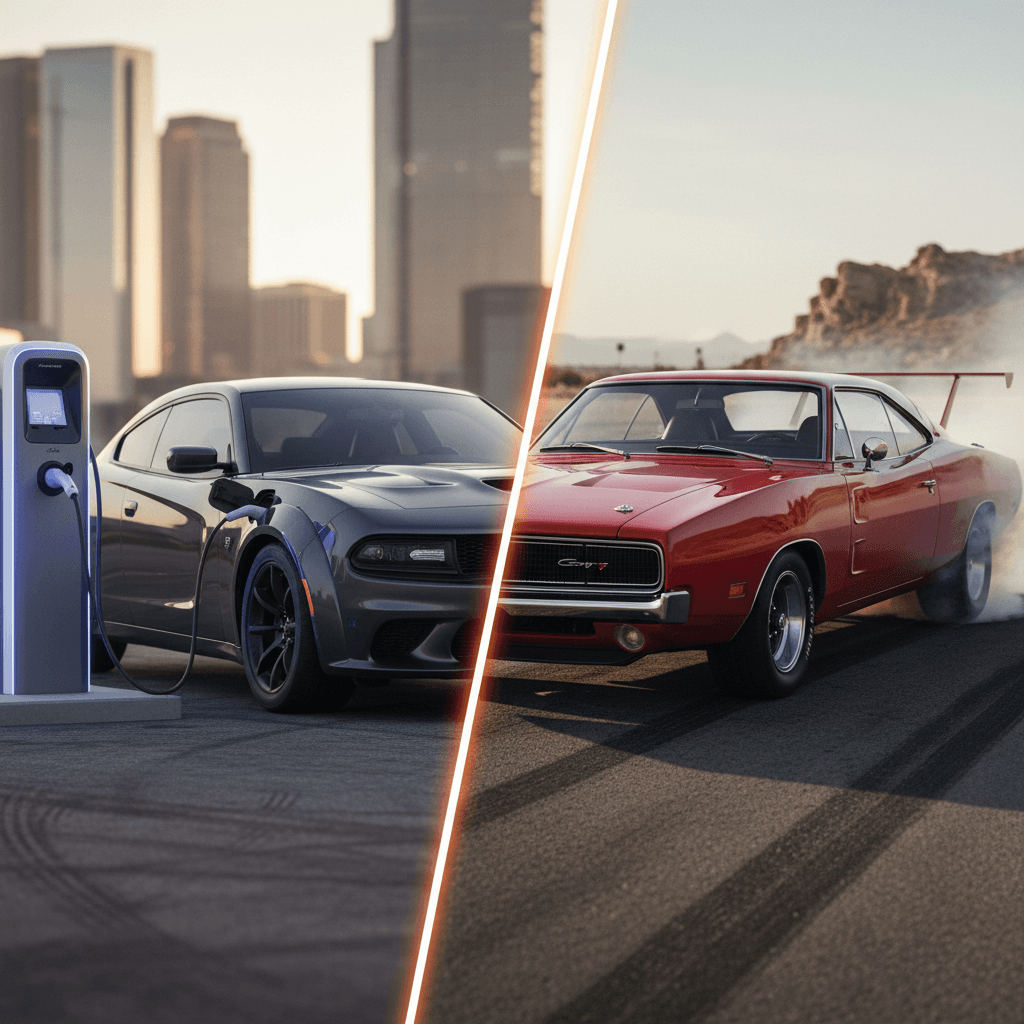
If the phrase Daytona Scat Pack already has your pulse up, you’re not alone. Dodge has used the Scat Pack badge for years to signal big power and old‑school attitude, and now the Daytona name adds an electric twist. The result is a family of Chargers that ranges from a 670-horsepower AWD EV to a new twin‑turbo gas Scat Pack – all aimed at muscle‑car diehards trying to make sense of an electrifying future.
Quick primer
What is the Daytona Scat Pack today?
Dodge quietly turned the muscle‑car world upside down by applying the Daytona name to its new electric Charger. In this lineup, the Charger Daytona Scat Pack sits at the top of the EV range, above the Daytona R/T. It’s a dual‑motor, all‑wheel‑drive electric muscle car that uses a 400‑volt battery pack and twin 335‑hp motors for a combined 670 horsepower and around 627 lb‑ft of torque.
Daytona Scat Pack headline numbers (factory targets)
Those figures put the Daytona Scat Pack firmly in modern super‑sedan territory. Straight‑line performance rivals the quickest Hellcat-era cars, but the character is very different: instant torque, no gearshifts, and a 400‑volt EV powertrain instead of a roaring supercharged V8.
EV twist on a classic formula
Power, performance and sound: what you actually get
How the Daytona Scat Pack feels from the driver’s seat
Specs are one thing; how it delivers them is what matters
Brutal launches
With all‑wheel drive and instant torque, the Daytona Scat Pack simply hooks up and goes. A 3.3‑second 0–60 time means you’re in super‑car acceleration territory – but in a full‑size sedan that can haul kids and groceries.
Consistent pull
EVs shine in repeatability. There’s no heat‑soaked intercooler or slipping automatic to slow you down. As long as the battery has charge and temperature under control, it delivers the same wall of torque launch after launch.
Fratzonic sound
Dodge knew silence wouldn’t cut it for muscle‑car buyers, so the Daytona Scat Pack uses an external Fratzonic Chambered Exhaust to simulate an exhaust note. It’s not a HEMI, but it’s far more theatrical than most EVs.
From behind the wheel, the Daytona Scat Pack feels more like a modern super‑sedan than a classic big‑block. Steering is quick, body control is surprisingly tight thanks to adaptive dampers, and the AWD system lets the car rotate out of corners instead of just plowing its nearly 6,000 pounds straight ahead. You still feel the weight, but you also feel a level of grip and launch control that old V8 Chargers could only dream of.
Weight and range reality
The electric Daytona Scat Pack: specs, range and charging
Core specs: Charger Daytona Scat Pack (EV)
Key factory performance and battery details for the electric Daytona Scat Pack.
| Category | Daytona Scat Pack EV |
|---|---|
| Drivetrain | Dual‑motor all‑wheel drive |
| Total output | Up to 670 hp / ~627 lb‑ft |
| Battery | ~94 kWh usable, 400‑volt architecture |
| 0–60 mph | ~3.3 seconds (factory target and independent tests) |
| Quarter‑mile | Low 11‑second range, around 11.5–11.7 sec |
| EPA range | Roughly low‑ to mid‑200 miles depending on package |
| DC fast charge | Peak around the 180 kW range; ~20–80% in 20–25 minutes |
| Onboard AC charging | Level 2 at home; think overnight recharge from a 240‑V, 40‑50‑amp circuit |
Always confirm final production specs with Dodge; figures below reflect current published and tested numbers.
Dodge offers different performance and equipment packages for the Daytona Scat Pack, and those choices affect range. Track‑focused wheels and tires typically sacrifice some efficiency in exchange for grip. If you want maximum range, the non‑Track Pack setup is your friend.
- Expect roughly 220–260 miles of usable real‑world range if you mix highway with city driving.
- Hammering the car on back roads or doing repeated launches will cut that figure substantially.
- At a powerful DC fast charger, you’re looking at roughly 20–30 minutes to add a meaningful chunk of range.
- For daily use, Level 2 charging at home is the most convenient option – plug in at night, wake up full.
Where charging fits into your life
If you don’t already have home charging, installing a 240‑volt circuit in your garage is the single best upgrade you can make for any EV. And if you’re not ready for that investment, you might find the gas Sixpack Scat Pack more compatible with your current lifestyle.
Gas-powered Charger Scat Pack Sixpack: the ICE alternative
The other piece of the modern Scat Pack puzzle is the gas‑powered Charger Scat Pack with the Sixpack engine. Instead of a V8, Dodge uses a 3.0‑liter twin‑turbo inline‑six derived from Stellantis’ Hurricane family. In Scat Pack tune it’s rated at about 550 horsepower and 531 lb‑ft of torque, backed by an automatic transmission and standard all‑wheel drive that can decouple the front axle for rear‑drive antics.
EV Daytona Scat Pack
- 670 hp, AWD, single‑speed drive.
- Instant torque and extremely quick launches.
- Range in the low‑ to mid‑200‑mile neighborhood.
- Requires home or reliable public charging access.
- Higher curb weight, very quiet aside from synthetic sound.
Gas Charger Scat Pack Sixpack
- ~550 hp, AWD with switchable RWD mode.
- 8‑speed automatic, traditional shifting feel.
- Quick 0–60 (sub‑4 seconds claimed) and higher top speed than the EV.
- Familiar refueling routine in minutes at any gas station.
- Lighter than the EV, real turbo and exhaust soundtrack.
Two ways to do modern muscle
Daytona Scat Pack vs traditional Scat Pack 392
If you’ve been around Dodge muscle for a while, you may be thinking of the old Charger Scat Pack 392 – the naturally aspirated 6.4‑liter HEMI V8 with about 485 hp. That car delivered a big, lazy tidal wave of torque, rear‑wheel drive, and a soundtrack that defined an era of American performance sedans.
How the old 392 Scat Pack compares to today’s Daytona Scat Pack EV
Same badge, wildly different technology
Power and speed
The old 392 made around 485 hp and typically ran 0–60 mph in the high‑4s. The Daytona Scat Pack EV’s 670 hp and 3.3‑second 0–60 puts it in another league for outright performance.
Sound and character
Nothing quite replaces a naturally aspirated HEMI’s rumble. The Daytona Scat Pack’s synthetic exhaust is creative, but if sound is everything to you, a used 392 Scat Pack or Hellcat will still tug at your heart.
Running costs
A 392‑powered Charger is thirsty, especially in city driving. The Daytona Scat Pack can be much cheaper to run if you charge primarily at home, though frequent DC fast charging will narrow that gap.
In the used market, you’ll see a wide spread between late‑run 392 Scat Pack Chargers, early Hellcats, and the new Daytona EVs. Older cars will usually be cheaper to buy, but they come with higher fuel bills and more traditional maintenance. The Daytona Scat Pack commands a premium today because it’s both the future‑leaning option and a limited‑production conversation piece.
Daily driving: energy use, range and real-world costs
A key question for any performance car – especially an EV – is what it’s like to live with day in and day out. The Daytona Scat Pack is quick enough to scare supercars, but it still has to commute, run errands, and handle bad weather.
Ownership at a glance (typical U.S. commuter)
Run the math and the Daytona Scat Pack can be much cheaper to feed than a big‑cube HEMI if you rack up highway miles and charge at home. Public DC fast charging, on the other hand, can cost nearly as much per mile as gasoline – and you’ll spend more time waiting.
Don’t ignore insurance and tires
How Daytona Scat Pack stacks up against modern EVs
Daytona Scat Pack vs key performance EV rivals
Approximate performance context versus some well‑known electric performance models.
| Model | Drivetrain | Max hp (approx) | 0–60 mph | EPA range (approx) | Key trait |
|---|---|---|---|---|---|
| Dodge Charger Daytona Scat Pack | Dual‑motor AWD | Up to 670 | ~3.3 s | Low‑ to mid‑200 mi | Muscle‑car attitude, line‑lock, synthetic exhaust |
| Tesla Model 3 Performance | Dual‑motor AWD | ~455–500 | ~2.9–3.1 s | High‑200 to low‑300 mi | Lightweight, very efficient, track‑ready |
| Tesla Model S Plaid | Tri‑motor AWD | ~1,020 | <2.0 s | High‑300 to ~400 mi | Ultimate straight‑line bragging rights |
| Hyundai Ioniq 5 N | Dual‑motor AWD | ~641 | ~3.2 s | Low‑ to mid‑200 mi | Track focus, drift‑mode antics |
| Ford Mustang Mach‑E GT | Dual‑motor AWD | Up to ~480 | ~3.5–3.7 s | Mid‑200 to mid‑300 mi | SUV body with muscle‑car flavor |
Exact specs vary by model year and trim; this table focuses on general positioning, not every configuration.
The Daytona Scat Pack isn’t trying to be the most efficient EV on the market. It’s built to give you a Charger‑shaped alternative to sleek liftbacks and crossovers, with enough power and personality to satisfy someone who might otherwise have shopped a supercharged V8. If efficiency and road‑trip range are your priorities, a Tesla Model 3 or Model S will typically go farther on a charge. If you want a big, brash four‑door that still feels unmistakably Dodge, the Daytona Scat Pack is in its own niche.
Buying used: Daytona Scat Pack vs older Scat Pack Chargers
As Daytona Scat Packs and Sixpack Chargers start to filter into the used market, they’ll sit alongside a deep bench of older Scat Pack 392s, R/Ts and Hellcats. Choosing between them comes down to how you balance performance, running costs and long‑term confidence in complex technology like batteries or turbo systems.
Considering a used Daytona Scat Pack EV
- Battery health is the big question. You’ll want data, not guesses.
- Check DC fast‑charging history – heavy use can age packs faster.
- Software updates can significantly change behavior over time.
- Brake and tire wear may be higher if the car saw track use.
Considering a used Scat Pack 392 or Sixpack
- Look for full maintenance records and oil‑change intervals.
- Listen for drivetrain noises, especially on hard shifts.
- Inspect for modifications: tunes, pulley swaps, non‑OEM turbos.
- Underbody inspection is crucial if the car lived in the Rust Belt.
Where Recharged fits in
A lot of shoppers cross‑shop Daytona Scat Packs with other high‑output EVs – or even consider a more practical dual‑motor crossover instead. On Recharged, you can compare them side by side, including expected range, battery condition and total cost of ownership, before you ever get on a plane or step into a showroom.
Checklist: what to evaluate before you buy
Daytona Scat Pack and Scat Pack Sixpack pre‑purchase checklist
1. Clarify which Scat Pack you want
Are you shopping for a <strong>Daytona Scat Pack EV</strong>, a <strong>gas Charger Scat Pack Sixpack</strong>, or an older <strong>392 Scat Pack</strong>? They share a name but differ dramatically in daily usability, running costs and character.
2. Be honest about your charging or fueling reality
If you can install Level 2 charging at home and do most of your driving within 150 miles a day, the Daytona Scat Pack EV can work beautifully. If you live in an apartment with limited charging, the Sixpack or a different ICE performance car may be less stressful.
3. Test drive in the way you really drive
Don’t just do a short loop around the block. Try highway merges, rough pavement and low‑speed parking. Pay attention to throttle response, brake feel and low‑speed drivability; these are the things you’ll live with every day.
4. Look past straight-line speed
Nearly everything in this segment is quick. Focus on seating position, visibility, control layout, and how confident you feel in the car when traffic gets ugly or weather turns bad.
5. Run a true cost-of-ownership comparison
Include energy or fuel, insurance, tire costs, likely maintenance and potential tax incentives. An EV that’s more expensive up front can still make sense if you drive a lot and charge cheaply.
6. Get the car inspected
On a used Daytona Scat Pack, prioritize a high‑quality EV inspection with a battery health report. On a used Scat Pack 392 or Sixpack, have a trusted mechanic check compression, turbos or superchargers, suspension bushings and signs of abuse.
Daytona Scat Pack FAQ
Frequently asked questions about the Daytona Scat Pack
Bottom line: who the Daytona Scat Pack is really for
The Daytona Scat Pack is Dodge’s statement that muscle cars don’t have to fade away in an electric age – they just have to change shape. The EV version is explosively quick, packed with tech, and more affordable to feed than a supercharged V8 if you charge at home. The gas Sixpack Scat Pack, meanwhile, exists for drivers who still want turbocharged noise and the simplicity of a fuel pump.
If you love the idea of a big four‑door that can outrun yesterday’s Hellcats while gliding quietly through traffic, the Daytona Scat Pack deserves a test drive. If you’d rather balance straight‑line speed with long‑range road‑trip comfort, you may want to compare it with other performance EVs and plug‑in models. On Recharged, you can put modern EV muscle cars side by side, dig into Recharged Score battery reports, and get expert guidance on financing, trade‑ins and nationwide delivery so that the fun part – driving – starts on day one.