If you’ve been Googling the cost of a Chevy Volt battery, you’ve probably seen scary numbers, often five figures for a brand‑new pack. The reality in 2025 is more nuanced: most Volt owners never pay that full headline price, and you have more options than just “write a giant check or junk the car.” This guide breaks down real‑world costs, what drives them up or down, and how to decide whether to repair, replace, or move on to a different EV or plug‑in hybrid.
Quick background: what battery are we talking about?
Why Chevy Volt battery costs look so high online
Search for “Chevy Volt battery price” and you’ll see screenshots of dealer quotes around $10,000–$15,000 or more. Those numbers typically reflect a brand‑new OEM pack with dealer labor, programming, and full markup. In other words, the most expensive path you can take. They also don’t reflect what owners actually do once a Volt pack shows problems: many choose repair, a refurbished pack, or a used pack from a salvage vehicle instead of a brand‑new replacement.
- Online quotes rarely separate parts vs. labor.
- New OEM high‑voltage packs are priced to cover GM’s parts, logistics, and dealer margins.
- Most independent shops and EV specialists can source used or remanufactured packs for far less.
- Some Volt issues are fixable at the module or wiring level without a full pack replacement.
Sticker shock vs. real‑world options
Typical cost of a Chevy Volt battery in 2025
Chevy Volt battery cost ranges in 2025 (U.S.)
Those numbers are ballparks, not quotes, but they’re a realistic snapshot of what U.S. owners report in 2024–2025. Where you land depends on your Volt’s generation and how you choose to fix the problem.
Chevy Volt high‑voltage battery cost breakdown (2025 estimates)
Approximate U.S. pricing ranges for common Chevy Volt battery options. Actual costs vary by region, shop, and parts availability.
| Option | What it includes | Estimated Parts Cost | Estimated Labor | Typical Total |
|---|---|---|---|---|
| Dealer new OEM pack | Brand‑new GM pack, dealer labor, programming | $7,500–$11,000 | $1,500–$3,000 | $9,000–$14,000 |
| Independent shop, used or reman pack | Salvage or reman pack with limited warranty | $3,000–$6,000 | $1,000–$2,000 | $4,000–$8,000 |
| Module‑level repair | Replace failed modules, reseal, re‑balance | $500–$2,000 | $300–$1,000 | $800–$3,000 |
| Diagnostics only | Scan tools, test drive, initial tear‑down | Included or $150–$300 | , | $0–$300 |
Use this as a planning tool, then get quotes from local EV‑savvy shops.
Check if you still have battery warranty
6 factors that change what you’ll actually pay
What drives Chevy Volt battery cost up or down?
Your total bill depends on more than the pack itself.
1. Model year & generation
2. Where you live
3. New vs. used pack
4. Shop type
5. Warranty coverage
6. Extra work discovered
State of health vs. outright failure
A Volt battery doesn’t suddenly jump from “perfect” to “dead” in most cases. More often, owners notice reduced electric range, fault codes, or the car relying more on the gas engine. A pack that still works but has lost capacity may not justify a full replacement, especially on older, high‑mileage cars.
Impact on your long‑term plans
If you plan to keep your Volt for another 5–7 years and the car is in otherwise great shape, investing in a solid used or reman pack can make sense. If you’re only trying to get 12–18 more months out of it, a lower‑cost repair, or selling the car as‑is, might be smarter.
Repair vs. replacement: which makes sense?
Not every Chevy Volt with a warning light needs a full battery transplant. In practice, shops see three broad scenarios: issues outside the pack, fixable pack problems, and true end‑of‑life failures. Where your car lands will determine whether repair or replacement is the better financial move.
How to think through repair vs. replacement
1. Confirm it’s really the high‑voltage pack
DC/DC converter failures, contactor issues, coolant leaks or wiring problems can all mimic a “bad battery.” A thorough diagnostic with a shop that knows Volts is step one.
2. Compare repair quote to vehicle value
If your 2012 Volt is worth $6,000 in good running condition and you’re staring at a $9,000 battery bill, it’s time to reconsider. For a newer, low‑mile Volt worth $15,000+, a $6,000–$8,000 repair may still pencil out.
3. Ask about module‑level repairs
Some shops can open the pack, replace bad modules, and re‑balance cells. This is cheaper than a full pack swap but may not restore like‑new capacity.
4. Get a price on used or reman packs
A salvage pack from a low‑mileage Volt, or a remanufactured unit from a specialist, can cut the parts cost dramatically while still offering warranty coverage.
5. Factor in your driving pattern
If you mostly drive short distances and don’t need full EV range, you might live with reduced capacity longer. Heavy freeway commuters will feel degradation sooner.
6. Consider moving to a newer EV or PHEV
Sometimes the right answer is to take that repair budget and put it toward a newer plug‑in with more range and modern safety tech. That’s where a strong trade‑in or instant offer matters.
Where Recharged fits in
Ready to find your next EV?
Browse VehiclesLabor, diagnostics, and shop fees to budget for
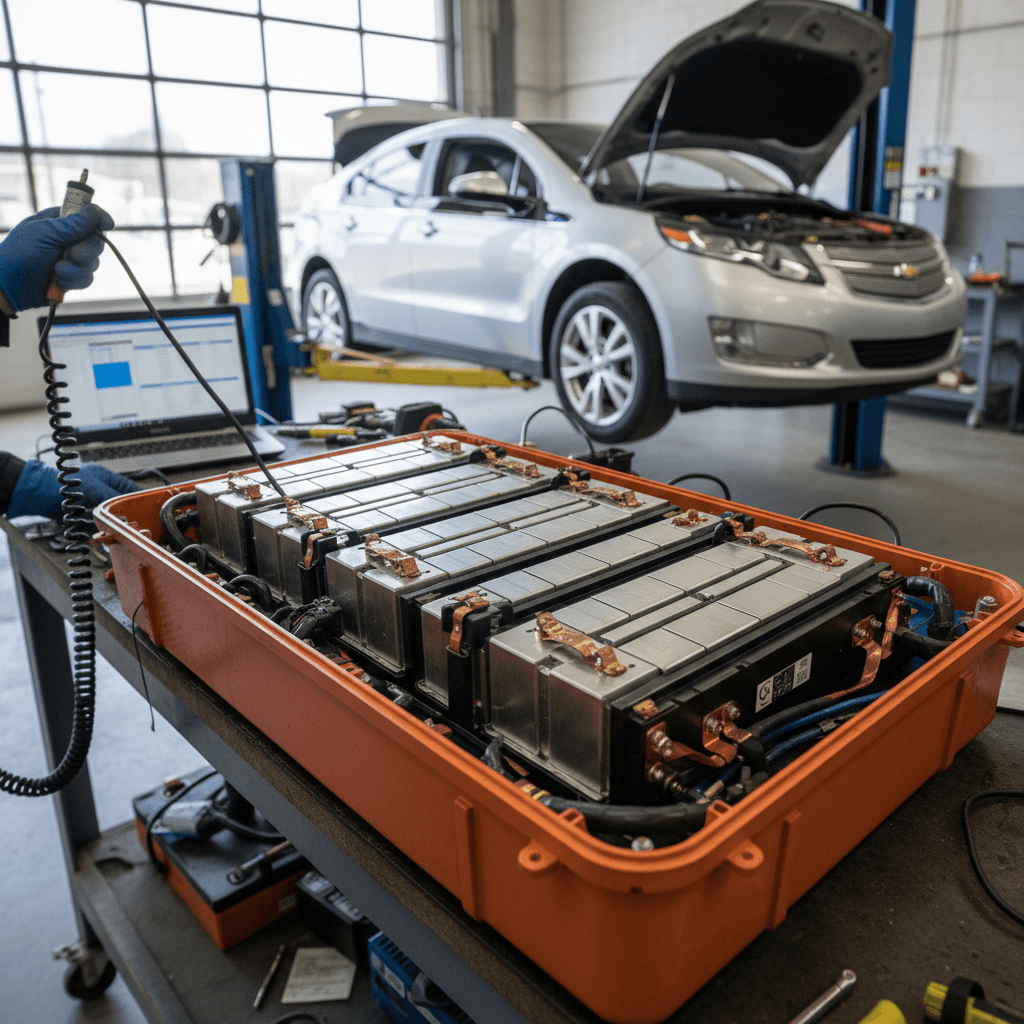
Battery pack work on a Chevy Volt is specialized but not exotic anymore. Independent hybrid/EV shops and some Chevy dealers perform these repairs routinely. Expect your invoice to include several line items beyond the pack itself.
- Diagnostic fee: $150–$300 at many shops, sometimes waived if you approve repair.
- Battery R&R (remove and replace) labor: commonly 6–12 hours billed, depending on generation, corrosion, and shop practices.
- Programming and calibration: some dealers charge separate fees to program control modules or perform required software updates.
- Shop supplies and disposal: coolant, fasteners, and waste handling for any damaged components.
High‑voltage safety is non‑negotiable
How battery health affects used Chevy Volt value
Battery condition is the swing factor in the value of any used plug‑in hybrid or EV, and the Chevy Volt is no exception. Two identical Volts on paper, same year, mileage, options, can be thousands of dollars apart in market value if one has a weak pack and the other has strong battery health with documentation.
Battery health vs. market value
Why serious buyers look beyond mileage.
Healthy pack, documented
Weak pack, warning lights
How Recharged handles battery transparency
Smart ways to save on a Chevy Volt battery
If a high‑voltage battery issue blindsides you, it’s easy to feel backed into a corner. In reality, Volt owners have several levers they can pull to keep costs under control or avoid a big bill altogether.
Practical cost‑saving tips
1. Get at least two quotes
Dealer pricing is just one data point. Call at least one independent hybrid/EV shop in your area and ask specifically about their experience with Chevy Volts.
2. Ask about used or reman packs
Some shops work with suppliers who specialize in refurbished high‑voltage packs. These often cost thousands less than new OEM, with 12–36 month warranties.
3. Verify the diagnosis
If the quote seems out of line with the car’s value, consider paying a second shop for an independent diagnostic before committing.
4. Keep up with coolant and software updates
The Volt’s battery cooling system matters. Addressing leaks or overdue maintenance early can prevent more expensive battery damage later.
5. Consider your exit options early
If your Volt is older and high‑mileage, it may be smarter to make a plan to upgrade before you’re forced into an emergency decision.
When a bad battery means it’s time to move on
Every aging plug‑in reaches a fork in the road: put serious money into the battery, or redirect that cash into a newer vehicle. For early‑generation Volts that already have high mileage, worn interiors, or rust, even a discounted battery job can exceed the car’s realistic resale value.
Signs it’s not worth a big repair
- The car needs other major work (engine, transmission, suspension) on top of the battery issue.
- Your shop quotes a battery bill close to, or higher than, the car’s private‑party value.
- You were already thinking about upgrading to a vehicle with more range and newer safety tech.
How to exit without leaving money on the table
Instead of wholesaling the car for pennies, look for buyers who understand the value of Volts as parts or project cars, or get an instant offer from a platform that knows plug‑ins. Using that value as a trade‑in credit toward a vetted used EV through Recharged can simplify the transition.
FAQ: Chevy Volt battery costs and ownership
Frequently asked questions about Chevy Volt battery costs
Bottom line on Chevy Volt battery costs
The headline cost of a Chevy Volt battery can be intimidating, but it doesn’t have to be a black‑and‑white choice between paying dealer list price or giving up on the car. In 2025, you have a spectrum of options: detailed diagnostics, repair of specific components, used or remanufactured packs, or using your Volt’s remaining value as a launchpad into a newer plug‑in or full EV.
If you’re facing a big battery decision, start with clear diagnosis, realistic quotes, and an honest look at your long‑term plans. And if you decide it’s time to move on, Recharged can help you trade in or get an instant offer, then guide you into a used EV or plug‑in backed by transparent battery health data, fair pricing, and EV‑specialist support from first click to delivery.