If you own or are shopping for a Chevy Silverado EV, understanding the current recalls list isn’t just a box to check, it’s central to knowing how safe and up‑to‑date your truck really is. Because the Silverado EV launched in low volumes and is still ramping up, every recall tells you something about how GM is maturing this new Ultium‑based pickup.
Quick context
Overview: Chevy Silverado EV recalls so far
General Motors began delivering Silverado EV Work Truck (WT) models in 2023 and has rolled out more trims since. With any new platform, especially a full‑size electric truck, you should expect early recalls. The key is what’s being fixed and how hard it is to repair, not just how many campaigns exist.
Chevy Silverado EV recalls at a glance
So far, the Silverado EV recalls we’ve seen are the kind you actually want: issues caught early, on a small number of units, with clear, straightforward fixes, seatbelt hardware and software calibration, rather than structural or battery‑pack redesigns.
Chevy Silverado EV recall timeline (2023–2026)
Chevy Silverado EV recall timeline
High‑level view of known Silverado EV safety recalls by year.
| Year | GM / NHTSA campaign | Main issue | Primary fix | Approx. U.S. vehicles |
|---|---|---|---|---|
| 2023 (late) | Small early campaign | Seatbelt buckle bolt torque on a handful of trucks | Inspect and correctly torque or replace bolts | 3 |
| 2024 (filed Feb 2024) | 24V-087 / GM internal number varies | Rear center seatbelt bezel may damage belt in severe crash | Replace bezel with revised part | ~352 |
| 2025 (filed Jan 2025) | N242483530 | Pedestrian warning sound may be too quiet at low speeds | Body control module software update | 46 (U.S. WT units) |
| 2025 (filed Sept 2025) | Stability control telltale recall | ESC warning light may not re‑illuminate after key cycle | Software update to instrument‑cluster logic | 1,191 (Silverado EV + Sierra EV, MY 2026) |
Dates are based on NHTSA filings and GM communications; always verify your individual truck via VIN lookup.
Always go by your VIN, not just this table
Recall 1: Rear center seatbelt bezel tearing risk (2024)
The first substantial Silverado EV recall most owners will encounter involves the rear center seatbelt. In late 2023 a GM engineer flagged that some trucks had the wrong plastic bezel where the belt passes through the rear‑seat trim. Sled testing showed that in a severe frontal crash with a heavy rear‑center occupant, the belt could bunch at the opening and tear.
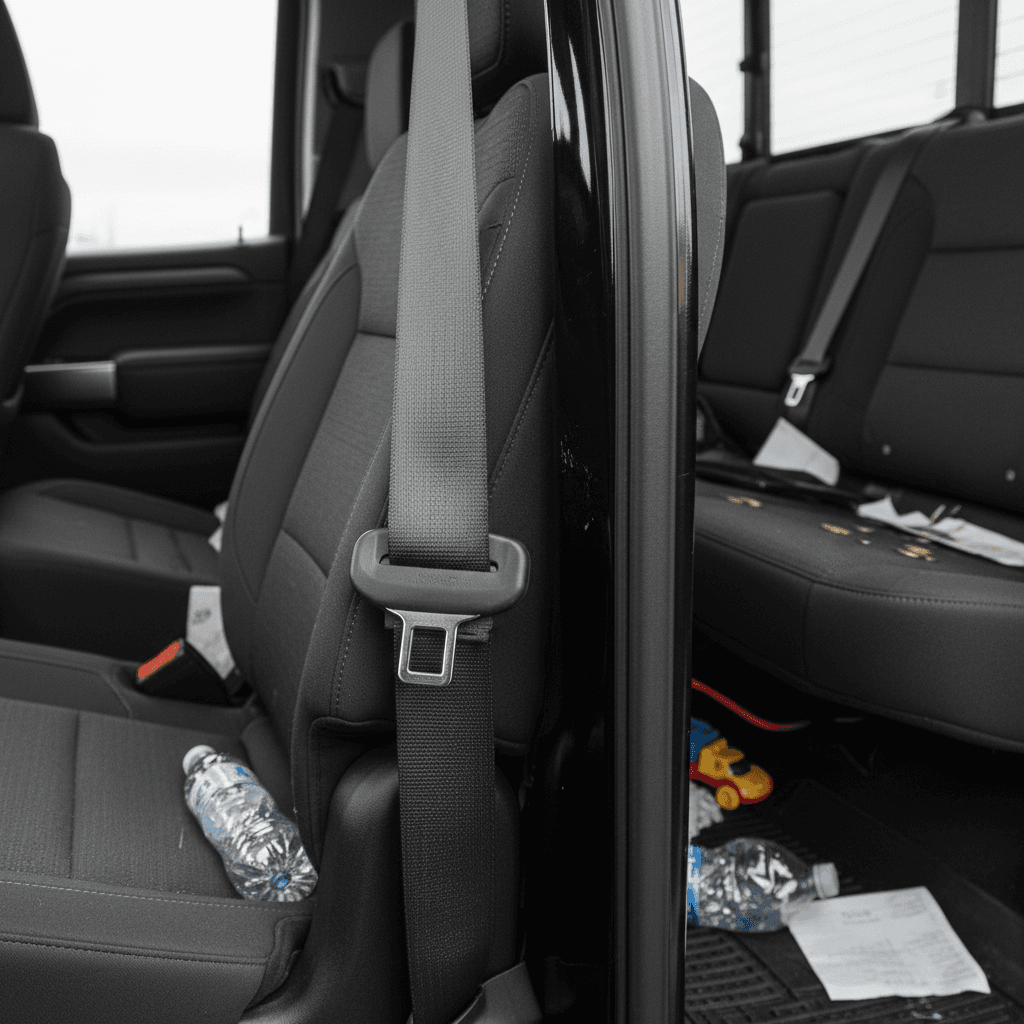
- Campaign scope: about 352 Silverado EV trucks built between February 23, 2023 and November 14, 2023, primarily early Work Truck (WT) units.
- Core risk: Under a high‑severity frontal crash, the rear center belt could be damaged or torn, reducing restraint performance for that passenger.
- Root cause: Incorrect bezel supplied to the assembly line; caught internally via GM’s “Speak Up For Safety” process rather than field failures.
- Fix: Dealers replace the bezel with a revised part designed to prevent bunching. Owners are often offered a loaner vehicle while work is completed.
What this says about the truck
Recall 2: Pedestrian warning sound too quiet (2025)
The second widely‑reported Silverado EV recall is much less dramatic but still important: certain 2025 Silverado EV WT trucks may not make enough artificial pedestrian warning sound at low speeds. U.S. and Canadian rules require EVs and hybrids to emit an external sound at city‑parking‑lot speeds so people can hear the vehicle approaching.
- Campaign: GM Safety Recall N242483530.
- Models: 2025 Silverado EV WT.
- Issue: Due to incorrect software calibration, the exterior sound generator may not meet the required volume between about 12–19 mph (20–30 km/h).
- Safety concern: At very low speeds, especially in parking lots and driveways, pedestrians who rely on sound cues may not realize the truck is moving.
- Remedy: Dealers reflash the body control module (BCM) with updated software; some unsold inventory may receive an over‑the‑air (OTA) update before delivery.
- Scale: 46 trucks in the U.S. and a few hundred more in Canada.
How to know if this recall matters to you
Recall 3: Stability control warning light behavior (2025)
In late 2025 GM initiated a recall that groups the Chevy Silverado EV and GMC Sierra EV together. The problem isn’t that the trucks lack electronic stability control (ESC); it’s that the dashboard warning light may not behave correctly after you turn the truck off and back on again.
If the ESC system detects a fault, the warning light is supposed to keep reminding you there’s an issue until it’s fixed. On roughly 1,191 2026‑model Silverado EV and Sierra EV trucks, the light may only illuminate the first time the fault occurs. After a key cycle, the fault remains, but the light might stay off, leaving you unaware that stability control could be compromised.
- Campaign scope: 1,191 2026 Silverado EV and Sierra EV trucks.
- Symptom: ESC telltale may fail to re‑illuminate after a restart while a fault is still present.
- Risk: Drivers may continue driving on compromised stability control without a clear warning, which could increase crash risk on slick or emergency‑maneuver situations.
- Fix: Software update to the electronic control logic. Some trucks may receive this via OTA; others will require a quick dealer visit.
Don’t ignore stability control issues
What about the GMC Sierra EV? Shared recalls to know
The GMC Sierra EV and Chevy Silverado EV are twins under the skin, built on GM’s BT1 Ultium truck platform. That means some recalls, especially software‑based ones, apply across both brands.
If you’re cross‑shopping Silverado EV and Sierra EV
How to check if your Silverado EV has an open recall
The only way to know with certainty whether your specific Silverado EV has open recalls is to run its 17‑digit VIN through an official database. Don’t assume you’ll get every letter in the mail, owners miss recall notices all the time, especially on fleet or second‑hand trucks.
Step‑by‑step: Checking your Silverado EV recall status
1. Locate your VIN
You’ll find it at the base of the windshield on the driver’s side, on the driver‑door jamb label, and on your registration or insurance card.
2. Use an official recall lookup
In the U.S., go to the NHTSA recall lookup site or Chevrolet’s own recall page. Enter the full VIN exactly as shown.
3. Review safety recalls and campaigns
The tool will list any <strong>open safety recalls</strong>. Some sites also show completed recalls and customer‑satisfaction campaigns (non‑safety fixes).
4. Call a Chevy EV‑certified dealer
Ask for the service department and confirm your recall status. If you’re buying used, give them the VIN and ask for a printout of open campaigns.
5. For used shoppers, get documentation
If a seller claims all recalls are done, ask to see a recent service invoice or screenshot from the dealer system backing that up.
Buying used? Bring a printout to the test drive
What happens during a recall fix for your Silverado EV
Recall work can feel intimidating on a brand‑new technology like an Ultium truck, but in practice the process is straightforward, and legally, it’s free. Here’s what to expect when you schedule recall service for your Silverado EV.
Typical Silverado EV recall experience
From appointment to pickup, how the process usually works
Appointment & intake
You schedule with an EV‑certified Chevy dealer. At drop‑off they verify your VIN and which campaigns apply, then explain the work.
Software‑based recalls
For sound‑level or warning‑light updates, technicians connect a factory laptop or trigger an OTA session. The flash itself often takes under an hour.
Hardware‑based recalls
For items like seatbelt bezels, a technician removes trim, swaps the part, and reinspects the belt routing and function before re‑assembly.
Many dealers will wash the truck and perform a quick multi‑point inspection while it’s in the bay. And because EVs have fewer wear items, a recall visit is often the only time an early‑life Silverado EV ever sees a service lift.
Cost and downtime
Recalls vs. service bulletins: What’s the difference?
Silverado EV owners are already seeing a mix of safety recalls, service bulletins, and software updates in forums and Facebook groups. It’s easy to lump them together, but they play very different roles.
Safety recalls
- Ordered when a defect raises an unreasonable safety risk or violates a regulation.
- Must be reported to NHTSA (in the U.S.) and tracked by VIN.
- Repairs are mandatory for the automaker to offer and always free to the owner.
- Examples: seatbelt bezel that might tear in a crash, too‑quiet pedestrian warning sounds.
TSBs and campaigns
- Technical Service Bulletins (TSBs) give dealers guidance to fix known issues when customers complain.
- Customer‑satisfaction campaigns may update software or hardware for comfort, durability, or drivability.
- Not all TSBs are free out of warranty, and they don’t always rise to the level of a safety recall.
- Examples: infotainment quirks, minor range‑estimator tweaks, or trim‑related squeaks and rattles.
Why this matters when buying used
Used Silverado EV shoppers: How to use recalls to your advantage
Because Silverado EV production has been relatively low and skewed toward fleets, the first wave of used trucks will be extremely condition‑sensitive. Recalls give you a surprisingly powerful lens into how carefully a truck has been owned and maintained.
Recall‑smart checklist for used Silverado EV buyers
Confirm every recall is closed
Ask the seller for documentation that the seatbelt and software recalls (where applicable by VIN) are completed. An attentive fleet manager or first owner usually has this filed.
Compare build date to recall ranges
Early 2023–2024 WT trucks sit right in the recall windows. If a seller insists their truck is unaffected, verify the build month on the door jamb label.
Use gaps as negotiation leverage
Open recalls don’t cost you money to fix, but they do cost you time. If work still needs to be done, that’s a fair argument for a lower price or a pre‑sale dealer visit written into the deal.
Look beyond recalls to battery health
Recalls don’t capture everything that matters on a used EV. Ask for DC fast‑charging history if possible and look for a third‑party battery health report, this is exactly what a <strong>Recharged Score</strong> is designed to surface.
How Recharged can help if you’re going used
Chevy Silverado EV recall FAQ
Frequently asked questions about Silverado EV recalls
Key takeaways for Silverado EV owners and shoppers
The Chevy Silverado EV recalls list is still relatively short, and so far it reads more like a checklist of early‑production cleanup items than a fundamental indictment of the truck’s design. Seatbelt hardware, low‑speed sound calibration, and dashboard warning‑light logic are the types of issues you want to see caught and corrected early, while volumes are low and fixes are straightforward.
If you own a Silverado EV today, your best move is simple: run your VIN, schedule any open recall work, and keep your documentation. If you’re shopping used, treat recall history as one pillar in a broader due‑diligence process that also includes battery health, charging behavior, and real‑world usage.
And if you’d rather skip the guesswork altogether, buying through a specialist EV retailer like Recharged means every vehicle comes with a Recharged Score Report, expert guidance, and a clear paper trail, so you know where a truck has been before you commit to where it can take you next.