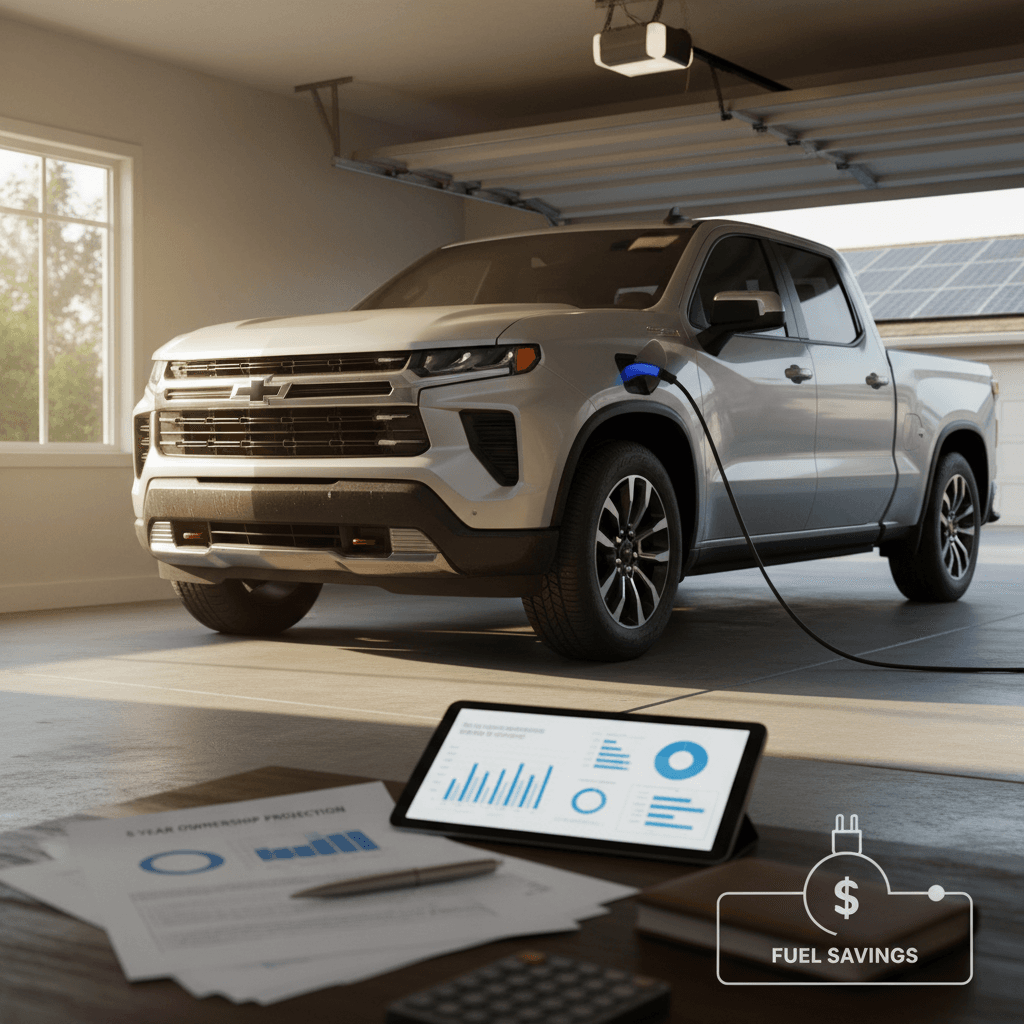
If you’re considering a Chevy Silverado EV, you’re probably not just thinking about sticker price. You want to know the long-term ownership cost, what this electric truck will really cost to live with over 5–10 years compared with a gas or diesel pickup.
What this guide covers
Why Silverado EV ownership costs look different from a gas truck
Chevy positions the Silverado EV as a full-size work and lifestyle truck with serious range and capability. Depending on configuration, GM estimates up to around 450+ miles of range on certain trims, with work-truck models closer to the high‑200‑mile range. That battery pack and Ultium platform give you instant torque and very low day‑to‑day fuel and maintenance costs, but they also affect price and depreciation in ways that are different from a traditional Silverado 1500.
- Higher upfront price than a comparable gas truck, especially for early-model trims
- Much lower “fuel” cost per mile when you charge at home
- Fewer routine maintenance items (no oil changes, spark plugs, or transmission services)
- Higher curb weight, which can mean faster tire wear and higher tire replacement costs
- Depreciation patterns that, so far, are steeper than many gas pickups, especially in the first 3–5 years
Early electric trucks are depreciating faster
Key cost factors for Chevy Silverado EV long-term ownership
The 5 pillars of Silverado EV ownership cost
Every long-term cost you’ll face fits into one of these buckets.
Charging & energy
Electricity at home, DC fast charging on the road, and possible demand or time‑of‑use rates from your utility.
Maintenance & repairs
Basic wear items like tires, brakes, filters, and any out‑of‑warranty repairs to EV components.
Depreciation
The difference between what you pay for the Silverado EV and what you can sell or trade it for later.
Insurance & fees
Insurance premiums, registration fees, and, in some states, EV‑specific road‑use charges.
Battery health & warranty
How the propulsion battery ages, what’s covered under Chevy’s warranty, and what that means for resale value.
Financing costs
Interest you pay on a loan or the opportunity cost of tying up cash, especially important with higher‑priced EV trucks.
Electricity vs gas: what you’ll spend to “fuel” a Silverado EV
Let’s start with energy, because it’s where most truck shoppers hope to save big. The Silverado EV’s exact efficiency will vary by trim, tire choice, load, and driving style, but you can use some realistic ballpark numbers to understand your costs.
Estimated fueling costs: Silverado EV vs gas truck (U.S. averages)
If you assume a Silverado EV averages about 2.4 miles per kWh in mixed driving and you pay $0.15 per kWh at home, that’s roughly $0.062 per mile in energy cost. A comparable gas truck that averages 18 mpg at $3.25 per gallon costs about $0.18 per mile in fuel, nearly three times as much.
Illustrative annual fuel cost: Silverado EV vs gas pickup
Assuming 15,000 miles per year. Numbers are approximations to show the relative scale of costs.
| Scenario | Energy cost per mile | Annual miles | Estimated annual fuel/energy cost |
|---|---|---|---|
| Silverado EV – mostly home charging | $0.06 | 15,000 | $900 |
| Silverado EV – mix of home & DC fast charging | $0.08 | 15,000 | $1,200 |
| Gas pickup – 18 mpg, $3.25/gal | $0.18 | 15,000 | $2,700 |
| Gas pickup – 15 mpg, $3.50/gal (towing/short trips) | $0.23 | 15,000 | $3,450 |
Actual costs will depend on your local electric and fuel prices, efficiency, and driving habits.
Boost savings with smart charging
Maintenance and repairs: where EV trucks can save you money
Chevy’s own materials emphasize that its EVs do not need oil changes, transmission flushes, engine belts, or spark plugs. You still have wear items, tires, wiper blades, cabin filters, and you still need brake fluid service and suspension work as the miles add up, but the routine service menu is simpler than a gas Silverado.
- No oil changes or engine air filters
- No spark plugs or timing belts
- No traditional multi‑speed automatic transmission to service
- Regenerative braking that can significantly extend brake pad life
- Tire rotations roughly every 7,500 miles, often included with service packages
- Cabin air filter and wiper replacements on a similar schedule to other vehicles
Chevy EV maintenance coverage
Typical EV truck costs (first 5 years)
- Tire rotations and inspections twice a year
- New tires every 30,000–40,000 miles (heavier trucks may eat tires faster)
- Brake fluid service around year 4–5
- Cabin filter, wipers, and small incidentals
For many owners, that works out to hundreds of dollars per year, not thousands, unless you face accident damage or out‑of‑warranty repairs.
Gas truck comparison
- Oil and filter changes 2–4 times per year
- Transmission fluid services
- Engine‑related repairs as the miles add up
- More complex emissions and exhaust components
Those additional items can easily add $500–$1,000 per year over a high‑mileage lifecycle, especially as trucks age.
Depreciation and resale value: the big wild card
Depreciation, the amount of value your truck loses over time, is where the Silverado EV story gets complicated. Pricing data so far suggests that electric pickups are depreciating faster than many gas trucks, especially in the first few model years as incentives, new competitors, and rapidly evolving battery tech shuffle the market.
Early indications on electric pickup depreciation
In plain English: if you buy a brand‑new Silverado EV at or near MSRP and sell it within five years, you should be prepared for a bigger percentage hit than you’d likely see with a similar gas Silverado. But that same trend benefits you if you buy used, because someone else already absorbed that early drop.
Why depreciation can be your friend
Insurance, taxes, and fees: hidden costs to budget for
Insurance and registration tend to track with vehicle price and repair costs. The Silverado EV is a high‑value vehicle with advanced electronics and aluminum bodywork, so insurance premiums may be higher than for a basic gas work truck but similar to a well‑equipped half‑ton crew cab.
- High purchase price and repair complexity can push premiums up
- Some insurers still price EVs conservatively because long‑term claim data is limited
- Incentives and tax credits may offset upfront cost but don’t directly reduce insurance
- A few states add annual EV fees to offset lost gas-tax revenue, factor those into your budget
Call your insurer before you fall in love
Battery health and warranty: how long will it last?
Battery longevity is a fair concern with any EV truck. Chevy backs the Silverado EV’s propulsion battery with an 8‑year/100,000‑mile limited warranty on most recent models, alongside its standard bumper‑to‑bumper coverage. That doesn’t mean the battery dies at eight years, it means Chevy will repair or replace it if it fails or degrades beyond specified limits during that period.
Habits that help your Silverado EV battery age gracefully
1. Avoid 100% daily charging
For everyday commuting, it’s healthier to charge to around 80% instead of topping off to 100% every night. Save full charges for road trips.
2. Limit frequent DC fast charging
Fast charging is great for long trips, but living on DC fast chargers can add thermal stress. Use Level 2 at home or work when you can.
3. Park in moderate temperatures
Extreme heat is especially tough on lithium‑ion batteries. When possible, park in a garage or shaded area and avoid baking the truck in the sun all day.
4. Keep software up to date
GM can refine thermal management and charging behavior through software updates. Staying current helps protect the battery and optimize range.
How Recharged helps de‑risk battery concerns
Sample 5‑year total cost of ownership scenarios
Nobody’s usage is identical, but looking at a couple of sample cases can give you a feel for the Silverado EV’s long‑term costs. These are directional examples, not quotes, but they show how the pieces add up.
Scenario A: New Silverado EV, 15,000 mi/year
- Purchase price: $70,000 out‑the‑door for a well‑equipped trim
- 5‑year depreciation: Truck worth ~40–45% of original price after 5 years → ~$38,000 loss on paper
- Energy cost: $1,000/year average (mix of home and some DC fast charging) → ~$5,000 over 5 years
- Maintenance: $400/year average (tires, cabin filters, wipers, fluids) → ~$2,000
- Insurance & fees: Highly variable, but easy to see $1,800–$2,200/year in many markets
Biggest driver of cost: Depreciation, especially in the first 3 years.
Scenario B: 3‑year‑old used Silverado EV, 12,000 mi/year
- Purchase price: $45,000 for a clean, low‑mileage truck
- 5‑year depreciation: If it’s worth ~55–60% of purchase price after another 5 years, you lose ~$18,000–$20,000
- Energy cost: ~$800/year at lower annual mileage → ~$4,000 over 5 years
- Maintenance: Budget a bit higher for tires and age‑related items, say $600/year → ~$3,000
- Insurance & fees: Often lower than a new $70,000 truck because the insured value is lower
Key takeaway: Buying used can cut your depreciation bill nearly in half over the next 5 years.
Think in cost per year, not just price tag
How buying a used Silverado EV changes the math
Because early electric pickups have depreciated quickly, the real value play for many shoppers is in the used market. You’re letting the first owner eat the steepest curve while you step into a truck that still has years of battery warranty coverage left.
New vs used Silverado EV: ownership cost advantages
Why the second owner often gets the better deal.
Lower depreciation going forward
A truck that’s already three years old has likely taken its biggest value hit. Over the next 5 years, the annual depreciation burden often shrinks dramatically.
Battery still under warranty
Many used Silverado EVs will have several years of the 8‑year/100,000‑mile battery warranty remaining, limiting your exposure to catastrophic battery costs.
Transparent condition reports
When you shop through a specialist like Recharged, you get a Recharged Score Report that spells out battery health, pricing fairness, and any red flags before you buy.
Real‑world history baked in
Used trucks come with tire wear patterns, charging histories, and service records. That data, properly analyzed, tells you how the truck was actually used.
How Recharged fits into your Silverado EV search
Ready to find your next EV?
Browse VehiclesTips to lower your Silverado EV long-term ownership cost
7 ways to keep Silverado EV ownership costs in check
1. Prioritize total cost of ownership, not just payment
Look at depreciation, energy, and maintenance together. A slightly higher monthly payment on a fairly priced used Silverado EV may beat a low‑payment new lease once you include fuel and wear items.
2. Charge smart at home
Use a Level 2 charger and schedule charging for off‑peak hours. That minimizes your per‑kWh rate and reduces reliance on expensive DC fast charging.
3. Right‑size your trim
Oversized wheels, aggressive tires, and every option box checked don’t just raise the price, they can hit range, tire life, and insurance. Choose the configuration that matches how you really use a truck.
4. Keep tires inflated and rotated
Proper tire pressure and regular rotations improve efficiency and keep you from burning through an already expensive set of EV‑rated tires faster than necessary.
5. Stay ahead on software and recalls
Chevy can tweak range, charging behavior, and safety systems via updates. Building dealer visits into your schedule can maintain performance and resale value.
6. Document everything
Keep a neat folder or digital log of maintenance, tire replacements, and charging‑related service. That paperwork helps protect resale value when it’s time to move on.
7. Shop specialized EV marketplaces
When you’re ready for a Silverado EV, or ready to sell yours, using an EV‑focused marketplace like Recharged can mean better pricing transparency, battery health verification, and a smoother transaction.
Chevy Silverado EV long-term cost: FAQ
Frequently asked questions about Silverado EV ownership costs
Bottom line: is a Silverado EV worth it long term?
If you cover decent annual mileage and can charge at home, a Chevy Silverado EV can be a very economical truck to operate. Electricity is usually far cheaper per mile than gas, and the simplified maintenance schedule cuts down on time and money spent at service bays. The trade‑off is that early electric pickups like the Silverado EV have shown heavier front‑loaded depreciation than many gas trucks, something you need to factor into your long‑range budget.
From a long‑term ownership‑cost perspective, the sweet spot for many shoppers is a carefully chosen used Silverado EV: one with documented service records, verified battery health, and pricing that already reflects the early depreciation hit. That’s exactly the kind of transparency Recharged is built to provide, with Recharged Score battery diagnostics, fair market pricing, EV‑savvy guidance, and nationwide delivery. Do your homework on total cost of ownership, then choose the truck, and the buying path, that makes the numbers work for you over the long haul.