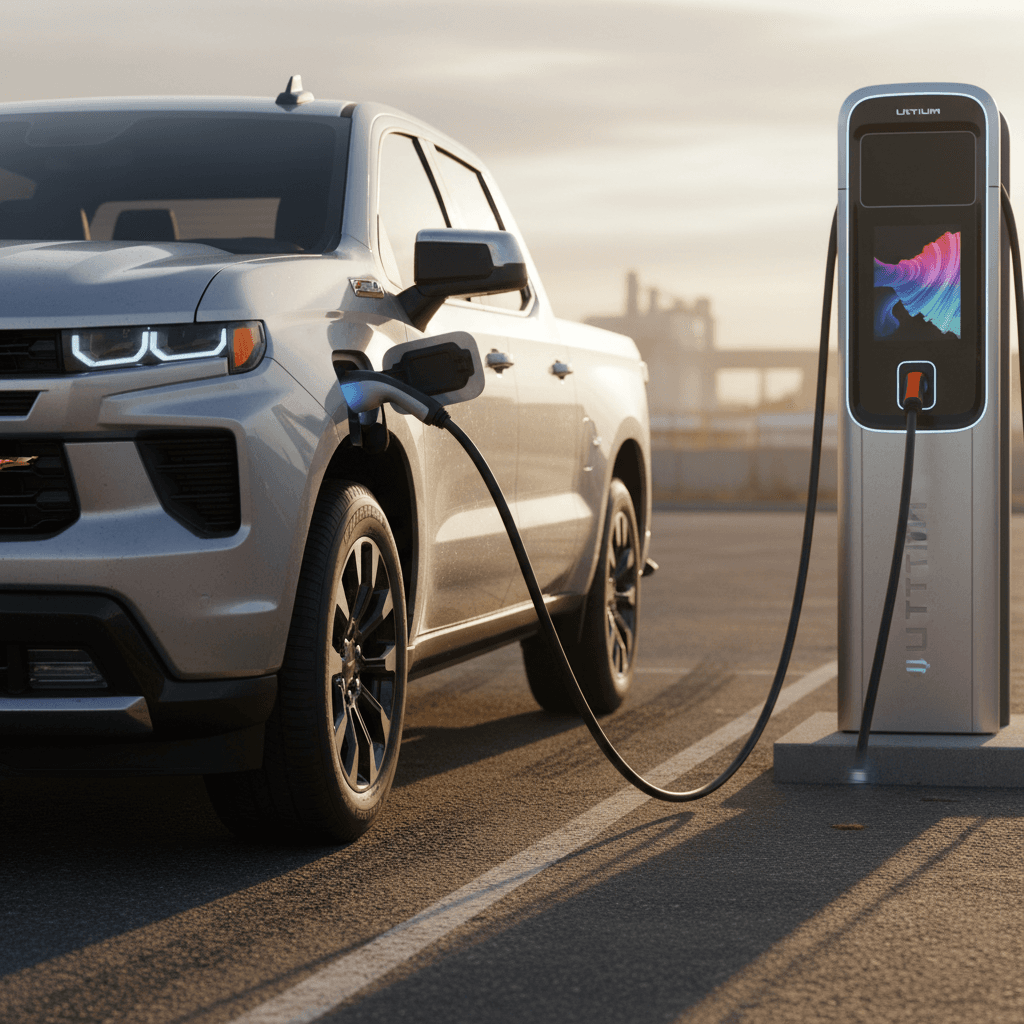
If you’re looking at a Chevy Silverado EV, you’re probably wondering how fast this massive Ultium battery really charges. The headline numbers, up to 350 kW DC fast charging and roughly 100 miles in 10 minutes, sound impressive on a spec sheet. But what happens in a real Silverado EV charging speed test when you plug into a public fast charger or a home Level 2 station?
Why charging speed matters on a big truck
Silverado EV charging overview: what the specs promise
Key Chevy Silverado EV charging numbers
Chevrolet’s own specs paint an ambitious picture. On DC fast charging, the Silverado EV can accept up to 350 kW100 miles of range in roughly 10 minutes on a 350 kW station when the battery is in the right state of charge window.
At home, the truck supports robust Level 2 charging. Depending on trim, you get either an 11.5 kW or 19.2 kW onboard AC charger. Plugged into a properly wired 240‑volt circuit with a high‑power wall unit, Chevy rates the truck at roughly 34 miles of range per hour of Level 2 charging on the higher‑power setup.
Spec sheet fine print
Fast charging speed tests: how the Silverado EV performs
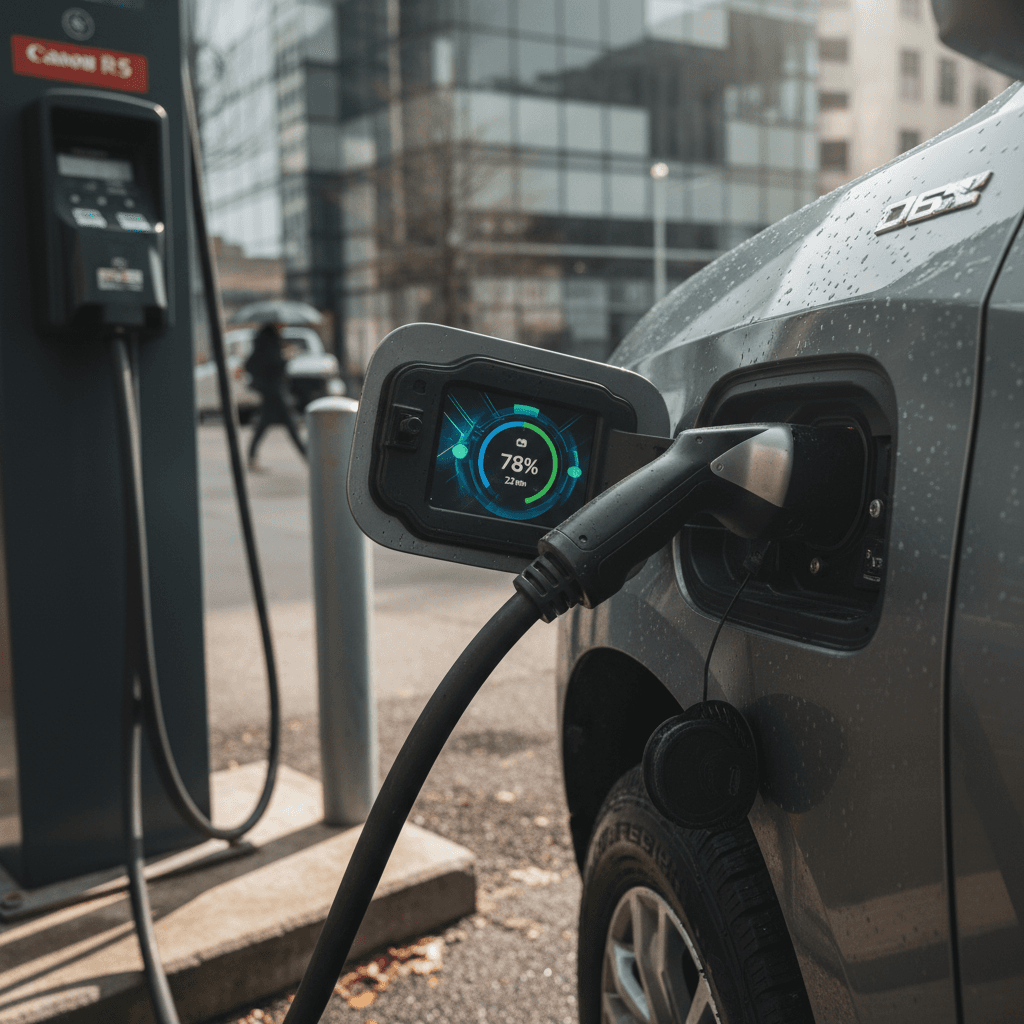
Independent testing has already put Chevy’s claims to the test, and the Silverado EV has come out swinging. In Car and Driver’s DC fast‑charging comparison, a Silverado EV RST ran from 10% to 90% state of charge while averaging about 198 kW over the entire session, making it one of the fastest‑charging EVs they’ve ever tested.
Another deep‑dive test by EV charging analysts charted the full 0–100% charging curve on a Silverado EV RST using a 350 kW DC station. Power ramped up extremely quickly to just under 350 kW in the first few minutes and held a plateau near 300+ kW into the low‑20% state‑of‑charge range. As the pack warmed, charging power dropped into the ~150 kW range around mid‑pack, then climbed back above 200 kW before tapering in the 70s and beyond.
What real‑world DC fast charging tests show
Here’s what you can reasonably expect when you plug into a strong DC fast charger.
Blistering early peak
Strong overall average
Thermal management matters
Realistic highway stop
Understanding the Silverado EV’s DC fast charging tech
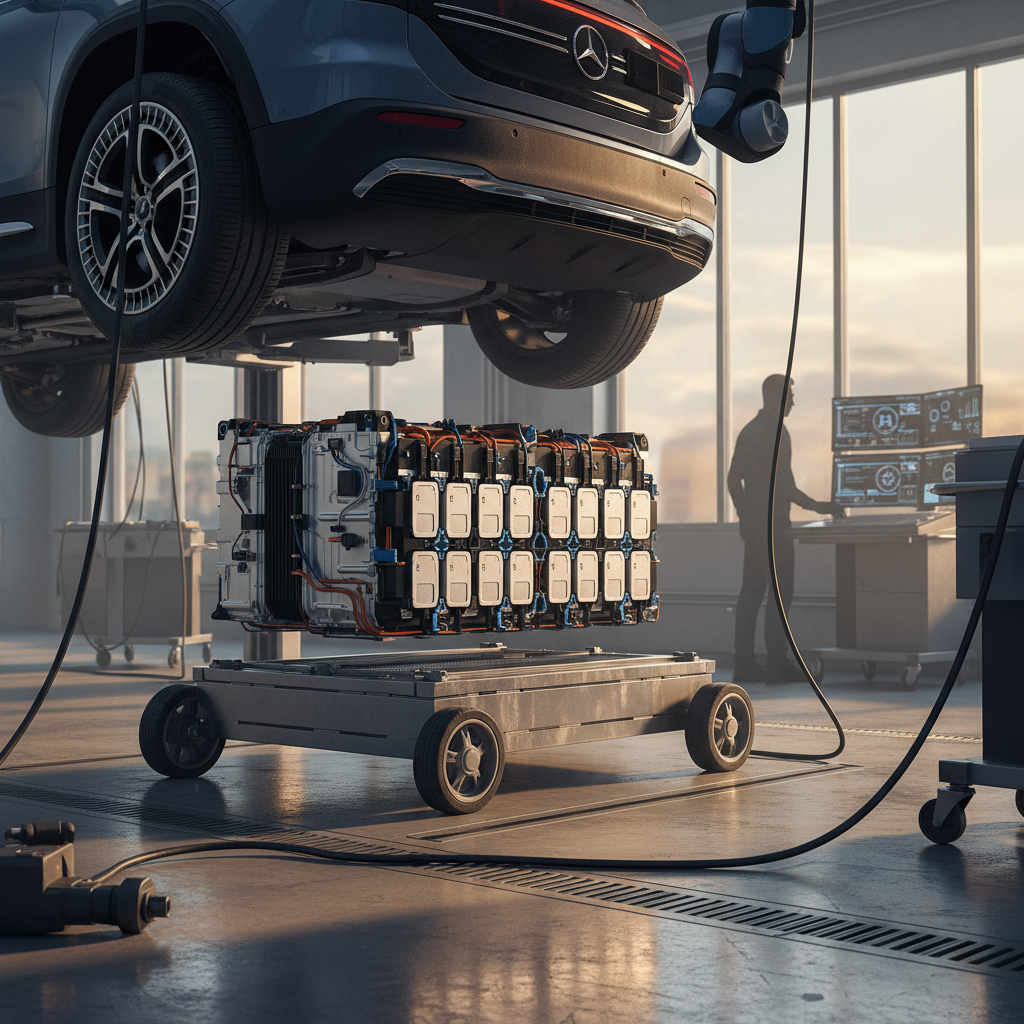
The Silverado EV’s fast‑charging party trick is its dual‑stack Ultium battery. The pack is effectively two 400‑volt sections. In normal driving they sit in parallel like a typical 400‑volt EV. When you plug into a compatible DC fast charger, a contactor arrangement switches them into a series connection, giving the truck an approximate 800‑volt architecture for charging.
On 800‑volt capable DC chargers
- The truck can request up to 350 kW of power, depending on trim.
- Peak power typically shows up between roughly 5–25% state of charge.
- This is where you see those eye‑catching “100 miles in 10 minutes” claims.
On 400–500‑volt DC chargers
- The Silverado EV is limited by charger voltage and current, so you may never see the full 300+ kW peaks.
- Expect lower max power, longer sessions, and more modest averages, even if the display says “350 kW station.”
Check charger details before you plug in
Home charging speed: Level 1 vs. Level 2
Out on the highway, the Silverado EV can gulp energy at a shocking rate. At home, the story is more about overnight replenishing. With a battery of roughly 200+ kWh, you’ll absolutely want a serious Level 2 setup if you drive much at all.
Approximate Silverado EV home charging times
Rough estimates from near‑empty to full. Real‑world times depend on trim, battery size, and your actual driving and charging habits.
| Charging type | Voltage / amps (typical) | Power (kW) | Approx. miles of range per hour | Rough time 10–100% |
|---|---|---|---|---|
| Level 1 (portable cord) | 120V / 12A | ~1.4 kW | ~3–4 mi/hr | Well over 48 hours on a near‑empty large pack |
| Level 2 – 32A | 240V / 32A | ~7.7 kW | ~15–20 mi/hr | Roughly 20–24 hours from very low |
| Level 2 – 48A | 240V / 48A | ~11.5 kW | ~25–30 mi/hr | Roughly 14–18 hours from very low |
| Level 2 – 80A (19.2 kW trims) | 240V / 80A | ~19.2 kW | ~30–35+ mi/hr | Around 10–12 hours from very low |
Think of Level 1 as an emergency backup. For daily use, a 240‑volt Level 2 charger is practically mandatory with a full‑size electric truck.
The key spec to look at is your truck’s onboard AC charger rating. Some trims top out at 11.5 kW, while others can take the full 19.2 kW from a powerful home wall box. If you install more amperage than your onboard charger can use, you won’t charge any faster, you’ll just have more overhead in the circuit.
Don’t DIY high‑power home charging
Charge speeds by Silverado EV trim and battery
Not every Silverado EV charges at exactly the same rate. Different trims pair different battery sizes with different onboard AC chargers and slightly different DC fast‑charge ceilings. The table below combines manufacturer data and reporting from independent outlets; treat it as a directional guide rather than gospel, especially as Chevrolet continues to tweak the lineup.
Silverado EV trims and typical charge specs
Representative specs for common Silverado EV trims as of the 2024–2025 model years.
| Trim | Battery configuration | Onboard AC charging | Max DC fast charge rating |
|---|---|---|---|
| WT (work truck, lower range) | Standard / extended Ultium pack | 11.5 kW (some versions 11.5–19.2 kW) | ~220–300 kW (trim‑dependent) |
| WT Max Range | Largest Ultium pack (~200+ kWh) | Up to 19.2 kW | Up to ~350 kW |
| LT / LT with Premium Package | Extended‑range pack | 11.5 or 19.2 kW (equipment‑dependent) | Up to ~300 kW |
| RST First Edition / RST Max Range | Largest Ultium pack (~205+ kWh) | 19.2 kW | Up to 350 kW |
Higher‑range trims tend to pair the biggest battery with the fastest DC and AC charge hardware.
Trim info will keep evolving
Spec sheet vs. reality: what you’ll actually see
It’s one thing to read that your truck can do “up to 350 kW.” It’s another to stand at a winter‑chilled charging plaza with a trailer on the hitch, watching the numbers on the screen. The Silverado EV is legitimately one of the fastest‑charging EVs on sale today, but like every electric vehicle, its real‑world performance depends on variables you can’t see on the window sticker.
- State of charge: The truck charges fastest when the battery is low. Arriving at a DC fast charger around 5–15% and unplugging near 60–70% usually gives you the best mix of speed and range per minute spent charging.
- Battery temperature: After highway driving, your pack is typically warmed up and ready to accept high power. If the truck has been sitting in extreme cold or heat, charge power will be limited until the battery comes into its comfort zone.
- Charger capability: Many “350 kW” stations can’t sustain those numbers for long or may be limited by voltage or current. You might see 150–250 kW max even on a big Silverado‑friendly charger.
- Shared power: On some networks, two stalls share the same power cabinet. If another EV is charging hard next to you, both vehicles may be limited.
- Truck load and usage: Heavy towing, big elevation climbs, and high HVAC use can add heat to the system and affect how aggressively the truck will charge.
Plan your stops, not just your charge rate
How to get the fastest possible charge from your Silverado EV
Seven ways to maximize Silverado EV charging speed
1. Arrive low, leave in the sweet spot
Try to roll into a DC fast charger under <strong>20% state of charge</strong> and unplug around 60–70%. That’s where the Silverado EV spends the most time at high power.
2. Use high‑power, 800‑volt capable stations
Favor newer 350 kW chargers that explicitly support 800‑volt vehicles. Older 400‑volt stations may never let your Silverado hit its advertised peaks.
3. Precondition when you can
If your route planner or myChevrolet app offers <strong>battery preconditioning</strong> for fast charging, use it. Warming (or cooling) the pack on the way to the station can shave minutes off your stop.
4. Avoid back‑to‑back 100% charges
Regularly fast charging all the way to 100% stresses any lithium‑ion pack. For battery health, save full DC charges for rare road‑trip days and rely on Level 2 at home the rest of the time.
5. Watch for paired stalls
If a station labels stalls as 1A/1B, 2A/2B, etc., those pairs may share power. If possible, pick an unpaired stall to give your Silverado the best shot at the cabinet’s full output.
6. Keep your charging gear updated
For home charging, update firmware on your wall box, follow Chevy’s software updates, and check settings in the truck’s charging menu so you’re not unintentionally capping current or charge limits.
7. Don’t ignore simple things like cable tension
On very high‑power sessions, a loose or poorly seated connector can cause early shutoffs or lower power. Make sure the plug is fully latched into the Silverado EV’s charge port before you walk away.
Charging tips if you’re shopping for a used Silverado EV
If you’re considering a used Chevy Silverado EV, charging performance should be near the top of your checklist. A truck that lives its life on DC fast chargers, towing at max capacity, will age differently than one that mostly sips energy from a home Level 2 station.
Questions to ask the seller
- How was the truck usually charged? Mostly at home Level 2, or frequent DC fast charging?
- Any issues at fast chargers? Random shutoffs, unusually low power, or repeated fault codes can hint at problems.
- Which wall charger is installed? If they’re including a home EVSE, confirm its amperage and whether it matches the truck’s onboard charger.
How Recharged helps
Every used EV sold through Recharged includes a Recharged Score Report with verified battery health and charging performance. Our diagnostics look beyond the dash display to give you an honest picture of pack condition, DC fast‑charge history, and expected range.
If you’re trading in a gas truck or another EV, Recharged can also arrange transparent trade‑in offers and nationwide delivery right to your driveway.
Why battery health matters for charging speed
Chevy Silverado EV charging speed FAQ
Frequently asked questions about Silverado EV charging speed
The Chevy Silverado EV isn’t just a big‑battery electric truck; it’s also one of the quickest‑charging EVs you can buy when you put it on a strong DC fast charger. Independent tests back up Chevy’s bold claims, with peak power brushing 350 kW and averages that rival far lighter, smaller‑battery EVs. At home, a properly sized Level 2 setup turns that huge Ultium pack from a liability into a quiet overnight workhorse. If you’re cross‑shopping electric trucks, or hunting for a used Silverado EV, understanding how, where, and how fast it charges is just as important as horsepower or towing numbers. And when you’re ready to make the leap, Recharged can help you find a truck with the battery health and charging performance to match your real‑world life, not just a marketing brochure.