
The Tesla Cybertruck’s spec sheet reads like a dare: up to 11,000 pounds of towing capacity and well over 300 miles of rated range. But once you hitch up a boat, camper, or car trailer, the real question isn’t “Can it tow?” It’s “How far can I actually go between charges?” This guide breaks down Tesla Cybertruck towing capacity and range in the real world so you can sanity‑check your use case before you sign anything, or before your next road trip.
Headline numbers at a glance
Cybertruck towing and range: what matters most
If you’re coming from an F‑150, Ram, or Silverado, you’re used to two parallel truths: the brochure says one thing, the truck does another. Electric pickups are no different. The Cybertruck will happily yank five tons of trailer; the limiting factor is energy consumption at highway speed, not raw pulling power.
- Towing capacity tells you what the truck can legally and mechanically pull.
- Payload (passengers + cargo + tongue weight) is just as critical, overload this and you can’t safely use the full tow rating.
- Range while towing is where EV physics makes itself known. A big trailer can double or triple your energy use.
- Charging access (Superchargers and other DC fast chargers) determines whether a long towing trip is pleasant or painful.
Don’t fixate on the 11,000‑lb headline
Official Tesla Cybertruck towing capacity by trim
As of early 2026, Tesla sells multiple Cybertruck flavors, and they don’t all tow the same. The original launch trims and the newer, de‑contented work‑truck spec share the same basic stainless wedge, but their tow ratings diverge.
Tesla Cybertruck towing capacity by trim (2026)
Key Cybertruck variants and their factory tow ratings. Always confirm against the door‑jamb label and your owner’s manual.
| Trim | Drive | Official tow rating | Approx. rated range (no trailer) | Notes |
|---|---|---|---|---|
| AWD “Premium” (Foundation/high‑spec) | Dual‑motor AWD | 11,000 lbs | ~340 mi (20" wheels) | Launch‑spec truck with adaptive air suspension and higher‑end interior. |
| Cyberbeast (tri‑motor) | Tri‑motor AWD | 11,000 lbs | ~320 mi | Brutally quick; same tow rating as AWD but more performance‑oriented. |
| AWD “base” / work‑truck spec | Dual‑motor AWD | 7,500 lbs | ~325 mi | New lower‑cost version with reduced suspension hardware and lower tow rating. Limited‑time pricing has hovered around $60k. |
Tow ratings here are based on Tesla’s published specs and recent price‑cut announcements.
Why the cheaper Cybertruck tows less
Payload, tongue weight, and hitch basics
You can’t talk about Tesla Cybertruck towing capacity and range without sorting out payload and tongue weight. Tesla lists payload around 2,500 lbs on the higher‑spec trucks, and tongue weight (the downward force of the trailer on the ball) is typically rated at about 10% of max tow, roughly 1,100 lbs at an 11,000‑lb tow rating.
- Passengers + cargo + tongue weight must stay under the payload rating printed on your door jamb.
- For stable towing, aim for 10–15% tongue weight of the trailer’s total loaded weight.
- A 7,000‑lb camper should put 700–1,050 lbs on the hitch, before you add coolers, tools, and bikes in the bed.
- Because the Cybertruck’s battery makes it heavy already, it hits GVWR limits sooner than a gas half‑ton, even though it has stout motors.
Never exceed payload for the sake of tow rating
Cybertruck range ratings and battery basics
Under the stainless skin, the Cybertruck is basically a giant skateboard of battery and motors. The dual‑motor models use a pack in the roughly 120–130 kWh usable range, with EPA‑style efficiency numbers in the mid‑20s kWh/100 km (high‑30s kWh/100 mi). That translates to realistic no‑trailer ranges in the low‑to‑mid‑300‑mile window when driven reasonably.
Key Cybertruck range and battery figures
Tesla has also teased and begun rolling out a Range Extender, a supplemental battery module that sits in the bed and trades cargo space for more kWh. The promise is “100+ extra miles” of rated range, which matters a lot more when you’re dragging a giant aerodynamic brick behind you.
Think in kWh, not just miles
Real‑world Cybertruck range while towing
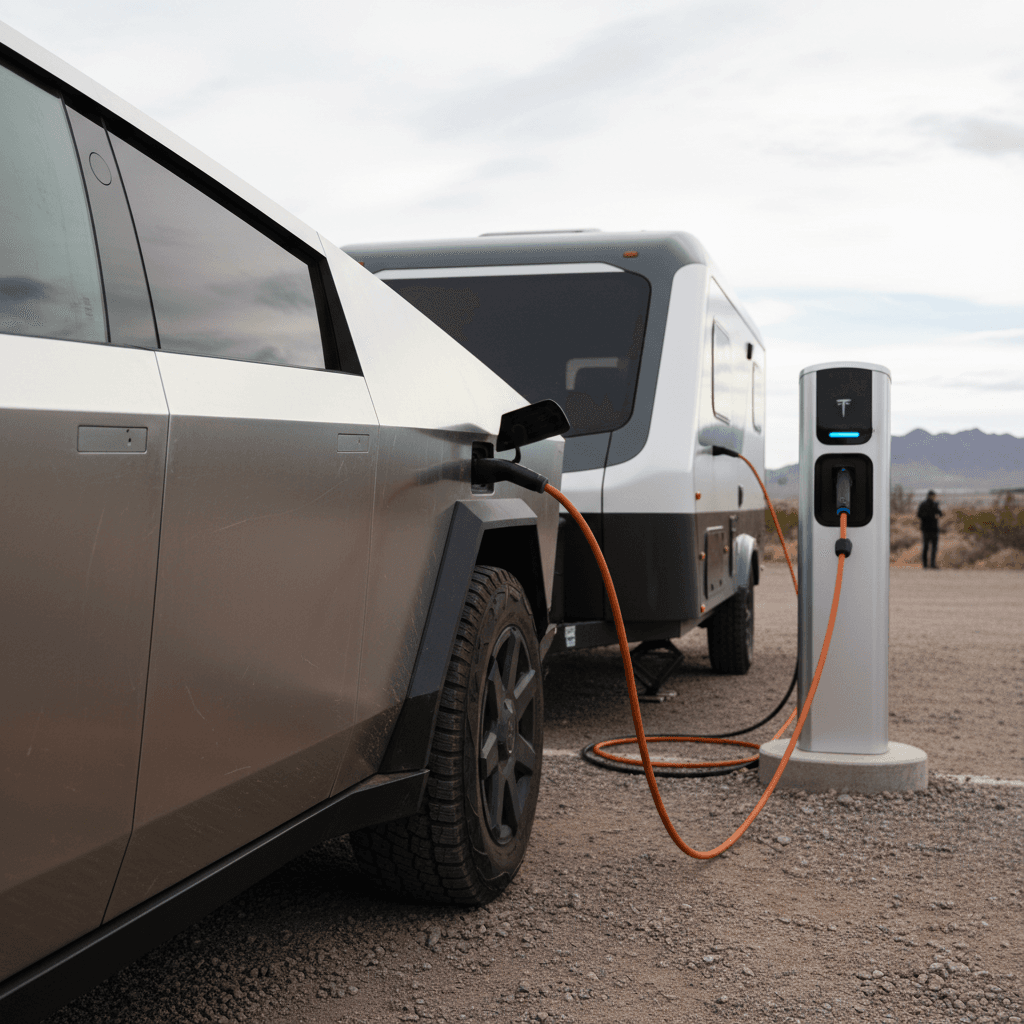
Independent early tests give us a useful window into Cybertruck’s towing behavior. In one widely discussed run, a dual‑motor truck towing roughly 6,000 lbs (a Model Y on a U‑Haul car hauler) averaged about 749 Wh per mile over 110 miles and used 83 kWh of its pack. Extrapolated to a full charge, that’s on the order of 160 miles of total range while towing in those conditions.
Light aero trailer (3,000–4,000 lbs)
Think small travel trailer or open utility trailer with a side‑by‑side. In good weather, 60–65 mph, and flat-ish terrain, many owners will see ~200 miles between charges from a full battery, sometimes a bit more.
The truck’s shape helps, but a boxy trailer still punches a big hole in the air.
Heavier, boxy trailer (6,000–8,000 lbs)
With a tall camper or car hauler, especially at 70+ mph, it’s more realistic to plan around 130–180 miles before you’ll really want a DC fast‑charge stop.
Hills, headwinds, and winter temps all shave that number down further; a range extender or frequent stops become non‑negotiable for long hauls.
EV towing rule of thumb
How Cybertruck compares to gas and other EV trucks
On pure tow rating, the Cybertruck sits in the same neighborhood as mainstream half‑tons but well below the brawniest HD diesels. Its party trick isn’t max numbers; it’s how calmly it tows up to that number, quiet, instant torque, one‑pedal driving, if you’re willing to live with more frequent fuel stops in the form of DC fast charging.
Cybertruck vs gas and EV truck rivals
Tow numbers are just part of the story; how often you stop and what it costs also matters.
Vs. half‑ton gas trucks
Ford F‑150, Silverado 1500, Ram 1500 can tow roughly 11,000–13,500 lbs in the right configuration, usually a bit higher than Cybertruck.
They’ll go farther per tank while towing, but you’ll feel every downshift and fuel bill.
Vs. HD diesels
Ram 3500, F‑250/350, Silverado HD can pull 20,000+ lbs. If you’re hauling big fifth‑wheels or equipment, they’re still in a different league.
Cybertruck simply isn’t aimed at that market.
Vs. other electric trucks
Rivian R1T and Ford F‑150 Lightning top out around 10,000 lbs of tow capacity with similar “half‑range when towing” behavior.
Cybertruck’s efficiency and Tesla’s Supercharger access give it an edge on road‑trip convenience in many regions.
Where the Cybertruck shines
Planning a trip while towing with a Cybertruck
EV towing is part logistics puzzle, part personality test. The Cybertruck gives you the tools, tow mode, live energy predictions, Supercharger routing, but you still need a plan. Here’s a simple workflow that works whether you’re hauling to a race weekend or a family campground.
Step‑by‑step Cybertruck towing trip plan
1. Define your real trailer weight
Don’t use brochure dry weight. Add water, propane, cargo, and toys to estimate the true loaded weight, and compare that to your truck’s tow and payload ratings.
2. Map your route at 150‑mile intervals
In the Tesla navigation or third‑party apps, drop pins every 120–160 miles along your route near high‑speed chargers. You may skip some in practice, but they’re there if weather or headwinds spike consumption.
3. Verify charger access with a trailer
Not every DC fast charger is trailer‑friendly. Superchargers often are, but some sites require you to <strong>unhitch</strong>. Street‑view and user photos are your friends.
4. Aim for 10–80% state of charge
Plan to arrive at chargers around 10–20% and leave around 70–80%. Above ~80%, fast‑charge speeds taper off hard and you’re burning daylight for little gain.
5. Use Tow Mode and watch the prediction graph
Turn on Tow Mode so the Cybertruck adjusts traction control, stability, and range prediction around your trailer. Let the energy graph teach you how speed and wind affect your consumption.
6. Build in buffer time
Add at least 25–30% extra time to whatever your favorite mapping app says. Towing slows you down anyway, and charging breaks become snack, kid, and dog breaks.
The time‑cost of EV towing
How to maximize range when you’re towing
You can’t change physics, but you can choose which side of it you live on. With the Cybertruck, small choices add up to meaningful range gains when you’re pulling a trailer.
Six ways to stretch your towing range
Every little bit helps when you’re pushing a wall of air.
Slow down to 60–65 mph
Aerodynamic drag rises with the square of speed. Dropping from 75 to 65 mph can easily give you 20–30% more range while towing.
Mind the wind and weather
Headwinds and cold temperatures are silent range killers. If a front is moving through, shorten your legs or charge a bit deeper at each stop.
Pack light and low
Keep heavy items low and near the trailer’s axles, and avoid stacking tall cargo on the roof or front of the trailer where it adds drag.
Use the tonneau cover
If your trailer allows it, running the Cybertruck’s powered tonneau closed cleans up airflow over the bed and can shave a bit off consumption.
Choose saner routes
A slightly longer route with gentler grades and more chargers can be faster in practice than a shorter, mountainous path with limited charging.
Keep the battery happy
Precondition the pack before fast‑charging and avoid sitting at 100% for long periods. That helps preserve long‑term battery health and keeps peak range intact, especially important on a used Cybertruck.
Used Cybertruck buyers: check battery health
Is the Cybertruck right for your towing needs?
The Cybertruck upends the traditional truck value equation. Instead of asking, “Can it tow the biggest number on the brochure?” you should be asking, “Does its towing capacity and range align with how I actually use a truck?” For many owners, the honest answer is yes, within a specific envelope.
Great fit
- You tow 5–8k lbs a handful of times a year, boats, mid‑size campers, car trailers.
- Your typical tow trip is under 300 miles a day, or you’re fine building in charging and sightseeing time.
- You value the quiet, instant‑torque EV experience as much as raw capability.
- You have reliable home or workplace charging to refill cheaply overnight.
Think twice
- You routinely tow 10k+ lbs across long distances on tight schedules.
- Your routes run through sparse charging regions with limited Superchargers or CCS fast chargers.
- You need a truck to double as a daily heavy construction workhorse where uptime and payload trump everything.
- You’re uncomfortable planning around charging stops and energy graphs.
Leaning toward a used Cybertruck?
Ready to find your next EV?
Browse VehiclesFAQ: Tesla Cybertruck towing capacity and range
Frequently asked questions
The Tesla Cybertruck is a deeply modern answer to an old question: how do I move heavy things from A to B without hating the experience? On paper it boasts stout towing capacity; on the road it trades diesel‑like range for silent thrust and smart software. If your real life looks like weekend boats and campers more than daily 14,000‑lb equipment hauls, and you’re willing to plan your stops, its combination of towing capability and usable range may be more than enough. And if you’re considering a used Cybertruck or another electric truck for towing, Recharged can help you decode battery health, true range, and fair pricing so you buy a rig that matches the way you actually tow.