If you’re looking at a used Chevy Bolt, you’re probably wondering what the real Chevy Bolt EV range looks like today, not just the number on a window sticker from years ago. The good news: when you understand how EPA ratings, driving style, weather, and battery health interact, the Bolt’s range is not only predictable, it’s one of the strongest values in the used EV market.
Quick answer
Chevy Bolt EV range at a glance
Official Chevy Bolt EV & EUV range numbers
For range discussions, it helps to separate generations and trims. In the real world today there are three "Bolts" you’ll see on the used market: - 2017–2019 Bolt EV – 60 kWh pack, 238‑mile EPA rating. - 2020–2023 Bolt EV – 65 kWh pack, 259‑mile EPA rating. - 2022–2023 Bolt EUV – same 65 kWh pack in a slightly larger body, 247‑mile EPA rating. GM ended production of this first‑generation Bolt family in late 2023, and a second‑generation Bolt is slated for 2026+ on GM’s Ultium platform. That means every Chevy Bolt EV or EUV you see listed today is effectively a used EV, and range depends heavily on how that specific car has been driven and cared for.
Shopping shorthand
EPA vs real-world Chevy Bolt EV range
EPA numbers are a good starting point, but they’re not a promise. They’re based on a standardized test cycle that mixes city and highway driving under controlled conditions. In the real world, speed, temperature, elevation, and HVAC use move your range up or down. The Bolt happens to be fairly honest: independent testing has shown the 259‑mile Bolt EV can slightly beat its EPA rating on a mild‑weather mixed route, and owner reports back that up.
EPA vs real-world Chevy Bolt EV & EUV range
Approximate ranges assume a healthy battery and moderate driving. Your results will vary by climate and speed.
| Model & scenario | EPA rating | Typical real-world | Notes |
|---|---|---|---|
| 2020–2023 Bolt EV – mixed driving, mild weather | 259 mi | 230–280 mi | Many owners can match or exceed EPA in 60–75°F weather |
| 2020–2023 Bolt EV – 70–75 mph highway, mild weather | 259 mi | 200–230 mi | Highway aero drag and speed matter more than anything else |
| 2020–2023 Bolt EV – cold winter highway | 259 mi | 170–210 mi | Cabin heat + cold battery can trim 20–35% |
| 2022–2023 Bolt EUV – mixed driving, mild weather | 247 mi | 220–260 mi | Slightly less efficient, but same pack and motor |
| 2017–2019 Bolt EV – mixed driving, mild weather | 238 mi | 210–250 mi | Older pack, smaller capacity, but still strong if healthy |
How EPA ratings translate into day‑to‑day experience for most drivers.
Don’t plan around 0%
Bolt EV vs Bolt EUV range compared
Bolt EV (hatchback)
- EPA range: 259 miles (2020–2023)
- Strengths: Best efficiency and range, slightly lighter and lower than the EUV.
- Who it fits: Commuters, efficiency nerds, people who prioritize range over rear-seat space.
Bolt EUV (small crossover)
- EPA range: 247 miles (2022–2023)
- Strengths: More rear legroom, available Super Cruise, more SUV‑like stance.
- Who it fits: Families, rear‑seat passengers, or anyone willing to trade ~10–15 miles of range for comfort.
On paper the difference between 259 miles and 247 miles doesn’t sound huge, and in practice, it isn’t. On most days, Bolt EV and Bolt EUV owners experience very similar range, especially at lower speeds in the city. Where you’ll notice the EUV’s slightly worse aero is on long, fast highway runs, where its taller shape and extra weight cost a bit more energy per mile.
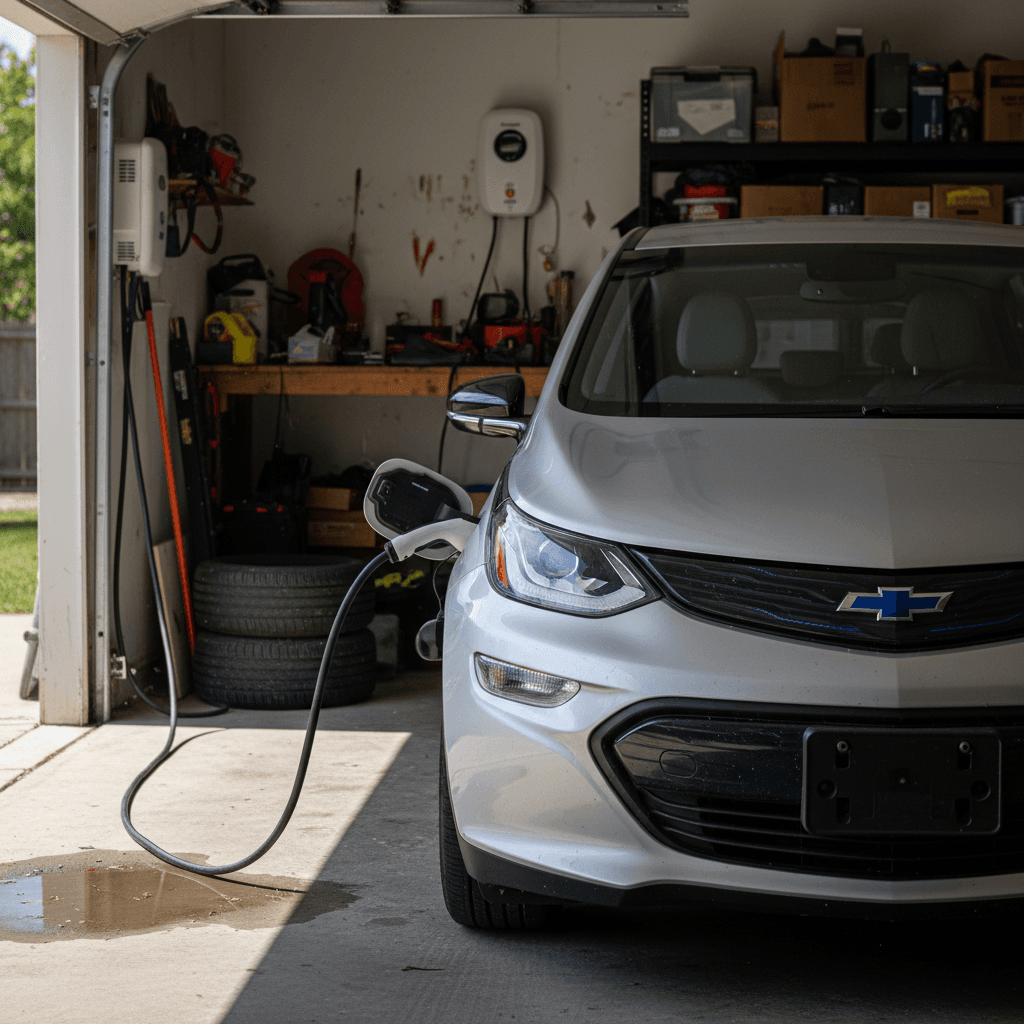
City vs highway vs weather: what actually cuts your range
Four big factors that move your range up or down
EPA ratings assume a mix. Real life usually doesn’t.
Speed & aerodynamics
Temperature
Drive cycle
Battery & tires
Think in mi/kWh, not miles
Battery degradation: how Bolt packs hold up over time
Because every Bolt on the market today is a used car, the key range question becomes: how much battery has it actually lost? GM’s 65 kWh replacement and later‑model packs have developed a reputation for better‑than‑average longevity, especially compared with some early EVs. Owner‑collected data and long‑term reports generally show modest degradation in the first few years, then a long, slow plateau.
- Many owners with 2020+ Bolt EVs report usable capacity still in the low‑60 kWh range after tens of thousands of miles.
- Data sets comparing the original 60 kWh pack to the newer 65 kWh pack show the newer chemistry degrading at roughly half the rate over a similar timeframe.
- Real-world anecdotes of 100k‑mile Bolts still comfortably hitting 200+ miles on a charge in decent weather are common.
Why that matters for range
Signs a Bolt’s battery may have lost noticeable range
Unrealistic guess‑o‑meter swings
If the range estimate drops sharply in the first few miles, or fluctuates wildly day‑to‑day, it may point to a pack or sensor that needs closer inspection.
Low predicted range in mild weather
On a full charge at 60–75°F, a 2020–2023 Bolt EV showing <strong>well under ~220 miles</strong> with normal driving habits is worth a deeper look.
DC fast charging feels unusually slow
Fast chargers that ramp quickly on other EVs but limit your Bolt to very low power could indicate a battery that is cold, degraded, or being heavily protected by software.
Error messages or reduced propulsion warnings
Any high‑voltage battery or reduced power alerts should be taken seriously and evaluated before you rely on the car’s full range. This is where a professional inspection, and a solid warranty, matters.
Don’t rely on a range guess alone
How far you can really go on a trip
Once you understand usable capacity and degradation, trip planning becomes a math problem instead of a leap of faith. With about 65 kWh usable in a healthy newer Bolt and real‑world efficiency between 3.0 and 4.0 mi/kWh depending on speed and conditions, you can back into realistic scenarios pretty quickly.
Common Chevy Bolt EV trip scenarios
These are ballpark numbers for a healthy 2020–2023 Bolt EV starting at 90–100% and arriving with 10% buffer.
| Scenario | Assumed efficiency | Usable battery window | Comfortable distance between charges |
|---|---|---|---|
| Summer mixed driving, 45–65 mph | 4.0 mi/kWh | ~80% of 65 kWh ≈ 52 kWh | ~200–210 miles |
| Summer highway, 70–75 mph | 3.2 mi/kWh | ~52 kWh | ~165–175 miles |
| Cold winter highway, 65–70 mph | 2.5 mi/kWh | ~52 kWh | ~125–135 miles |
| City‑heavy driving in mild weather | 4.5 mi/kWh | ~52 kWh | ~230–240 miles |
How far you can comfortably plan between stops in different situations.
Use 10–80% for fast‑charging trips
Simple ways to improve your Chevy Bolt range
Six easy levers to pull for more real-world range
None of these require babying the car – they’re just smart adjustments.
Dial back highway speed
Pre‑condition in winter
Prefer seat and wheel heaters
Use one‑pedal driving
Check tire pressures
Travel light & clean
Buying a used Chevy Bolt EV: range questions to ask
A key advantage of the Bolt is that range is quantifiable if you have the right data. When you’re considering a used Bolt EV or EUV, a short test drive and a window sticker won’t tell you enough. You want to understand both the battery’s health and how that translates into usable miles for your lifestyle.
Range-focused questions to ask before you buy
1. Which battery and model year is it?
Clarify whether you’re looking at a <strong>2017–2019 (238‑mile)</strong> Bolt EV, a <strong>2020–2023 (259‑mile)</strong> Bolt EV, or a <strong>2022–2023 (247‑mile)</strong> Bolt EUV. This sets your baseline expectation before any degradation.
2. What’s the verified usable capacity?
Ask for a <strong>battery health report</strong>, not just a screenshot of the range estimate. At Recharged, every car gets a <strong>Recharged Score battery diagnostic</strong>, so you see usable capacity rather than guessing from the dash.
3. How and where has the car been driven?
Lots of <strong>high‑speed highway miles</strong> and frequent <strong>DC fast charging</strong> aren’t necessarily bad, but they matter for context. Similarly, life in extreme heat or cold can impact long‑term degradation.
4. How does it perform on a realistic test route?
A short drive at <strong>your typical speeds</strong> in <strong>similar traffic</strong> will tell you much more than a spin around the block. Watch the efficiency (mi/kWh) and estimate range from that, not just the guess‑o‑meter.
5. What warranty or return options exist if range disappoints?
Especially on higher‑mileage cars, it’s reassuring to know you’re not stuck if the pack turns out weaker than expected. A transparent seller should be comfortable backing up their battery claims.
6. Does the price reflect the car’s actual range?
Two Bolts with the same model year and mileage can have <strong>meaningfully different usable range</strong>. At Recharged, fair market pricing is informed by both <strong>condition and battery health</strong>, so you’re not overpaying for a tired pack.
How Recharged approaches Bolt range
Chevy Bolt EV range FAQ
Chevy Bolt EV range: frequently asked questions
Bottom line: Is the Chevy Bolt’s range enough?
If you strip away the marketing and the mythology, the Chevy Bolt EV range story is simple: it delivers honest, usable miles at a price that undercuts most competitors, especially on the used market. The 65 kWh cars, in particular, offer enough range that even with some degradation you’re still comfortably inside the envelope for commuting, errands, and plenty of regional trips.
The right question isn’t “Is the Bolt’s range good?”, it’s “Is this specific Bolt’s range right for my life?” That comes down to your daily miles, your access to charging, your climate, and the health of the particular battery you’re buying. When you layer those realities on top of a transparent battery health report and fair pricing, the Bolt stops being a speculative bet and starts looking like what it is: one of the best range‑per‑dollar EVs you can buy used today.
Ready to find a Bolt that fits your range needs?
Ready to find your next EV?
Browse Vehicles