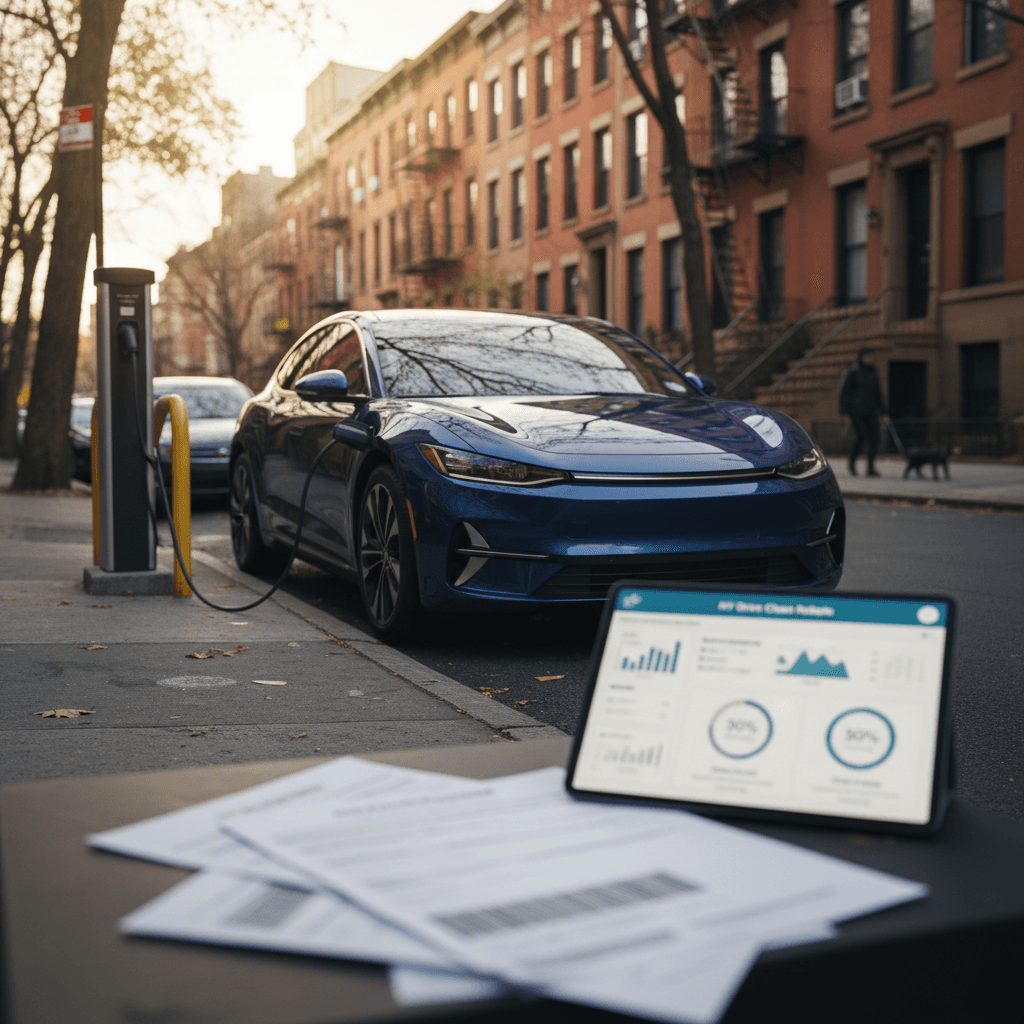
If you live in Brooklyn and you’re even half-thinking about going electric, EV rebates are the difference between *interesting idea* and *no‑brainer*. The good news: there are still meaningful EV rebates in Brooklyn in 2026, federal, New York State, and Con Edison programs you can stack, especially if you’re smart about buying used.
Why timing matters
Why EV rebates matter in Brooklyn right now
Brooklyn is almost a laboratory for the future of car ownership: dense, transit-rich, street-parking-heavy, and increasingly hostile to gas cars via congestion, parking costs, and air-quality rules. At the same time, electricity in New York is not cheap, and new EV sticker prices can feel out of reach. That’s where rebates and incentives come in: they don’t just knock a few dollars off the window sticker; they can be the difference between a $450 monthly payment and a $320 payment on a practical EV, especially when you look at used models.
Brooklyn EV savings at a glance
Quick overview: EV rebates available in Brooklyn
The main EV rebate buckets for Brooklyn drivers
You’re juggling three arenas: federal, state, and local/utility.
1. Federal incentives
New EVs: The classic $7,500 credit has largely sunset after September 30, 2025, with narrow exceptions and lease-based workarounds.
Used EVs: A separate credit of up to $4,000 still exists for qualifying buyers and vehicles, but is subject to phase-outs and political crossfire.
2. New York State programs
Drive Clean Rebate: Up to $2,000 off a new EV at the dealership.
State guidance on IRA credits: NYSERDA maintains up-to-date lists of models that qualify for both state rebates and whatever is left of federal credits.
3. Local & utility incentives
Con Edison SmartCharge New York: Cash rewards, often around $400/year, for off‑peak charging in Brooklyn.
Workplace & multifamily charging: Property owners can tap separate rebates to install Level 2 chargers in garages and lots.
Look beyond the sticker price
Federal EV tax credits after 2025: what’s left?
The 30D New Clean Vehicle Credit under the Inflation Reduction Act originally offered up to $7,500 for qualifying new EVs, plus a separate used EV credit. Beginning in 2024 and 2025, tougher content rules and a new “foreign entity of concern” restriction narrowed the list of eligible vehicles, and by September 30, 2025, Congress effectively ended the broad $7,500 consumer credit for most retail purchases. A few carve‑outs remain, especially via leasing and for contracts signed before the cutoff, but you should think of the classic new‑EV tax credit as a party that is mostly over.
New EVs
- The straightforward $7,500 new EV tax credit is now heavily restricted and effectively sunset for most direct retail buyers.
- Some automakers still bake in a $7,500 lease incentive for EV leases because their finance arms can claim commercial credits, then pass savings through as discounts.
- Eligibility depends on final assembly in North America, battery content rules, price caps, and your income caps.
Used EVs
- A separate used EV credit, 30% of the price up to $4,000, is still available for qualifying buyers and vehicles, but is scheduled for its own phase‑outs.
- Vehicle must be at least 2 model years old, bought from a dealer, under a price cap (historically $25,000), and you can’t be claimed as someone else’s dependent.
- Income limits apply here too, but they’ve been lower than the new‑EV thresholds, which often makes this credit a better fit for middle‑income Brooklyn households.
Policy is a moving target
New York’s Drive Clean Rebate for new EVs
Unlike the federal roller coaster, New York’s Drive Clean Rebate is boring in the best possible way. It’s a straightforward, point‑of‑sale rebate applied right on the purchase or lease contract for a new EV, available in all 62 counties, including Kings County (Brooklyn). For many Brooklyn buyers, this is the single most reliable chunk of money on the table for a new electric car.
How the NY Drive Clean Rebate works
Rebate amounts depend on MSRP and electric range.
| EV type / range | Rebate amount | Key conditions |
|---|---|---|
| All‑electric, >200 miles range | $2,000 | MSRP cap applies; must be on NYSERDA’s eligible model list |
| All‑electric, 40–199 miles range | $1,000 | Shorter‑range BEVs and some plug‑in hybrids |
| Plug‑in hybrid, <40 miles range | $500 | Mostly older or lower‑range PHEVs |
| Any EV with MSRP >$42,000 | $500 | Higher‑priced models get a flat, smaller rebate |
All rebates are applied at the dealership as an instant discount.
The beauty of Drive Clean is that you don’t have to file anything with Albany yourself. Participating dealers handle the paperwork and simply subtract the rebate from your purchase price or capitalized cost if you lease. On a $36,000 long‑range EV, that $2,000 is effectively your down payment.
Stacking with federal and local perks
Used EV rebates and tax credits for Brooklyn drivers
Now to the sweet spot for a lot of Brooklynites: used EVs. New York’s Drive Clean Rebate is for new cars only, but the federal used EV credit and your lower running costs can make a two‑ or three‑year‑old EV the smartest money in the borough.
- Federal used EV credit of up to $4,000 (30% of price) for qualifying buyers and vehicles, subject to income and price caps and eventual phase‑outs.
- Lower depreciation hit: new EVs have already taken their biggest value drop in the first 2–3 years, so someone else funded that discount for you.
- Brooklyn‑friendly sizes: models like Nissan Leaf, Chevy Bolt, Hyundai Kona Electric, and older Tesla Model 3s are easy to park, cheap to fuel, and widely available on the used market.
At Recharged, every used EV comes with a Recharged Score Report that includes battery health diagnostics, so you’re not guessing about degradation, crucial when you’re banking on a smaller rebate but plan to keep the car for years.
Utility and charging incentives in Brooklyn
In New York City, your local incentives mostly flow through Con Edison. For Brooklyn drivers, the big one is a charging‑behavior program rather than a one‑time cash rebate.
Key Con Edison EV programs for Brooklyn residents
You don’t need a driveway in Park Slope to capture some of this value.
SmartCharge New York (Con Edison)
SmartCharge pays you to charge off‑peak, typically midnight–8 a.m. Eastern.
- Average earnings around $400 per year per vehicle or charger.
- 10¢ per kWh bonus for off‑peak charging.
- Seasonal bonuses for avoiding weekday summer peaks.
- One‑time enrollment and "avoid peak" bonuses plus refer‑a‑friend credits.
Great if you have home or workplace charging and can schedule overnight sessions.
Multifamily & workplace charging
Through NYSERDA’s Charge Ready NY 2.0, building owners in Brooklyn can get per‑port rebates to install Level 2 chargers in garages and lots.
- Higher incentives for locations in disadvantaged communities.
- Useful leverage when lobbying your landlord or condo board.
These rebates don’t go directly to drivers, but they create more places to plug in close to home.
Don’t ignore workplace charging

Real-world savings examples for Brooklyn drivers
Let’s translate all this policy into a Brooklyn‑sized reality check. These are simplified examples assuming incentives remain in their current structure and that you meet the income and vehicle‑eligibility rules. Numbers are illustrative, not tax advice.
Sample EV rebate scenarios for Brooklyn
Approximate savings for three common buyer profiles.
| Scenario | Vehicle type & price | Key incentives | Estimated net savings |
|---|---|---|---|
| Bushwick renter, used EV | 2019 Nissan Leaf SV, $15,000 from a dealer | Used federal EV credit up to $4,000 (30% of price) | ≈$4,000 off via tax credit |
| Park Slope family, new long‑range EV | New 2025 Hyundai Ioniq 5, $44,000 MSRP | $2,000 NY Drive Clean + potential lease‑based $7,500 incentive | ≈$9,500 in stacked support if structure remains |
| Sunset Park commuter, modest new PHEV | New plug‑in hybrid with 35‑mile electric range, $34,000 | $1,000–$2,000 Drive Clean (depending on final range), limited or no federal credit | ≈$1,000–$2,000 at point of sale |
All numbers are rough estimates and exclude sales tax and registration fees.
Don’t buy on the incentive alone
How to stack Brooklyn EV rebates step by step
Step-by-step playbook for Brooklyn EV savings
1. Decide new vs. used first
Before you chase any incentives, be honest about budget, parking, and how long you’ll keep the car. If you’re payment‑sensitive and don’t need the latest tech, a used EV, especially via a specialist marketplace like Recharged, is usually the better economic play in Brooklyn.
2. Check current federal rules
Visit the IRS and Department of Energy clean vehicle credit tools to see which new or used EVs still qualify and confirm income limits. Screenshot or print the relevant pages; rules are in flux and you want a record of what you saw when you made the decision.
3. Cross-reference NYSERDA’s eligible model lists
On NYSERDA’s site, pull up the latest <strong>Drive Clean Rebate</strong> model list and, if you’re shopping new, look for overlap with any remaining federal eligibility. This is where you’ll find the best new‑EV stack: one car that hits both pots of money.
4. Run the numbers with total cost of ownership
Don’t stop at MSRP minus rebates. Compare monthly payment, insurance, fuel, and maintenance versus your current gas car. Used EVs with strong battery health (backed by a <strong>Recharged Score</strong>) often win this math even with smaller or no incentives.
5. Get pre-approved before you shop
Brooklyn dealers are busy, and the easiest way to protect yourself from "creative" finance math is to walk in pre‑approved. Recharged can help you <a href="/financing">pre‑qualify for EV financing</a> online with no impact on your credit, so you know your ceiling before you fall in love with a car.
6. Enroll in SmartCharge once you have the car
As soon as you take delivery and have a regular charging spot, home, workplace, or a garage that allows overnight sessions, enroll in Con Edison’s <strong>SmartCharge New York</strong>. Set a calendar reminder to review your earnings after three months so you can see your true all‑in savings.
Common pitfalls and how to avoid them
Brooklyn EV rebate mistakes (and fixes)
You’re not the first person to trip over fine print.
Buying from a private seller
Problem: The federal used EV credit only applies if you buy from a dealer, not your neighbor in Bay Ridge.
Fix: Use a licensed retailer or marketplace like Recharged that can provide the paperwork your tax preparer needs.
Missing income and price limits
Problem: You assume you qualify for incentives, then discover your income or the car’s price busts through the caps.
Fix: Check income and MSRP/price thresholds for every program before you test‑drive anything.
No realistic place to charge
Problem: You hop on a great rebate, then realize street parking in Carroll Gardens makes charging a weekly scavenger hunt.
Fix: Line up a charging strategy, garage, workplace, or DC fast‑charging plan, before you buy. Incentives don’t fix a bad charging fit.
Assuming incentives are forever
Problem: You plan to buy "next year" and discover Congress or Albany changed the rules.
Fix: Treat incentives you see today as expiring opportunities. If the deal works for you now, waiting rarely makes it better.
FAQ: EV rebates in Brooklyn
Frequently asked questions about EV rebates in Brooklyn
Bottom line: Should you buy a used EV in Brooklyn now?
If you strip away all the acronyms and political noise, the story in 2026 is simple: the federal buffet is shrinking, but New York State and Con Edison still want you in an EV, and the used market has never been richer. For many Brooklyn drivers, especially apartment dwellers with stable parking or reliable access to workplace charging, a well‑vetted used EV, backed by transparent battery health and fair pricing, is the lowest‑risk path into electric ownership.
That’s exactly the corner of the market Recharged was built for. Our Recharged Score Report takes the guesswork out of battery life, our financing options are designed for real‑world budgets, and we can help you map which EV rebates in Brooklyn you can still use on top of a smart used‑car deal. If the numbers add up and the car fits your life, the best rebate is the one you capture now, not the one you keep waiting for.