If you’re looking at a Chevy Bolt, you’re probably asking a simple question with a not‑so‑simple answer: how far will this EV really go on a charge? Official numbers for Chevy Bolt electric range look great on paper, but your actual miles depend on the model year, weather, speed, and how the battery has been treated, especially on a used Bolt. This guide breaks it down so you know exactly what to expect before you buy.
Why range matters more on a used Bolt
Chevy Bolt electric range at a glance
Chevy Bolt electric range snapshot
In practical terms, most healthy first‑generation Chevy Bolt EVs and EUVs deliver around 200–230 miles of real-world range in mixed driving for most owners, with more in city use and less at 75‑mph highway speeds or in deep winter. The upcoming second‑generation 2027 Bolt targets a similar headline range but with faster charging and a different battery chemistry.
EPA-rated Chevy Bolt range by model year
To make sense of Chevy Bolt electric range, start with the official EPA numbers. Think of these as a best‑case, mixed‑driving benchmark, not a guarantee of what you’ll see every day.
Chevy Bolt EV and Bolt EUV EPA range by generation
Key EPA-rated range figures you’ll see on window stickers and spec sheets.
| Generation / model | Model years | Battery (usable) | EPA combined range | Notes |
|---|---|---|---|---|
| Bolt EV (early) | 2017–2019 | ~60 kWh | 238 mi | Original pack; many received replacement batteries under recall. |
| Bolt EV (updated) | 2020–2021 | ~65 kWh | 259 mi | Efficiency tweaks and slightly larger usable pack. |
| Bolt EV (refresh) | 2022–2023 | ~65 kWh | 259 mi | Restyled interior/exterior; range essentially unchanged. |
| Bolt EUV | 2022–2023 | ~65 kWh | 247 mi | Slightly larger body, a bit less efficient than EV. |
| Bolt (Ultium, est.) | 2027+ | 65 kWh LFP | ~250–255 mi | Second generation on Ultium platform, LFP chemistry, faster fast‑charging. |
EPA ratings assume moderate temperatures and mixed driving; your actual range will vary.
Don’t over-interpret a single number
Real-world Chevy Bolt range: city, highway, and seasons
Chevy Bolt owners quickly learn that how and where you drive matters as much as the badge on the hatch. The same Bolt that looks like a 259‑mile car on paper can be a 190‑mile car at 75 mph into a headwind, or a 300‑mile car creeping through city traffic on a mild day.
Typical real-world range scenarios for a healthy Bolt
Assuming a Bolt EV/EUV with a good battery and no extreme terrain.
City & suburban driving
In 35–45 mph traffic with frequent stops and good use of regen, many owners see 10–20% better than EPA.
- 2020–2023 Bolt EV: ~270–300 miles
- Bolt EUV: ~260–280 miles
Highway at 65–70 mph
On flat highways at 65–70 mph in mild weather, range typically falls in line with EPA or a bit below.
- Bolt EV: ~220–250 miles
- Bolt EUV: ~210–235 miles
Cold-weather highway driving
Below freezing, with heat on and speeds above 70 mph, you can see 30–40% less range.
- Bolt EV: ~150–190 miles
- Bolt EUV: ~145–185 miles
Winter preconditioning pays off
Why Bolts love city driving
The Bolt’s single-speed drivetrain and strong regenerative braking mean it wastes very little energy at lower speeds. Every time you lift off the accelerator, the car recovers some of that motion back into the battery. In stop‑and‑go traffic, that adds up, so it’s common to beat the EPA rating in city use.
Why high speeds shrink your range
Above about 60 mph, aerodynamic drag climbs quickly. Push a Bolt to a steady 75–80 mph and your energy use per mile jumps, shaving dozens of miles off a charge. If you road‑trip often on fast interstates, plan around those lower real‑world numbers, not the EPA sticker.
Battery size, chemistry, and why they matter for range
Under the floor, all first‑generation Bolt EV and EUV models rely on a lithium‑ion pack in the roughly 60–65 kWh usable range. That’s the real workhorse behind the 238–259‑mile EPA ratings. The upcoming 2027 Bolt switches to a 65‑kWh LFP pack on GM’s Ultium platform, which changes how the car behaves day‑to‑day without radically changing the headline range.
- 2017–2019 Bolt EV: Older chemistry, officially ~60 kWh usable and 238‑mile EPA range; many have received newer packs under the recall, bringing them closer to later models in capacity and range.
- 2020–2023 Bolt EV/EUV: Newer pack with about 65 kWh usable and 259‑mile (EV) or 247‑mile (EUV) EPA ratings, plus modest efficiency tweaks.
- 2027 Bolt (Ultium): 65‑kWh LFP pack, roughly 250–255 miles of estimated range, with faster DC charging and a shift to the NACS (Tesla-style) plug.
LFP vs. NMC in simple terms
What range means when you’re shopping a used Bolt
If you’re considering a used Chevy Bolt, range isn’t just a spec sheet number, it’s a window into how the battery has aged and whether the car still fits your lifestyle. Two identical 2022 Bolts can drive very differently if one spent its life on fast chargers at 100% charge and the other mostly trickle‑charged in a temperate garage.
Used Chevy Bolt range checks before you buy
1. Compare displayed range at 100% to EPA
Fully charge the car and note the estimated range. A healthy Bolt EV that originally had 259 miles EPA shouldn’t be showing 170 unless it has a lot of hard miles or the estimate is based on unusually aggressive recent driving.
2. Ask whether the battery was replaced under recall
Many 2017–2019 cars and some later ones received new packs. A recall replacement often means you’re effectively getting a newer battery with less real‑world degradation than the odometer suggests.
3. Look at lifetime energy use
In the Bolt’s energy screens, check average kWh/100 miles or Wh/mile. Very high numbers suggest lots of fast highway or heavy‑foot driving, which can influence both range and long‑term battery health.
4. Test a realistic drive loop
If possible, do a 30–40 mile loop on your typical mix of roads. Compare miles driven to the drop in remaining range to get a feel for how the car will behave on your commute.
5. Consider your daily range needs
Work backward from your longest regular day. If you do 120 miles round‑trip at highway speeds, a Bolt that realistically offers 180–200 miles year‑round may still work; if you’re regularly pushing the edge, look for a stronger battery or plan to charge at your destination.
6. Use independent battery diagnostics
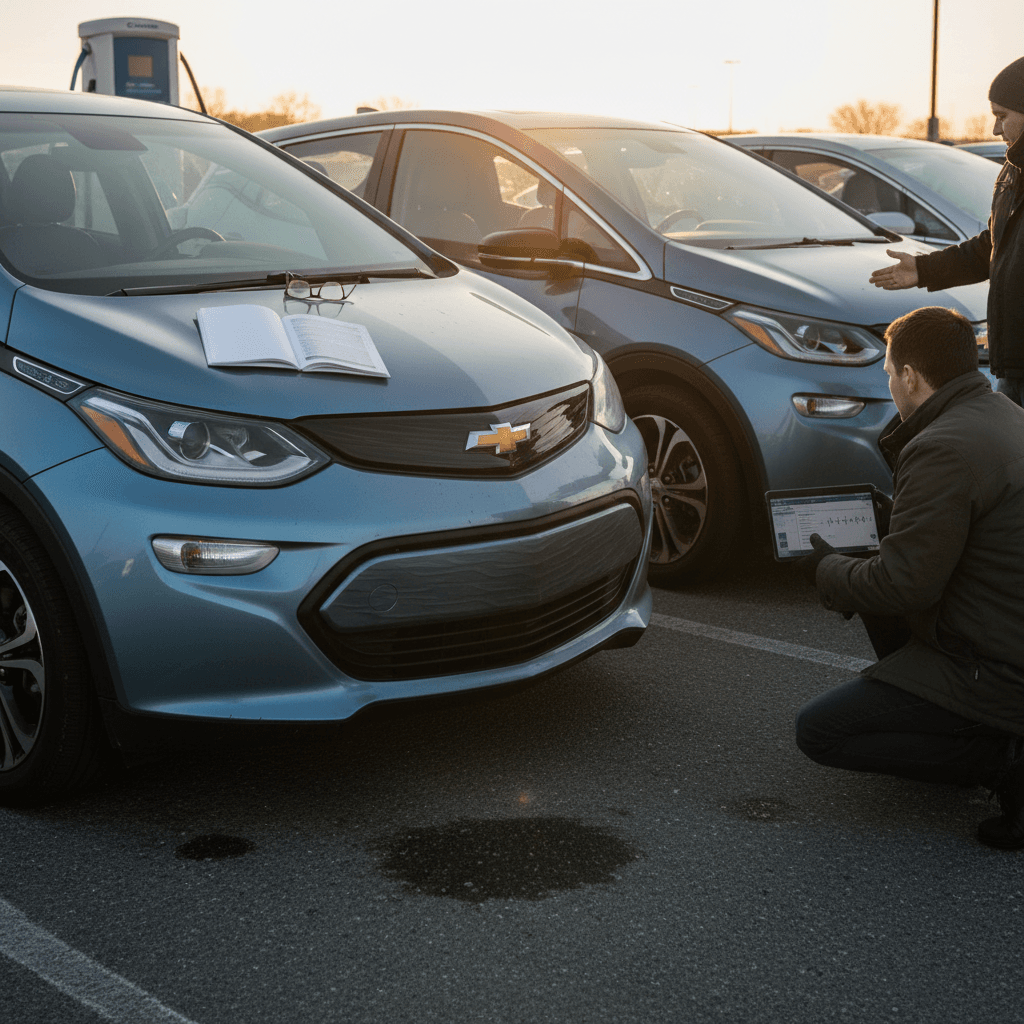
A proper state‑of‑health test tells you far more than a guess based on the dash estimate. At Recharged, every vehicle comes with a <strong>Recharged Score Report</strong> that includes verified battery health and range insight so you’re not buying blind.
How Recharged helps de-risk Bolt range
Ready to find your next EV?
Browse VehiclesCharging speeds, DC fast charging, and road-trip range
Range is only half the story; how fast you can add miles back matters just as much. The first‑gen Bolt isn’t a charging monster by 2025 standards, but it’s still very workable for road trips if you manage expectations.
Chevy Bolt charging and range recovery
How quickly you can add usable miles back to the pack.
Level 1 (120V wall outlet)
Slow but steady, about 3–4 miles of range per hour of charging. Best for topping up overnight on low-mileage days or as a back‑up at destinations.
Level 2 (240V home or public)
With a 32–48A Level 2 charger, you’re typically adding 25–35 miles of range per hour, taking a depleted pack to full in roughly 7–9 hours.
DC fast charging
First‑gen Bolts peak around 50–55 kW, which usually means roughly 90–100 miles in 30 minutes under good conditions. The 2027 Bolt targets up to 150 kW and much faster 10–80% times.
Hot battery, slower charging
Planning around realistic highway legs
On a 2022–2023 Bolt EV, a good long‑term strategy is treating it as a 180–200‑mile highway car between comfortable DC fast charges. That usually means starting around 80–90% and arriving near 10–15%, where charging is still reasonably quick.
Second‑gen Bolt: faster stops, similar range
The 2027 Bolt’s Ultium/LFP pack doesn’t radically boost range, but the jump to around 150 kW DC fast charging and a NACS (Tesla) port should make road‑tripping much easier. You’ll likely do similar leg lengths, but you’ll spend far less time parked at each charger.
How to get the most range from your Chevy Bolt
Maximizing range in a Chevy Bolt is less about driving painfully slowly and more about stacking a few smart habits. Many owners pick up 10–20% more usable range just by tweaking how they charge, drive, and heat or cool the cabin.
Simple ways to extend your Bolt’s real-world range
1. Use one-pedal driving and strong regen
Set the car to its highest regenerative braking setting and get comfortable driving mostly with the accelerator pedal. The less you rely on the friction brakes, the more energy you feed back into the battery.
2. Watch your speed on the highway
If you can trim cruising speeds from 75 mph down to 65–68 mph, you’ll often gain dozens of extra miles of range without adding much time to your trip, especially over long distances.
3. Precondition while plugged in
On cold or very hot days, schedule departure in the Bolt’s settings so it warms or cools the cabin and battery while still connected. That keeps more energy available for actual driving.
4. Avoid living at 100% or 0%
For first‑gen NMC‑equipped Bolts, try to stay in the 20–80% state‑of‑charge window for daily use. Save full 100% charges for days when you truly need the extra range.
5. Check tire pressures regularly
Under‑inflated tires add rolling resistance and can cost you range. Set pressures to the door‑jamb spec and check them monthly, especially as seasons change.
6. Travel light when you can
Roof racks, cargo boxes, and heavy loads all eat into efficiency. Remove unnecessary accessories and weight if you’re chasing every last mile, especially on long highway drives.
Range anxiety vs. range reality
Chevy Bolt electric range: FAQs
Frequently asked questions about Chevy Bolt range
Bottom line: Is Chevy Bolt range enough for you?
For most drivers, a Chevy Bolt’s electric range is more than enough, especially if you can charge at home or work. A healthy first‑generation Bolt EV or EUV will reliably cover 180–230 real‑world miles in mixed driving, and the upcoming Ultium‑based 2027 Bolt should deliver similar miles with faster charging and a more forgiving LFP battery. The key is matching those capabilities to your life: daily commuting, weekend trips, climate, and charging access.
If you’re shopping used, focus less on the original EPA rating and more on the current battery health and real‑world behavior of the specific car in front of you. That’s where tools like the Recharged Score Report, expert EV guidance, and transparent pricing make a real difference. With the right Bolt, and the right expectations, range doesn’t have to be something you worry about every time you unplug.