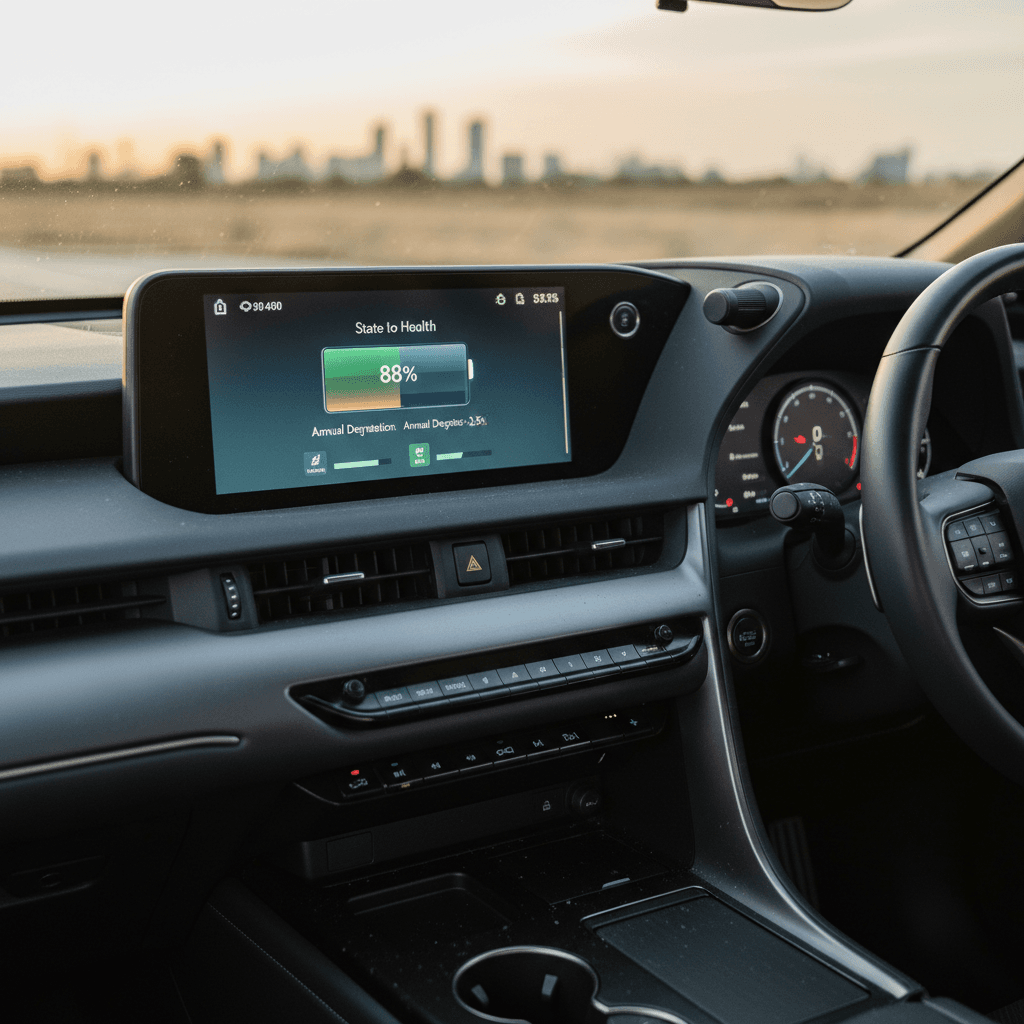
If you’re considering a Lexus RZ 450e, or already own one, it’s natural to worry about battery degradation per year. The RZ’s range is modest to begin with, so even a small hit to usable capacity feels like a big deal. The good news: Toyota/Lexus has been extremely conservative with its battery chemistry and warranties, and early data suggests slower‑than‑average degradation for this platform. The bad news: winter efficiency and charging behavior can easily masquerade as “degradation” if you’re not looking at the right numbers.
Key takeaway
Lexus RZ 450e battery degradation: the big picture
The Lexus RZ 450e rides on the same e‑TNGA platform and battery architecture as the Toyota bZ4X and Subaru Solterra. That gives us two helpful anchors for understanding RZ 450e battery degradation per year:
- Toyota/Lexus has historically favored long‑life, conservative battery tuning over headline‑grabbing range or charging speeds.
- Official documentation for the RZ and other Lexus BEVs frames up to 30% capacity loss as “normal” over the warranty period, with coverage kicking in only below that threshold.
- Owner reports from bZ4X/Solterra, real‑world siblings to the RZ, generally show single‑digit percentage loss over the first 3–5 years when charged and driven reasonably.
No hard RZ‑only dataset yet
Lexus RZ 450e battery & warranty at a glance
What Lexus actually guarantees on RZ 450e battery degradation
To understand Lexus RZ 450e battery degradation per year, start with what Lexus is willing to stand behind in writing. In the 2023 RZ 450e warranty and in regional brochures, Lexus makes two important points:
- Capacity loss up to 30% is considered normal. Lexus explicitly notes that a reduction of lithium‑ion battery capacity by 30% or less over the warranty period is not a defect and isn’t covered by warranty repair.
- Below ~70% capacity, Lexus steps in. In many markets, the RZ’s traction battery is covered for 8 years / 100,000 miles if energy storage falls below roughly 70% of the original usable capacity, assuming you’ve followed maintenance and charging guidelines.
- Some regions (like parts of Europe and Australia) layer on extended “battery health check” programs that can stretch functional coverage up to 10 years with annual inspections.
What that means in plain English
Crucially, this is not just marketing. Toyota has decades of field data from hybrid batteries and early BEVs like the UX 300e, and they’ve already offered million‑kilometer capacity guarantees in some markets. The RZ 450e inherits that conservative engineering mindset.
Real‑world Lexus RZ 450e battery degradation per year
Because the RZ 450e is relatively new, we piece together its expected yearly degradation from three sources: lab testing, warranty design, and on‑road owner data from the RZ and its Toyota/Subaru siblings.
How much RZ 450e battery loss should you expect?
A realistic range of outcomes for different usage patterns
Careful daily driver
Profile: Mainly Level 2 home charging, 20–80% SoC, few DC fast‑charge sessions, mild climate.
Expected loss: Around 1% per year over the first decade, or roughly 10% after 10 years.
Typical mixed use
Profile: Combination of home charging and public DC fast charging, occasional 100% charges, some hot/cold weather.
Expected loss: Roughly 1–2% per year, or about 10–20% over 10 years.
Hard‑use scenario
Profile: Frequent DC fast charging, sustained high‑speed driving, hot climate, lots of time sitting full or empty.
Expected loss: Up to the Lexus “normal” threshold of ~30% over 8–10 years, which pencils out to 3–4% per year.
Don’t confuse winter range with degradation
Early owner reports for bZ4X and Solterra, vehicles using the same core battery and thermal design, show less than 5% measured degradation after ~60,000 km (about 37,000 miles) in many cases, even in cold climates, which fits squarely in that 1–2% per‑year band.
Range loss vs battery degradation on the RZ 450e
EV drivers often experience something that feels like brutal “degradation” in the first year or two with a Lexus RZ 450e: the car never gets close to its EPA range, highway trips fall short of expectations, and winter range craters. But that’s only partially about battery health.
Usable capacity loss (true degradation)
- Permanent, chemistry‑driven reduction in how many kWh the pack can store.
- Shows up as less energy added when charging from, say, 10% to 80% vs when the car was new.
- Usually slow and subtle, on the order of 1–2% per year for the RZ’s pack under normal conditions.
- Is what Lexus’ 70% capacity warranty is actually targeting.
Range loss from efficiency factors
- Highly sensitive to speed, temperature, HVAC use, tires and wind.
- Can change dramatically day‑to‑day even when the battery is brand new.
- RZ 450e is already range‑constrained; small efficiency hits feel big in miles.
- Winter tests and owner stories often show 30–40% less range in cold weather with no underlying capacity loss.
How to self‑check degradation
6 factors that speed up RZ 450e battery wear
Lexus’ conservative tuning gives the RZ 450e a healthy head start, but your habits still matter. The following behaviors are most likely to push you toward the high end of that 30% “normal” loss envelope over 8–10 years:
RZ 450e habits that accelerate degradation
1. Living at 100% state of charge
Regularly parking your RZ 450e at or near 100% SoC for days at a time, especially in hot weather, puts constant stress on the upper part of the battery’s voltage window.
2. Frequent deep discharges to near 0%
Running the pack down to single‑digit SoC before charging, over and over, increases wear on the lower end of the voltage window. Occasionally is fine; habitually is not.
3. Heavy DC fast‑charging use
The RZ’s DC curve is already conservative, but relying on 150 kW fast charging for most energy, rather than Level 2 AC, still adds more heat and stress than slower home charging.
4. High average pack temperature
Parking outside in hot sun, then fast‑charging immediately, or towing and sustained high‑speed driving in hot climates all push battery temperatures up, which accelerates aging.
5. Long storage without use
Letting the car sit for months at very high or very low SoC is harder on cells than regular, moderate cycling. If you’re storing the car, aim for 40–60% SoC and a cool garage.
6. Aggressive tuning or oversized tires
While the RZ isn’t a modder’s favorite, big wheels or aggressive tires can raise consumption and temperature slightly, further squeezing range and stressing the pack on hard drives.
How to slow Lexus RZ 450e battery degradation
The flipside is simple: treat the Lexus RZ 450e’s pack like the long‑life component it was engineered to be. A few practical tweaks to how you charge and drive can easily shave a percentage point or two off your long‑term degradation curve.
Practical ways to protect your RZ 450e battery
Small habits that compound over 8–10 years
Use Level 2 as your default
Make 240V Level 2 charging at home or work your primary fuel source. Save DC fast charging for road trips or genuine time crunches, not nightly top‑ups.
Aim for a mid‑pack SoC window
When possible, keep your daily use between roughly 20–80% SoC. Full charges to 100% are fine before a trip; just don’t leave the car sitting at 100% for days.
Work with the climate, not against it
In extreme heat, park in the shade or a garage and avoid back‑to‑back fast charges. In the cold, pre‑condition the cabin while plugged in rather than blasting heat from a cold start.
Drive smoothly on the highway
The RZ’s aero and gearing already handicap highway range. Smooth, moderate‑speed driving not only extends miles per charge but also keeps battery temps lower over time.
Check health periodically
Use Lexus dealer health checks or a third‑party diagnostic (like the Recharged Score on used RZs) every few years to quantify degradation and spot outliers early.
Keep software and recalls current
Lexus has already issued software updates and recalls for HVAC and thermal‑management behavior on this platform. Staying current ensures the battery management system does its job.
The quiet upside of conservative tuning
Shopping used: judging Lexus RZ 450e battery health
If you’re cross‑shopping a used Lexus RZ 450e against other EVs, battery health should be high on your checklist. With a relatively short rated range to begin with, an RZ that has lost 15–20% of capacity can feel materially different to live with.
Quick signals of RZ 450e battery health on a test drive
What to look for when evaluating a used Lexus RZ’s pack without lab equipment
| Signal | What to check | What’s reassuring | What’s concerning |
|---|---|---|---|
| DC fast‑charge history | Ask the seller how often the car was fast‑charged, and review any app logs if available. | Mostly home/Level 2 charging with occasional fast‑charge use. | Daily or near‑daily fast charging, especially in hot climates. |
| Displayed range vs SoC | At 100% SoC, compare the predicted range to EPA and to other RZs you research. | Displayed range in the same ballpark as other owners in similar climates. | Range estimate far below typical reports, even in mild weather. |
| Charging speed on Level 2 | How many kW does the car pull at a 32–40A Level 2 station from a mid‑pack SoC? | Consistent with spec (roughly 6–7 kW for many RZ trims). | Noticeably reduced AC charging power with no clear explanation. |
| Service & recall history | Ask for Lexus dealer records and check for completed battery/thermal updates. | All recommended software updates, HVAC recalls, and battery checks done. | Spotty service history; open HVAC or thermal‑management recalls. |
| Climate & storage | Where has the car lived and how was it stored? | Garage‑kept, temperate climate, no long storage at very high/low SoC. | Hot or extremely cold climate, long idle periods outside at full or empty. |
These aren’t lab‑grade measurements, but together they paint a useful picture of how the pack has been treated.
Red‑flag behavior on a used RZ
How Recharged measures Lexus RZ battery health
Battery degradation is where used‑EV transparency often falls apart. Range estimates fluctuate, sellers don’t always know how the car was charged, and buyers are left guessing. Recharged was built to fix exactly that problem.
Every used EV we list, including the Lexus RZ 450e, comes with a Recharged Score Report, which includes objective battery‑health diagnostics. Instead of hand‑waving about “still feels like new,” we combine pack data, charging history, and model‑specific benchmarks to show how a particular RZ compares to where it should be at its age and mileage.
- A verified battery‑health score benchmarked against other RZ 450e vehicles and Toyota’s expectations for the platform.
- Charging behavior history where available, highlighting heavy DC fast‑charge use or other risk factors.
- A fair‑market price analysis that bakes in battery condition, so you aren’t overpaying for an RZ with abnormally high degradation.
- Optional financing, trade‑in, and nationwide delivery, all wrapped in a fully digital process with EV‑specialist support.
Why this matters on a Lexus RZ
FAQs about Lexus RZ 450e battery degradation
Frequently asked questions about RZ 450e battery life
Bottom line: should you worry about RZ 450e battery life?
The Lexus RZ 450e has its flaws, range and charging performance are behind the curve, but catastrophic battery degradation is unlikely to be one of them. With Toyota/Lexus’ conservative approach, most owners who use Level 2 charging, avoid extreme SoC storage, and keep software current are likely to see only modest capacity loss, on the order of 1–2% per year.
Where you do need to be vigilant is matching the RZ’s real‑world range, especially in winter, to your life. A pack that’s down 10–15% will feel very different if your commute already pushes the car’s limits. That’s why objective battery‑health data and honest, model‑specific expectations matter so much on this platform.
If you’re looking at a used Lexus RZ 450e, consider shopping through Recharged. Every vehicle comes with a Recharged Score Report, EV‑specialist guidance, fair‑market pricing, and options for financing, trade‑in, and nationwide delivery. It’s the easiest way to make sure the RZ you fall for also has the battery life you’re counting on.