If you’re looking at a Mini Cooper SE, especially used, one of your first questions is usually, “How much battery degradation per year should I expect?” With a relatively small pack, every lost kilowatt‑hour matters, so understanding Mini Cooper SE battery degradation per year is critical to predicting real‑world range and long‑term value.
Quick take
Mini Cooper SE battery basics: size, buffers, and warranty
Before you think about degradation, you need to know what you’re starting with. First‑generation Mini Cooper SE hatchbacks (the F56‑based models sold in the U.S. for 2020–2024) use a 32.6 kWh gross battery pack, with about 28.9 kWh usable. Mini holds back a chunk of capacity as a buffer so you never truly charge to 0% or 100%, which slows degradation and hides some early wear from the driver.
- Battery chemistry: liquid‑cooled lithium‑ion pack, similar cells to the BMW i3
- Gross capacity: about 32.6 kWh; usable capacity ~28.9 kWh
- EPA‑rated range (U.S. F56 SE): roughly 110–114 miles when new, depending on model year
- Charging: up to 7.4 kW AC (Level 2) and up to ~50 kW DC fast charging in ideal conditions
- High‑voltage battery warranty: typically 8 years / 100,000–125,000 miles in the U.S. with coverage down to around 70% of original capacity (check the specific model year and market)
Battery recall note
How fast do EV batteries usually degrade per year?
Large datasets across many brands now show modern liquid‑cooled EV batteries typically losing about 1.5–2.5% of capacity per year in average use. That includes calendar aging (the pack just sitting with time) and cycling (charging and discharging as you drive).
Typical modern EV battery aging benchmarks
Why averages matter
Real‑world Mini Cooper SE battery degradation so far
The Mini Cooper SE hasn’t been on the road as long as something like a Nissan Leaf or Tesla Model S, but we now have several years of owner data from 2020–2021 cars. The pattern is encouraging: measured capacity loss is usually in the low single digits after 3–4 years for typical mileage.
Snapshot of owner‑reported Mini SE battery health
Not lab tests, real cars in the wild
Around 2–4 years old
Owners of early 2020–2021 cars commonly report State of Health (SOH) in the 96–98% range after 20,000–30,000 miles, based on OBD apps and professional checks.
Higher‑mileage cars
Even cars approaching 60,000–90,000 miles have shown only modest, measurable loss with no dramatic range collapse in normal use, according to forum anecdotes and shop data.
Range vs. capacity
Many owners notice little to no practical range change unless they regularly drive near the car’s limits or in harsh winter conditions, range swings more with weather and speed than with early degradation.
How that translates per year
Why Mini’s battery degradation looks better than you’d expect
1. Conservative usable capacity
Mini only lets you use about 28.9 kWh of the pack’s 32.6 kWh. That roughly 10–12% buffer means you never truly hit 0% or 100% at the cell level, both of which are rough on lithium‑ion batteries. By limiting the extremes, Mini slows chemical aging and hides early capacity loss from the gauge.
This approach is especially important on a small‑pack car like the SE, where each kilowatt‑hour translates into several miles of range.
2. Liquid cooling and BMW battery know‑how
The Cooper SE uses a liquid‑cooled pack and inherits a lot of battery management experience from BMW’s i3. Active thermal management keeps cells in a comfortable temperature window, which reduces stress during both fast charging and hot‑weather parking.
That’s a big reason why the Mini SE tends to age much more gracefully than older, air‑cooled EVs.
Good news for used buyers
6 factors that speed up or slow down Mini SE battery loss
Average degradation numbers don’t tell your whole story. How you use and charge your Mini SE has a big impact on how quickly the pack ages. Here are the main levers you control.
Key habits that affect Mini SE battery degradation per year
1. Time spent at 100% charge
Occasionally charging to 100% for trips is fine, but <strong>parking at 100% for days at a time accelerates aging</strong>. For daily use, stopping around 70–90% is gentler on the pack.
2. Deep discharges to “empty”
Frequently running the battery down to very low state of charge is stressful. Try to keep your Mini SE <strong>above roughly 10–15% most of the time</strong>, especially in extreme heat or cold.
3. High temperatures
Heat is enemy number one for lithium‑ion cells. Regularly parking in the sun in hot climates, especially at high state of charge, will age the battery faster than cool‑weather use. Whenever possible, <strong>park in shade or a garage</strong>.
4. Frequent DC fast charging
The SE can handle DC fast charging, but <strong>constant fast‑charge use generates more heat and higher stress</strong> than Level 2. Occasional road‑trip use is fine; daily fast charging will likely increase long‑term degradation.
5. Annual mileage and driving style
Higher mileage means more charge cycles, but <strong>steady, moderate‑speed driving is easier on the pack</strong> than constant hard acceleration and 80‑mph freeway blasts. The Mini encourages spirited driving; just know that efficiency and heat matter.
6. Storage patterns
If you store the car for weeks, aim to leave it around <strong>40–60% charge in a cool place</strong>. Putting it away at a hot 100% or letting it sit at 0% for long periods is much harder on the cells.
What to avoid long‑term
What 5%, 10%, or 20% degradation really does to your range
Because the Mini Cooper SE starts with a modest EPA range, even small percentage changes can feel big. Here’s how common degradation levels translate into real miles for a U.S.‑spec F56 Mini SE that started around 114 miles of rated range when new.
Mini Cooper SE battery degradation vs. estimated range
Approximate impacts on usable range for a first‑gen F56 Cooper SE that started near 114 miles EPA. Real‑world numbers will vary with weather and driving style.
| Estimated degradation | Approx. usable capacity | Expected EPA‑style range | What it feels like day to day |
|---|---|---|---|
| 0% (brand‑new) | ~28.9 kWh | ~110–114 miles | Full original range; you can comfortably do 70–80 mile days without thinking. |
| 5% loss | ~27.5 kWh | ~104–108 miles | You might notice 5–8 miles less in ideal weather, barely noticeable for short commutes. |
| 10% loss | ~26.0 kWh | ~98–102 miles | Plan a bit more carefully for 80–90 mile days; winter highway runs feel tighter. |
| 20% loss | ~23.1 kWh | ~88–92 miles | Still fine for city use, but regular 70‑plus‑mile freeway trips start to feel constrained. |
| 30% loss | ~20.2 kWh | ~78–82 miles | Usable as a second city car, but many owners would consider pack repair or replacement. |
These are ballpark estimates, your actual range will swing day to day for reasons unrelated to degradation.
Range swings aren’t always degradation
How to check battery health on a used Mini Cooper SE
If you’re shopping for a used Mini Cooper SE, you don’t have to guess about the battery. You can get a reasonably clear picture of pack health with some basic checks, and, ideally, a proper diagnostic report.
Step‑by‑step battery health check on a used Mini SE
1. Confirm model year, mileage, and recall status
Start with the basics: verify the exact model year and mileage, and confirm any battery‑related recalls have been completed. This frames what “normal” should look like and protects you on the safety front.
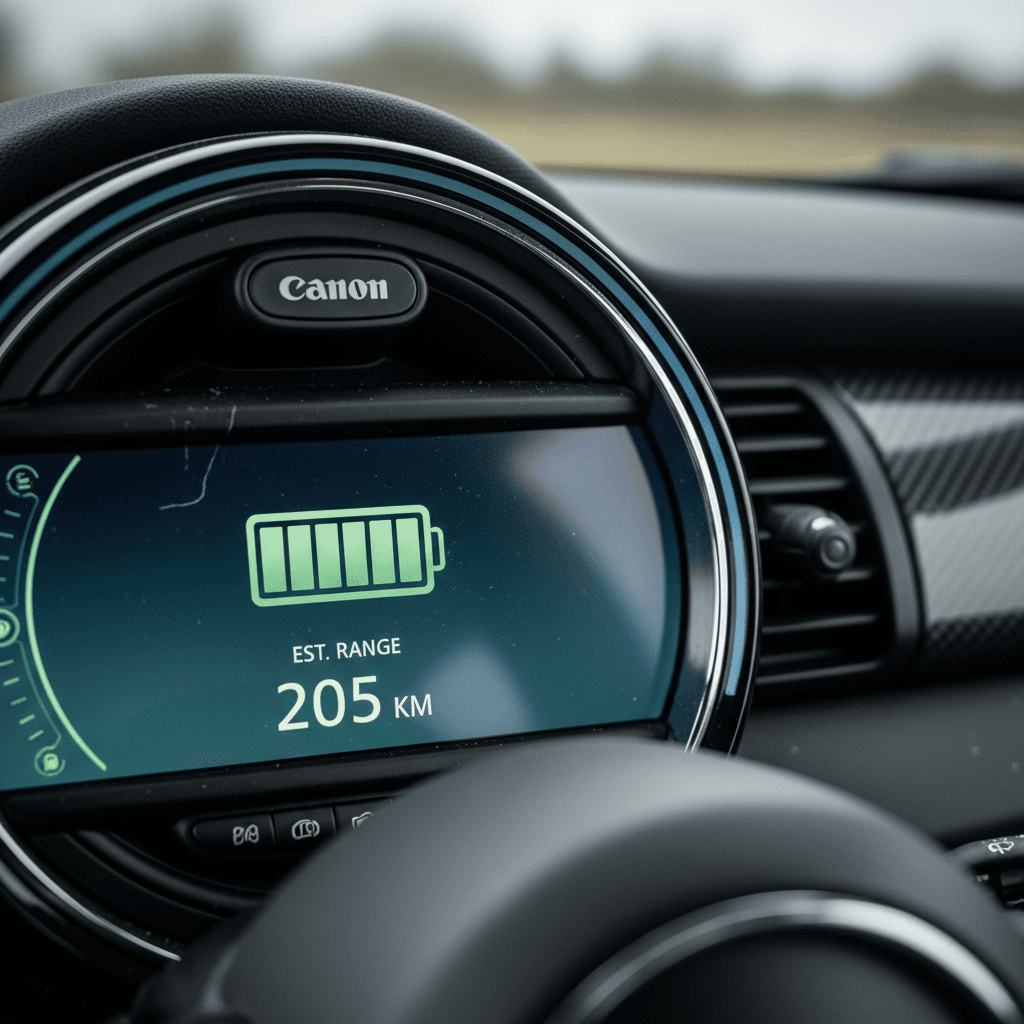
2. Look at the car’s indicated range at 100%
On a fully charged battery in mild temps, note the estimated range. <strong>Don’t fixate on a single number</strong>, but if a low‑mileage car only shows 80–85 miles in perfect conditions, ask more questions.
3. Review charging and storage history
Ask the seller how they charged it: mostly home Level 2 to 80–90%, or lots of DC fast charging and long periods at 100%? A thoughtful charging routine usually lines up with slower degradation.
4. Use an OBD dongle and app, if possible
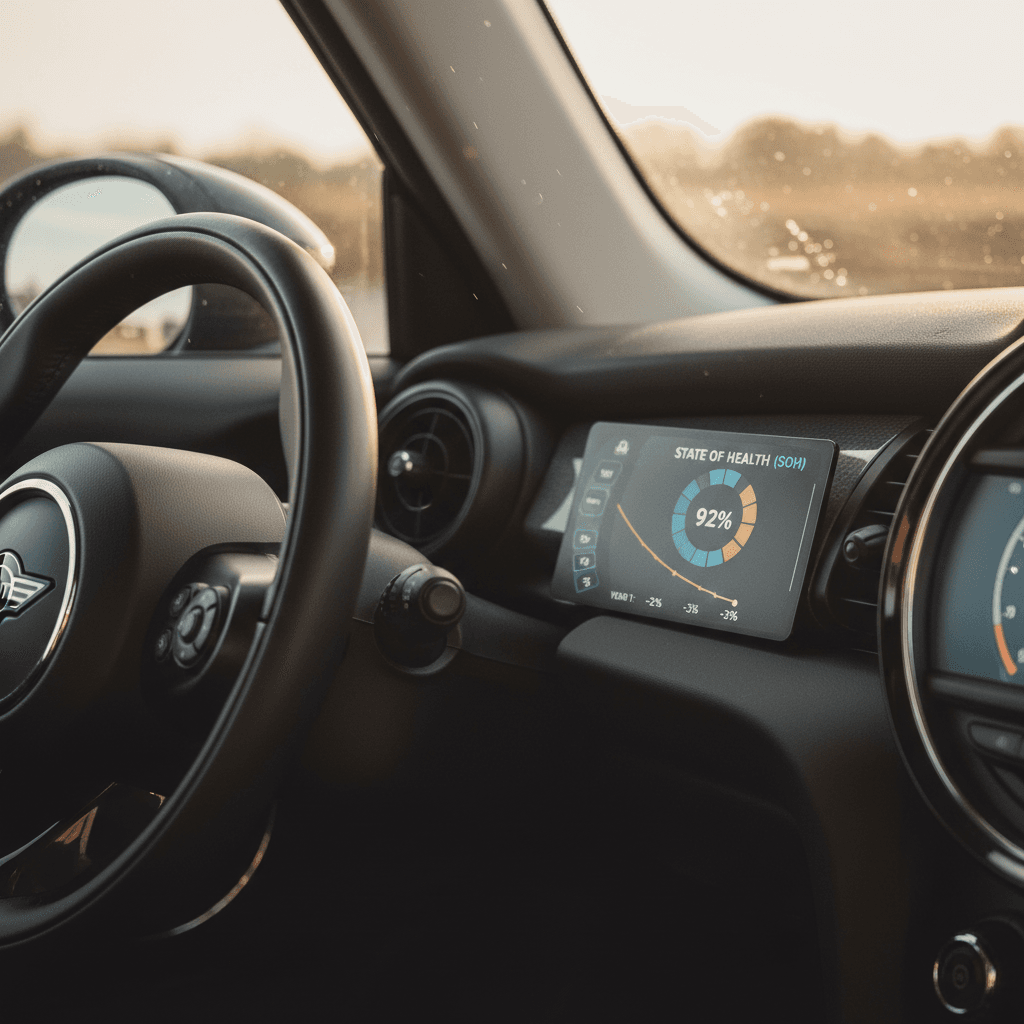
For deeper insight, many owners use an OBD II dongle and third‑party apps that can read <strong>State of Health (SOH)</strong> directly from the car. SOH in the mid‑90s or better on a 3‑ to 5‑year‑old Mini SE is generally a positive sign.
5. Get a professional battery diagnostic
If you want maximum confidence, especially for higher‑mileage or out‑of‑warranty cars, consider a <strong>professional battery health test</strong>. At Recharged, every Mini Cooper Electric gets a Recharged Score battery diagnostic so you see verified capacity, not just a guess.
6. Cross‑check with a long test drive
Finally, do a meaningful test drive. Start with a known state of charge and see how the <strong>percentage drops over 20–40 miles</strong> of mixed driving. That real‑world consumption check helps validate any SOH numbers you’ve seen.
How Recharged simplifies battery homework
Buying a used Mini SE: what’s “normal” degradation?
When you’re standing on a lot or browsing online listings, you want a simple rule of thumb: is this Mini SE’s battery aging about as expected, or is something off? Here’s how to think about “normal” vs. questionable degradation for the F56 generation.
Mini Cooper SE degradation: normal vs. red flags
Approximate guidance based on age and mileage
Signs of normal degradation
- 3–5 years old, under ~40k miles with SOH in the mid‑90s or better.
- Predicted full‑charge range still roughly in the 95–105‑mile ballpark in mild weather.
- No history of repeated cell or module replacements, just recall work.
- Owner primarily used home Level 2 charging, with only occasional fast‑charge use.
Possible red flags
- SOH readings in the mid‑80s or lower on a low‑mileage car.
- Full‑charge range consistently under ~90 miles in mild temps, with average driving.
- History of heavy fast‑charging use or long‑term storage at 100% in a hot climate.
- Unresolved battery recall items or repeated high‑voltage faults on service history.
Where depreciation works in your favor
Mini Cooper SE battery degradation FAQ
Mini Cooper SE battery degradation per year: common questions
Bottom line: how long will a Mini Cooper SE battery last?
If you treat it reasonably well, a Mini Cooper SE’s battery should deliver useful city‑car range for a long time. With degradation in the 1–2% per year neighborhood, you’re looking at well over a decade before capacity loss becomes a serious constraint for typical urban and suburban use. Because the car starts with a smaller pack, you’ll feel each percent a bit more than a long‑range EV owner, but the pack itself appears to be aging gracefully.
For shoppers, the key is not to chase a mythical “zero‑degradation” car, but to find a Mini SE with documented battery health that matches its age, mileage, and price. That’s exactly why Recharged includes a Recharged Score battery diagnostic with every EV we sell, offers EV‑savvy financing and trade‑in support, and can deliver a vetted Mini Cooper Electric right to your driveway. If you love the idea of a fun, compact EV and your daily driving fits its range, the Mini Cooper SE can be a surprisingly durable long‑term partner.