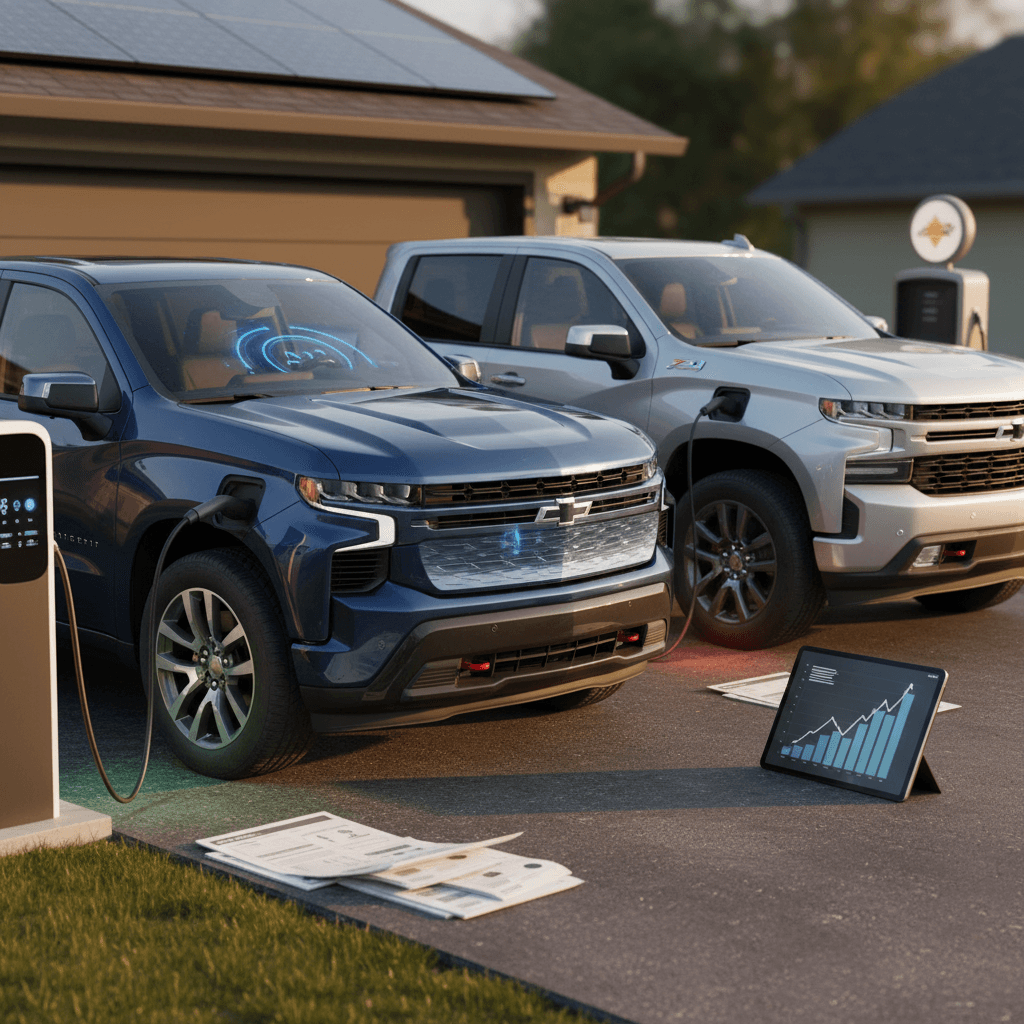
If you’re cross‑shopping a **Chevrolet Silverado EV** against a traditional gas Silverado, you’re probably not just chasing novelty. You want to know whether the Silverado EV’s total cost of ownership really beats a comparable gas truck once you add up payments, fuel, maintenance, and resale value. Let’s walk through the numbers in plain English and see where the electric truck pulls ahead, and where it doesn’t.
What “total cost” actually means here
How much does a Silverado EV really cost to own?
Sticker shock is real with the **Chevrolet Silverado EV**. Early RST First Edition trucks have pushed into the $90,000+ range, and even work‑focused WT models start in the mid‑$50,000s before options. Meanwhile, a well‑equipped gas Silverado 1500 can look thousands cheaper on a window sticker. But EVs fight back with dramatically lower **energy** and **maintenance** costs, especially if you drive a lot and can charge at home.
Silverado EV vs gas truck: headline cost clues
Those headline numbers are averages, not a promise. A Silverado EV that lives on DC fast chargers and tows a 9,000‑lb trailer every weekend will cost more per mile than one that lives on cheap overnight home charging. The same goes for a gas truck that spends its life pulling air instead of payload. So we’ll build a realistic comparison and show you how the math moves when your life doesn’t look like the brochure.
The trucks we’re actually comparing
To make this feel like a real buying decision, we’ll park two trucks in your imaginary driveway:
- Silverado EV WT Standard Range: crew cab, dual‑motor Ultium platform work truck. EPA range in the high‑200‑mile ballpark, massive battery (roughly 165 kWh usable), rear‑wheel steering and plenty of payload for a contractor or hard‑working family truck.
- Silverado 1500 4x4 Crew Cab, 5.3L V8: a mainstream gas equivalent. Think LT or RST trim with a 4x4 drivetrain, similar cab and bed, and typical tow/haul capability for a half‑ton gas truck.
Why this gas comparison makes sense
Silverado EV snapshot
- Powertrain: Dual‑motor all‑wheel drive
- Battery: Roughly 165–200 kWh usable depending on trim
- Range: High‑200s to nearly 500 miles (trim‑dependent)
- Efficiency: Around 1.7–1.9 mi/kWh in mixed driving
- Max DC charge rate: Up to ~350 kW on compatible chargers
Gas Silverado snapshot
- Engine: 5.3L V8 (or similar high‑volume option)
- Combined mpg: Often around 17–20 mpg in real‑world use
- Fuel tank: 24–28 gallons; 400+ miles on the highway when empty
- Refueling: 5 minutes at any gas station, any time
- Towing/hauling: Rated similarly high, but efficiency drops sharply under load
Purchase price, incentives, and financing
On day one, the Silverado EV’s **MSRP is usually higher** than a similar‑trim gas truck. Early RSTs launched well north of $90,000; more work‑minded WT and mid‑level trims land in the mid‑$50,000s to $70,000s before options. A comparably roomy, well‑equipped gas Silverado 1500 often undercuts that by several thousand dollars.
How the purchase math usually stacks up
Numbers are directional, not a quote from any dealer
Sticker price
Gas Silverado 1500
Well‑equipped 4x4 crew cabs commonly sit in the mid‑$50,000s.
Silverado EV
Work‑oriented WT models start in the high‑$50,000s and climb quickly with battery and equipment.
Incentives & tax credits
Depending on how your Silverado EV is built and where you live, you may qualify for federal or state EV incentives, or for a commercial EV tax credit if it’s a work truck.
Those programs can effectively knock thousands off the EV’s cost, especially if your tax situation lets you use the credits fully.
Financing and interest
Assume you’re financing both trucks over 60 or 72 months with similar interest rates. A higher upfront price means a higher monthly payment for the EV, even after incentives.
The question is whether lower running costs claw that back over time.
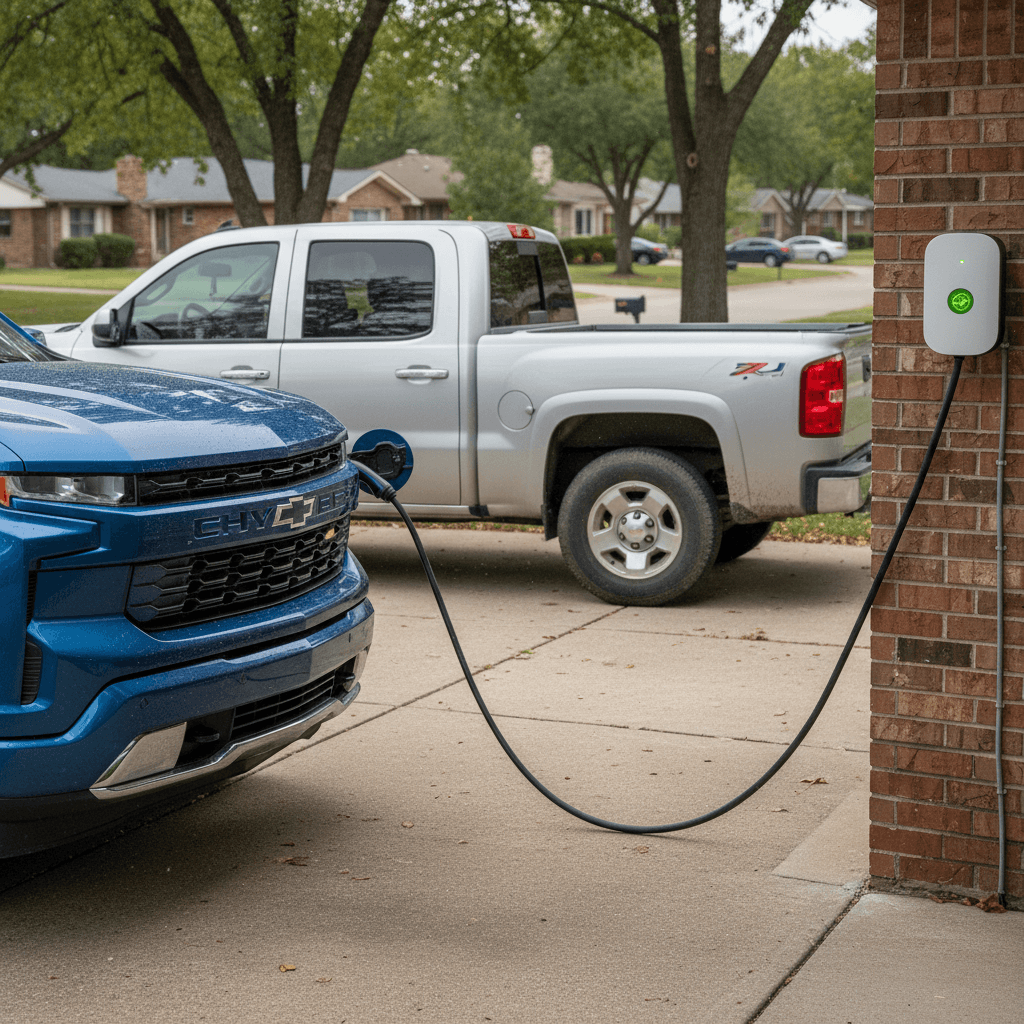
Don’t forget the home charger
Fuel vs electricity: cost per mile
This is where the Silverado EV starts earning its keep. In 2025, a typical U.S. driver charging at home is often paying roughly 4–6¢ per mile in electricity, while a comparable gas vehicle can be closer to 13–18¢ per mile, depending on mpg and local gas prices. A big, thirsty pickup tilts toward the high end of that gas range.
Estimated energy cost per mile: Silverado EV vs gas Silverado
Illustrative U.S. averages for 2025 using common assumptions
| Truck | Assumptions | Cost per mile (energy only) | Annual energy cost @ 15,000 miles |
|---|---|---|---|
| Silverado EV (mostly home charging) | 1.8 mi/kWh, $0.16/kWh blended home rate | ≈$0.09/mi | ≈$1,350 |
| Silverado EV (heavy DC fast charge) | 1.6 mi/kWh, $0.40/kWh public fast charging | ≈$0.25/mi | ≈$3,750 |
| Gas Silverado 1500 4x4 | 18 mpg combined, $3.25/gal gas | ≈$0.18/mi | ≈$2,700 |
Your exact numbers will vary with local utility and gas prices, driving style, and how often you fast charge.
That table makes a critical point. If you mostly **charge at home**, the Silverado EV can easily slash your “fuel” bill by roughly half or more compared with a gas Silverado. If you live on pricey DC fast chargers on the road, much of that advantage evaporates, and in some corridors, you can actually spend more per mile on electricity than on gasoline.
How to estimate your own cost per mile
Maintenance, tires, and unplanned repairs
The Silverado EV doesn’t need oil changes, transmission services, spark plugs, or exhaust work. That’s a big chunk of what makes trucks expensive to maintain once the new‑car glow fades. You’re still going to buy tires, brake fluid, and cabin air filters, and you’ll want an occasional inspection. But the menu at the service desk is shorter and cheaper.
Typical maintenance outlook: EV vs gas Silverado
Exact numbers depend on mileage and how hard you work the truck
Routine service
Gas truck: Oil and filter changes, transmission fluid, spark plugs, belts, emissions system checks, several visits a year once you’re out of the free‑maintenance window.
Silverado EV: No oil changes, fewer moving parts. Routine checks are mostly fluids, software, and mechanical inspections.
Tires & brakes
Both trucks are heavy; both eat tires if you tow or hustle. The EV’s regenerative braking can stretch brake pad life, especially around town, but you won’t escape tire bills. Figure on high‑quality truck tires every 30,000–40,000 miles if you use the truck as a truck.
Repairs & wear items
With no traditional transmission or exhaust, the Silverado EV has fewer expensive wear items. On the flip side, out‑of‑warranty battery or high‑voltage repairs can be pricey, which is why battery health and a solid warranty matter so much when buying used.
Where the Silverado EV usually wins big
Towing, hauling, and work-truck usage
Hook a big trailer to either truck and costs go up. A gas Silverado that averages 18 mpg empty can easily slide into the low‑teens or worse when towing. An electric truck like the Silverado EV can see its effective range cut nearly in half with a tall, heavy load in bad weather. In both cases, your **cost per mile** climbs, but the way it feels day‑to‑day is very different.
Silverado EV under load
- Instant torque off the line, very smooth uphill pulling.
- Range shrinks faster, so you’ll stop to charge more often on long trips.
- Public fast charging with a trailer can be awkward if charging stalls aren’t pull‑through.
- Energy costs per mile rise, but you still avoid $100+ gas station stops if you start every day with a full battery from home.
Gas Silverado under load
- Familiar behavior, revving engine, downshifts, and heat when climbing grades.
- Fuel economy plummets, especially with boxy trailers and high speeds.
- Refueling is easy anywhere, but it’s not hard to drop $125 on a tank during busy towing season.
- Long‑term, frequent heavy towing favors the gas truck’s predictability unless you have excellent DC charging along your routes.
If you tow heavy, infrastructure matters
Depreciation and resale value
Depreciation is the quiet line item that can dwarf everything else. Early EV trucks, Rivian, F‑150 Lightning, Hummer EV, have seen some wild value swings as production ramps up, incentives change, and new competitors show up. The Silverado EV is no exception. Gas half‑tons can also fall quickly off MSRP, but they have decades of predictable used‑truck behavior behind them.
- Gas Silverados are known quantities. Contractors, fleets, and private buyers all know what they’re getting, so resale demand is broad and steady.
- Silverado EVs are newer to the party. Battery health, real‑world range, and charging experience all matter to second owners, and they pay close attention to how the truck was used (lots of fast charging and heavy towing, or mostly commuting?).
- As EV trucks become more common and battery diagnostics get better, the market is slowly learning how to price them. That’s where tools like a Recharged Score, a detailed battery‑health and pricing report we provide with every used EV we sell, can give you confidence that you’re not buying someone else’s experiment.
Leasing vs buying for first‑generation EV trucks
5‑year total cost scenario: Silverado EV vs gas
Let’s plug in some round, conservative numbers for a typical owner who buys new, finances over 72 months, drives 15,000 miles a year, charges mostly at home, and keeps the truck for five years. These are not quotes; they’re a framework you can adjust with your own prices.
Illustrative 5‑year cost of ownership: Silverado EV vs gas Silverado
Simplified comparison for a typical mixed‑use owner in the U.S.
| Category (5 years) | Silverado EV (home charging focus) | Gas Silverado 1500 4x4 |
|---|---|---|
| Purchase price (after incentives) | $68,000 | $58,000 |
| Financing interest (approx.) | $8,000 | $6,800 |
| Home charging electricity | $6,750 (75,000 mi @ $0.09/mi) | , |
| Public fast charging (occasional trips) | $1,250 | , |
| Gasoline | , | $13,500 (75,000 mi @ $0.18/mi) |
| Routine maintenance & repairs | $4,000 | $6,500 |
| Tires (both trucks) | $3,000 | $3,000 |
| Estimated resale value after 5 years | −$32,000 | −$28,000 |
| Approx. 5‑year net cost | ≈$59,000 | ≈$59,800 |
All dollars are rough estimates; adjust for your own purchase price, gas and electricity rates, and incentives.
In this middle‑of‑the‑road scenario, the **Silverado EV and gas Silverado land in roughly the same 5‑year cost ballpark**, with the EV pulling slightly ahead thanks to cheaper energy and maintenance. If you drive more miles, or your gas prices are higher than the U.S. average, the EV’s advantage grows. If you rarely drive, or you rely heavily on expensive DC fast charging, the gas truck may end up cheaper to own.
How to sanity‑check this for your life
Who actually saves money with a Silverado EV?
When the Silverado EV wins, and when the gas truck does
Match your life to the scenario that looks most like you
You’re the right fit for a Silverado EV if…
- You can install or already have a Level 2 charger at home.
- You drive at least 12,000–15,000 miles a year.
- Most of your miles are commuting, errands, and regional trips, with only occasional long‑distance towing.
- You live in an area with reasonably priced electricity and don’t rely on DC fast charging every day.
- You value smooth, strong acceleration and quiet operation as much as you value tailpipes and engine noise.
A gas Silverado still makes more sense if…
- You tow heavy, long‑distance loads frequently and can’t afford longer stops or route planning around chargers.
- You have no realistic path to home or workplace charging.
- Your annual mileage is low enough that fuel savings can’t offset the EV’s higher upfront price.
- You need absolute flexibility to head deep into rural areas where fast charging remains thin or non‑existent.
Tips if you’re shopping new or used Silverado EV
Make the total‑cost math work in your favor
1. Be honest about your mileage
If you only drive 7,000 miles a year, fuel savings alone won’t rescue a high‑MSRP EV truck. On the other hand, if you pound out 20,000 miles annually, the Silverado EV’s lower per‑mile energy and maintenance costs can stack up quickly.
2. Plan your charging strategy first
Before you fall in love with the truck, figure out where it’s going to drink. Can you charge at home overnight? At work? Will you lean on public fast charging? The more you can keep charging at home, the better the EV’s total cost story gets.
3. Look at battery health on any used Silverado EV
Battery condition is as important to a used EV truck as engine compression is to a used gas truck. At Recharged, every used electric truck gets a <strong>Recharged Score</strong> report so you can see verified battery health, real‑world range expectations, and whether the price reflects that.
4. Compare real payment, not just MSRP
Ask your lender or dealer to quote you real monthly payments on both the gas Silverado and the Silverado EV, factoring in any incentives. Sometimes the difference is smaller than the sticker price gap suggests, especially if you’re rolling fuel savings into your budget.
5. Think about resale before you buy
If you’re the type to trade every three years, pay attention to lease deals or projected residual values. If you plan to keep the truck a decade, the EV’s long‑term maintenance and fuel savings can outweigh the resale unknowns, especially if the battery ages well.
6. Consider buying used through an EV‑focused retailer
Early depreciation can make a lightly used Silverado EV dramatically cheaper than new. A marketplace like <strong>Recharged</strong> specializes in used EVs, with battery diagnostics, fair‑market pricing, financing, trade‑in options, and nationwide delivery so you’re not experimenting alone.
FAQ: Chevrolet Silverado EV total cost vs gas truck
Frequently asked questions
When you peel back the marketing and the what‑ifs, the **Chevrolet Silverado EV total cost vs a gas Silverado** comes down to how you use your truck and where you plug it in. For the right driver, reasonable mileage, good home charging, mostly regional trips, the EV can deliver a quieter, quicker, lower‑maintenance truck that costs as much or less to own than its gas cousin. For the wrong use case, low mileage, heavy long‑distance towing, no home charging, the familiar gas V8 still makes financial sense. The smart move is to run your own numbers, then shop with tools and partners who treat an EV truck like the serious working vehicle it is. That’s exactly how Recharged approaches every used electric pickup: with battery data, clear pricing, and experts who help you make the numbers, and the truck, work for your life.