If you live in Jacksonville and are shopping for an electric car, you’ve probably heard a lot of mixed news about EV rebates in Jacksonville, FL. Federal tax credits have changed, Florida never had a big statewide rebate, and local utility programs have come and gone. The good news: there are still real ways to save money on an EV and home charging in 2025–2026, you just have to know where to look.
Time‑sensitive snapshot
Overview: Jacksonville EV rebates in 2025–2026
At a glance: EV incentives for Jacksonville drivers
Here’s the short version for Jacksonville in 2026:
- No more big federal purchase credits for new or used EVs after September 30, 2025.
- No Florida state EV tax credit or statewide rebate on the car itself.
- No active JEA EV purchase rebates as of their latest EV incentives update; prior programs have sunset.
- One last federal win: a tax credit of up to $1,000 for installing home charging equipment through June 30, 2026.
What happened to the big federal EV tax credit?
For years, the headline deal was simple: up to $7,500 off a new EV and up to $4,000 off a used one, thanks to federal tax credits created under the Inflation Reduction Act. Many Jacksonville shoppers planned their budgets around those numbers.
That changed in 2025. A new law, often referred to as the “One Big Beautiful Bill”, dramatically shortened the life of EV incentives. The result for everyday drivers is straightforward:
- The new EV purchase tax credit (up to $7,500) ended for consumer purchases on September 30, 2025.
- The used EV credit (up to $4,000) also ended on September 30, 2025.
- A popular leasing workaround that treated many leases as “commercial” and preserved the credit also sunset on that date.
Why this matters in Jacksonville
Federal savings still available for Jacksonville drivers
The big vehicle credits may be gone, but there’s still one federal benefit Jacksonville homeowners can grab: the Alternative Fuel Vehicle Refueling Property Credit for EV charging equipment.
Your remaining federal EV incentives
These are still relevant for Jacksonville owners in early 2026
Home EV charger tax credit
What it is: A federal income‑tax credit worth 30% of your EV charger and installation costs, up to $1,000.
- Applies to qualifying Level 2 home charging equipment.
- Covers both hardware and professional installation.
- Available for installations completed through June 30, 2026 (unless changed by new law).
Commercial & multi‑family charging support
If you’re involved with a business, workplace, or multi‑family building in Jacksonville, there may still be federal support for installing shared chargers:
- Commercial versions of the same tax credit can cover up to 30% of project costs, with higher caps.
- Projects often stack this with federal NEVI infrastructure funding and utility programs.
These incentives don’t lower the price of your car, but they can dramatically reduce the ongoing cost and hassle of charging.
Pro tip: Keep your receipts
State of Florida EV incentives: what you can and can’t get
Here’s the blunt truth: Florida does not offer a statewide EV purchase rebate or personal income‑tax credit for buying an electric car. Because Florida has no state income tax, you won’t see the kind of state‑level tax credits that drivers in places like Colorado or New York enjoy.
Florida statewide EV incentives for Jacksonville drivers
What the State of Florida does, and doesn’t, offer today
| Incentive type | Does Florida offer it? | What it means for you in Jacksonville |
|---|---|---|
| State EV purchase rebate | No | You won’t get a state check or rebate off the price of a new or used EV. |
| State EV income‑tax credit | No | Florida has no personal income tax and no equivalent statewide EV credit. |
| State EV charger rebate | No direct rebate to homeowners | Charger incentives are handled at the federal and utility level, not by the state. |
| HOV/express lane perks | Yes (in certain areas) | Eligible EVs and hybrids can access some HOV and express lanes with proper decals. |
| Support for charging corridors | Yes | Florida participates in federal programs (like NEVI) to expand fast‑charging along major highways. |
Statewide Florida EV incentives focus more on infrastructure and driving perks than cash back on the car itself.
For a Jacksonville‑area shopper, that means your savings are going to come from three places: remaining federal credits, local/utility programs, and smart vehicle selection, especially in the used market.
Jacksonville & JEA programs: current local offers
Local utilities are often where the real EV money hides. In Jacksonville, your key player is JEA, the community‑owned electric utility. Historically, JEA has offered cash rebates for plug‑in EVs and home chargers, but as of their latest EV incentives update, the picture looks very different.
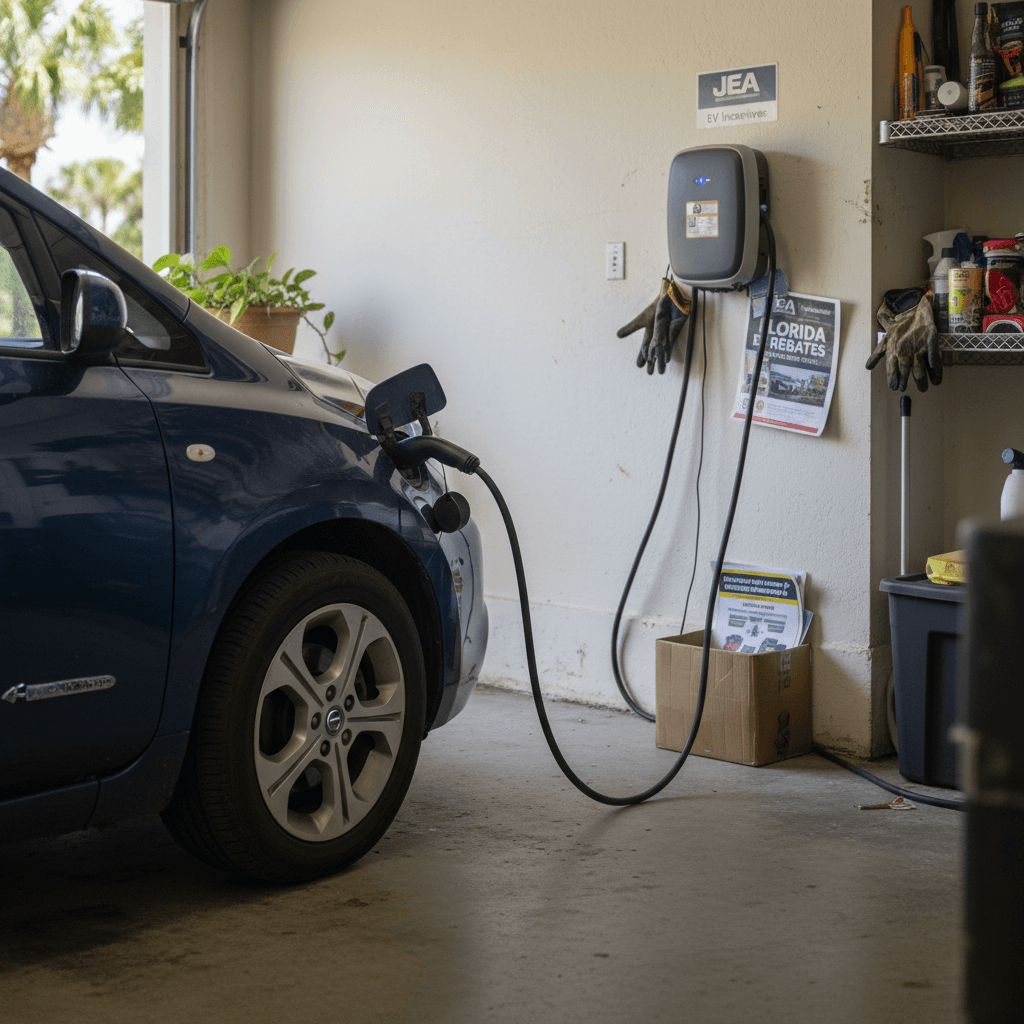
- No active JEA EV purchase rebates: JEA’s current EV incentives page states they do not offer rebates for EV purchases or home charging equipment at this time.
- Off‑Peak Charging and Electric Upgrade incentives closed: New enrollment for their off‑peak charging rebate and some electrical upgrade rebates closed in November 2025. Existing participants continue receiving benefits through the end of their program window.
- Research and pilot programs: JEA has partnered with companies like Optiwatt to run EV research studies that pay participating customers monthly for sharing charging data, one recent study paid about $84 per EV per year. These aren’t guaranteed or permanent, but they’re worth watching for.
How to check JEA’s latest EV offers
EV charger and home upgrade rebates in Jacksonville
Even without a standing JEA rebate, you still have a few levers to pull to reduce the cost of home charging in Jacksonville. The key is pairing the federal credit with any temporary or pilot‑program money you can find.
1. Use the federal home charger credit
If you install a Level 2 charger at your house or townhome before June 30, 2026, you can likely claim the federal Alternative Fuel Vehicle Refueling Property Credit:
- Credit equals 30% of the total project cost (equipment + labor).
- Maximum benefit is $1,000 for a primary residence.
- You must have enough federal tax liability to use the credit.
2. Watch for JEA Electrification Rebates
Separate from EV‑specific programs, JEA’s broader Electrification Rebate Program (ERP) sometimes includes rebates for non‑road EV charging equipment, infrastructure upgrades, or custom projects.
These are more common for commercial customers, fleets, or special retrofit projects, but if you run a business or manage a multi‑family property in Jacksonville, it’s worth talking to JEA about whether an on‑site charging project could qualify.
Safety warning: don’t DIY high‑voltage work
Other “hidden” EV perks in Florida
Not every benefit shows up as a rebate check. Some of Florida’s EV advantages are baked into how, and where, you drive.
How to stack EV savings on a used EV with Recharged
With the big federal purchase rebates gone, the single most powerful “incentive” left is buying the right used EV at the right price. That’s where Recharged comes in.
- Start with price transparency: Every vehicle on Recharged comes with a Recharged Score Report that breaks down battery health, market pricing, and vehicle history so you’re not guessing what a fair deal looks like in Jacksonville’s market.
- Focus on battery health, not just miles: In Florida’s heat, a strong battery matters. The Recharged Score verifies real‑world battery performance, so you’re not buying a discounted EV that’s secretly lost too much range.
- Use financing strategically: With fewer rebates to offset sticker price, affordable financing matters more. Recharged can help you pre‑qualify with no impact to your credit, then structure a loan that fits your budget.
- Trade‑in and instant offer options: If you’re coming out of a gas or hybrid car in Jacksonville, Recharged can provide an instant offer or consignment solution so you can roll that value into your EV purchase.
- Nationwide inventory, local delivery: You’re not limited to whatever’s on a single Jacksonville lot. Shop nationally through Recharged and have the right car delivered to your driveway or pick it up via our Experience Center in Richmond, VA.
Used EVs: where the math still works
Checklist: how to claim EV rebates in Jacksonville
Step‑by‑step: don’t leave money on the table
1. Confirm current programs
Before you sign anything, check three places: the IRS EV incentives page, the Florida Department of Transportation site for HOV/express‑lane rules, and JEA’s EV/ERP pages for any new rebates or pilot programs.
2. Decide new vs. used (and be realistic)
With federal purchase credits gone, run the numbers on a <strong>low‑mileage used EV</strong> versus new. Include insurance, depreciation, and charging costs, not just the monthly payment.
3. Get a battery‑health report
If you’re buying used, insist on objective battery data. A <strong>Recharged Score Report</strong> gives you that up front so you’re not gambling on range in Florida’s heat.
4. Plan your home charging
Get quotes from licensed electricians for a Level 2 charger and any panel upgrades. Ask them to break out hardware vs. labor on the invoice so you can maximize your federal tax credit.
5. Keep detailed documentation
Save purchase contracts, charger receipts, installation invoices, and any JEA program enrollment emails. You’ll need them for tax filing and any utility or research‑study payouts.
6. Talk to a tax pro
EV incentives have changed rapidly. A CPA or enrolled agent who follows energy‑efficiency credits can help you correctly claim the remaining federal charger credit and avoid surprises.
FAQ: EV rebates in Jacksonville, FL
Frequently asked questions about EV rebates in Jacksonville
Bottom line: what Jacksonville EV rebates look like now
If you’re hunting for EV rebates in Jacksonville, FL in 2026, you’re not imagining things, the era of big, simple rebates is largely over. Florida never had a statewide EV purchase credit, JEA’s early rebate programs have sunset, and the marquee federal credits for new and used EVs ended in September 2025.
But that doesn’t mean an EV is a bad deal. It just means the savings have shifted. Today, Jacksonville drivers win by buying smart, often in the used market, documenting every charger and home‑upgrade expense to grab that remaining federal credit, and watching local utility sites for new pilot programs. With verified battery health, fair pricing, financing support, and trade‑in options, Recharged is built to help you make those numbers work, even in a post‑rebate world.