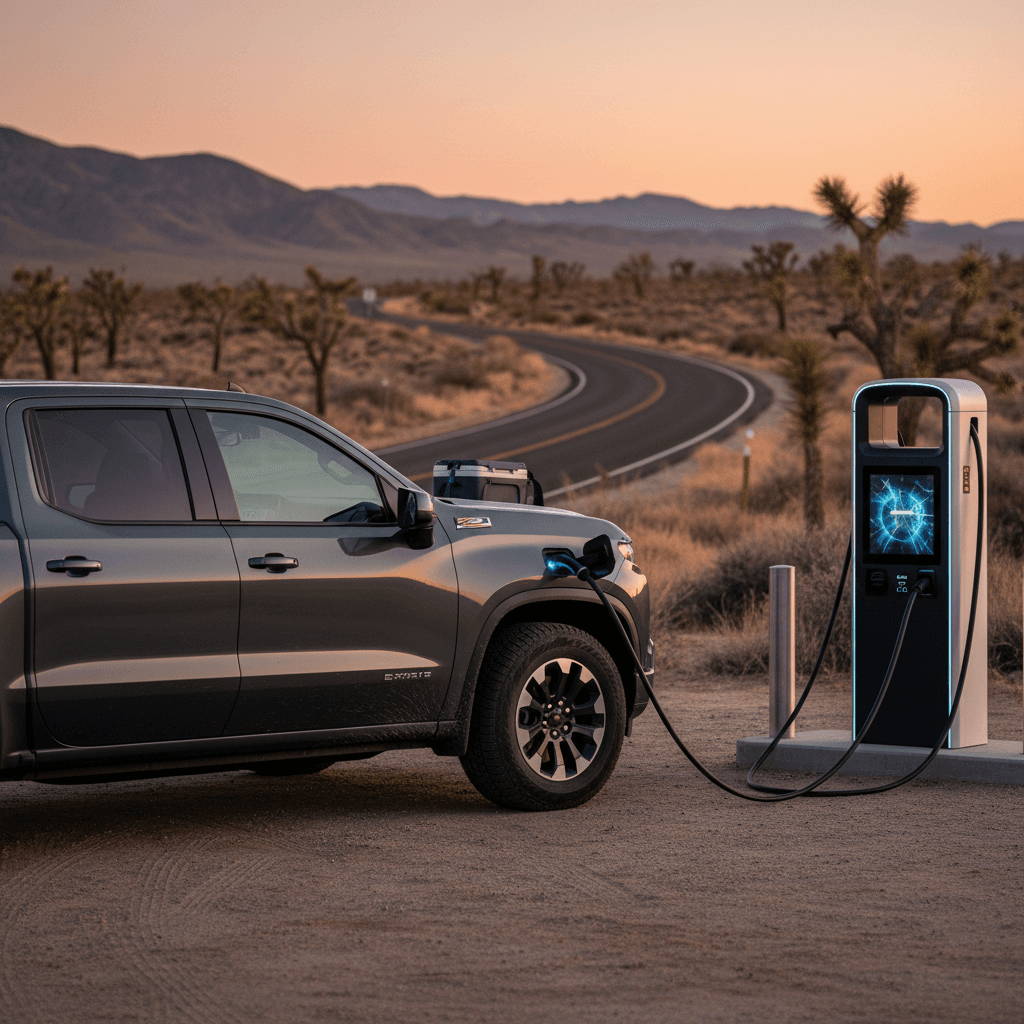
The Chevrolet Silverado EV is the rare electric truck that looks like it was engineered by people who actually tow things, go places, and occasionally forget to charge the night before. On paper it’s a monster: huge Ultium battery, truck‑scale towing numbers, and EPA ranges that make other EV pickups look like early prototypes. But a Chevrolet Silverado EV road trip review lives or dies in the real world, on a windy interstate with a bed full of gear, kids in the back, and the next fast charger 140 miles away.
Context: what’s on sale now
Silverado EV in the real world
If you come from the world of gas half‑tons, the Silverado EV is going to feel weirdly overqualified for the daily grind and slightly underqualified for the American road trip as we’ve known it since Eisenhower. It’s shockingly quick, eerily quiet, and the big battery gives you a comforting buffer in day‑to‑day life. But push past 300–400 miles in a day and you’re suddenly in a relationship with charging infrastructure, charge curves, wind, temperature, and trailer aerodynamics.
Silverado EV road trip numbers at a glance
How to read this review
Spec sheet vs suitcase: what you’re working with
Key Silverado EV specs that matter on the road
Approximate figures for 2024–2025 Silverado EV trims you’re most likely to see on the used market. Always verify exact specs by VIN.
| Trim / pack (2024–2025) | EPA range (empty) | Battery size (approx.) | Max DC charge rate | Max tow rating |
|---|---|---|---|---|
| WT 3WT / standard range | High‑200s–low‑300s mi | ≈170–180 kWh | Up to 350 kW | 10,000–12,500 lb |
| WT 4WT / large pack | ≈450 mi (EPA) | ≈200+ kWh | Up to 350 kW | Up to 12,500 lb |
| RST First Edition / Extended | Low‑400s mi GM‑est. | ≈200+ kWh | Up to 350 kW | Up to 10,000 lb |
| Later trims (2025+ WT/LT/TB mixes) | High‑200s to just under 500 mi | Varies by pack | Up to 350 kW | Up to ~12,500 lb |
Exact range and tow ratings vary by model year, trim, and battery pack.
On the spec sheet, the Silverado EV’s ace is range. Work Truck 4WT models have boasted EPA estimates around 450 miles, and updated 2025+ trucks push advertised range even higher in certain configs. The RST First Edition’s GM‑estimated 0–60 in under 4.5 seconds belongs more in a Corvette brochure than a crew‑cab pickup. For road‑trip duty, though, the headline act is that big Ultium battery, because range isn’t just freedom, it’s flexibility in where you stop and how hard you can tow.
What the specs promise
- Up to mid‑400‑mile EPA range on certain WT trims.
- Massive pack means fewer stops than rivals at the same speed.
- Fast DC charging (on paper) rivals or exceeds most non‑Tesla trucks.
- Serious tow ratings that match or beat gasoline half‑tons.
What matters on a road trip
- How long you can sit at 70–80 mph before hitting 10–15%.
- Where the high‑power chargers actually are along your route.
- How quickly the truck charges from roughly 10–60% on a warm battery.
- How much range you lose when you hang a 25‑foot wall behind it.
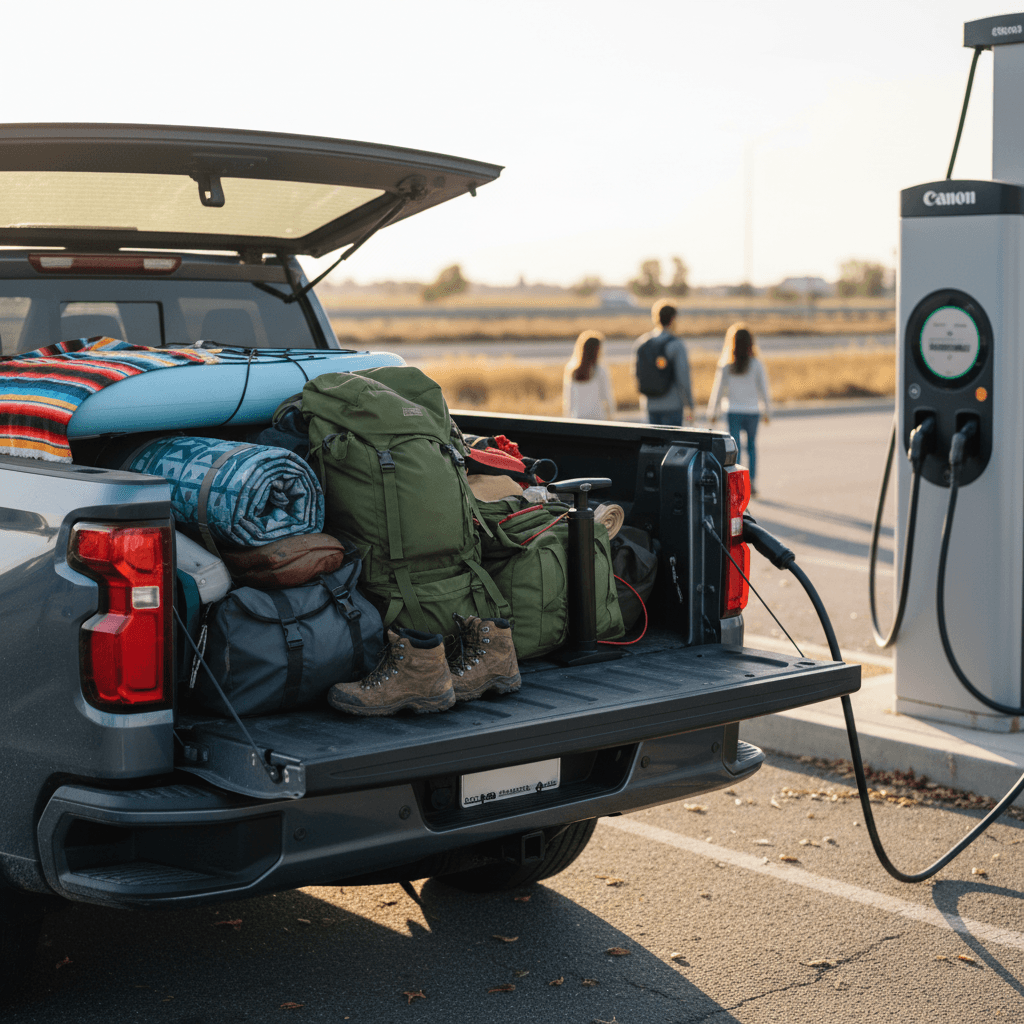
Highway range on a road trip: what drivers actually see
The dirty secret of every EV road trip is that EPA range is a city‑weighted fantasy. The Silverado EV is no different. Its huge battery and slippery front end make it one of the better highway trucks in the class, but physics still shows up at 75 mph. Owner reports of unloaded highway driving often land around 2.3–2.7 mi/kWh, which, on a ~200 kWh pack, translates into a genuine 350–450 miles if you were reckless enough to run it flat.
- At 65 mph in mild weather, you can get surprisingly close to EPA numbers if you start full and run deep into the pack.
- At 75–80 mph, expect to give back 15–25% of that ideal range, more in winter or high winds.
- Climbing and descending mountains often nets out, but long uphill pulls will chew through charge quickly.
- Cold weather can carve another 10–25% off your best‑case numbers, especially if you aren’t preconditioning.
Highway hero, winter villain
Charging on the road: networks, speeds, and stop rhythm
The Silverado EV speaks CCS today, not Tesla’s NACS plug, though adapters and future NACS‑equipped trims are part of the longer‑term picture. For this generation, your life is mostly on Electrify America, EVgo, and regional DC fast networks. When they’re humming along, the Silverado’s charge curve makes it one of the easiest trucks to road‑trip; when a site is half‑dead on a holiday weekend, it’s just you, a parking lot, and a slow 50 kW unit.
What DC fast charging in a Silverado EV actually feels like
Not just kW numbers, your day has a rhythm now.
The good stop
You arrive at ~10–15% on a warm battery. A 350 kW or 250 kW station is alive and healthy. The truck jumps quickly into high power, and in ~25 minutes you’re back in the 70–80% band with another 200+ miles in hand.
The meh stop
You hit an older 150 kW unit or share power with another car. You still add useful range quickly, but you’re closer to 35–40 minutes to feel really confident about the next leg.
The bad stop
You arrive low, the site is partially down, and a single slow charger is working. Now your ‘short bathroom break’ becomes a podcast marathon. This is when a giant battery is both a blessing and a curse.
Plan around 10–80%
Smart charging habits for Silverado EV road trips
1. Pre‑condition the battery when you can
If your route planner or the truck’s software allows, navigate to the fast charger early so the truck can warm or cool the pack. A properly conditioned pack hits peak charge speeds sooner.
2. Favor reliable stations over fringe ones
On remote stretches, prioritize big multi‑stall sites you see lots of recent check‑ins for. One good site beats two sketchy ones when you’re driving a 7,000‑lb laptop.
3. Don’t over‑charge out of fear
Stopping too early is better than running it to 1%, but charging from 75 to 100% is slow and adds relatively little usable highway range. Two efficient stops often beat one overlong session.
4. Stack your chores at the charger
Pick stops where you can walk the dog, feed kids, and grab real food. The Silverado EV turns every DC session into a forced break, use it to stay fresh rather than staring at the kW number.
5. Keep an AC Plan B
If your route includes rural stretches, know where slower Level 2 or even RV‑park outlets live. An overnight 240V session will refill that huge battery if DC sites misbehave.
Towing and hauling on a trip: the honest math
If you’re eyeing a Silverado EV because you pull campers, boats, or enclosed trailers, here’s where the fairy tale gets rewritten. The truck will absolutely move a trailer with an authority that makes gas half‑tons feel asthmatic. But you pay at the pump of electrons. Real‑world reports with tall, heavy trailers commonly come in around 0.6–0.8 mi/kWh at highway speeds, that’s roughly 35–45% of your unloaded highway range.
Rough towing range expectations for a big‑battery Silverado EV
Not official numbers, rule‑of‑thumb estimates to help you sanity‑check your plans. Assumes a large‑pack WT or RST on 20–24" wheels.
| Use case | Trailer example | Estimated highway range band | Charging rhythm |
|---|---|---|---|
| Light utility trailer | Open 5x10 with gear, ~2,000 lb | ≈250–320 mi on a large pack | Longer legs, fewer stops; easy mode. |
| Mid‑size camper | 20–25' travel trailer, 5,000–7,000 lb | ≈150–220 mi on a large pack | Plan around 120–160‑mile legs with margin. |
| Tall enclosed hauler | 8.5x24 car hauler, 7,000–9,000 lb | ≈120–180 mi on a large pack | Expect frequent 80–130‑mile legs, especially in wind. |
Aerodynamics matter more than pure weight; a tall, blunt camper hurts far more than a low equipment trailer of the same mass.
Don’t buy the tow rating, buy the use case
If you tow a few times a year
- The Silverado EV shines as a daily driver that can absolutely handle 3–6 big tow trips a year.
- Budget time on those trips: more stops, but each stop is a chance to decompress.
- Use your first tow trip as recon, log efficiency, wind sensitivity, and ideal cruising speed.
If towing is your whole life
- If you spend every weekend towing long distance, any current EV truck will feel like a range‑restricted specialist tool.
- Watch for denser DC networks on your routes and future NACS access to improve the picture.
- Until then, know that the Silverado EV is brilliant within a 150–250‑mile towing radius, less so beyond that.
Comfort, quiet, and tech on long drives
Set aside the charge cards and physics for a moment: as a travel companion, the Silverado EV is deeply relaxing. The Ultium platform gives it a low center of gravity and independent suspension, so it floats over expansion joints the way older body‑on‑frame trucks never did. There’s no engine drone, just a faint whir under hard acceleration and some tire slap on coarse pavement. After a day in the saddle, you feel like you’ve been in a big electric SUV, not a work‑spec pickup.
Road‑trip livability: where the Silverado EV shines
A big battery is nice; a calm cabin is nicer.
Seats & space
Crew‑cab models offer stretch‑out rear legroom and broad, supportive front seats. If you’re coming from an older half‑ton, road‑trip fatigue drops a couple notches immediately.
Noise & refinement
With no V8 burble and tight body control, long days at 75 mph feel oddly serene. You notice crosswinds more in the steering than in your ears.
Screens & software
Big central displays, modern driver‑assist tech, and app‑based route planning make it easier to manage charging and navigation, when the software behaves itself.
Software is your co‑pilot, for better or worse
Silverado EV vs other electric trucks on a road trip
Road‑tripping an EV truck in 2026 is less about brand loyalty and more about tradeoffs: range, charging network, interior comfort, and how much truck you actually need. The Silverado EV positions itself as the pragmatic long‑leg runner: big battery, straightforward styling, and work‑ready specs rather than sci‑fi theatrics.
How the Silverado EV stacks up for road trips
High‑level comparison of today’s major electric trucks from a road‑trip perspective.
| Truck | Highway range feel | Charging experience | Ride & comfort | Best suited for |
|---|---|---|---|---|
| Chevrolet Silverado EV | Strong; big battery makes 300–400‑mile days realistic unloaded. | Good on CCS when stations cooperate; NACS future will matter. | Calm, composed, more SUV‑like than old trucks. | Drivers who do lots of miles, occasional towing, and want a familiar‑looking truck. |
| Ford F‑150 Lightning | Shorter legs; feels more range‑limited at highway speeds. | Access to the Tesla Supercharger network (with adapter) is a huge advantage. | Comfortable and familiar; cabin feels like a modern F‑150. | Suburban use, moderate trips, strong charging‑network access now. |
| Rivian R1T | Good but pack is smaller than Silverado’s biggest options. | Decent CCS support, brand’s own network growing but still limited. | Sporty, almost European ride; adventure‑truck vibe. | Enthusiasts and adventure travelers who value style and off‑road ability. |
| Tesla Cybertruck | Efficient once dialed in; aero helps at speed. | Best‑in‑class NACS Supercharger access, but truck‑size stalls still patchy. | Firm, polarizing, futuristic cockpit. | Buyers who live in the Tesla ecosystem and prioritize Supercharger access over traditional truck feel. |
Individual trims, wheel choices, and software updates can nudge these impressions, but the basic characters are clear.
Where the Silverado EV wins
Used Silverado EV road trip buyer checklist
If you’re shopping the used market, you’re not just buying a truck, you’re buying its battery history, charging habits, and whatever software updates the previous owner cared enough to install. Before you imagine yourself carving across Utah with a paddleboard in the bed, make sure the specific Silverado EV you’re eyeing is truly road‑trip ready.
Checklist: is this used Silverado EV ready for road trips?
Confirm battery health and usable range
Look for a current battery health report, not just the original EPA rating. Tools like the Recharged Score can give you a verified snapshot of pack condition, so you’re not guessing at real‑world range.
Check DC fast‑charge history
A truck that’s lived its life on fast chargers isn’t automatically bad, but you’ll want to know. Ask for service records and look for any charging‑related warranty work.
Verify charging hardware compatibility
Make sure the CCS inlet is in good shape, check that DC fast charging works properly on a test session, and confirm whether the truck has any available adapter support for NACS or future networks.
Inspect tires and wheels
Those big 22–24" wheels look great but can hurt efficiency and ride. Uneven wear or cheap replacement tires might hint at suspension or alignment issues that could make long drives tiring.
Test all driver‑assist features
Adaptive cruise, lane‑keeping, and automatic braking are road‑trip essentials now. Verify everything works smoothly; inconsistent driver‑assist behavior will wear you out faster than road noise ever did.
Update software before your first big trip
Schedule time with the truck on home Wi‑Fi or at a dealer to pull down any pending updates. Fresh software often improves charging logic, route planning, and bug fixes that matter on the highway.
Where Recharged fits in
Who the Silverado EV road trip truck is really for
Great match for
- Drivers who rack up highway miles for work or family but tow only a few times a year.
- Owners who want a familiar, full‑size truck shape without the look‑at‑me factor of some EV competitors.
- People who live along healthy CCS corridors today, or who can wait for NACS access and network growth.
- Buyers who value a calm, quiet highway ride as much as spec‑sheet heroics.
Poor fit for
- Folks who tow tall, heavy trailers cross‑country several times a year and expect diesel‑like range.
- Drivers in regions with sparse DC fast charging and no reliable Level 2 options.
- Anyone allergic to tech quirks, the Silverado EV, like all modern EVs, is a rolling software project.
- Buyers whose road trips are 800‑mile cannonballs; an EV truck forces you into a different rhythm.
Chevrolet Silverado EV road trip FAQ
Frequently asked questions about Silverado EV road trips
Bottom line: road-tripping a Silverado EV
The Chevrolet Silverado EV is a deeply modern answer to an old American question: how do I go far, carry a lot, and still feel like I’m in a truck? As a road‑trip companion, it’s composed, quiet, and far more efficient than a lifted V8 on 35s has any right to be. The battery is enormous, the range is genuinely useful, and when the DC fast‑charging stars align, you cover ground with startling ease.
The catch is that, for now, you’re co‑authoring every long journey with the charging map and the weather report, especially if you tow. If that bargain sounds acceptable, the Silverado EV may be the most rational long‑leg electric truck you can buy, particularly on the used market where its capability often outstrips its image. And if you’d like help finding the right configuration and understanding what those spec‑sheet numbers mean for your family, your gear, and your routes, Recharged’s EV specialists are literally here to ride shotgun, minus the snacks and playlists.