If you’re eyeing a Chevrolet Bolt EV, especially a used one, the first question that usually pops up is simple: how much battery degradation per year should I expect? Range is the whole game with an EV. The good news is that, for most Bolt owners, yearly degradation has been modest and predictable. The even better news: smart habits and a good inspection can keep unpleasant surprises at bay.
Key takeaway up front
How much Chevrolet Bolt EV battery degradation per year is typical?
Let’s start with what you came here for: a realistic answer. We’re looking at thousands of real‑world reports from early 2017–2022 Chevrolet Bolt EVs and the refreshed Bolt EUV and 2022+ packs, plus broader EV degradation studies. Exact numbers vary car to car, but a clear pattern has emerged.
Typical Chevrolet Bolt EV degradation over time
So when people ask, “How many miles of range does a Chevy Bolt lose per year?” a practical answer is this: on a 238–259‑mile Bolt, many drivers see about 3–6 miles of range loss per year on average once the pack is past that early break‑in phase. That assumes typical commuting, mixed climates, and reasonable charging habits.
Outliers exist
Bolt EV battery specs and what “degradation” really means
Chevy Bolt EV battery basics
- 2017–2019 Bolt EV: 60 kWh pack, EPA range ~238 miles
- 2020–2021 Bolt EV: 66 kWh pack, EPA range ~259 miles
- 2022+ Bolt EV/EUV: 65 kWh pack, similar real‑world range
- Liquid‑cooled lithium‑ion pack with active thermal management
What “degradation” actually is
Battery degradation isn’t something breaking overnight. It’s a gradual reduction in how much energy the pack can hold. As the pack ages, the car’s software slightly lowers the top of the usable window to protect the cells, and the cells themselves lose capacity at the microscopic level.
You’ll notice it as slightly less range at the same state of charge and a slower climb from, say, 20% to 80% during charging.
Importantly, most Bolts have a buffer between the physical pack size and what’s made available to you. GM uses that hidden capacity to manage cell health and safety. That buffer is why a Bolt can still feel “normal” even after a few percentage points of degradation.
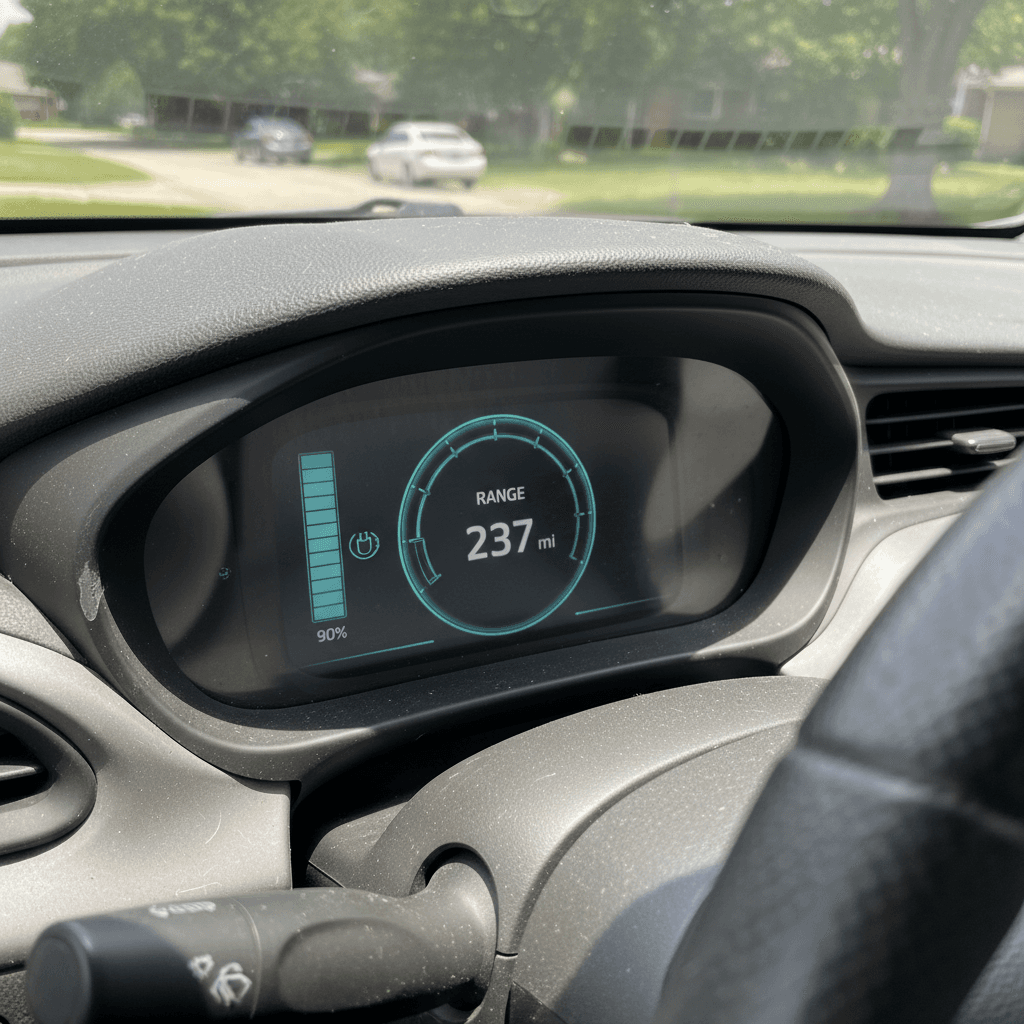
Real‑world Bolt EV degradation patterns by model year
GM hasn’t published a detailed year‑by‑year capacity‑loss curve for the Bolt, but thousands of owners track state of health using scan tools and apps. When you line those up, certain patterns show up across the big model‑year groups.
How different Chevy Bolt generations typically age
These are broad real‑world patterns, not guarantees for any one car.
2017–2019 original 60 kWh
These early cars are now approaching or past 7–9 years. For well‑cared‑for examples, many owners report:
- 5–10% total loss after ~5 years
- Some higher‑mileage cars in hot climates closer to 15%
- Recalls on certain packs led to full replacements in some cars
2020–2021 66 kWh update
The 66 kWh pack brought slightly more range and some under‑the‑skin changes. Real‑world reports so far:
- 2–4% loss in the first 2–3 years
- Slowing to ~1–2% per year afterward
- Lower‑mileage commuter cars often look near‑new
2022+ Bolt EV & EUV (65 kWh)
These refreshed cars are still relatively young, but early data suggests:
- 1–3% initial loss in the first couple of years
- Very stable capacity in mild climates
- Plenty of warranty runway ahead for most shoppers
What about recalled batteries?
What actually causes Bolt EV batteries to degrade?
Every lithium‑ion EV battery ages. But the rate of Chevrolet Bolt EV battery degradation per year depends overwhelmingly on how and where the car is used. Four big factors matter more than anything else.
- Heat: High temperatures are battery enemy number one. Bolts have liquid cooling, which helps a lot, but a car that spends years baking in a hot driveway or sitting fully charged in 100°F weather will lose capacity faster than the same car in a mild climate garage.
- Time at high state of charge (SOC): Parking at 90–100% for days on end stresses the cells. It’s much kinder to hover in the 30–80% band for daily use and save 100% charges for trips.
- High charge and discharge rates: Lots of DC fast‑charging, especially to very high SOC, puts extra wear on the pack. So does routinely flooring it from every stop (constant hard acceleration).
- Deep cycling: Regularly running down to single‑digit percentages before charging back to full is harder on the battery than shallower cycles, especially when combined with heat.
The worst‑case combo
How to slow Chevrolet Bolt EV battery degradation
Now for the part you can actually control. Whether you already own a Bolt or you’re about to buy one, especially a used example, these habits can meaningfully reduce your per‑year degradation and keep your range solid for the long haul.
Bolt EV battery‑friendly habits
1. Aim for 30–80% for daily driving
For most commutes, you don’t need 100%. Set your home charger or in‑car target to stop around 70–80% for routine use. This keeps the pack in its comfort zone and can shave a point or two off long‑term degradation.
2. Save 100% charges for road trips
If you need full range, charge to 100%, but time it so you start driving shortly after it hits full rather than letting it sit. Think “charge‑and‑go,” not “charge Friday for Sunday.”
3. Treat DC fast charging as a tool, not a lifestyle
Fast charging is wonderful when you need it, but living on DC power every day will age the pack faster. For daily use, a Level 2 charger at home or work is kinder and often cheaper.
4. Keep the car cool when you can
Whenever possible, park in the shade or in a garage. In very hot weather, avoid leaving the car fully charged outside for long stretches. The Bolt’s thermal management helps, but it’s not magic.
5. Avoid deep discharges to nearly empty
Running the pack down to 0–5% occasionally isn’t the end of the world, but consistently yo‑yoing from very low to very high SOC is harder on the cells. Try to recharge when you drop into the 15–25% range in everyday use.
6. Keep software and recalls up to date
GM occasionally updates battery management software and, in some cases, hardware. Make sure recall work and updates are complete. They’re free, and they can improve both safety and long‑term health.
Think like a long‑distance runner, not a drag racer
Chevy Bolt battery warranty and when to worry
GM backs the Bolt with an 8‑year/100,000‑mile battery warranty (from the original in‑service date) covering defects and excessive capacity loss. The specifics can vary slightly by year and region, but the general idea is that if the battery drops below roughly 70% of its original capacity within that window, you may qualify for repair or replacement.
Chevrolet Bolt EV battery warranty snapshot (U.S.)
Always confirm details for the exact model year and your state, but this gives you the big picture.
| Item | Typical Coverage | What It Means |
|---|---|---|
| Battery components | 8 years / 100,000 miles | Defects in materials or workmanship in the high‑voltage battery pack |
| Capacity loss threshold | Around 70% of original capacity | If usable capacity drops below this inside warranty, GM may repair or replace the pack |
| Transferable? | Yes, usually | Coverage follows the car, which is important for used‑Bolt buyers |
| Recall replacements | Varies by case | Many Bolts received full pack replacements under recall; those packs often carry their own coverage terms |
Capacity warranties are designed to catch outliers, not normal slow degradation.
When to actually be concerned
Buying a used Chevy Bolt: battery‑health checklist
Used Bolts can be electric‑car bargains, especially cars with a fresh recall battery. But the same question always hangs in the air: What shape is the pack really in? Here’s how to size up Chevrolet Bolt EV battery degradation per year when you’re shopping.
Used Chevrolet Bolt battery‑health checklist
1. Start with model year and recall history
Ask directly whether the car’s battery was replaced under the Bolt recall and when. A 2018 with a 2023 pack is a very different proposition from a 2018 still on its original pack. Request service records if possible.
2. Look at odometer and usage pattern
A higher‑mileage Bolt that mostly saw highway commuting and Level 2 charging can be healthier than a low‑miler that sat at 100% in the sun. Ask how the previous owner charged and stored the car.
3. Check estimated range at a known SOC
With the car at a stable temperature, look at the predicted range at, say, 80% charge. Compare that to what the same model usually shows when new. Big differences call for deeper investigation.
4. Use a proper battery health report, not just the dash
The in‑car guess‑o‑meter is just that, a guess. A <strong>professional battery diagnostics test</strong>, like the Recharged Score battery‑health report, measures usable capacity and cell balance directly.
5. Confirm warranty status
Ask for the in‑service date and verify how much of the 8‑year/100,000‑mile window is left. A used Bolt with years of battery warranty remaining offers extra peace of mind if degradation accelerates unexpectedly.
6. Drive it like you’ll use it
On the test drive, watch how quickly the state of charge drops for your normal style of driving. A pack that falls on its face under modest acceleration or highway speeds may have more degradation than the numbers suggest.
Where Recharged fits in
Ready to find your next EV?
Browse VehiclesHow Recharged measures Chevy Bolt battery health
With a gasoline car, you listen to the engine and maybe pull the dipstick. With an EV like the Bolt, the battery pack is the whole ballgame, and it’s hidden under the floor. That’s why Recharged built a diagnostics process specifically for used electric vehicles, including the Chevrolet Bolt EV and EUV.
Deep‑dive battery diagnostics
- We plug into the car’s diagnostic port and retrieve pack‑level and cell‑level data.
- Software models calculate usable capacity vs. original to estimate real state of health.
- We look for cell imbalances or abnormal behavior that might not show up on the dash.
What you get as a shopper
- A Recharged Score Report summarizing battery health in plain language.
- Fair‑market pricing that already reflects the pack’s condition and mileage.
- Optional expert‑guided support if you want help comparing one used Bolt to another or to a different EV.
So when you’re asking, “How much has this particular Bolt’s battery degraded per year?” you’re not guessing, you’re reading the answer.
FAQ: Chevrolet Bolt EV battery degradation per year
Chevy Bolt battery degradation questions, answered
The bottom line on Chevrolet Bolt EV battery degradation
Here’s the honest summary: for most owners, Chevrolet Bolt EV battery degradation per year is modest and predictable. Expect a couple of percentage points in the early years, then a slow, steady decline that still leaves plenty of usable range a decade in, especially if you treat the pack kindly.
If you’re shopping used, don’t let battery anxiety talk you out of a great Bolt. Focus on real data: model year, recall history, charging habits, climate, and a proper battery‑health report. That’s exactly what the Recharged Score is built to deliver, alongside transparent pricing, EV‑savvy support, and nationwide delivery when you’re ready to bring the right Bolt home.
Take care of the battery, and the Chevy Bolt EV will quietly take care of your commute, your errands, and your road trips for years to come, with far less drama than most gasoline cars ever managed.