If you’re looking at a Chevrolet Bolt EUV, you’ve probably heard that it’s one of the cheapest ways to drive on electricity. But what does that actually look like in dollars and cents? In this guide, we’ll break down the Chevrolet Bolt EUV charging cost per mile at home and on public chargers using up-to-date efficiency and electricity price data, then show you how to keep that number as low as possible.
Quick answer
How much does it cost per mile to charge a Chevy Bolt EUV?
Let’s put some simple numbers on the table before we go deep into the math. Using current U.S. electricity prices and the Bolt EUV’s official efficiency ratings, you can expect roughly:
Typical Chevrolet Bolt EUV charging cost per mile (2026)
Estimates based on nationwide average electricity prices and EPA efficiency
Home Level 2 (national avg)
~4.5–5.5¢ per mile
Assumes about 29–30 kWh/100 miles and a residential price around 16–18¢/kWh.
Public DC fast charging
~9–15¢ per mile
Assumes common fast-charging rates in the 30–50¢/kWh range.
Comparable gas SUV (for context)
~14–20¢+ per mile
Assumes 28–35 mpg on $3.50–$4.00/gal gasoline.
Those are broad ranges. Your actual Bolt EUV cost per mile depends on three main factors: how efficient your driving is, what you pay per kWh, and how often you fast charge versus plugging in at home.
Bolt EUV efficiency: the numbers behind cost per mile
To understand cost per mile, you first need the car’s energy use per mile. The Chevy Bolt EUV shares its ~65 kWh battery pack with the Bolt EV and carries an EPA-rated range of about 247 miles on a full charge. That works out to roughly 26–29 kWh per 100 miles, depending on the specific EPA metric or tool you reference.
Key Chevrolet Bolt EUV efficiency specs
- If your Bolt EUV averages 3.4 mi/kWh and you pay $0.16/kWh, your energy cost is about 4.7¢ per mile.
- If you drive more efficiently at 3.8 mi/kWh on cheaper power (say $0.13/kWh), you’re closer to 3.4¢ per mile.
Remember the U.S. average is just a starting point
Home charging: Chevrolet Bolt EUV cost per mile
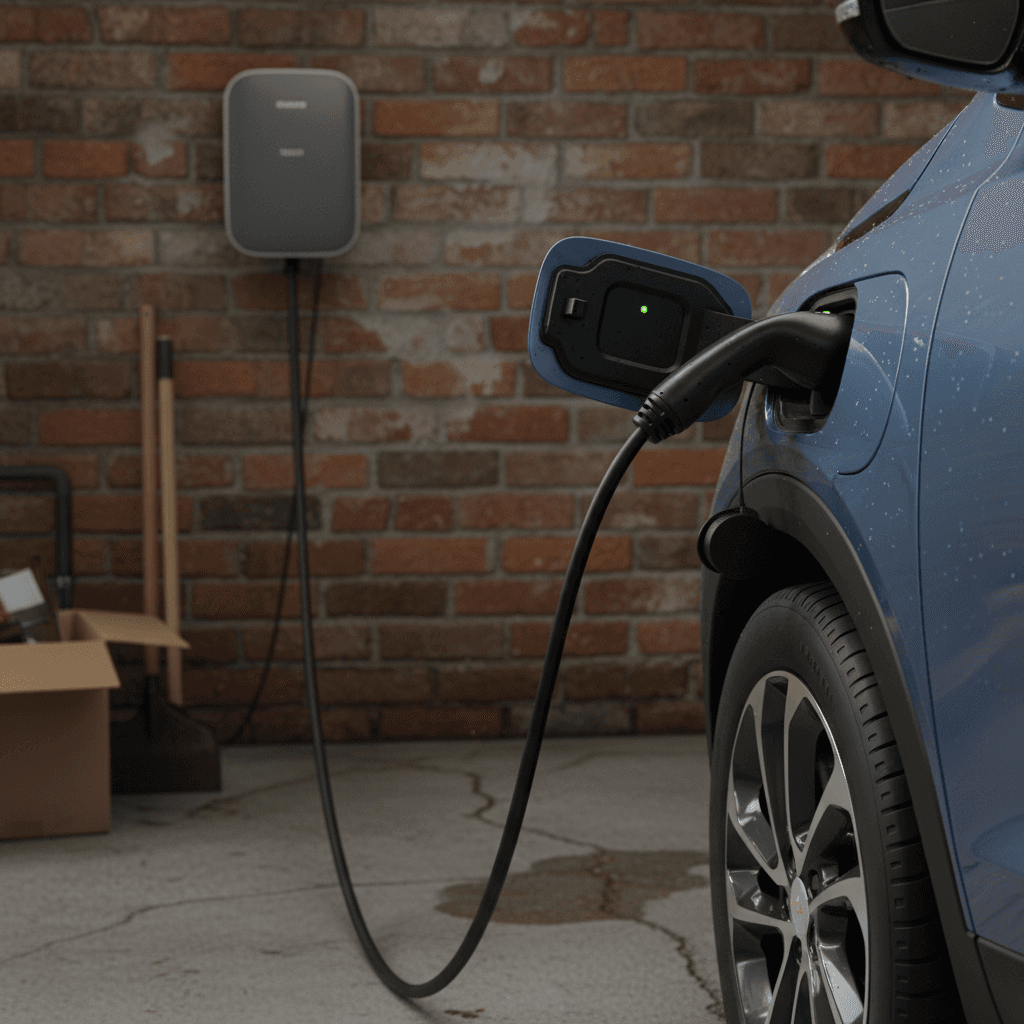
For most Bolt EUV owners, home Level 2 charging is where the vast majority of miles come from, and it’s almost always the cheapest way to run the car. Let’s walk through a few realistic home-charging scenarios.
Chevrolet Bolt EUV home charging cost per mile
Examples using common U.S. residential electricity prices and realistic efficiencies.
| Scenario | Electricity price (¢/kWh) | Assumed efficiency (mi/kWh) | Cost per mile (¢) | Cost to drive 1,000 miles |
|---|---|---|---|---|
| Low-cost power state | 12¢ | 3.6 | 3.3¢ | $33 |
| Near current U.S. average | 16.5¢ | 3.4 | 4.9¢ | $49 |
| High-cost coastal city | 25¢ | 3.2 | 7.8¢ | $78 |
| Time-of-use off‑peak rate | 10¢ | 3.6 | 2.8¢ | $28 |
Your exact cost per mile will depend on your local kWh rate and driving style, but these examples show the ballpark for most drivers.
These numbers assume a Level 2 charger at home with modest charging losses. The key takeaway: even at relatively high electricity prices, a Chevy Bolt EUV usually stays comfortably under ten cents per mile for home charging, and often well under five.
Watch for flat monthly EV charging fees
Public fast charging cost per mile
DC fast charging is where your Bolt EUV charging cost per mile can creep up. The Bolt EUV’s peak DC charge rate (around 55 kW) is modest by modern standards, but pricing on major networks is typically similar per kWh regardless of your car’s max speed. That means your cost per mile is mostly about price per kWh, not how fast the electrons flow.
Chevrolet Bolt EUV cost per mile on DC fast charging
Illustrative examples using common public fast-charging prices.
| Charger type | Price structure | Assumed price | Assumed efficiency (mi/kWh) | Cost per mile (¢) |
|---|---|---|---|---|
| Discounted member rate | Per kWh | 35¢/kWh | 3.0 mi/kWh | 11.7¢ |
| Standard public rate | Per kWh | 45¢/kWh | 3.0 mi/kWh | 15.0¢ |
| Session + per‑minute fees | Effective per kWh | 50¢/kWh | 2.8 mi/kWh | 17.9¢ |
Use your actual fast-charging network price per kWh to refine these estimates.
On road trips where you rely heavily on DC fast charging, it’s realistic to see your energy cost per mile in the low‑ to mid‑teens (cents). That’s still often competitive with a gas car, but it’s a big step up from the 3–6¢ per mile you’ll see at home.
Avoid using DC fast charging as your default
How Bolt EUV charging cost per mile compares to gas cars
Typical compact crossover on gasoline
- Fuel economy: 28–32 mpg combined.
- Gas price: If we assume $3.75/gal as a middle‑of‑the‑road example:
- Cost per mile ≈ $3.75 ÷ 30 mpg = 12.5¢ per mile.
Chevy Bolt EUV on electricity
- Efficiency: ~3.4 mi/kWh in mixed driving.
- Home power at 16.5¢/kWh: 16.5¢ ÷ 3.4 ≈ 4.9¢ per mile.
- DC fast charging at 45¢/kWh: 45¢ ÷ 3.0 ≈ 15¢ per mile.
In other words, when you mostly charge at home, a Chevrolet Bolt EUV can easily cost less than half as much per mile to energize as a comparable gas crossover. Even when you lean on fast charging, you’re usually in the same ballpark as gasoline, with the upside of lower maintenance costs and no oil changes.
Real-world Chevrolet Bolt EUV cost per mile examples
Let’s walk through three concrete scenarios using realistic numbers. Replace the electricity price with your own rate to get a personalized estimate.
3 real-world Bolt EUV cost per mile scenarios
1. Suburban commuter with home Level 2
• Drives 1,000 miles/month • Averaging 3.5 mi/kWh (mostly city + suburban mix) • Pays 15¢/kWh on a fairly typical residential rate Cost per mile = $0.15 ÷ 3.5 ≈ <strong>4.3¢ per mile</strong> Monthly energy cost ≈ <strong>$43</strong> to drive 1,000 miles.
2. Apartment dweller mixing workplace and DC fast charge
• Drives 800 miles/month • Workplace Level 2 is free for half the miles; pays for DC fast charging for the rest at ~40¢/kWh • Efficiency is lower on the highway: say 3.0 mi/kWh Paid miles: 400 mi ÷ 3.0 ≈ 133 kWh × $0.40 ≈ <strong>$53</strong> Effective cost per mile across all 800 miles ≈ $53 ÷ 800 ≈ <strong>6.6¢ per mile</strong>.
3. Road-trip month with lots of fast charging
• 2,000 road-trip miles in a month • Mostly highway, averaging 3.0 mi/kWh • 80% of energy from DC fast charging at 45¢/kWh, 20% from home at 16¢/kWh Home portion: 400 mi ÷ 3.0 ≈ 133 kWh × $0.16 ≈ <strong>$21</strong> DCFC portion: 1,600 mi ÷ 3.0 ≈ 533 kWh × $0.45 ≈ <strong>$240</strong> Total energy ≈ $261 → cost per mile ≈ <strong>13.1¢ per mile</strong>.
Want a quick personal estimate?
How to lower your Bolt EUV charging cost per mile
You can’t control wholesale power markets, but you have more influence over your Chevy Bolt EUV cost per mile than you might think. It comes down to a mix of charging strategy and driving behavior.
Practical ways to cut your Bolt EUV cost per mile
Focus on the levers you control: when you charge, where you charge, and how you drive.
Shift more charging to home off‑peak hours
Many utilities now offer time‑of‑use (TOU) plans with cheaper overnight rates. If you can charge mostly between, say, midnight and 6 a.m., your kWh price can drop dramatically, cutting your cost per mile by 30–50% compared with peak rates.
Reserve DC fast charging for trips
Use DC fast chargers for road trips and occasional top‑ups, not your weekly routine. Every mile you shift from 40–50¢/kWh DC fast charging to 10–20¢/kWh home charging is an immediate win for your budget.
Drive for efficiency, not for bragging rights
Moderate speeds, gentle acceleration, and smart use of one‑pedal driving can easily swing your efficiency from 3.0 to 3.8 mi/kWh. That’s like getting a 25% fuel economy bonus without spending a dime.
Consider installing a dedicated Level 2 charger
If you’re still on Level 1 or relying on public Level 2, a home Level 2 charger gives you flexibility to use the cheapest hours every night. At Recharged, our EV specialists can help you understand home charging options when you’re considering a used Bolt EUV.
Audit your electric plan once a year
Electric rates and plans change. Revisit your utility’s EV‑specific tariffs or green energy options annually. In many markets, simply opting into an EV‑friendly plan can save enough per kWh to shave 1–2¢ off every mile you drive.
Leverage rooftop solar if you have it
If your home already has solar, shifting Bolt EUV charging to sunny hours can bring your marginal cost per kWh close to zero after system payback. Just remember to value panel output you’d otherwise sell back to the grid.
Used Bolt EUV battery health, range, and your cost per mile
If you’re shopping for a used Chevrolet Bolt EUV, you might wonder how battery health and range affect your charging cost per mile. The short answer is that even with some degradation, cost per mile typically stays very low, what changes more is your convenience (how often you have to plug in) rather than the energy cost itself.
- Most Bolt EUVs on the used market still retain the bulk of their original ~65 kWh capacity, especially under 100,000 miles.
- A modest range reduction, from 247 miles to, say, 220 miles, barely changes your energy use per mile; you’re still in roughly the same 3.2–3.5 mi/kWh band if you drive the same way.
- The bigger risk to cost per mile is a pack that has been fast‑charged very heavily and now runs hotter and less efficiently, another reason to check usage history when possible.
How Recharged helps with used Bolt EUV battery health
Battery health is just one dimension of total ownership cost. When you shop for a used Bolt EUV through Recharged, you also get transparent pricing, optional financing, and EV‑specialist support that can help you estimate your personal cost per mile before you sign anything.
FAQ: Chevrolet Bolt EUV charging cost per mile
Frequently asked questions about Bolt EUV charging costs
Bottom line: what to expect from Bolt EUV charging costs
The Chevrolet Bolt EUV built its reputation on being one of the most cost‑effective EVs you can own, and the math still backs that up in 2026. For most drivers, home‑charged miles land in the 4–6¢ per mile range, while occasional DC fast charging pushes that closer to 10–15¢ per mile on long trips. Even at the higher end of those ranges, you’re typically at or below the fuel cost of a comparable gas crossover, before you even account for lower maintenance and the absence of oil changes.
If you’re shopping used, a Bolt EUV with a healthy battery remains one of the strongest value plays in the EV market. And if you’d like help turning national averages into your actual cost per mile, Recharged can walk you through the numbers, show you used Bolt EUVs with verified battery health via the Recharged Score, and even arrange financing and delivery so you can get to those low‑cost electric miles sooner rather than later.