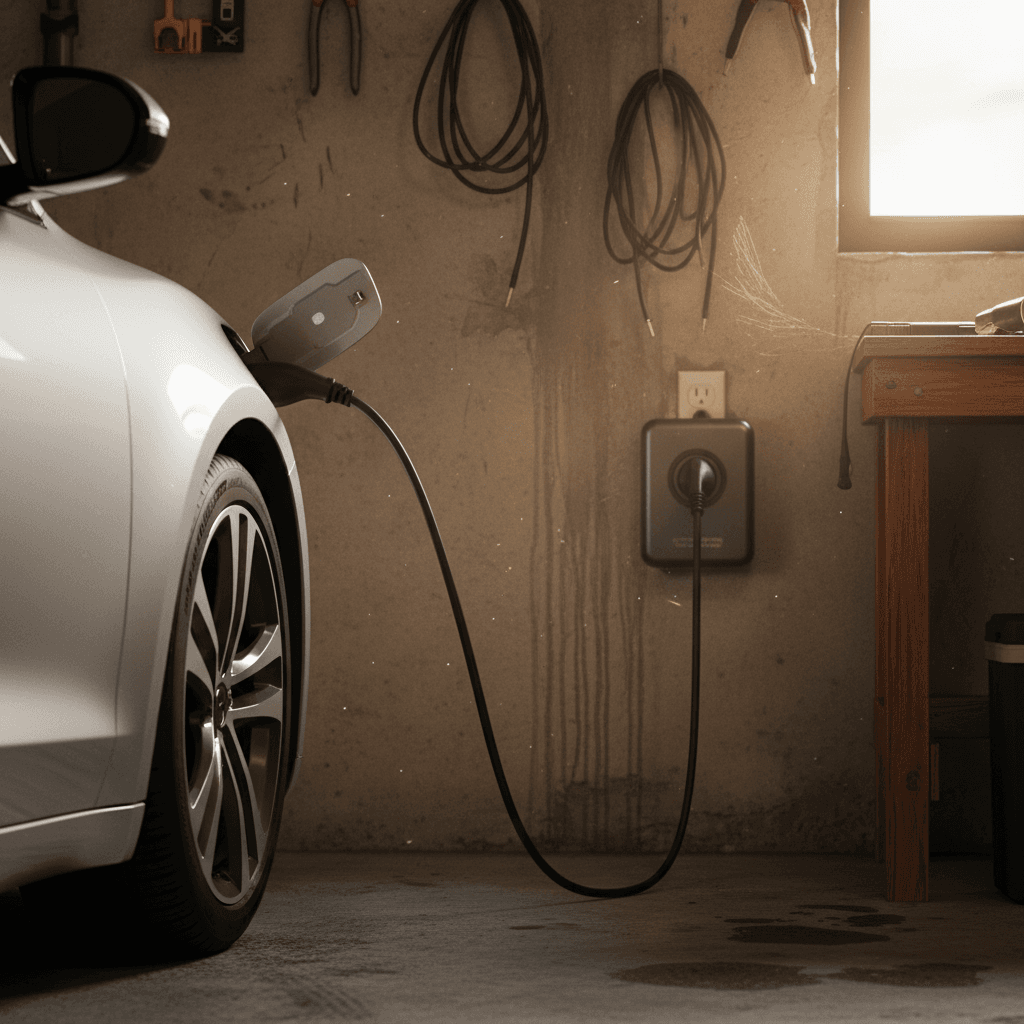
If you just typed “car charger repair near me” because your home EV charger stopped cooperating, you’re not alone. As more drivers move to electric, more Level 1 and Level 2 chargers are failing, misbehaving, or simply confusing their owners. The good news: many issues are minor, and with a clear plan you can decide whether to reset, repair, or replace your EV charger safely.
First things first: safety
Why your search for “car charger repair near me” keeps growing
In 2025, home Level 2 charger installations in the U.S. are now commonly quoted in the $800–$2,500 range including labor, and the national average installation cost sits around $2,400. That’s a serious investment sitting on your garage wall, so when it stops working, it’s natural to look for a repair, not a full replacement.
Home EV charging: why repair matters
With that much money tied up in equipment and installation, it usually pays to understand whether a fix is as simple as a tripped breaker or as serious as a failed circuit board.
Common home EV charger problems (and quick checks)
Most common “my charger’s broken” complaints
What the symptoms usually look like, and what might be behind them
No power to the charger
The charger is completely dark, no LEDs, the app can’t see it, and the car won’t start charging.
- Tripped breaker or GFCI outlet
- Loose wiring in the junction box
- Failed power supply inside the EVSE
Charging keeps stopping
The session starts, then stops after a few minutes or randomly overnight.
- Breaker undersized or overloaded
- Thermal cutout from heat buildup
- Cable damage or worn connector
Error lights or app warnings
Flashing red LEDs, app error codes, or “Check charging equipment” on your car’s screen.
- Ground fault or wiring issue
- Internal electronics failure
- Firmware or connectivity bug
Tip: Check your car first
What you can safely check before calling for repair
You don’t need to be an electrician to rule out some simple, harmless issues. Before you schedule a “car charger repair near me” visit, walk through these quick checks. If anything feels over your head, stop and call a pro.
DIY checks most owners can handle
1. Confirm the outlet or breaker
If you use a plug‑in Level 2 charger, test the 240 V outlet with another appliance rated for that voltage, or at least check that the breaker hasn’t tripped. For hardwired units, inspect your main panel for a tripped breaker, but don’t remove panel covers yourself.
2. Inspect the cable and connector
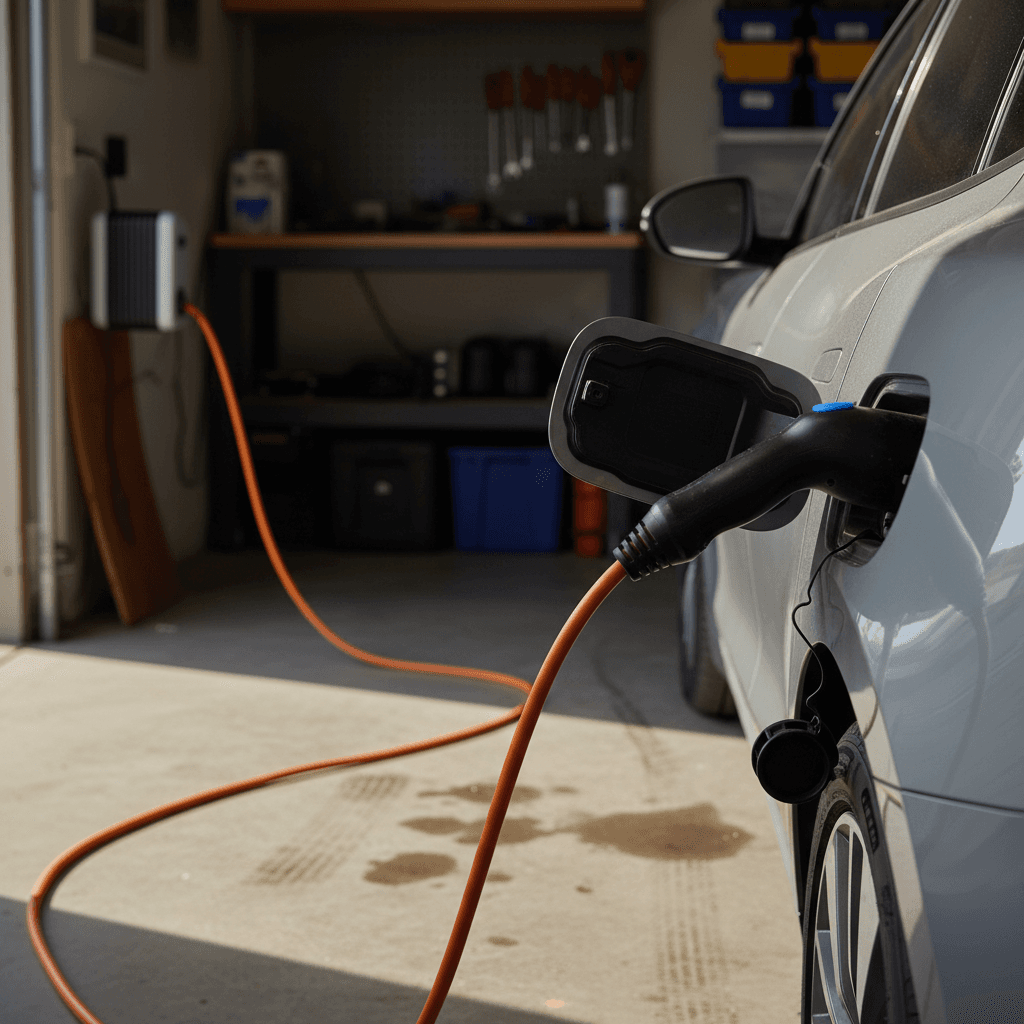
Run your hand (once the cable is cool) along the length of the cord. Look for cuts, crushed sections, exposed conductors, or a loose vehicle connector. If you see damage, stop using the charger and call a professional.
3. Look for status lights or error codes
Most modern EVSEs use colored LEDs and error patterns. Note the color and blink pattern, then check the manual or manufacturer’s support page to translate the code.
4. Reboot the charger and app
Power‑cycle the charger by turning its breaker off for 30 seconds, then back on. Restart the companion app or your Wi‑Fi router if connectivity seems suspect. This can clear software glitches.
5. Try a different charging schedule or amperage
If your charger or car uses scheduled charging, temporarily disable schedules and lower the charging current. Sometimes a bad time‑of‑use setting or marginal circuit only fails at full power.
6. Test with another EV, if possible
If a friend or neighbor has an EV, try a short test session. If their car fails too, it points to the charger or electrical supply, not your vehicle.
When to stop troubleshooting and call a pro
There’s a clear line between safe owner checks and work that belongs to a licensed electrician or EVSE technician. If you hit any of these situations, stop DIY efforts immediately and escalate your search for car charger repair near me.
- Visible melting, scorch marks, buzzing, or burning smells from the charger, plug, or breaker panel
- Breaker trips repeatedly as soon as charging starts, even after you’ve lowered the current
- Any sign of water intrusion into an outdoor unit, conduit, or junction box
- Error codes pointing to ground faults, internal temperature faults, or insulation failures
- You’re not comfortable opening or working near electrical panels and wiring (most drivers aren’t, and that’s okay)
Do NOT do this
How much EV car charger repair costs in 2025
Because labor and parts vary by brand and region, no two EV charger repair bills look identical. Still, we can sketch realistic 2025 ballparks so your “car charger repair near me” search doesn’t feel like financial roulette.
Typical 2025 home EV charger repair price ranges
Actual costs depend on your electrical system, charger brand, and local labor rates.
| Issue / Service | What’s involved | Typical Cost Range (USD) |
|---|---|---|
| Basic diagnostic visit | Electrician or EVSE tech visit, visual inspection, meter tests, simple fix if quick | $150 – $300 |
| Breaker or GFCI replacement | Swap failed breaker/outlet with correctly sized unit, basic testing | $200 – $400 including parts |
| Outlet or plug replacement | Replace worn NEMA 14‑50 or similar receptacle and inspect wiring | $200 – $450 |
| Cable or connector replacement | New EVSE cable assembly or vehicle connector (if available) plus labor | $300 – $700 |
| Hardwired EVSE repair | Opening unit, replacing internal board, sensor, or contactor | $300 – $900 |
| Full EVSE replacement (reuse wiring) | New charger head unit, using existing 240 V circuit | $800 – $2,000 including hardware |
| Panel upgrade (if required) | Service upgrade to 200 A, new breakers, permits, inspections | $1,500 – $3,000+ |
Use this as a planning tool, your local quotes will fine‑tune the numbers.
Is repair covered by warranty?
Who actually fixes an EV car charger?
When you search for car charger repair near me, you’ll see a mix of electricians, solar companies, EV‑focused installers, and sometimes the dealer where you bought your car. They don’t all do the same thing, and that matters.
Licensed electricians
These are usually your first call for anything involving wiring, breakers, or outlets.
- Diagnose power supply issues and tripping breakers
- Replace outlets, breakers, and damaged conduit
- Verify your panel and circuit are correctly sized for the charger
Look for someone with recent EV charger experience, not just general residential work.
EV charger specialists & OEM support
Many regions now have EV‑only installers or techs who work with specific brands.
- Fluent in brand‑specific error codes and firmware quirks
- Handle board swaps, sensor failures, and warranty claims
- Sometimes dispatched by the charger manufacturer after a support call
Your car dealer may help coordinate if the charger was part of your vehicle purchase bundle.
Good news for EV owners
How to find trustworthy car charger repair near you
A broken charger is stressful, but choosing the wrong repair partner is worse. Here’s how to use that “car charger repair near me” search wisely instead of just clicking the first ad.
What to look for in a charger repair pro
Use these filters as you read reviews and talk to contractors
Proper licensing & insurance
Confirm they’re a licensed electrician in your state with liability insurance and (ideally) recent EV projects.
EV charger experience
Ask how many Level 2 home chargers they’ve installed or repaired in the last year and which brands.
Clear estimates & communication
Look for written quotes, clear labor rates, and a willingness to explain options instead of pushing the most expensive fix.
Step‑by‑step: finding and booking the right repair
1. Check the manufacturer first
Visit the charger brand’s website or app. Many have approved installer networks and warranty procedures that start online.
2. Gather photos and details
Take clear photos of the charger label, wiring, breaker, and any error lights. Note when the problem started and whether it’s consistent or intermittent.
3. Get 2–3 quotes when possible
For anything beyond a simple breaker swap, try to get at least two estimates. Prices can vary widely, especially for panel work.
4. Ask about rebates or credits
Some utilities offer rebates when you replace an older charger with a smart, load‑managed unit. That can offset part of the repair or replacement cost.
5. Confirm warranty impact
If your unit is still under warranty, ask whether a third‑party repair will preserve coverage. Sometimes only OEM‑authorized techs keep the warranty intact.
Repair vs. replace: When a new charger makes more sense
Not every repair is worth doing. If your Level 2 unit is older, out of warranty, or undersized for your current EV, replacement might be smarter than pouring money into boards and cables.
Leaning toward repair
- Charger is less than 3–4 years old and still under warranty
- Issue appears limited to an outlet, breaker, or plug
- The unit has the right amperage and features for your EV and driving habits
- Repair quote is clearly cheaper than a new unit plus installation
Leaning toward replacement
- Unit is older, out of warranty, or from a discontinued brand
- Multiple components are failing (cable + board + connector)
- You’re upgrading to a higher‑amp charger or adding smart features anyway
- Repair quote approaches or exceeds a new, warrantied unit
Think long‑term, not just this repair
Used EV buyers: What a bad home charger can tell you
If you’re shopping for a used EV, the state of any included home charger is a small but useful data point. A neglected or obviously damaged charger doesn’t automatically mean the car was abused, but it should prompt a few smart questions.
How Recharged helps here
- Ask how and where the previous owner usually charged, home, work, or DC fast charging
- Look for obvious abuse like yanked cables, crushed connectors, or makeshift extension cords
- Use the charger’s condition as leverage to negotiate replacement or a credit if you’ll need a new unit
- Remember that a healthy battery (verified by diagnostics) matters far more than a scuffed wallbox
FAQ: “Car charger repair near me”
Frequently asked questions about EV charger repair
Key takeaways and next steps
A dead or unreliable home charger doesn’t have to derail your EV ownership. Start with simple, safe checks, then lean on your manufacturer and a licensed electrician to handle anything involving wiring or internal electronics. In many cases, a modest repair gets you back to overnight charging; in others, a modern replacement is the smarter long‑term play, especially if you can stack rebates and tax credits.
If you’re also rethinking the car in your driveway, remember that Recharged makes used EV ownership more transparent. Every vehicle includes a Recharged Score Report with verified battery health, pricing you can sanity‑check, and EV‑savvy support from first question to final delivery. That way, whether you’re fixing the charger you already own or shopping for your next EV, you’re making decisions with real data, not guesswork.