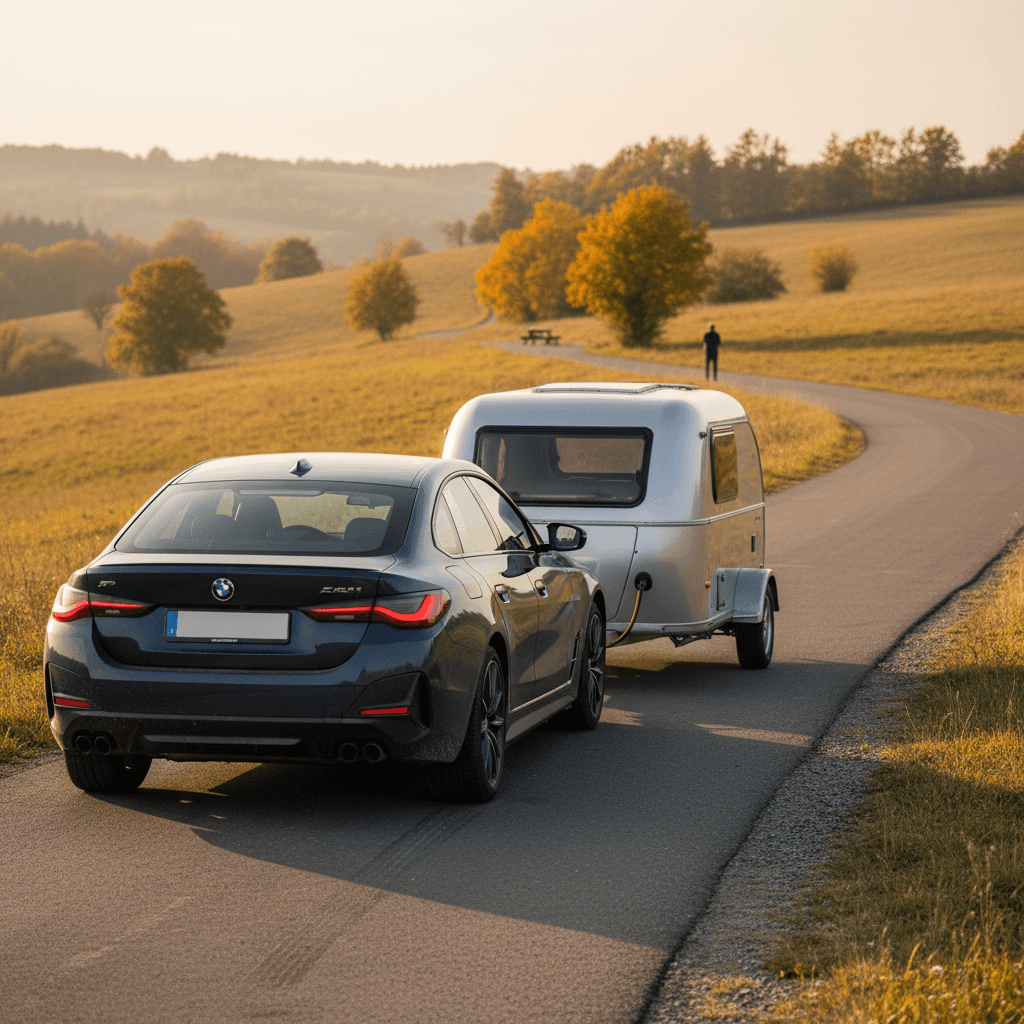
If you’re eyeing a BMW i4 but still want to pull a small camper, utility trailer, or even just a hitch‑mount bike rack, you’re not alone. The big question is simple: can a BMW i4 tow a trailer, and if so, how much, and what’s it like to live with?
Quick context
Can a BMW i4 Tow a Trailer? (Short Answer)
Yes, the BMW i4 can tow a trailer when it’s properly equipped. BMW’s own technical documentation and market guides list a maximum braked trailer load of about 1,600 kg (3,500 lbs) and 750 kg (1,650 lbs) unbraked for the i4 with a factory tow hitch. In real-world terms, that’s small travel trailers, lightweight cargo or utility trailers, and many pop‑up campers, provided you stay within your specific car’s limits and follow local regulations.
Important for U.S. drivers
BMW i4 Towing Capacity at a Glance
BMW i4 Factory Towing Numbers (Typical Markets)
These numbers are broad factory figures pulled from BMW technical material and international spec sheets. Your individual i4’s rating can vary based on market, model year, and configuration, so always confirm against your documentation before you start shopping for a trailer.
Which BMW i4 Models Can Tow, and How Much?
Most BMW i4 variants share the same basic body and battery architecture, and that’s good news for towing. In markets where towing is officially supported, BMW typically lists the same maximum trailer loads across trims, as long as the car is fitted with the approved tow bar.
Typical BMW i4 Towing Ratings by Variant (Factory Tow Hitch)
Indicative figures based on BMW’s published technical data in markets where towing is enabled. Always verify your specific vehicle’s rating.
| BMW i4 variant | Drivetrain | Max braked trailer | Max unbraked trailer | Approx. tongue weight |
|---|---|---|---|---|
| i4 eDrive35 | RWD | 1,600 kg (3,500 lbs) | 750 kg (1,650 lbs) | ~75 kg (165 lbs) |
| i4 eDrive40 | RWD | 1,600 kg (3,500 lbs) | 750 kg (1,650 lbs) | ~75 kg (165 lbs) |
| i4 xDrive40 | AWD | 1,600 kg (3,500 lbs) | 750 kg (1,650 lbs) | ~75 kg (165 lbs) |
| i4 M50 | AWD | 1,600 kg (3,500 lbs) | 750 kg (1,650 lbs) | ~75 kg (165 lbs) |
Use this as a high‑level guide, then double‑check your own VIN‑specific documentation.
Where to find your exact limit
What Kind of Trailer Can a BMW i4 Safely Tow?
Think of the i4 as a strong, heavy compact–luxury sedan with a stout electric powertrain. It’s not a half‑ton pickup, but it’s far from fragile. Within its limits, it handles certain types of towing very comfortably.
Trailers That Fit the BMW i4’s Sweet Spot
Stay within weight limits, keep frontal area modest, and the i4 can be a surprisingly capable tow partner.
Small camping trailers
Utility & cargo trailers
Bike racks & gear carriers
What the i4 is not for
Hitches for the BMW i4: Factory vs. Aftermarket
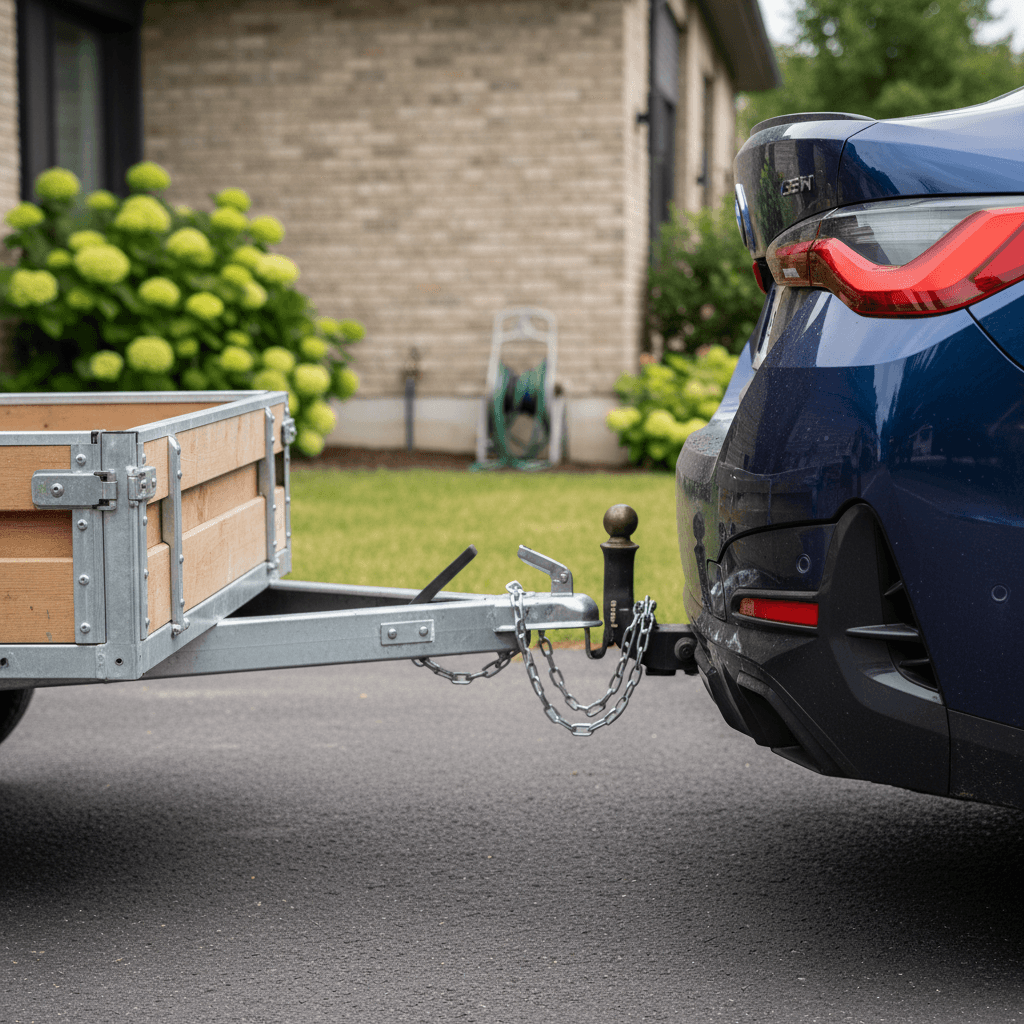
From the factory, BMW documents an electrically deployable tow hitch for the i4 in some regions. In the U.S., however, that option has been scarce or absent on order sheets, which is why owners often turn to aftermarket solutions.
Factory BMW tow hitch (where available)
- Integrated with the car’s cooling, stability control, and wiring.
- Typically rated to the full 1,600 kg braked capacity.
- Cleanly hidden or retractable when not in use.
- Usually the most expensive option, especially retrofits.
Aftermarket hitches (more common in the U.S.)
- Bolt‑on hitches from brands like EcoHitch, Stealth, and others.
- Often rated around 3,500 lbs towing / 350 lbs tongue, but that doesn’t override the car’s own limits.
- Frequently installed for bike racks and light cargo, sometimes without trailer wiring.
- Installation quality matters: look for shops with EV experience.
Bike rack only?
How Towing Affects Your BMW i4 Range and Charging
Here’s where towing an EV diverges sharply from towing with a gasoline car. The BMW i4 has instant torque, so it doesn’t feel strained, but the aero drag and weight of a trailer show up quickly on your range readout.
- Expect 30–50% less range at highway speeds with a medium‑size trailer. Taller, boxier trailers hurt more than low, sleek ones.
- Your Wh/mi consumption can nearly double with a heavier or less aerodynamic trailer.
- DC fast‑charging remains just as quick, but you’ll be stopping more often, plan your charging stops closer together on road trips.
- Regenerative braking helps on descents, but you still need a properly braked trailer for safety and control.
Plan your route like a trucker
Setting Up Your BMW i4 for Safe Towing
Before you ever drop a trailer onto that shiny new hitch, you’ll want a setup routine that keeps you, and your battery, out of trouble. Think of it as your pre‑flight checklist.
Pre‑Tow Checklist for Your BMW i4
1. Confirm your i4’s official tow rating
Double‑check your owner’s manual and registration for braked/unbraked limits, tongue weight, and gross combination weight. Don’t rely on hearsay or what a hitch vendor says alone.
2. Choose the right hitch and installer
Select a hitch that matches or exceeds the car’s rating, and use an installer familiar with EVs so cooling ducts, high‑voltage cables, and sensors aren’t compromised.
3. Make sure the trailer has brakes
Anything approaching the i4’s upper towing range should have its own <strong>electric or surge brakes</strong>, correctly adjusted and legally wired for your region.
4. Weigh your loaded trailer
A trailer that’s “about 2,000 pounds” is guesswork. Use a truck scale or RV park scale to verify loaded weight and confirm you’re under both trailer and tongue limits.
5. Balance tongue weight properly
Aim for roughly <strong>10% of trailer weight on the hitch</strong> unless your documentation says otherwise. Too light and you’ll get sway; too heavy and you overload the rear axle and hitch.
6. Dial back speed and drive modes
Use a more relaxed drive mode, give yourself longer following distances, and keep speeds down. Your i4’s torque can hide how much work it’s really doing.
Warranty and liability reality check
BMW i4 vs. Other EVs for Towing
How does the i4 stack up against the rest of the EV pack? It’s not the tow king of the hill, but it’s better than you might think if you’re coming from a compact ICE sedan.
How the BMW i4 Compares to Other EV Tow Vehicles
Approximate braked trailer limits for popular EVs with factory tow packages, where offered.
| Model | Vehicle type | Max braked trailer | Best suited for |
|---|---|---|---|
| BMW i4 | Electric sedan / gran coupé | ~1,600 kg (3,500 lbs) | Small campers, utility trailers, moto/ATV trailers |
| Tesla Model 3 | Electric sedan | Up to ~1,000 kg (2,200 lbs) in some markets | Very light campers, small utility trailers |
| Hyundai IONIQ 5 | Electric crossover | Up to ~1,600 kg (3,500 lbs) | Small–medium campers, boats, utility trailers |
| Ford F‑150 Lightning | Electric pickup | Up to 4,500+ kg (10,000 lbs) | Heavy travel trailers, car haulers, boats |
| Rivian R1T | Electric pickup | Up to ~4,990 kg (11,000 lbs) | Serious RV and toy‑hauler duty |
Numbers are indicative and can vary by market and configuration, always verify for your specific vehicle.
Where the i4 shines
When Towing with an EV Makes Sense, and When It Doesn’t
Electric vehicles tow differently than gasoline trucks and SUVs. The i4 is strong and stable, but its battery range is finite, and public charging wasn’t built with trailers in mind.
Good use cases for an i4 tow setup
- Weekend camping within a few hundred miles, especially if your campground has charging nearby.
- Local utility hauling: mulch, lumber, furniture, or yard equipment with a small open trailer.
- Toy hauling to nearby trailheads, dirt bikes, ATVs, or snowmobiles, if you plan your charging.
- Daily life convenience with a hitch‑mount bike rack or cargo carrier.
Times to think twice
- Cross‑country RV trips where charging access is sparse or stations are hard to enter while hitched.
- Towing near the i4’s maximum capacity across mountain passes or extreme heat.
- Situations where your local BMW docs explicitly prohibit towing for your configuration.
- If your insurance provider warns that towing could complicate coverage in your region.
FAQ: BMW i4 and Towing
Frequently Asked Questions About BMW i4 Towing
Thinking About a Used BMW i4 for Towing?
Shopping used is a smart way to get into an i4, especially if you want budget left over for a hitch, wiring, and a well‑sorted trailer. But adding towing duty to any used EV raises a few extra questions.
Used BMW i4 Towing Checklist
What to ask before you hitch a trailer to a pre‑owned i4.
1. Ask about prior towing
2. Check battery health
3. Inspect suspension & brakes
How Recharged can help
- Identify BMW i4s that are good candidates for light towing.
- Understand realistic range when towing your specific trailer.
- Plan financing, trade‑in, and even nationwide delivery so the right i4 shows up at your driveway ready for its first road trip.
Ready to find your next EV?
Browse VehiclesBottom Line: Can You Live with an i4 as a Tow Car?
If your idea of towing is a 7,000‑pound travel trailer and a cross‑country itinerary, the BMW i4 isn’t the hero you’re looking for. But if you’re after a refined, quick electric sedan that can also pull a modest camper, small utility trailer, or a rack full of bikes on the weekend, the answer is much more encouraging: yes, a BMW i4 can tow a trailer, and it can do it well, as long as you respect its limits.
Set yourself up with the right hitch, keep trailer weights realistic, plan your charging a little more carefully, and the i4 becomes a genuinely useful multitool. And if you’re considering a used i4 for this role, working with a specialist like Recharged gives you the battery insight and expert guidance to know exactly what you, and your trailer, are getting into.