You don’t need a spreadsheet or an engineering degree to calculate EV charging cost. What you do need is a basic formula, your local electricity price, and a realistic idea of how efficient your car is in the real world, not the fantasy numbers on the window sticker.
The 10‑second answer
Why bother calculating EV charging cost?
Electric vehicles are sold with a promise: cheap to run, quiet, and clean. That’s broadly true, but only if you understand where your charging dollars actually go. Knowing how to calculate EV charging cost helps you decide whether an EV fits your budget, compare models, and plan road trips without playing roulette with your credit card at a DC fast charger.
EV charging cost in real numbers
The core formula to calculate EV charging cost
Underneath all the apps and glossy dashboards, EV charging cost is just high‑school algebra. Here’s the core formula you’ll use again and again:
Essential EV charging cost formulas
Keep these three formulas in your back pocket. They work for home charging, public charging, and road‑trip planning.
| What you want to know | Formula | Example |
|---|---|---|
| Cost to fully charge your EV | Battery size (kWh) × electricity price ($/kWh) | 60 kWh × $0.17 = $10.20 |
| Cost per 100 miles | kWh per 100 miles × electricity price | 28 kWh × $0.17 = $4.76 per 100 miles |
| Cost per mile | (kWh per 100 miles × price) ÷ 100 | (28 × $0.17) ÷ 100 ≈ $0.048 per mile |
Use these formulas with your own numbers to create a personal EV charging cost calculator.
Think in kWh, not percent
Step 1: Find your electricity price per kWh
Your electricity rate is the single biggest driver of EV charging cost. In early 2025, the U.S. average residential rate is hovering around $0.17–$0.18 per kWh, but the spread is wild: single digits in parts of the Pacific Northwest, north of $0.30 in Hawaii and some New England states.
- Grab a recent electric bill and look for a line that shows your rate in ¢/kWh or $/kWh. If you see multiple line items (energy, delivery, fees), add them all together, your EV doesn’t care which part of the bill is which.
- If your utility has time‑of‑use (TOU) pricing, note the off‑peak rate. That’s the rate that matters if you can set your EV or home charger to fill up overnight.
- If you can’t find a clear rate, divide the total electricity charges (before taxes) by the total kWh used for that month. That rough “all‑in” rate is good enough for cost estimates.
Watch out for demand charges and tiers
Step 2: Estimate how much energy you’ll use
Every EV turns electrons into motion a little differently. A lightweight hatchback and a three‑row SUV live very different lives, aerodynamically speaking. To estimate EV charging cost accurately, you need a realistic efficiency number, not the marketing fantasy on the EPA sticker.
Three ways to estimate your EV's efficiency
Pick whichever is easiest, you just need a kWh‑per‑100‑miles number.
Use your car’s display
Most EVs show average consumption in Wh/mi or kWh/100 mi.
- If it shows Wh/mi, multiply by 100 and divide by 1,000.
- Example: 280 Wh/mi → 28 kWh/100 mi.
Use EPA or window‑sticker data
Look up your car on the EPA fuel‑economy site or in the owner’s manual. You’ll usually see kWh/100 mi.
Knock that number up by 10–20% for real‑world driving, especially if you have a lead foot, big wheels, or cold winters.
Use a simple rule of thumb
If you don’t have the car yet, assume:
- Small EVs: 24–27 kWh/100 mi
- Midsize crossovers: 28–32 kWh/100 mi
- Large SUVs/pickups: 34–40+ kWh/100 mi
Next, estimate your annual mileage. The average U.S. driver is around 12,000–13,500 miles per year. If you commute 40 miles a day and take a few road trips, you’re probably right in that zone.
A quick annual energy estimate
Step 3: Calculate home EV charging cost
Now the fun part: turning theory into dollars. Let’s say you’re charging a 2023–2025 compact or midsize EV at home, with a consumption of 28 kWh/100 miles and a typical U.S. electricity rate of $0.17/kWh.
Example 1: Cost per full charge
Imagine a 60 kWh battery and you arrive home at 20% and charge to 80% most nights.
- Battery capacity: 60 kWh
- Energy added: 60 × (0.80 – 0.20) = 36 kWh
- Electricity price: $0.17/kWh
Charging cost = 36 × $0.17 = $6.12 for that session.
Example 2: Monthly home charging cost
Assume 1,000 miles per month and 28 kWh/100 miles at $0.17/kWh.
- Energy use: (1,000 ÷ 100) × 28 = 280 kWh
- Cost: 280 × $0.17 = $47.60 per month
Double the mileage to 2,000 miles and you’re still under $100/month in most states.
What about Level 1 vs. Level 2?
Public charging costs: kWh, session fees, and idle fees
Public charging is where many new EV owners get sticker shock. At home you’re paying residential rates; out on the highway you’re paying for prime real estate, hardware, maintenance, payment processing, and profit. In 2025, public Level 2 and DC fast charging in the U.S. often averages in the $0.30–$0.45/kWh range, with outliers above and below depending on network and state.
Typical public charging price structures
Same units (kWh), very different rules.
Energy‑based pricing
You pay by the kWh, similar to your home bill.
- Example: $0.39/kWh DC fast charge
- 40 kWh added → $15.60
Time‑based pricing
You pay by the minute or hour, common where state rules limit per‑kWh billing.
- Example: $0.40/min at 150 kW station
- 30 minutes → $12.00, whether you charge at 30 kW or 120 kW.
Session & idle fees
Many networks add a flat session fee (e.g., $1.00) or idle fee once you hit a high state of charge.
Those extras can turn a $14 stop into a $20 stop if you linger.
Let’s compare a realistic highway top‑up to that tidy home‑charging example.
Home vs. DC fast charging: one session
Same car, same energy, very different price depending on where you plug in.
| Where you charge | Energy added | Price structure | Rate | Total cost |
|---|---|---|---|---|
| Home Level 2 | 40 kWh | Per kWh | $0.17/kWh | 40 × $0.17 = $6.80 |
| DC fast charger | 40 kWh | Per kWh + $1 fee | $0.42/kWh + $1 | (40 × $0.42) + $1 = $17.80 |
| DC fast (time‑based) | ~40 kWh in 30 min | Per minute | $0.40/min for 30 min | 30 × $0.40 = $12.00 (if you actually average 80 kW) |
Assume you add 40 kWh on a road trip to get back on the road quickly.
The expensive last 20%
Cost per mile, and how it compares to gas
Comparing EVs to gas cars on a “tank vs. battery” basis is clumsy. Cost per mile is where EVs really flex.
EV cost per mile
Using that same 28 kWh/100 mi and $0.17/kWh home rate:
- Cost per 100 mi = 28 × $0.17 = $4.76
- Cost per mile = $4.76 ÷ 100 ≈ $0.048
At a pricey DC fast charger at $0.42/kWh, that jumps to about $0.12/mile.
Gas car cost per mile
Take a 30‑mpg gasoline car and a perfectly average $3.15/gal gas price.
- Cost per mile = $3.15 ÷ 30 ≈ $0.105
- Cost per 100 miles ≈ $10.50
On home charging, the EV costs less than half as much per mile. On pricey fast chargers, it’s roughly on par with, or a bit cheaper than, a typical gas car.
City vs. highway flips the script
Six ways to lower your EV charging costs
Once you understand how to calculate EV charging cost, the next question is obvious: how do you make that number smaller without driving like a rolling roadblock?
Practical ways to pay less for EV charging
1. Charge at home whenever you can
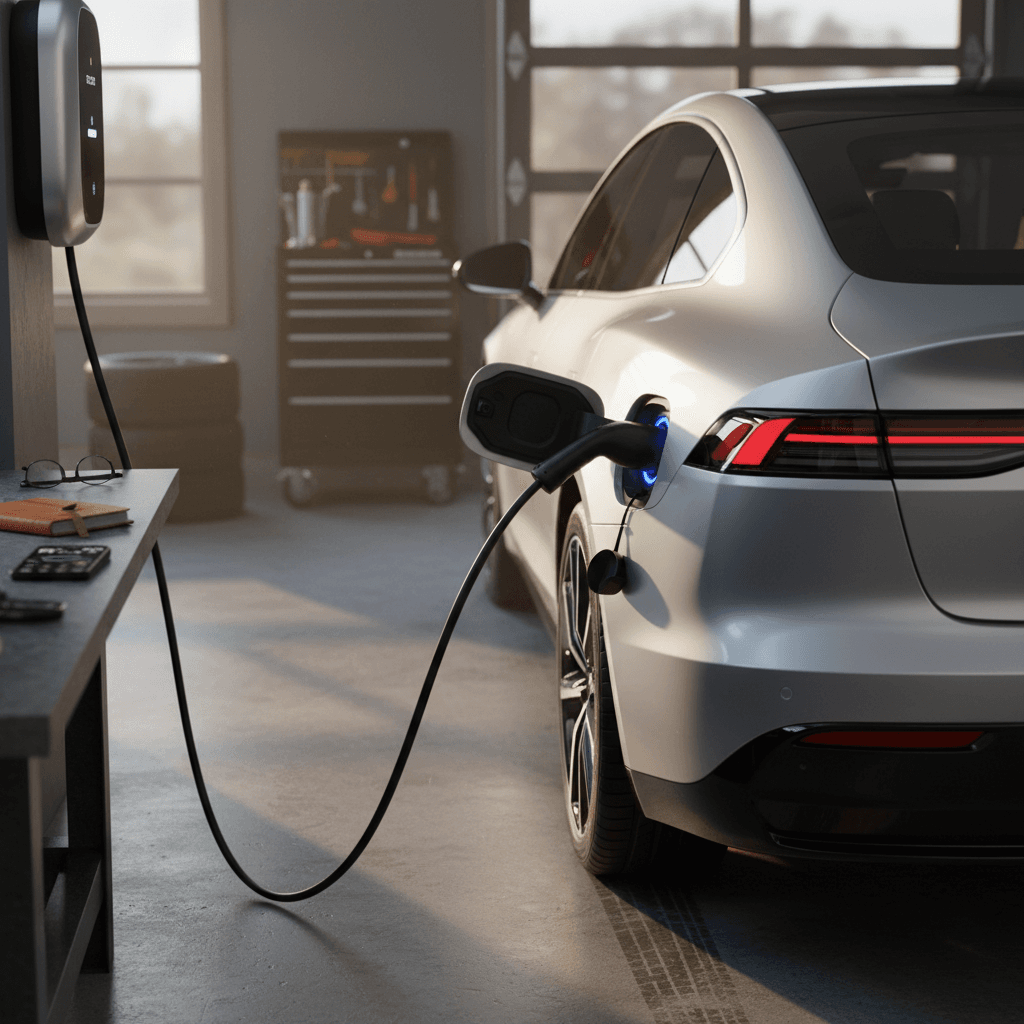
Residential electricity is almost always cheaper than public charging. If you own your home, a Level 2 charger in the garage is often the single biggest lever you have over lifetime EV running costs.
2. Use off‑peak or EV‑specific rates
Ask your utility about time‑of‑use or EV plans. Setting your car to start charging at midnight can effectively cut your cost per kWh by 20–50% in many markets, especially where nighttime demand is low.
3. Avoid the 80–100% fast‑charge trap
Those last few percentage points can take as long as the first half of the charge. On time‑billed DC chargers, that’s a terrible deal. Calculate whether the extra 20% saves you a stop, or just burns money.
4. Mind your speed and tires
Aerodynamics and rolling resistance matter. Driving 75 vs. 65 mph can bump your kWh/100 mi enough to add 20–30% to your energy use. Underinflated or aggressive tires do the same.
5. Precondition while plugged in
In hot or cold weather, pre‑heat or pre‑cool the cabin while the car is still on the plug. That energy comes from the grid, not your battery, keeping your on‑road consumption (and cost) in check.
6. Plan smarter road‑trip stops
Use apps that show charger pricing, not just availability. A five‑minute detour to a cheaper station can save real money over a day’s driving, especially if you avoid idle fees.
Charging cost and buying a used EV
If you’re shopping for a used EV, charging cost isn’t just about your utility rate. It’s also about how healthy the battery is and how efficient the car will be five or ten years into its life. A tired pack that’s lost 15–20% of its original capacity forces more frequent fast charges and can push you into expensive public charging more often.
Battery health = charging cost in disguise
Two identical EVs can have very different real‑world range and efficiency depending on how their batteries were treated. Lots of high‑power DC fast charging, constant 100% charges, or long periods sitting at very high or low state of charge can all age a pack faster.
The result? You buy the car, but you also inherit someone else’s charging habits.
How Recharged fits into the math
Every EV sold through Recharged comes with a Recharged Score Report that includes verified battery health and diagnostics. That gives you a much clearer picture of how much useful range you’ll actually get, and, by extension, what you’ll realistically pay to charge the car over time.
If you’re trading in or selling an EV, that transparency helps buyers understand the car’s true value, including its long‑term charging costs.
Turn a listing into a cost estimate
EV charging cost FAQ
Frequently asked questions about EV charging cost
Bottom line: EV charging cost is math you can actually use
When you strip away the jargon, calculating EV charging cost comes down to three numbers: your price per kWh, your car’s kWh per 100 miles, and how far you drive. With those, you can sketch out your monthly spend, compare home vs. public charging, and see exactly how an EV stacks up against your current gas bill.
If you’re already in an EV, use these formulas to tune your charging habits and cut waste, especially on road trips. If you’re shopping for a used EV, pair this math with a transparent Recharged Score Report so you’re not guessing about battery health or real‑world range. Either way, once you can put a dollar sign on every kilowatt‑hour, the EV ownership picture gets a lot clearer.