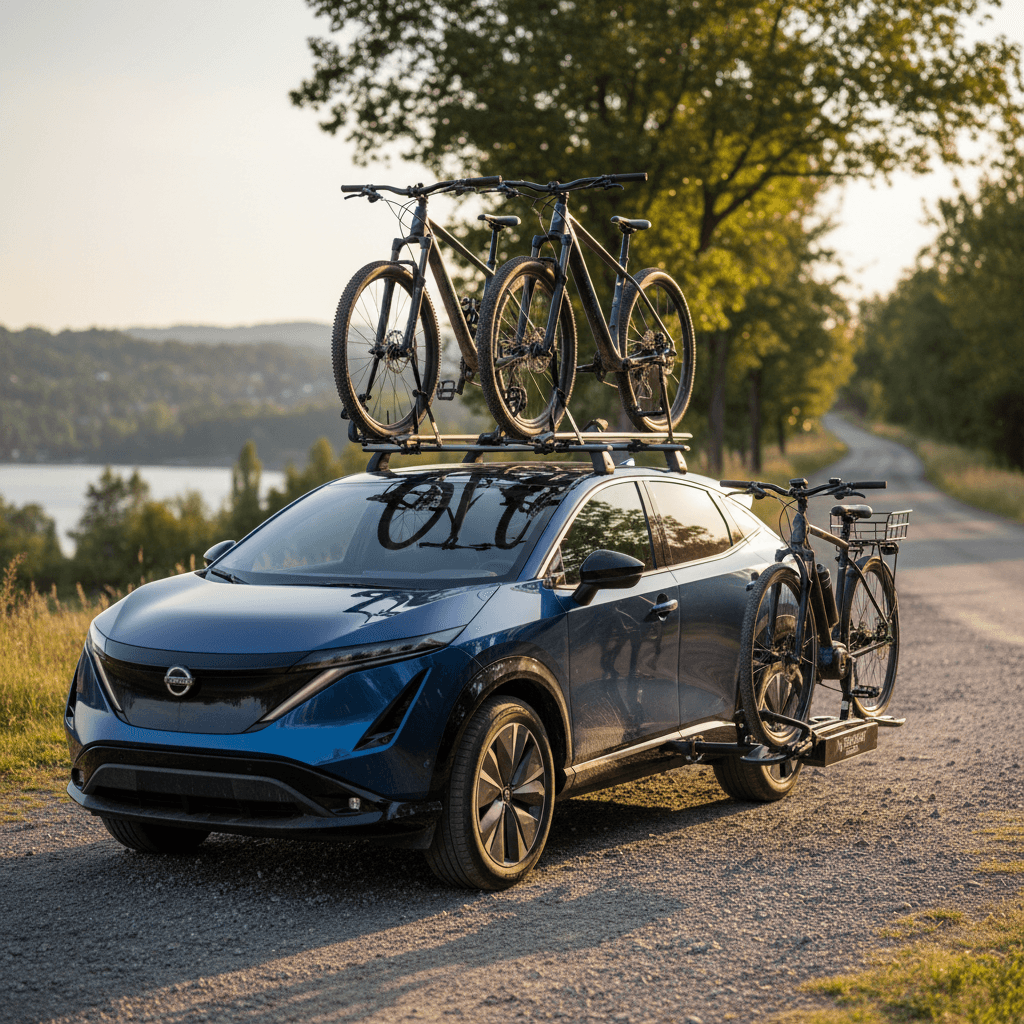
If you’re shopping for Nissan Ariya bike rack options, you quickly realize two things: Nissan hasn’t exactly made towing and hitches simple in the U.S., and most rack makers still treat the Ariya as a niche model. The good news is that with the right hitch or roof setup, your Ariya can carry one to four bikes safely, without wrecking range or your warranty.
Key takeaway
Overview: How the Nissan Ariya Handles Bike Racks
Before you pick a rack, you need to understand three things about the Ariya: how its hitch options work, how much tongue weight (vertical load on the hitch) it can realistically handle, and how bikes affect EV range and usability (like the power tailgate and rear camera). Compared with a typical compact SUV, the Ariya is perfectly capable of hauling bikes, but the margin for error on weight and aerodynamics is smaller, and the aftermarket still hasn’t fully caught up.
Nissan Ariya bike hauling at a glance
Does the Nissan Ariya Have a Factory Hitch?
This is where things get confusing. Nissan has taken different approaches to towing and hitches depending on region and trim, and U.S. dealers haven’t been consistent about how they talk about it.
- United States: early 2023–2024 Ariya models were sold with no published tow rating for FWD trims and limited or no hitch availability from Nissan. Dealers that did install a hitch often positioned it as "for accessories only" (cargo trays and bike racks), not for towing heavy trailers.
- AWD e-4ORCE trims: in many markets outside the U.S., the same Ariya is rated to tow about 750 kg (≈1,650 lb) FWD and 1,500 kg (≈3,300 lb) AWD. In practice, U.S. owners and some dealers use these numbers as a sanity check, even when Nissan USA’s documentation is conservative.
- Dealer-installed "tow bars": in Europe, OEM detachable towbars with wiring are widely offered and fully endorsed for light towing and bike racks. In North America, dealer-installed kits exist but are less standardized and sometimes not clearly advertised.
- Bottom line: if you’re in the U.S., assume your Ariya did not come with a factory hitch unless you can physically see a receiver under the rear bumper or find it on your purchase paperwork. You’ll likely be looking at aftermarket hitches for bike racks.
Don’t assume your Ariya is tow-rated
Aftermarket Hitch Options for the Nissan Ariya
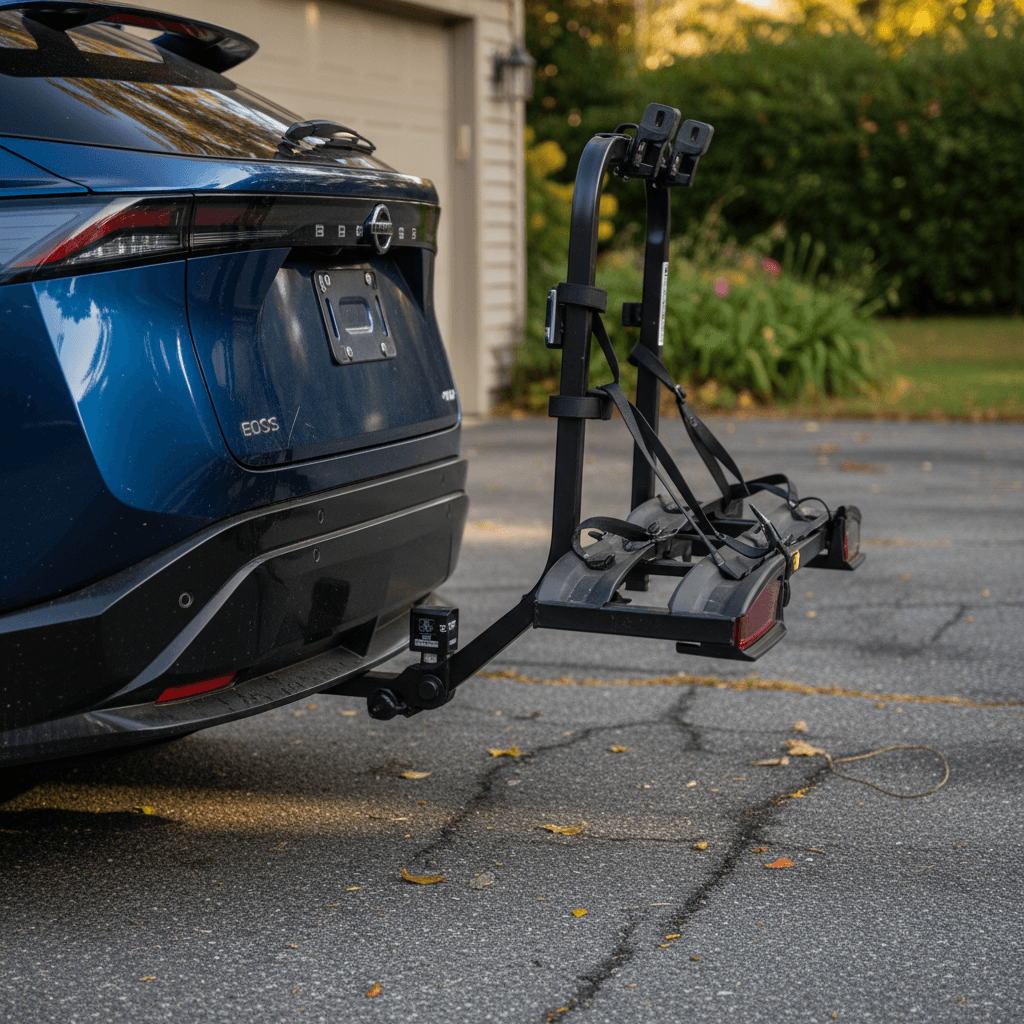
For bike racks, you’re almost always better off with a 2-inch Class III-style receiver. That opens up the full universe of modern platform racks, especially for heavy e‑bikes. Several brands now build Ariya-specific hitches that bolt to existing frame points and drop a receiver through the lower bumper trim.
Common Nissan Ariya hitch options for bike racks
Representative products and specs as of early 2026 (always verify current ratings before purchase).
EcoHitch (Torklift Central)
Receiver: 2" hidden-style hitch
Rated tongue weight: around 300 lb at the ball (accessory use somewhat lower)
Use case: Owners who want a more integrated look and maximum vertical capacity for e‑bikes or cargo trays.
Install typically requires lowering portions of the rear underbody panel and minor trimming that isn’t visible from normal viewing angles.
Curt / Draw-Tite / Reese
Receiver: 2" Class III hitches designed specifically for the Ariya
Rated tongue weight: commonly about 150 lb
Use case: Great for one or two conventional bikes, or a light 2‑bike platform rack, at a lower cost.
Check product notes for any impact on the power tailgate’s kick sensor or ground clearance.
Boutique EV‑focused hitches
Smaller fabricators and EV shops offer Ariya hitches rated around 200–300 lb tongue weight and up to ~2,000 lb of light towing.
Use case: Riders with heavier e‑bikes who want a bit more margin than budget hitches offer.
Because these are niche products, carefully read installation instructions and warranty terms.
Check tongue weight, not just tow rating
Best Bike Rack Types for the Nissan Ariya
Once you’ve sorted the hitch question, the next decision is which style of rack actually works with the Ariya’s shape, glass, and EV-specific quirks. Not every rack type is a good idea for an electric crossover with a lot of painted surfaces and a heat pump tucked behind the front fascia.
1. Hitch-mounted platform racks (recommended)
For most Ariya owners, a platform-style hitch rack on a 2" receiver is the sweet spot:
- Stable and easy to load: bikes rest on wheel trays rather than hanging by the frame.
- Better for e‑bikes: rated for 60–80 lb per bike on many models.
- Less wind drag than roof racks: especially if you keep speeds reasonable.
- Plays nicely with the hatch: many tilt away so you can still access cargo.
Look for trays that don’t block the Ariya’s rear camera completely, and verify compatibility with fenders if you ride commuters or city bikes.
2. Hitch-mounted hanging racks (budget but limited)
Traditional hanging-style hitch racks support bikes from the top tube. They’re lighter and cheaper, but come with tradeoffs:
- Not ideal for step‑through frames, kids’ bikes, or many full-suspension MTBs without adapters.
- Weight limits per bike are usually lower than with platforms.
- Bikes can sway and bump into each other or the tailgate if not carefully strapped.
If you mostly carry two fairly light road or gravel bikes and want to minimize rack weight on a 150 lb‑rated hitch, a high‑quality hanging rack can still make sense.
3. Roof-mounted bike racks
The Ariya’s sleek shape actually works reasonably well with roof racks, but there are EV‑specific costs:
- Higher range penalty: bikes up in the airstream can add 10–20% drag at freeway speeds.
- Lift height: getting a 40–60 lb e‑bike onto the roof is no joke.
- Garage clearance: it’s easy to forget bikes are up there, an expensive mistake.
If you mostly carry one lightweight analog bike and already own compatible crossbars, roof racks can be a flexible, hitch‑free solution. Just factor in the extra energy use on road trips.
4. Trunk / strap-on racks (last resort)
Strap-on trunk-mounted racks are widely available and don’t require a hitch, but they’re a poor match for many EV crossovers:
- The Ariya’s large glass hatch and painted edges make it hard to place feet and straps without risking scuffs or cracks.
- Rear wipers, spoilers, and cameras can interfere with a solid fit.
- Most trunk racks are not rated for heavy e‑bikes.
If you must go this route, pick a rack whose fit guide explicitly lists the Ariya and limit yourself to one or two light bikes. Check the fit carefully and re‑tighten straps every stop.
Weight Limits, Range Impact, and Safety Considerations
Bike racks sound simple until you start adding up numbers. The Ariya is a heavy EV; you don’t want to overload its rear suspension or hitch mounts with a couple of 70 lb e‑bikes and a 65 lb rack. Staying within conservative limits is cheap insurance.
Example weight math for Ariya bike rack setups
Always confirm the exact ratings in your hitch documentation and owner’s manual; these examples are for illustration only.
| Setup | Rack weight | Bike weight (each) | Number of bikes | Total tongue load | Works on 150 lb hitch? | Works on 300 lb hitch? |
|---|---|---|---|---|---|---|
| 2 analog bikes on light platform | 40 lb | 25 lb | 2 | 90 lb | Yes | Yes |
| 2 heavy e‑bikes on stout platform | 65 lb | 60 lb | 2 | 185 lb | Borderline/No | Yes, with cushion |
| 4 analog bikes on hanging rack | 35 lb | 25 lb | 4 | 135 lb | Yes, but tight | Yes |
| 3 mixed bikes on platform | 55 lb | 35 lb | 3 | 160 lb | No | Yes, but monitor |
When in doubt, downsize to a lighter rack or fewer bikes for more safety margin.
Never exceed the weakest link
- Mind the GVWR and payload: the Ariya already carries a heavy battery. Four adults, luggage, and a loaded bike rack can push you closer to the Gross Vehicle Weight Rating than you’d expect. Check the door jamb sticker and keep some headroom.
- Expect some range hit: a hitch rack with two bikes often costs 5–10% of your real-world range; a roof rack with bikes can cost more. For road trips, plan charging stops a bit earlier than usual.
- Watch departure angle: low-mounted receivers and long racks can scrape on steep driveways or ferry ramps. If your rack offers a rise adapter or a shorter shank, use it.
- Secure the front wheels and bars: on platform racks, use additional straps to stop bars from swinging into the Ariya’s hatch or taillights in crosswinds or potholes.
- Check fasteners regularly: after the first few trips, re‑torque the hitch bolts (per instructions) and always make sure the rack’s hitch pin and wheel straps are fully engaged before driving.
Installation, Fitment Quirks, and Warranty Considerations
On paper, most Ariya hitches are simple bolt‑ons. In the real world, you’re dealing with underbody panels, the EV’s cooling and high‑voltage layout, and a power tailgate that uses a kick sensor under the bumper on many trims. A few details are worth calling out.
What to know before installing a hitch on your Ariya
Underbody panel removal
Many hitches require removing or trimming the rear undertray to expose the mounting points. A clean install should leave the cut edges hidden; if you see major gaps or exposed foam, something’s off.
Kick sensor behavior
Some vehicles lose the hands‑free tailgate feature when a hitch or rack is installed, while others work with a different foot motion. Test yours after installation so you’re not kicking under the bumper in a rainstorm wondering what broke.
Warranty and documentation
Adding a well‑engineered hitch typically does not void your entire vehicle warranty, but damage directly caused by an accessory may not be covered. Keep your hitch paperwork and installation invoice in the glovebox in case any questions come up at the dealer.
DIY vs professional install
How to Choose the Right Ariya Bike Rack Setup
There’s no single “best” Nissan Ariya bike rack, there’s the setup that fits your bikes, driving patterns, and risk tolerance. A little structured thinking helps you avoid buying the wrong hardware twice.
Step-by-step: picking a Nissan Ariya bike rack
1. Count and weigh your bikes
Write down how many bikes you’ll carry most often, and their approximate weights. Two 55 lb e‑bikes demand a very different rack than three 22 lb road bikes.
2. Confirm your hitch’s tongue weight rating
If you already have (or are shopping for) a hitch, focus on the vertical load rating, 150 lb, 200 lb, 300 lb, etc. That number, not the flashy tow rating, governs what you can safely hang off the back.
3. Choose rack style based on bikes and use
Frequent e‑bike hauling and family trips almost always push you toward a 2" hitch and platform rack. Occasional single-bike transport, especially with an existing roof system, might favor a roof mount instead.
4. Consider who is loading the bikes
If shorter or less-strong family members will load the rack, a hitch platform at waist height is dramatically easier than wrestling bikes onto the roof, or fighting straps on a trunk rack.
5. Think about daily usability
Do you need constant hatch access? Look for a rack that tilts with bikes loaded. Park in a tight garage? Measure with the rack folded to be sure you can still close the door.
6. Set a realistic budget
A quality hitch plus a mid-range platform rack often lands in the $800–$1,400 range installed. It’s not cheap, but compared with damaged paint, broken glass, or a dropped e‑bike, it’s usually money well spent.
Buying a used Ariya? Check for hitch work.
If you’re looking at a used Nissan Ariya, a hitch can be either a bonus or a red flag. A clean, professionally installed receiver that’s clearly used for racks only is a nice value add. But a bent receiver, scuffed bumper, or mystery wiring could mean the car spent time towing beyond its comfort zone.
Every Ariya sold through Recharged includes a Recharged Score battery health report and a detailed inspection, including signs of accident or towing-related stress. If you want an Ariya that’s pre‑vetted for road trips and bike adventures, that kind of transparency matters.
Planning your first bike trip with an EV
Bike racks are one more variable in the EV learning curve. Before a big weekend trip, do a short shakedown drive with your full rack and bikes: listen for new noises, watch energy consumption, and practice backing up with the rack in place.
You can also pair this with a broader EV ownership tune‑up, like checking your home charging setup or learning how towing and cargo affect Ariya range, so there are no surprises when the car is loaded with people, bikes, and gear.
FAQ: Nissan Ariya Bike Racks & Hitches
Frequently asked questions about Nissan Ariya bike racks
Bottom Line: Setting Up Your Ariya for Bikes the Smart Way
The Nissan Ariya may not have the clean, factory-integrated hitch story that some crossovers enjoy, but it’s more than capable of being a solid bike hauler if you respect its limits. A well-installed 2" hitch and a quality platform rack give you the easiest loading and the least drama, especially if you’re hauling heavy e‑bikes or riding every weekend.
Take the time to match your hitch rating, rack capacity, and bike weights, and treat published numbers as ceilings, not goals. If you’re shopping for a used Ariya, or trying to understand how a hitch and rack fit into the broader cost and practicality of EV ownership, working with a retailer like Recharged, with transparent battery health reporting and EV‑savvy advisors, can make the whole process a lot less experimental. Then all that’s left is to charge up, load the bikes, and go find some new roads.