If you’re eyeing a BMW i5, especially as a future used EV, the big question is what happens to the battery over time. How much **BMW i5 battery degradation per year** is realistic, and at what point should you walk away from a car with too much loss in range?
Key takeaway
BMW i5 battery degradation per year: the short answer
The i5 only arrived for the 2024 model year, so we don’t have 10‑year case studies yet. But we do have three useful signals: (1) BMW’s official **8‑year / 100,000‑mile high‑voltage battery warranty** on the i5, (2) real‑world degradation data from closely related BMW EVs like the i4 and iX that share the same Gen5 eDrive architecture, and (3) large cross‑brand EV degradation studies.
What you can reasonably expect from an i5 pack
Put simply, with normal use you’re unlikely to see your BMW i5 “fall off a cliff.” Most owners will see **gradual, single‑digit percentage losses** over many years, not a sudden 40% hit in year three.
Degradation is not the same as winter range loss
How the BMW i5 battery is built (and why that matters for degradation)
Under the floor, the BMW i5 uses an **84 kWh‑class lithium‑ion pack with BMW’s fifth‑generation (Gen5) eDrive hardware**, shared with the i4 and iX. Cells are NMC (nickel‑manganese‑cobalt) chemistry in multiple modules, liquid‑cooled and managed by a fairly conservative battery management system (BMS).
- **Liquid cooling and thermal management** help keep cell temperatures in the sweet spot during fast charging and heavy driving.
- A relatively **conservative usable capacity window** (you can’t access 100% of the physical pack) protects the cells from deep cycling at the extremes.
- BMW’s Gen5 packs in the i4 and iX are already showing **slow, predictable degradation** in owner data, which bodes well for the i5 built on the same architecture.
Why BMW’s 70% warranty floor is conservative
Expected BMW i5 battery degradation by year
No one can tell you exactly what your specific i5 will do, that depends on climate, mileage, charging habits and build quality. But based on what we see from BMW’s Gen5 siblings and large third‑party EV studies, here’s a **reasonable expectation curve** for an i5 used in a typical U.S. climate with mostly home Level 2 charging:
BMW i5 battery degradation: realistic ballpark by year
These are broad, data‑informed ranges, not guarantees, for a well‑maintained BMW i5 driven 10,000–15,000 miles per year in a moderate climate with limited DC fast charging.
| Vehicle age | Typical usable capacity remaining | Approx. total capacity loss | What this usually feels like in range |
|---|---|---|---|
| Year 1 | 96–98% | 2–4% | You may not notice any meaningful change; range fluctuations are mostly weather and driving style. |
| Years 2–3 | 93–96% | 4–7% | A few fewer miles on a full charge, but day‑to‑day use feels essentially the same. |
| Years 4–5 | 88–94% | 6–12% | Highway road‑trip stops might be slightly closer together; local use remains easy. |
| Years 6–8 | 80–90% | 10–20% | Range loss becomes more noticeable, but still comfortably above BMW’s 70% warranty floor in most healthy packs. |
Use this as a directional guide when comparing used BMW i5s, not as a strict rulebook.
Rule of thumb for shopping used
Warranty limits and when BMW will step in
For 2024–2026 BMW i5 models in the U.S., BMW pairs a **4‑year / 50,000‑mile bumper‑to‑bumper warranty** with an **8‑year / 100,000‑mile high‑voltage battery warranty**. The battery warranty is capacity‑based: if your usable capacity drops below a specified threshold, typically ~70%, within that window, BMW may repair or replace modules or, in some cases, the entire pack.
- The high‑voltage battery warranty follows the car, so it still applies to **second or third owners** within the 8‑year / 100,000‑mile limit.
- Typical coverage is for **defects in materials or workmanship** and **abnormal capacity loss**, not for every small change in indicated range on the dash.
- A recall or service campaign for specific battery modules (for example, weld or fitment issues on a limited batch) is handled separately from normal degradation and can result in module or pack replacement even when capacity is fine.
When warranty won’t help
Driving and charging habits that actually speed up degradation
Across brands, the biggest driver of EV battery degradation isn’t the badge on the grille, it’s **how the car is charged and where it lives**. The BMW i5 is no exception. Here are the behaviors most likely to accelerate loss of capacity:
High‑stress patterns for a BMW i5 battery
You don’t need to be perfect, but these are worth avoiding when you can.
Frequent high‑power DC fast charging
Living in extreme heat
Sitting at 100% for long periods
Deep discharges to near 0%
Aggressive driving + heavy loads
Fast charging in heat or with cold battery
Practical ways to slow BMW i5 battery degradation
The good news: you don’t have to baby your BMW i5 to get a long, healthy battery life. A few simple habits make a noticeable difference over the long term without turning ownership into a science project.
Everyday habits that protect your i5 battery
1. Make home Level 2 your default
Use a **Level 2 charger at home or work** for day‑to‑day needs. Save DC fast charging for road trips or true emergencies.
2. Use a daily charge limit
In the My BMW app or iDrive, set a **daily charge target around 70–80%** for routine driving. Bump to 100% only when you need the full range, then drive soon after.
3. Avoid long sits at 0–5% or 100%
Try not to leave the car parked deeply empty or completely full for days. Anywhere between **20–80%** is a comfortable resting zone for the cells.
4. Let the car manage temperature
Leave **preconditioning and thermal management** enabled. In extreme heat or cold, the car may run systems briefly to protect the battery, it’s worth the tiny energy cost.
5. Be mindful in extreme climates
If you live in a **very hot region**, prioritize shaded or indoor parking and avoid repeated back‑to‑back fast charges in the heat.
6. Keep software up to date
BMW regularly refines **BMS logic and charging behavior** via updates. Staying current can improve battery longevity and charging performance.
How to check BMW i5 battery health (SOH)
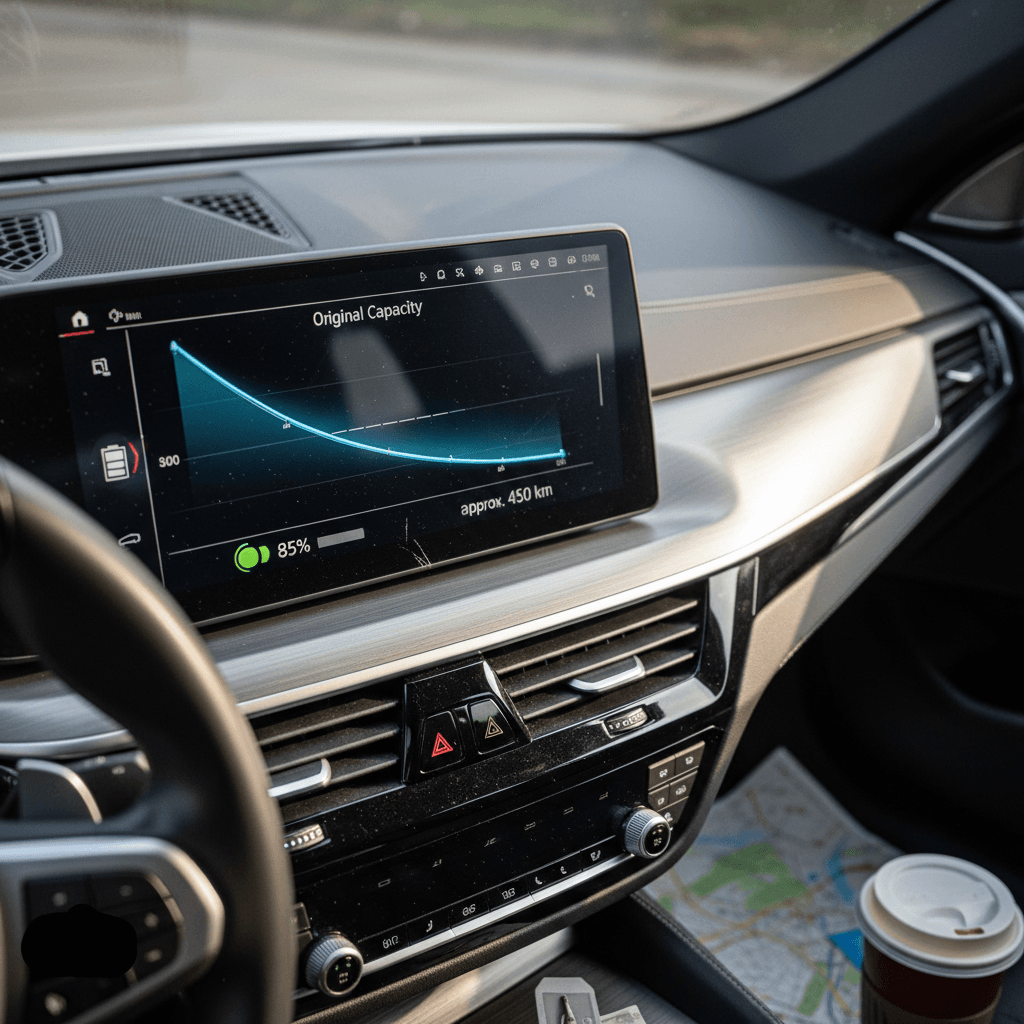
If you already own an i5, or you’re shopping used, it’s smart to look beyond the dash range estimate and get a feel for **state of health (SOH)**, the percentage of original usable capacity your pack still has.
1. Dealer or specialist diagnostics
BMW dealers can run a **high‑voltage battery test** that reports capacity and flags modules that are out of spec. This is the most authoritative way to document SOH, and it’s what BMW leans on for warranty decisions.
For a used purchase, asking for a **fresh battery test printout** is one of the best ways to de‑risk the deal.
2. Third‑party tools and real‑world tests
Some independent shops and advanced owners use **OBD readers and apps** that can read pack data in more detail. You can also perform controlled range tests, charging to a known level and driving a familiar route, to spot big outliers.
These methods aren’t as official as a BMW diagnostic, but they’re useful sanity checks.
What to watch for in diagnostics
Used BMW i5: how much degradation is “normal”?
Battery health matters even more if you’re looking at **off‑lease or used BMW i5s**. The first wave of 2024 cars will start appearing in volume in the next few years, and shoppers will quickly learn to ask about pack condition the way they ask about accident history today.
Ballpark benchmarks for used BMW i5 battery health
These aren’t hard rules, but they’re useful negotiating anchors.
2–3 years old
• Lightly used, mostly home‑charged cars can still look nearly new
• Ex‑fleet or rideshare vehicles may sit lower if fast‑charged heavily
4–5 years old
• Range loss is noticeable on paper but still workable for most commuters
• Big outliers below mid‑80s% warrant a closer look
6–8 years old
• Anything close to 70% is approaching BMW’s warranty floor and should be priced accordingly
Red flags when buying used
How Recharged evaluates BMW i5 battery health
Because the battery pack is the single most expensive component in any EV, Recharged bakes battery condition into every part of how we buy and sell vehicles, including the BMW i5.
- Every BMW i5 we list comes with a **Recharged Score Report**, which includes an in‑depth look at high‑voltage battery health, charging history indicators where available, and a comparison to typical degradation for that age and mileage.
- We use **specialized diagnostic tools and data‑driven benchmarks** from vehicles like the i4 and iX that share the same Gen5 eDrive hardware to spot outliers early.
- If a pack’s health or warranty history doesn’t meet our standards, the car **doesn’t make it onto the platform**, or it’s clearly priced and labeled so you know exactly what you’re getting.
- You can shop fully online, get **financing, trade‑in options, and nationwide delivery**, or visit our Experience Center in Richmond, VA if you prefer to see vehicles in person.
Why this matters for you
BMW i5 battery degradation: FAQ
Frequently asked questions about BMW i5 battery degradation
Bottom line: what to expect from a BMW i5 battery
When you cut through the noise, the story on **BMW i5 battery degradation per year** is reassuring. In normal use, you’re likely looking at a **gradual 2–3% capacity loss per year on average** over many years, with plenty of usable range left well past the end of the 8‑year / 100,000‑mile battery warranty.
The real variables are **where you live and how you charge**, not whether the car is called i5 or i4. Treat the pack reasonably, avoid living on DC fast chargers, and keep an eye on capacity with periodic diagnostics, and there’s every indication the i5’s battery will comfortably outlast a typical ownership cycle.
If you’re shopping used, focus on **documented battery health, warranty status, and usage history**, not just odometer mileage. That’s exactly what Recharged’s **Score Report** is built to surface, so you can buy a BMW i5 with eyes wide open and a clear picture of how much battery you’re really getting.