If you’re hunting for the best used Tesla Model S to buy in 2026, you’re arriving just as the curtain falls. Tesla has officially stopped taking new orders for the Model S, with only remaining inventory trickling out. That pushes the big electric sedan fully into “modern classic” territory, and makes getting the right year and trim more important than ever.
A legend, officially retired
Why 2026 is a unique moment for used Model S buyers
Massive tech maturity
Early Model S sedans launched back in 2012. By the 2018–2024 window, Tesla had largely solved the big stuff, motors, inverters, pack design, and software. In 2026 you can buy a 5–7 year-old flagship EV that still looks current and runs software far ahead of most new ICE luxury sedans.
Depreciation has finally done its job
Original sticker on a higher-spec Model S once lived in the $90,000–$130,000 realm. In 2026, many of those cars have slid into the $30,000–$60,000 band depending on year, mileage, battery, and options, without feeling remotely like "old" cars in daily use.
But the flip side…
Quick picks: best used Tesla Model S to buy in 2026
Best used Model S picks, by buyer type
If you don’t want to read the whole novel, start here.
Value all‑rounder
2018 late-build – 2019 Long Range / 100D
- Post-facelift styling and updated interior
- Long-range packs with improved reliability vs. early 90 kWh batteries
- Often the sweet spot for price vs. remaining life
Performance sweet spot
2020–2021 "Raven" Performance / Long Range
- Adaptive air suspension, more efficient motors
- Serious acceleration without Plaid-level pricing
- Better efficiency and range than earlier Performance cars
Future classic halo
2022–2024 Plaid
- Tri‑motor, hypercar‑quick even by 2026 standards
- Latest interior layout and infotainment
- Still expensive, but depreciation has shaved a lot off MSRP
Years and specs to approach cautiously
Model S by era: what changed and what to avoid
Tesla doesn’t really do tidy "model years" the way BMW or Mercedes do; they roll changes in whenever they’re ready. That makes build dates and major hardware eras more meaningful than the number on the title. Here’s how to think about it when you’re trying to pick the best used Tesla Model S to buy in 2026.
Tesla Model S eras at a glance
Major change points that matter on the used market.
| Era | Approx. Builds | What’s notable | Buy / Avoid verdict |
|---|---|---|---|
| Pre-facelift, early packs | 2012 – mid‑2014 | Original nose, first-gen 60/85 kWh packs | Great history piece; only with stellar records and strong battery health |
| Pre-facelift, 85/70/90 era | mid‑2014 – early 2016 | Autopilot HW1 appears; some 90 kWh packs degrade faster | Avoid early 90s; late 85s/70Ds ok if priced right |
| Facelift / AP1–AP2 transition | mid‑2016 – 2017 | New front fascia, better seats and trim | Late 2016–2017 cars can be good value; confirm Autopilot hardware |
| 100D & early Long Range | 2018 – 2019 | More efficient 100 kWh packs, range improves | Strong all‑rounder choice if battery health checks out |
| "Raven" update | 2019 – 2021 | Adaptive air, new motors, better efficiency | One of the best balances of comfort, speed, and range |
| Plaid / final refresh | 2021 – 2024+ | Tri‑motor, new interior, yoke/round wheel options | Pricey but aging very gracefully; best tech and cabins |
Focus less on the calendar year and more on which hardware era a car belongs to.
Autopilot hardware shorthand
For most buyers in 2026, the smart money lives in three zones: late‑2016 to 2017 facelift cars (value), 2018–2019 100D/Long Range (range + maturity), and 2019–2021 Raven (best all‑rounders). Plaid is a different conversation: it’s the poster car, less rational but arguably the one collectors will fight over in ten years.
Battery health: what matters more than model year
Underneath the debates about which year is "best" lurks the only question that really keeps buyers up at night: how much battery is left? Fleet data on the Model S and X packs suggests roughly 10–12% capacity loss by around 200,000 miles for well-cared-for cars, with Tesla’s own impact reports pointing to about 80–90% capacity retention deep into the life of the vehicle. For a big luxury EV, that’s quietly impressive.
Tesla Model S battery reality check
Why Recharged leans so hard on real data
Quick battery‑health triage when shopping privately
1. Compare rated vs. original range
Look at the displayed full‑charge range and compare it to the original EPA figure for that trim. A Long Range once rated at ~370 miles showing ~320 today is not a crisis, that’s within a normal degradation band.
2. Ask for charging behavior history
Frequent DC fast charging, regularly charging to 100%, and long periods sitting fully charged in hot climates all accelerate degradation. You want a seller who sounds a little nerdy about charge habits.
3. Scan for battery or drive‑unit replacements
A pack or drive‑unit replaced under warranty isn’t inherently bad; it can actually be a plus. What you don’t want is repeated failures with vague explanations.
4. Match software to hardware
Make sure the car’s reported battery type (60/75/85/90/100/Long Range/Plaid) matches the VIN details and build sheet. Odd mismatches can indicate past pack swaps or misrepresented trims.
5. Get an independent diagnostic
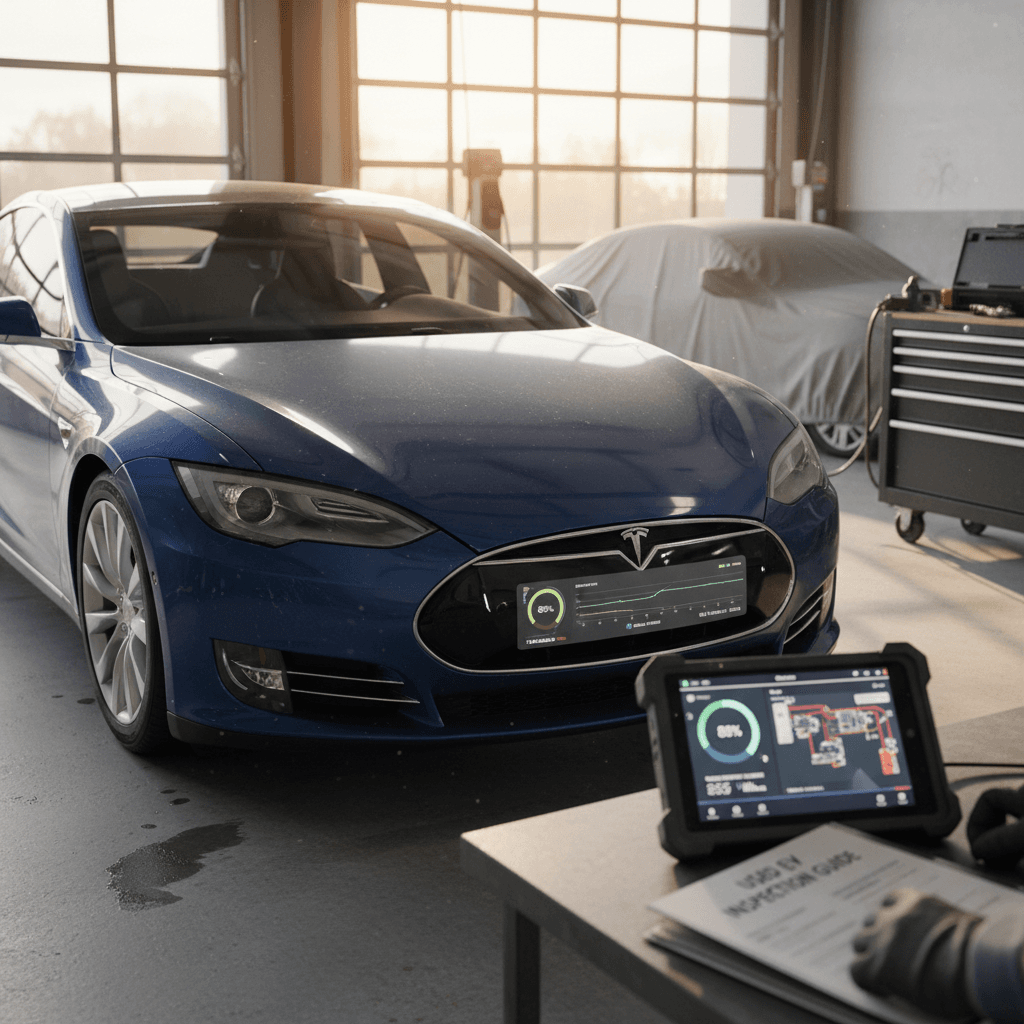
Whether through a Tesla service visit, a trusted EV shop, or a marketplace like Recharged that already does this, a proper battery health report is the cheapest insurance you can buy.
Autopilot, FSD and tech packages on a used Model S
Tesla’s driver‑assist and software story is a maze, and on used cars it gets even messier because some software packages do not always transfer when a car changes hands. The hardware also evolved substantially from the first Autopilot systems in 2014 to today’s camera‑heavy setups.
What hardware you want
- HW1 (late‑2014 – mid‑2016): Smooth lane-keeping and traffic-aware cruise, but limited future updates.
- HW2/HW2.5 (late‑2016 – 2018): More cameras and computing power, better long-term support.
- HW3+ (roughly 2019 onward): Tesla’s in-house computer designed for FSD; safest bet if software matters to you.
Questions to ask the seller
- Which Autopilot package is active, basic Autopilot, Enhanced Autopilot, or Full Self‑Driving?
- Has Tesla ever removed or changed software packages after a previous sale?
- Are all cameras and sensors functioning with no Autopilot or safety‑system alerts?
If you buy through Tesla directly, some cars include extra warranty coverage; marketplaces like Recharged focus instead on transparency around what software is actually on the car and how it works today.
Don’t overpay for ghost software
Price bands: what you can expect to pay in 2026
Exact numbers move with the used market and region, but by early 2026 some patterns are clear. The Model S is no longer the $100,000 sci‑fi unicorn it once was; in the right years and trims, it’s become a used luxury sedan with an unusually powerful software story.
Typical U.S. asking ranges in 2026
High‑level bands for private‑party and non‑certified used sales; local markets vary.
| Model S type | Approx. builds | Typical asking in 2026* | Who it suits |
|---|---|---|---|
| Older 70/85/90 (pre‑facelift) | 2013 – mid‑2016 | Low $20Ks – low $30Ks | High‑risk budget shoppers who prioritize price over polish |
| Facelift 75D/90D | mid‑2016 – 2017 | Mid $20Ks – mid $30Ks | Buyers wanting the "classic" S look on a budget |
| 100D / Long Range | 2018 – 2019 | Low $30Ks – low $40Ks | Best for range-conscious long‑distance drivers |
| Raven Long Range / Performance | 2019 – 2021 | High $30Ks – $50Ks+ | Enthusiasts seeking comfort, efficiency and serious speed |
| Plaid | 2022 – 2024 | $60Ks – $80Ks+ | Buyers cross‑shopping supercars who also have kids and groceries |
Use these as directional guideposts, not hard appraisals. Condition and battery health can move a given car far above or below these bands.
How Recharged thinks about price vs. value
Used Model S buying checklist
10 things to check before you wire any money
1. Confirm the hardware era
Use the VIN and build date to figure out which battery, motor and Autopilot hardware you’re getting. Don’t assume based on the model year printed on the title.
2. Pull a full history report
Accidents, storms, frequent auction flips and title issues matter more on a complex EV than on a Corolla. A branded title can be an instant walk‑away on a Model S.
3. Inspect the wheels and tires
Curb‑rashed 21‑inch wheels and mismatched bargain tires hint at an owner cutting corners. Heavy, powerful EVs eat tires quickly; quality replacements aren’t cheap.
4. Scan for suspension clunks
Over broken pavement, listen for knocks from the front end. Replacing control arms or air‑suspension components is not a trivial bill on a flagship EV.
5. Test every screen and switch
Center screen reboots, yellowing borders on older displays, dead pixels or unresponsive buttons are common wear items. Make sure you’re comfortable with the level of cosmetic aging.
6. Check charge‑port and Supercharging behavior
Plug into AC and, if possible, a DC fast charger. You want to see normal charging speeds, no random disconnects and no warnings about charge limits or pack health.
7. Verify keys, app access and connectivity
Confirm you’ll get all key cards/fobs and that the car can be added to your Tesla app account cleanly. You do not want to fight previous owners’ login ghosts.
8. Evaluate interior wear realistically
Tesla cabins wear differently than German luxury cars, fewer buttons, more vegan leather. Check bolsters, steering wheel, armrests and the driver door seal carefully.
9. Understand remaining warranty coverage
Many 2018+ cars are still within the 8‑year battery and drive‑unit warranty. That’s a significant safety net; know exactly when it expires by VIN and in‑app details.
10. Get a professional EV inspection
A pre‑purchase inspection from an EV‑savvy shop, or buying through a marketplace like Recharged that already performs one, turns hidden risk into known quantity.
How Recharged evaluates used Model S battery health
The Model S is a software‑heavy, high‑voltage device hiding in a handsome fastback suit. Kicking the tires is not enough. This is exactly why Recharged built the Recharged Score around battery and high‑voltage health, not just leather smell and tire shine.
Inside a Recharged Score Report for Model S
What you see when you shop a used Model S on Recharged.
Battery health diagnostics
We pull real pack data: usable capacity, fast‑charge history, balance between modules, and any high‑voltage fault codes. You see, in plain language, how this pack stacks up against similar Model S vehicles.
Mechanical & cosmetic review
Suspension wear, brake condition, tire life, glass, paint and interior are inspected with EV‑specific eyes. It’s not just "clean" or "rough", you get a breakdown of what’s good, what’s merely lived‑in, and what might cost you soon.
Fair‑market pricing context
Recharged benchmarks each car against live used‑EV data, year, mileage, options, region and battery status, so the asking price and Recharged Score sit in the same frame. You can see whether you’re paying for excellence or subsidizing someone else’s neglect.
Ready to find your next EV?
Browse VehiclesWhy this matters more on a Model S
Frequently asked questions: used Tesla Model S in 2026
Used Model S buyer FAQ for 2026
Is a used Model S the right EV for you?
The best used Tesla Model S to buy in 2026 isn’t a single magic year; it’s the car where hardware era, battery health, and price line up with the way you actually live. For a lot of drivers, that means a late‑2016–2019 Long Range or a 2019–2021 Raven, cars that feel every inch like modern luxury flagships but cost what mid‑spec crossovers did just a few years ago.
If you want to skip the spreadsheet phase, shopping through Recharged is one way to de‑stress the process. Every used Model S comes with a Recharged Score Report, verified battery diagnostics, fair‑market pricing, EV‑savvy support, and options for financing, trade‑in and nationwide delivery. That’s how you turn an electric icon from somebody else’s experiment into your everyday car, without rolling the dice on the most expensive component in the vehicle.