If you’re wondering about the best place to sell a used car in North Carolina, you’re not alone. From Charlotte and Raleigh to smaller towns along Highway 64, owners are staring at a set of keys and thinking: “Do I trade this in, list it online, or take an instant offer?” The right answer depends on your car, your timeline, and how much hassle you’re willing to tolerate with banks and the NCDMV.
Quick answer
How to choose the best place to sell your car in North Carolina
Start with your goals, not the buyer
Three questions that decide where you should sell
1. How fast do you need it gone?
If you need the car sold this week, trade-ins and instant-offer sites beat private listings every time. If you can wait a few weekends, a private sale can reward your patience.
2. Is every last dollar important?
If you’re squeezing every penny for your next down payment, private sale or a strong online offer is usually your best bet. Convenience buyers (dealers) charge for speed.
3. How much hassle can you stand?
Private selling in NC means photos, test drives, and a notarized title. Dealers and online services handle more paperwork but pay a little less for the privilege.
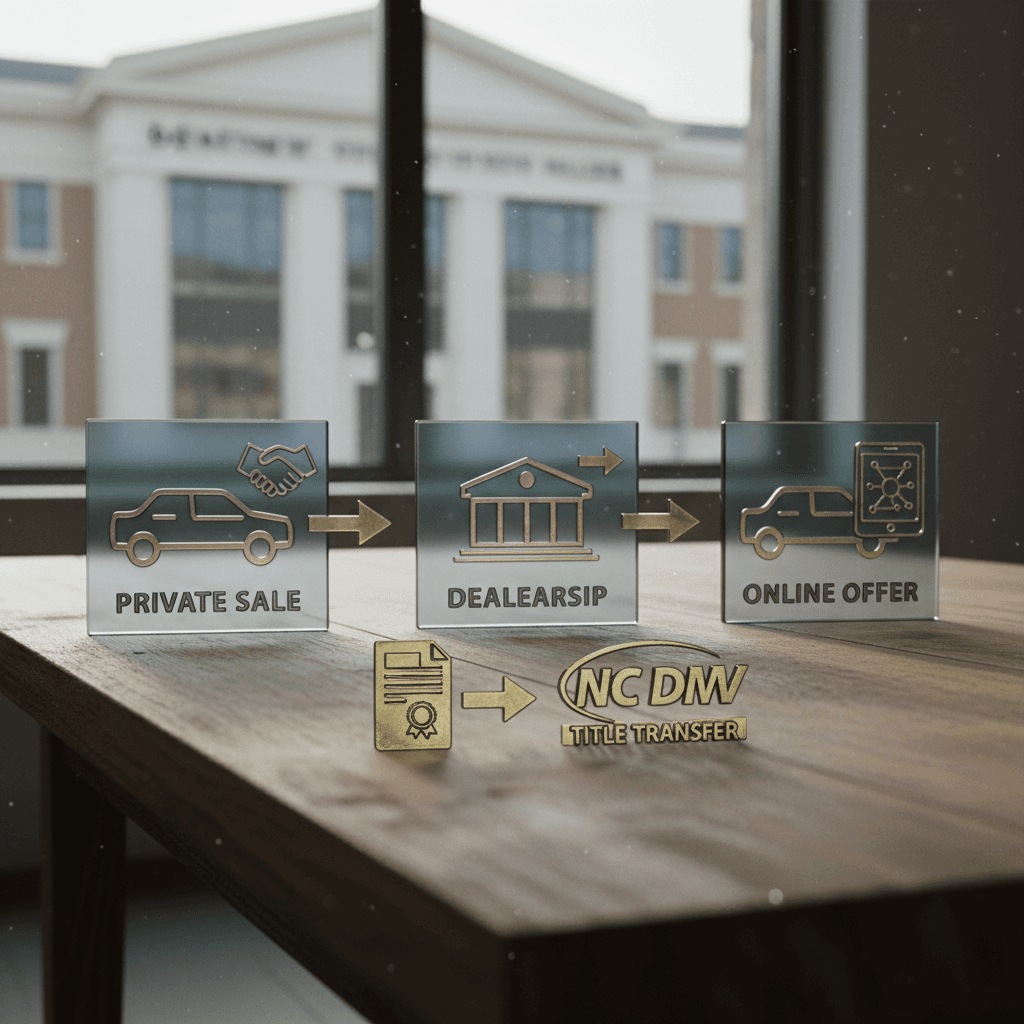
Once you’re clear on speed, price, and hassle, the “best place” to sell becomes easier to see. Let’s walk through your main options in North Carolina, then we’ll match them to common real-world situations.
The main ways to sell a used car in North Carolina
How most North Carolinians sell used cars today
- Private party sale (Facebook Marketplace, Craigslist, classifieds, word of mouth)
- Dealership trade-in or direct sale (franchise or independent used dealers)
- Online instant-offer buyers (CarMax, Carvana, Peddle and similar services)
- Specialist platforms for certain vehicles, especially used EVs (Recharged)
Use offers as leverage
Private sale in North Carolina: highest price, highest effort
A well-presented private sale is still the classic way to squeeze the most value from a used car in North Carolina. You handle the photography, the listing, and the test drives, and you pocket the retail price instead of a wholesale number.
Where to list in North Carolina
- Facebook Marketplace – by far the most common for local buyers from Raleigh, Durham, Charlotte, Greensboro and beyond.
- Craigslist – still useful for budget cars and enthusiasts.
- Local forums & community groups – neighborhood Facebook groups and workplace Slack channels.
- Old-fashioned word of mouth – co-workers, neighbors, family, church groups.
Why people choose private sale
- Highest potential price – especially for clean, well-maintained vehicles with good records.
- Control – you decide when to show the car and who drives it.
- Great for older cars – a 2007 sedan with 180k miles might be worth little as a trade-in but still attractive privately.
North Carolina wrinkle: notarization is mandatory
Risks and hassles of private sale
Screening buyers and avoiding scams
You’ll field messages, lowball offers, and the occasional scam. Stick to local, in-person buyers. Never accept strange payment methods or overpayment schemes.
Handling test drives safely
Meet in a public place, ideally near a notary or license plate agency. Check the buyer’s driver’s license and ride along on test drives.
Managing your own pricing strategy
You’ll set the price, negotiate, and adjust your listing. Research similar cars in your area before you post.
Doing paperwork the right way
You’re responsible for a correctly completed, notarized title, removing your plates, and cancelling or transferring insurance after the sale.
Dealership trade-in or straight sale: fast but less money
North Carolina has no shortage of franchise dealerships and independent used lots from Asheville to Wilmington. For many sellers, the dealer is still the first stop because it’s simple: bring the car, get an offer, walk out with a check or a credit on your next vehicle.
Dealership sales in North Carolina: pros and cons
Good when you value time more than top dollar
Why dealers are convenient
- Fast process – appraisal, offer, and paperwork often done in under an hour.
- Handles payoff – if you still owe money, the dealer can pay off your lender directly.
- Fewer strangers – no public meetups or test drives with random buyers.
Where dealers fall short
- Wholesale pricing – dealers need margin for reconditioning and resale, so they won’t pay what a private buyer might.
- Older and rough cars – many dealers won’t touch cars over a certain age or mileage.
- EV knowledge varies – some stores still struggle to price used electric vehicles accurately.
Trade-in tax advantage (and limitation)
Online instant-offer sites (CarMax, Carvana and others)
If you want dealer-like convenience without committing to one store, online instant-offer platforms are worth a look. Big names like CarMax, Carvana and national “we buy cars” services all operate in North Carolina, and many will even pick up the car at your home in larger metros.
Instant-offer options you’ll see in North Carolina
These aren’t endorsements, just the types of services you’ll encounter.
| Option | How it works | Best for | Typical downside |
|---|---|---|---|
| CarMax | Online estimate, in-person inspection at a CarMax store, same-day payment | Sellers who want a big, established brand and don’t mind driving to a location | Offer may be lower than private sale; they still need room for resale profit |
| Carvana | Online appraisal, in many NC areas they’ll pick up at your driveway and pay electronically | Busy sellers who want a truly at-home transaction | They’re picky on condition; will walk away from cars that need heavy reconditioning |
| National "we buy any car" services | Quick online quote, local partner location or mobile inspection | Older or higher-mileage cars that dealers don’t want | Pricing can be aggressive; read reviews and fine print carefully |
| Local online buyers | Smaller regional or local dealers advertising online appraisals | Cars with local demand or specific brands they specialize in | Less predictable experience; do your homework on reputation |
Always compare several offers; their algorithms value the same car very differently.
Read the fine print
The best place to sell an electric car in North Carolina
Electric vehicles are a different animal. A 2018 hatchback with 70,000 miles and a tired gas engine is worth one thing; a 2018 EV with 70,000 miles and a healthy battery is something else entirely. Where you sell in North Carolina can dramatically change what you’re offered for an EV.
Why EVs deserve a specialist buyer
Battery health is the new odometer reading
Battery health matters most
NC’s growing EV market
Transparency builds trust
How Recharged fits in
Ready to find your next EV?
Browse VehiclesBeyond pricing, Recharged can also help you trade in your EV, get financing for the next one, or receive an instant offer or consignment-style listing, with nationwide buyers and optional delivery. That’s especially helpful if local NC dealers are still on the fence about taking your used EV into stock.
Step-by-step checklist for selling a car in North Carolina
Before, during and after the sale
1. Gather documents and spare keys
Find your title, registration, loan payoff information (if any), service records, and all keys or key fobs. The more complete your package, the more confident buyers feel.
2. Clean and photograph the car
Give it a thorough wash, vacuum, and wipe-down. Take clear photos in daylight: front, rear, sides, interior, dash, and any flaws. Good photos pay for themselves in a private sale.
3. Get ballpark values
Use pricing tools and collect a few online or dealer offers. This gives you a realistic range and keeps you from over- or under-pricing your car.
4. Choose your selling channel
Decide between private sale, dealer, instant-offer platform, or EV specialist like Recharged based on your need for speed, money, and simplicity.
5. Complete the sale with a notary
In NC, meet your buyer (or dealer rep) at a bank, credit union, or tag office with a notary so your title can be properly notarized and signed at the same time.
6. Remove plates, cancel or transfer insurance
After the sale, remove your license plates, consider returning them to the NCDMV if you’re not transferring them, and update your insurance so you’re not covering a car you no longer own.
North Carolina DMV title transfer rules you can’t ignore
The part that makes most NC sellers nervous isn’t the negotiation – it’s the paperwork. The good news is that North Carolina’s rules are clear once you’ve seen them laid out. Follow them carefully and you’ll avoid ugly surprises like tickets or tolls on a car you no longer own.
- Use the correct title. If it’s a North Carolina title, you’ll complete the assignment section on the back; if it’s from another state, follow the instructions printed there, but NC will still require proper signatures.
- Sign in front of a notary. Don’t sign the title at home. Both seller and buyer should appear before the notary, present ID, and sign while the notary watches.
- Fill out all required fields. That usually includes buyer’s name and address, date of sale or delivery, odometer reading (for most vehicles under 10 years old), and a damage disclosure statement.
- Don’t leave your name on an active registration. Once the car is gone, remove your plates and work with NCDMV to ensure the vehicle is no longer in your name. You can transfer valid plates to another car you own if it meets inspection and insurance requirements.
- Know the timelines. The buyer typically has a limited window (often around two weeks) to complete the title transfer and pay Highway Use Tax. Encourage them to do it promptly so there’s a clear line between your ownership and theirs.
Do not "just hand over the title"
Where to sell: matching your car and situation to the right channel
Scenario A: Newer car, still under loan
You bought the car new or nearly new, still owe the bank, and want out before your next purchase.
- Get payoff information from your lender.
- Collect instant offers from dealers and online platforms.
- Take the best solid offer that covers your payoff with some equity left over.
Private sale can work, but dealing with your lender adds complexity, so many NC owners happily trade some money for a cleaner process.
Scenario B: Older, high-mileage gas car
Think of the 200,000-mile sedan or minivan that’s been in the family for a decade.
- Dealers often bid low or pass entirely.
- Online "we buy any car" bids may be modest.
- A local private buyer who needs transportation can be your best market.
Here, taking the time to list on Facebook Marketplace or Craigslist around Raleigh, Fayetteville or Winston-Salem can add hundreds over a wholesale offer.
Scenario C: Used EV or plug-in hybrid
You’ve been driving a Leaf, Bolt, Tesla or other EV and the next step is either a longer-range model or return to gas.
- Get at least one offer from a specialist EV buyer or marketplace like Recharged.
- Compare against generic dealer and online offers.
- Highlight battery health and charging flexibility in any listing.
A platform that lives and breathes EVs can usually explain – and price – your car better than a generalist used lot.
FAQs about selling a car in North Carolina
North Carolina selling questions, answered
Bottom line: the best place to sell a used car in North Carolina
If you’re in North Carolina, the best place to sell a used car depends on what you care about most. For maximum money and a bit more effort, a clean, well-advertised private sale is hard to beat. For minimal hassle and a quick exit, dealers and instant-offer platforms shine. And if you’re selling an electric vehicle, a specialist like Recharged can combine strong EV‑specific pricing with expert support and a modern, fully digital experience.
Whichever route you pick, respect North Carolina’s title rules, use a notary, and don’t be afraid to walk away from a deal that doesn’t feel right. The used-car market is competitive – and with a bit of homework, you can walk away with a fair price, a clean set of plates, and no loose ends following you down I‑40.