You only get one **first electric car**, and in 2026 the stakes are higher than ever. EV prices are all over the map, incentives have changed, and every commercial is promising “revolutionary range.” If you’re trying to decide on the **best first electric car in 2026**, without making a very expensive mistake, this guide is for you.
Who this guide is for
How to choose your first electric car in 2026
EV reality check for first‑time buyers in 2026
The best first EV for you is not the one with the biggest screen or the wildest acceleration. It’s the one that quietly fits your life: **enough range**, easy charging where you live, a payment that doesn’t keep you up at night, and a battery that will still be healthy when you’re done paying it off.
Four questions to answer before you pick a first EV
Get these right and half the decision is made.
1. How far do you really drive?
Log a normal week. If your longest regular day is under 120 miles, you don’t need a 340‑mile battery, especially for a first EV.
2. Can you charge at home?
A simple 240V Level 2 outlet turns EV ownership from a science project into a non‑event. Apartments require more planning.
3. What’s your true budget?
Don’t just stare at the sticker. Compare monthly payment, electricity vs. gas, insurance, and expected depreciation.
4. New vs. used comfort level
New EVs give you the latest tech. Used EVs often give you 60–70% of the price for 90% of the capability, if the battery checks out.
A quick rule of thumb
Best first electric cars 2026: Shortlist
Let’s start with a short list. If you bought any of these as your first EV in 2026, you’d be making a defensible decision. Then we’ll break them out by **new vs. used**, and by type of driver.
Best first electric car picks for 2026 (U.S. market)
Representative trims and ranges; always double‑check exact specs for the model year you’re shopping.
| Model | New or Used Focus | Approx. Price in 2026* | EPA Range (mi, ballpark) | Best For |
|---|---|---|---|---|
| Rivian R2 | New | Low‑to‑mid $40ks | 270–300 | One‑car households, adventure + kid duty |
| Hyundai Ioniq 5 | Used (2022–2024) | Mid‑$20ks to low‑$30ks | 256–303 | Design‑conscious drivers, comfy commuters |
| Chevrolet Bolt EUV | Used (2022–2023) | Mid‑$10ks to low‑$20ks | 247 | Budget buyers, city + suburban use |
| Hyundai Kona Electric | Used (2019–2023) | High‑teens to mid‑$20ks | 250–258 | Efficient commuters, small families |
| Kia EV6 | Used (2022–2024) | High‑$20ks to mid‑$30ks | 250–310 | Drivers who road‑trip and value fast charging |
| Fiat 500e (new‑gen) | New | Low‑to‑mid $30ks | 140–150 | Urban drivers, second car in multi‑car garages |
| Nissan Leaf (next‑gen, 2026) | New | Expected under $30k | ~200 | Value‑first shoppers who mostly drive locally |
These models balance range, price, charging speed, and everyday usability for first‑time EV owners.
About prices and ranges
Best new electric cars for first-time EV drivers
If you like untouched upholstery and full factory warranty coverage, these **new 2026 EVs** are strong candidates for your first electric car. They aren’t the flashiest things coming to market, but they are the ones that make sense.
Rivian R2 – the do‑everything first EV
Rivian built its reputation on charming, outdoorsy trucks and SUVs; the **R2** shrinks that vibe into a compact crossover with real‑world pricing. Think of it as the Patagonia fleece of EVs: practical, outdoors‑adjacent, and socially acceptable just about everywhere.
- Range: Targeting roughly 270–300 miles depending on configuration.
- Use case: One‑car households that need to commute, do Costco runs, and head for the trailhead on weekends.
- Charging: NACS port plus access to Tesla Superchargers, which simplifies road trips compared with many older EVs.
If Rivian hits its promised pricing, the R2 lands in that dangerous zone where a vehicle is both sensible and desirable. As a first EV, that’s exactly what you want: something that can shoulder daily life without feeling like a penalty box.
Downside? It’s new. That means less real‑world long‑term data. If you’re risk‑averse, a proven used EV with a known track record may feel wiser.
Fiat 500e – the charming city car
The reborn **Fiat 500e** is tiny, stylish, and finally designed as a proper global EV rather than a compliance afterthought. With roughly 140–150 miles of range, it’s no interstate warrior. But as a first EV for city dwellers or as a second car, it’s spot on.
- Best for: Short urban commutes, college towns, households keeping a gas car for road trips.
- Why it works: Easy to park, fun to drive, charging needs are modest, and you won’t be paying for unused capacity.
Next‑gen Nissan Leaf – value play for 2026
Nissan’s upcoming **Leaf replacement** is gunning to be one of the cheapest EVs on sale in the U.S. when it arrives, with around 200 miles of range and pricing expected under $30,000. That’s gasoline‑Corolla money for a fully electric daily driver.
If you rarely leave your metro area, a car like this may be the **most rational first EV** you can buy: low entry price, enough range for daily life, and simple tech that won’t overwhelm you.
When a new EV makes sense as a first EV
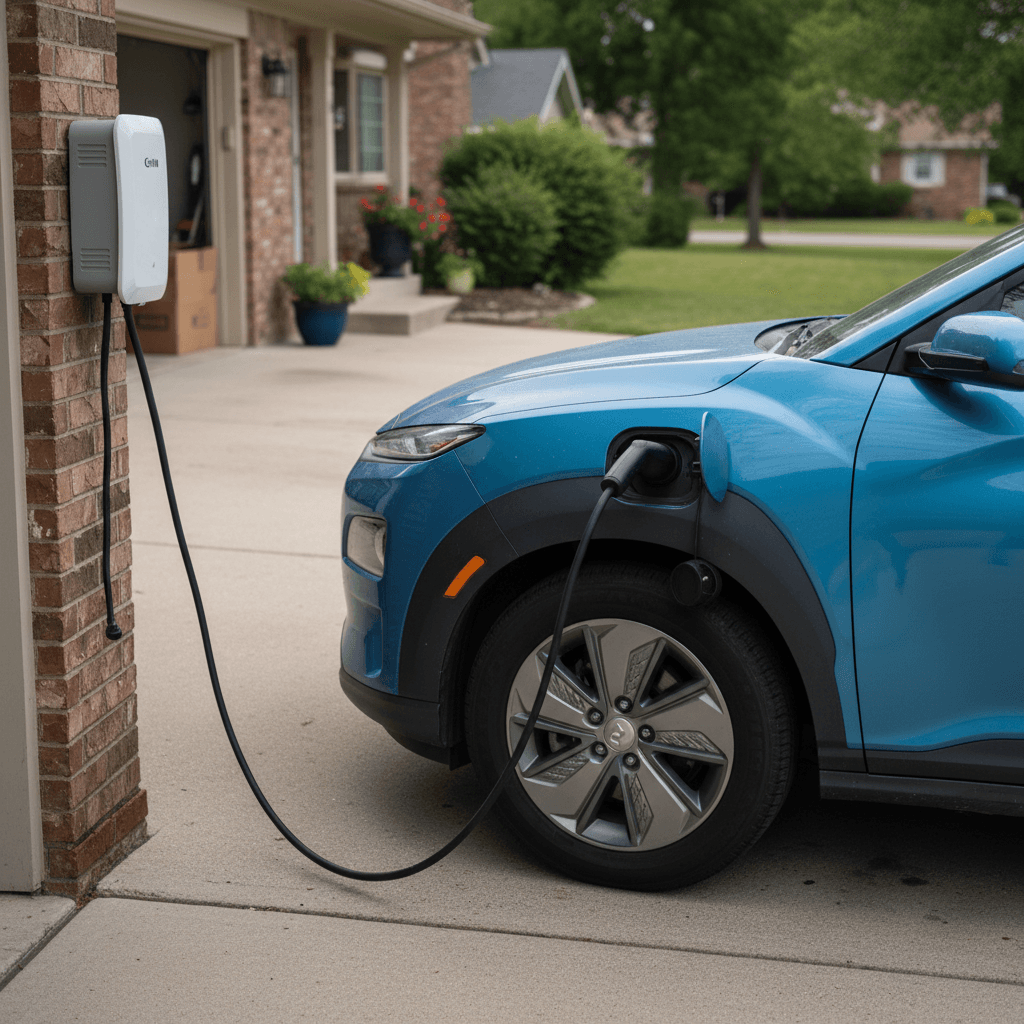
Best used electric cars that make great first EVs
In 2026, the best first electric car is very often a **used** electric car. Early adopters paid handsomely to be first in line; you get to buy those same vehicles after the biggest depreciation hit, with many years of battery warranty still on the table.
Used EV all‑stars for first‑time buyers
These models have strong real‑world track records and approachable pricing.
Hyundai Kona Electric (2019–2023)
Think of the **Kona Electric** as a sensible shoes EV: 250‑plus miles of range, compact SUV shape, and impressive efficiency.
- Typical 2026 prices: high‑teens to mid‑$20ks depending on year and mileage.
- Often still within Hyundai’s long battery warranty window.
Chevrolet Bolt EV / Bolt EUV (2020–2023)
The **Bolt twins** remain the go‑to answer for budget‑minded first‑time EV drivers.
- Range: ~247 miles (EUV), a bit more for some Bolt EV trims.
- Downsides: Smaller cabin, modest DC fast‑charge speeds, seats not for everyone.
Hyundai Ioniq 5 & Kia EV6 (2022–2024)
If you want your first EV to feel futuristic, **Ioniq 5** and **EV6** deliver: ultra‑fast charging, long range, and roomy interiors.
- Typical 2026 prices: high‑$20ks to mid‑$30ks.
- Excellent road‑trip partners if you learn the charging ropes.
Remember the recall histories
Recharged leans into this reality. Every used EV on the marketplace comes with a **Recharged Score Report**, including verified **battery health diagnostics**, pricing against fair‑market data, and expert EV‑specialist support. A three‑year‑old Kona Electric with strong health scores can be a far better first EV than a brand‑new model nobody has lived with yet.
Range: how much you really need (and what to avoid)
What EV range is right for a first‑time owner?
Match your real driving pattern to a sensible range target.
| Use Case | Daily Driving Pattern | Recommended Rated Range | What to Avoid |
|---|---|---|---|
| Urban + second car | Under 40 mi/day, gas car in driveway | 140–200 mi | Paying up for 300+ miles you’ll never use. |
| Suburban commuter | 40–80 mi/day, mostly home at night | 220–260 mi | Low‑range city EVs if winter is harsh where you live. |
| One‑car household, some trips | Mix of city + highway, a few road trips/year | 250–300 mi | Anything under ~220 mi; that’s tight with weather and detours. |
| Frequent road‑tripper | Regular 200+ mile drives | 280+ mi plus strong DC fast‑charge speeds | Low‑range cars and slow‑charging 50 kW‑limited models. |
More range is nice, but past a point you’re just buying a heavier, more expensive battery you’ll rarely use.
If you live in a cold climate
For a first EV in 2026, the smart money is on the **middle of the bell curve**: a car rated for around 240–280 miles. That gives you headroom for weather, detours, and battery aging without forcing you to finance a giant pack you’ll only tap twice a year.
Charging: home setup, public networks, and living with an EV
How you’ll actually charge your first EV
Most first‑time owners dramatically overestimate how often they’ll need fast charging.
Home Level 2 (the ideal)
A 240V **Level 2 charger** in your garage or carport turns your EV into a smartphone on wheels: you plug in at night, wake up full.
Plan on 20–35 miles of range added per hour, plenty for overnight recovery even after a long commute.
Apartment & street parking
No driveway? You’re not doomed, but you must plan harder.
- Look for workplace charging.
- Check nearby public Level 2 garages.
- Be honest about your tolerance for planning charging sessions.
DC fast charging
Think of this as your EV’s gas station for road trips. In 2026, more non‑Tesla EVs can plug into the Tesla Supercharger network via NACS ports or adapters, which is a huge quality‑of‑life upgrade.
Do not rely on DC fast charging for daily life
If you’re buying your first EV, **sort out home charging first**. Talk to an electrician about adding a 240V outlet, or, if you’re in a rental, ask the landlord in writing whether a simple outlet by your parking spot is possible. Then, when you shop cars on Recharged or elsewhere, you can narrow your search to models whose onboard chargers and range fit your new reality.
Budget: payments, depreciation, and total cost of ownership
Why the cheapest sticker price isn’t always the best first EV
That rock‑bottom city EV might be $4,000 less than a longer‑range compact crossover, but if it forces you into more ride‑shares, rentals, or a second car, it isn’t really cheaper.
On the flip side, chasing a 350‑mile luxury EV you don’t need means **financing battery capacity you’ll barely use**. Aim for the middle: enough car, not too much car.
Used EVs: depreciation is your friend
EVs tend to drop sharply in value over the first 3–5 years as new tech arrives. By 2026, that means there’s a deep bench of 2019–2023 models at sane prices.
Buying from a marketplace like Recharged gives you battery health transparency plus financing options, trade‑in offers, and even nationwide delivery, so you can shop value instead of just shopping your ZIP code.
Think in cost per mile, not just monthly payment
Battery health and the Recharged Score
The battery pack is the beating heart of any EV, and the part most first‑time buyers quietly worry about. You should. It’s also where buying from a data‑driven marketplace like Recharged changes the game.
What you should know about EV battery health
And how the Recharged Score de‑mystifies used EVs.
How batteries actually age
Most modern EV batteries lose a chunk of capacity in the first few years, then the curve flattens. Usage patterns, climate, and charging habits matter more than the odometer alone.
Two identical cars with 60,000 miles can have very different remaining range.
What the Recharged Score tells you
Every vehicle on Recharged includes a Recharged Score Report with:
- Verified battery health diagnostics.
- Fair‑market pricing vs. similar EVs.
- Notes from EV‑specialist reviewers.
Instead of guessing, you see how the car you’re eyeing actually stacks up.
Smart battery questions to ask before you buy
First‑time EV buyer checklist
Your 10‑step first EV decision checklist
1. Map a normal month of driving
Note your longest regular day, how often you road‑trip, and whether you have another vehicle. This alone will narrow your ideal range and body‑style target.
2. Confirm your home charging options
Talk to an electrician or landlord about 240V access. Budget for a Level 2 charger if you own your home; if you rent, identify at least two reliable Level 2 options nearby.
3. Decide on new vs. used
If you’re payment‑sensitive and open to a three‑year‑old car, lean used. If you want to keep the car a decade and crave the latest tech, lean new.
4. Set a hard out‑the‑door budget
Include taxes, fees, and the cost of a charger installation if needed. Don’t assume yesterday’s federal incentives still exist; double‑check current programs in your state or utility.
5. Focus your shopping list
Shortlist 3–5 models that fit your range, size, and budget. For many first‑timers in 2026, that list reasonably includes Kona Electric, Bolt EUV, Ioniq 5/EV6, and one or two new‑model contenders like Rivian R2.
6. Check real charging speeds and networks
Look beyond the brochure. How quickly can the car actually charge from 10–80%? Does it have native NACS or a clear path to Tesla Superchargers?
7. For used EVs, demand battery transparency
Review a battery health report, recall history, and service records. On Recharged, this is built into the Recharged Score; elsewhere, you may need to push to get it.
8. Test‑drive with your real life in mind
Bring the family, car seats, your bike, or whatever you haul weekly. Pay attention to visibility, driving position, and how intuitive the infotainment system feels.
9. Run the 5‑year cost comparison
Compare your top EV pick against a comparable gas car: monthly payment, energy, maintenance, and likely depreciation. If you’re not sure how, an EV specialist at Recharged can walk you through the math.
10. Plan your first month of ownership
Before you sign, know where you’ll charge, how you’ll pay at public stations, and which apps you’ll install. That first month sets the tone for your whole EV experience.
Best first electric car 2026: FAQ
Frequently asked questions about first EVs in 2026
Bottom line: how to pick your best first EV
Your **best first electric car in 2026** is not the internet’s favorite spec sheet. It’s the car that fits your commute, your parking situation, your appetite for tech risk, and your budget, without asking you to become your own fleet manager.
If you want a simple playbook, here it is: get honest about your driving, secure home or workplace charging if you can, aim for 230–280 miles of range, and consider a **three‑ to five‑year‑old compact EV** with documented battery health. Use tools like the **Recharged Score Report** to de‑risk the used market, and lean on EV‑specialist advisors instead of a random salesperson trying to move metal.
Do that, and your first EV won’t just be a good car for 2026, it’ll be the one that makes you wonder why you waited so long to plug in.