Compared with a gas Audi, the Audi Q4 e-tron service schedule is simpler, but it’s not “maintenance-free.” Instead of oil changes and timing belts, you’re dealing with inspections, software updates, and a handful of critical fluids. Understanding what Audi actually wants done at each visit will help you avoid overpaying at the dealer and, if you’re shopping used, spot how well a Q4 e-tron has been cared for.
Key idea
How the Audi Q4 e-tron service schedule actually works
Audi doesn’t publish a separate, wild-west schedule just for the Q4. In the U.S., the Q4 e-tron follows the familiar Audi pattern of regular “minor” service about every 10,000 miles / 12 months and deeper “standard” services roughly every 20,000 miles. The difference is that there’s no engine to service, so those visits skew toward inspections, software checks, and EV‑specific cooling systems rather than spark plugs or oil changes.
1. Minor service (10,000-mile rhythm)
- Multi-point inspection (suspension, steering, underbody)
- Tire rotation and tread inspection
- Brake pad and rotor inspection
- Check for software updates, campaigns, and recalls
- Top-off of washer fluid and basic consumables
2. Standard service (every ~20,000 miles)
- Everything in the minor service
- Closer look at suspension joints and bushings
- Cooling system and high‑voltage components visual checks
- Cabin air filter replacement at certain intervals
- Road test and documentation in Audi’s digital service history
Watch the fine print
Core Audi Q4 e-tron service intervals (U.S.)
Exact timing can vary by model year and region, so you should always confirm with the Audi USA maintenance portal or the Service section of your myAudi app. But for U.S.‑market Q4 e-tron SUVs and Sportbacks, the broad pattern looks like this:
- Every 10,000 miles or 12 months – Minor service: inspections, tire rotation, brake check, software/recall check.
- Every 20,000 miles – Standard service: minor service plus more in‑depth checks and usually a cabin filter change.
- Every 2 years (time-based) – Brake fluid change, regardless of mileage, per Audi’s general maintenance guidelines for modern models.
- Longer-term – EV‑specific items like drive unit fluid checks or coolant service show up later in the life of the vehicle, often beyond 60,000 miles.
Use the VIN-specific schedule
Audi Q4 e-tron maintenance schedule at-a-glance
Here’s a simplified U.S.-oriented view of what a typical Q4 e-tron owner will see between 10,000 and 80,000 miles. Use this as a framework, then adjust based on your car’s build year and options.
Typical Audi Q4 e-tron service schedule (simplified)
Common mileage and time-based service items for most U.S. Audi Q4 e-tron models. Always confirm details for your specific VIN.
| Mileage / time | Service type | Main items | Notes |
|---|---|---|---|
| 10,000 miles / 1 year | Minor | Multi-point inspection, tire rotation, brake inspection, software update check | First visit; establishes your digital service history. |
| 20,000 miles / 2 years | Standard + brake fluid | All 10K items, plus more detailed suspension/cooling checks, cabin filter; brake fluid flush (time-based) | Brake fluid interval is driven by time, not mileage. |
| 30,000 miles / 3 years | Minor | Inspection, tire rotation, brake inspection, software checks | Good point to look closely at tire wear on heavier EVs. |
| 40,000 miles / 4 years | Standard + brake fluid | Standard service plus brake fluid flush, cabin filter; dealer may inspect drive unit/coolant per TSBs | Watch for dealer-added extras not in the factory guide. |
| 50,000 miles / 5 years | Minor | Inspection, tire rotation, brake inspection, software checks | Aligns roughly with end of 4yr/50K new-vehicle warranty. |
| 60,000 miles / 6 years | Standard + brake fluid | Standard service, brake fluid flush, deeper EV system inspection | Some markets start calling for additional coolant checks. |
| Every 2 years, any mileage | Brake fluid | Brake fluid change | Critical for consistent pedal feel and corrosion prevention. |
| Ongoing | Tires, brakes, wipers | Replace as needed | Driving style and climate have a big impact on timing. |
Intervals are approximate and may vary by model year and market. Time limits (years) apply even if you drive fewer miles.
EV-specific maintenance for the Audi Q4 e-tron
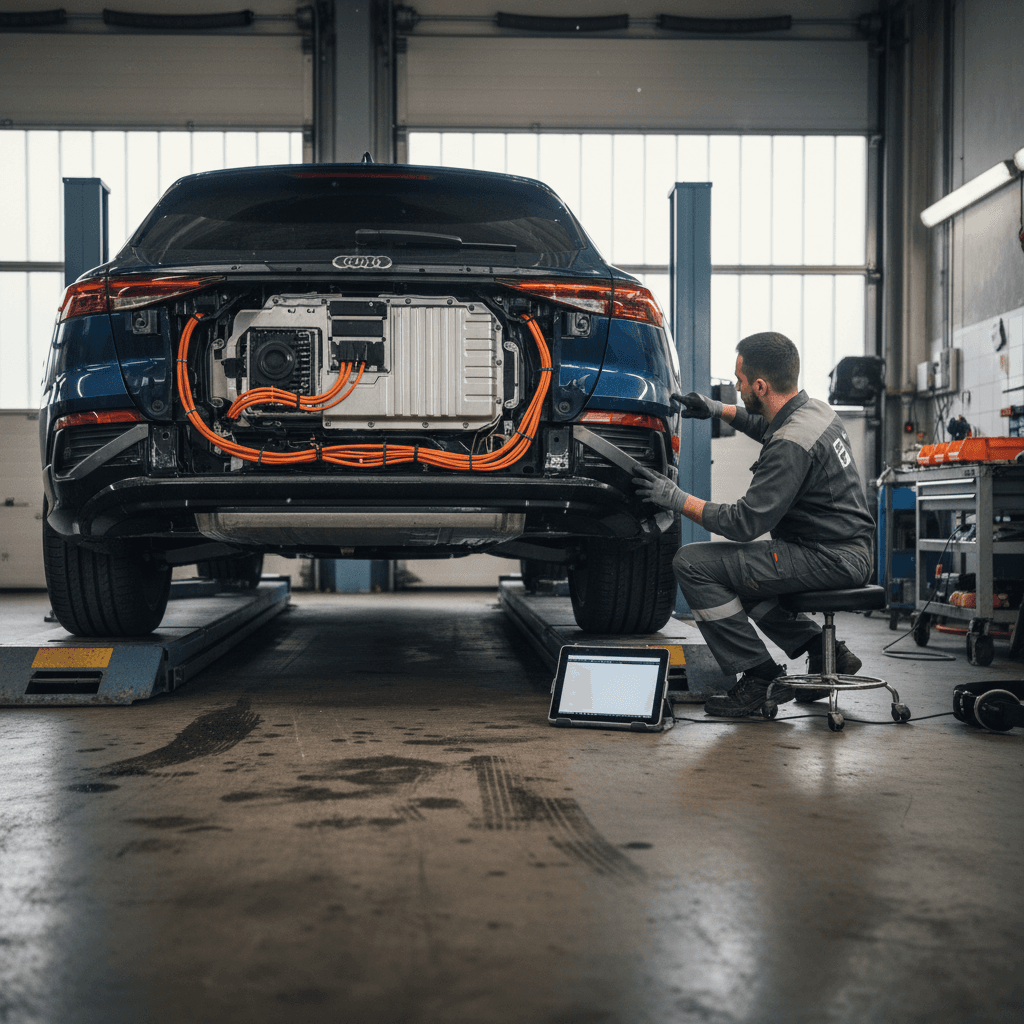
The Q4 e-tron’s high-voltage battery and motors are designed to be largely maintenance-free. You’re not changing “battery fluid” or doing motor tune‑ups. Instead, EV‑specific maintenance focuses on keeping the systems around the battery healthy and verifying that the car’s software is managing everything correctly.
What’s different about Q4 e-tron maintenance?
No oil changes, but a few EV-specific systems you should respect.
High-voltage battery
The pack itself isn’t a scheduled maintenance item. Instead, Audi monitors it via software and diagnostics. If you see range or charging issues, that’s a diagnostic visit, not a routine service.
Thermal management system
Coolant circuits manage battery, drive units, and power electronics. Long-interval coolant service may appear later in the life of the car; don’t let anyone sell you an early flush without backing documentation.
Charging hardware & seals
Technicians inspect charging ports, seals, and cables for wear and water ingress. Physical damage from public chargers or road debris is more common than "worn out" electric components.
High-voltage safety
Fluids, filters, and wear items you should plan for
Even though there’s no engine oil, the Q4 e-tron still has a short list of fluids and consumables that matter. Understanding what’s real and what’s dealer padding will save you money over the life of the car.
Key Q4 e-tron maintenance items
Brake fluid – every 2 years
Audi’s general guidance for modern models is a <strong>brake fluid change every two years regardless of mileage</strong>. That’s reasonable on a heavy EV that still relies on friction brakes in emergencies, even if regen does most day‑to‑day slowing.
Cabin air filter – ~20,000–30,000 miles
Usually bundled into standard services. A fresh filter improves HVAC performance and keeps dust and odors in check, which you’ll notice more in a quiet EV.
Tires – expect faster wear
Q4 e-tron curb weights and instant torque are tough on tires. Many owners see 20,000–30,000 miles on a set, sometimes less with aggressive driving. Budget for quality EV‑rated tires, not the cheapest option.
Brake pads & rotors – can last a long time
With regenerative braking doing most of the work, pads can last 60,000+ miles, sometimes well into six figures. But they may <em>corrode</em> before they wear out if you only drive gently, occasional firm stops help keep them clean.
Drive unit / reduction gear oil – long interval
Some service documents mention inspections or fluid service at higher mileage (often beyond 60K–90K). If a dealer recommends this early, ask to see the exact Audi document and interval it comes from.
Coolant – very long interval
Battery and power electronics coolant generally isn’t a short‑interval maintenance item. Audi’s own guidance tends to place coolant service late in the ownership timeline, if at all, unless there’s a repair.
Common upsell to question
What Q4 e-tron service typically costs & how Audi Care fits in
Because the Q4 e-tron doesn’t need engine work, routine services are mostly labor for inspections and a few fluids and filters. That can still add up, but over a 5‑ to 8‑year window it’s usually cheaper than a comparable gas Q5 or Q7.
Typical Q4 e-tron maintenance cost patterns
Audi wraps these visits into prepaid plans that can be useful if priced fairly:
Audi Care vs Signature Care for Q4 e-tron
How service plans change by model year.
Audi Care (MY 2025 & older)
For older Q4 e-tron models, Audi Care lets you prepay routine maintenance from about 10,000 to 40,000 miles. If you’re buying used and there’s unused coverage left, that’s real value, those services are already paid for.
Audi Signature Care (MY 2026 & newer)
For 2026‑and‑newer models, Signature Care bundles scheduled maintenance for the first three years or 30,000 miles into ownership. That effectively covers your first three visits, which is worth factoring into price comparisons.
Where Recharged fits in
Ready to find your next EV?
Browse VehiclesReading the service schedule when you’re buying a used Q4 e-tron
On a used Audi Q4 e-tron, the service schedule is more than a to‑do list, it’s a lie detector. You’re trying to answer two questions: has this car gotten its time‑ and mileage‑based services, and has it been driven in a way that’s kind to the battery and brakes?
Used Q4 e-tron service checklist
Confirm 10K/20K/40K services in the records
Look for documented visits near 10K, 20K, 30K, and 40K miles (or corresponding years). Gaps of 30,000+ miles with no service history are a red flag.
Verify brake fluid changes every ~2 years
There should be invoices or digital records for brake fluid flushes. If a six‑year‑old Q4 has never had brake fluid, budget for it immediately.
Scrutinize tire replacement history
Multiple tire sets in the first 30K miles may indicate aggressive driving or alignment issues. No tire changes by 40K miles could mean the odometer isn’t telling the whole story.
Check for battery or charging complaints
Service notes about charging faults, HV battery diagnostics, or repeated “unable to charge” complaints warrant questions. One resolved software update is fine; a pattern is not.
Look for Audi Care / Signature Care usage
If the first owner prepaid maintenance, you should see services clockwork‑regular. If those plans were purchased but services missed, that’s a yellow flag about how they treated other aspects of ownership.
Get an independent battery health view
Where possible, use tools like the <strong>Recharged Score</strong> to see quantitative battery health, fast‑charging frequency, and charge patterns. That tells you more than a stamped service booklet ever will.
DIY vs dealer: what you can safely do yourself
You don’t have to take a Q4 e-tron to the dealer for every minor task, but you also shouldn’t treat it like a 1990s economy car. The trick is knowing which jobs are about basic hardware, and which touch high‑voltage or safety‑critical systems.
Reasonable DIY / independent-shop items
- Tire rotations and replacements (with correct EV load and speed ratings)
- Wiper blade replacement and washer fluid top‑ups
- Cabin air filter changes, if you’re comfortable accessing panels
- Basic suspension and brake visual inspections
- Non‑HV software checks via the car’s own menus
Keep receipts and photos, documentation still matters for resale and warranty discussions.
Best left to Audi or EV‑trained shops
- Brake fluid changes and ABS bleed procedures
- Any work touching orange high‑voltage cables or the battery enclosure
- Drive unit / reduction gear fluid service
- HVAC refrigerant work on heat-pump‑equipped cars
- Software updates / recalls that require dealer tools
For used buyers, seeing these complex jobs done at a qualified shop is usually a plus, not a minus.
Independent EV specialists are emerging
Audi Q4 e-tron service schedule FAQ
Frequently asked questions about Q4 e-tron service
Bottom line: focus on inspections, software, and brakes
If you remember nothing else about the Audi Q4 e-tron service schedule, remember this: keep up with the 10,000‑mile / 12‑month visits, don’t skip the two‑year brake fluid changes, and make sure software updates and EV system inspections happen on schedule. Do that, and the lack of engine complexity starts to work in your favor.
For current owners, that means you can confidently say no to extras that aren’t in the factory maintenance guide. For used‑EV shoppers, it means you can read a Q4 e-tron’s service history like a roadmap to how it was treated. And if you’d rather not decode that alone, Recharged’s combination of Recharged Score battery diagnostics, service‑history review, and EV‑specialist guidance is there to turn what’s usually guesswork into a transparent ownership decision.