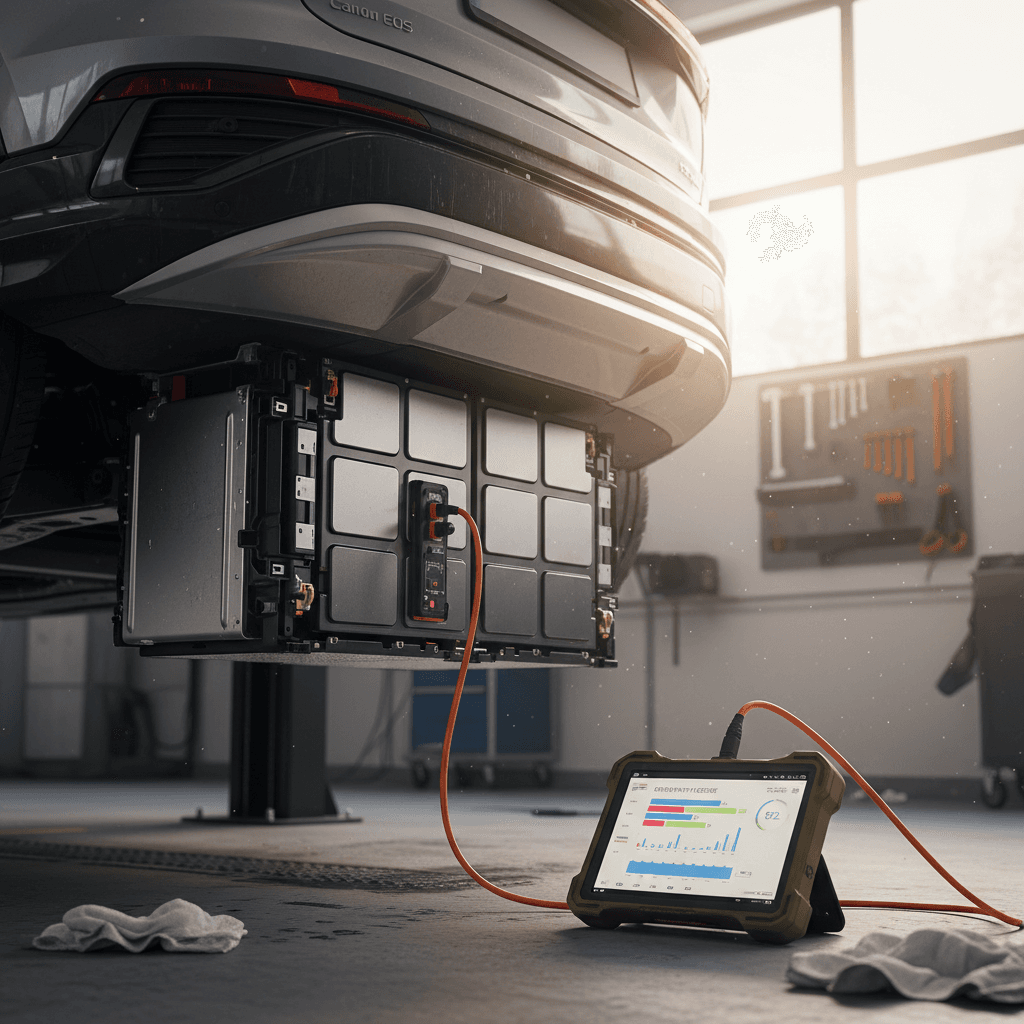
If you own, or are eyeing, a used Audi Q4 e-tron, the question behind all the glossy marketing is simple: how healthy is the battery, really? This guide walks you through exactly how to do an Audi Q4 e-tron battery health check, from quick DIY clues in your driveway to professional diagnostics and what to demand when you’re buying used.
First things first
Why battery health matters on the Audi Q4 e-tron
The Q4 e-tron’s high‑voltage pack is the most expensive component in the car and the heart of its real‑world usability. New, a Q4 e-tron with the larger 82 kWh gross pack delivers usable capacity in the high‑60s to low‑70s kWh range and EPA-rated range in the 240–270 mile ballpark depending on configuration. As the pack degrades, that usable capacity, and your practical highway range, shrinks.
- Battery health dictates how far you can actually drive between charges.
- It’s central to the car’s value on the used market.
- Excessive degradation may be covered under Audi’s 8‑year/100,000‑mile battery warranty, but only if you can document it.
- A healthy pack is more predictable on road trips and in winter, when range is already under pressure.
Don’t fixate on 100%
What Audi actually means by “battery health” and warranty
When Audi talks about Q4 e-tron battery health, they’re really talking about usable energy capacity, how many kilowatt‑hours the pack can still deliver compared with when it was new. Capacity slowly steps down over years of use; the chemistry doesn’t care about marketing copy.
Audi Q4 e-tron high-voltage battery basics
Audi’s U.S. warranty for modern e-tron models, including the Q4, typically covers the high‑voltage battery for 8 years or 100,000 miles. If the net usable capacity falls below roughly 70% within that window, and the car has been used within Audi’s guidelines, you may be eligible for repair or module replacement. That determination hinges on formal battery tests, not your dash‑displayed range on a windy day.
Capacity vs. state of charge
Quick at-home checks for Audi Q4 e-tron battery health
You don’t need a lab or an Audi dealer to get a first read on your Q4 e-tron’s battery health. You just need a consistent routine and a bit of patience. Think of this as a pre‑screen: if these checks look worrying, that’s your cue to book a professional test.
Driveway battery health check: 5 easy steps
1. Reset trip data and charge to a known level
On a mild day, charge to a specific SoC target, ideally 80%, and reset your trip computer. Avoid doing this test right after a hard highway run or DC fast charge when the pack is hot.
2. Drive a repeatable route
Pick a loop you know well, suburban mix or steady highway, and drive at your normal pace for 30–50 miles. Note average speed and climate settings; both matter more than you think.
3. Record energy used and SoC drop
At the end of the run, note miles driven, kWh/100 mi (or mi/kWh), and remaining SoC. This tells you how much energy the car thinks it used for that distance.
4. Estimate usable capacity
Rough math: take miles driven ÷ (miles per 1% SoC drop), then multiply by 100. Or use: usable kWh ≈ (miles driven × consumption in kWh/mi) ÷ SoC% used. Do this a few times; patterns matter more than one result.
5. Repeat in different conditions
Re‑run the same exercise in warmer and cooler weather, and once with a steady highway run. If you consistently see much lower implied capacity than other Q4 owners report, it’s time for a deeper check.
Use 80%, not 100%, as your test point
Using range and efficiency to spot battery degradation
Real‑world range is the easiest metric for an owner to track, but it’s also the fuzziest. Weather, speed, elevation, wind, tire choice, and even a dirty cabin filter can move the needle more than 10% either way. To use range as a window into battery health, you need to control the variables as best you can.
What you can infer from range
- Year‑over‑year change on the same commute. If your winter‑to‑winter range on a familiar route is down 10–15% with similar temps and habits, that hints at real degradation.
- Difference vs. other Q4 owners. If you’re consistently 20–25% below what other Q4 drivers see at similar speeds and climates, it’s worth digging deeper.
- Pre‑conditioning effect. A battery that warms properly before DC fast charging and still charges at expected speeds is usually in decent health.
What you can’t blame on the battery
- Cold‑soaked pack. Sub‑freezing temps can temporarily slash range without any lasting damage. That’s chemistry, not doom.
- Short‑trip city use. Lots of HVAC use and stop‑start driving will wreck your efficiency numbers even with a perfect battery.
- Big wheels and roof boxes. Aerodynamics and rolling resistance can quietly remove 10–15% of highway range.
Cold weather is a red herring
Getting a professional Audi Q4 e-tron battery health check
At some point, “it feels worse than last year” isn’t enough, especially if you’re staring down warranty limits or considering a used purchase. That’s where a formal high‑voltage battery health check comes in.
Two main ways to get a Q4 e-tron battery health report
Dealer diagnostics vs. independent assessments
Audi dealer or authorized EV specialist
Audi service centers and qualified independent EV shops can plug into factory diagnostic tools and run official battery tests.
- What they read: battery state of health (SoH), cell balance, temperature data, error codes, charge counters.
- When to go: before your 8‑year/100,000‑mile warranty expires, after a big range drop, or if you see HV battery warnings.
- Bonus: documented results carry weight in warranty claims.
Independent report, like a Recharged Score
When you shop a used Q4 e-tron through Recharged, every car comes with a Recharged Score report that includes a dedicated battery health assessment.
- What you get: verified battery condition, charge performance, and how it stacks up against similar Q4s.
- Why it matters: you’re not guessing from a seller’s word or a single test drive.
- Extras: fair‑market pricing and EV‑specialist guidance from start to finish.
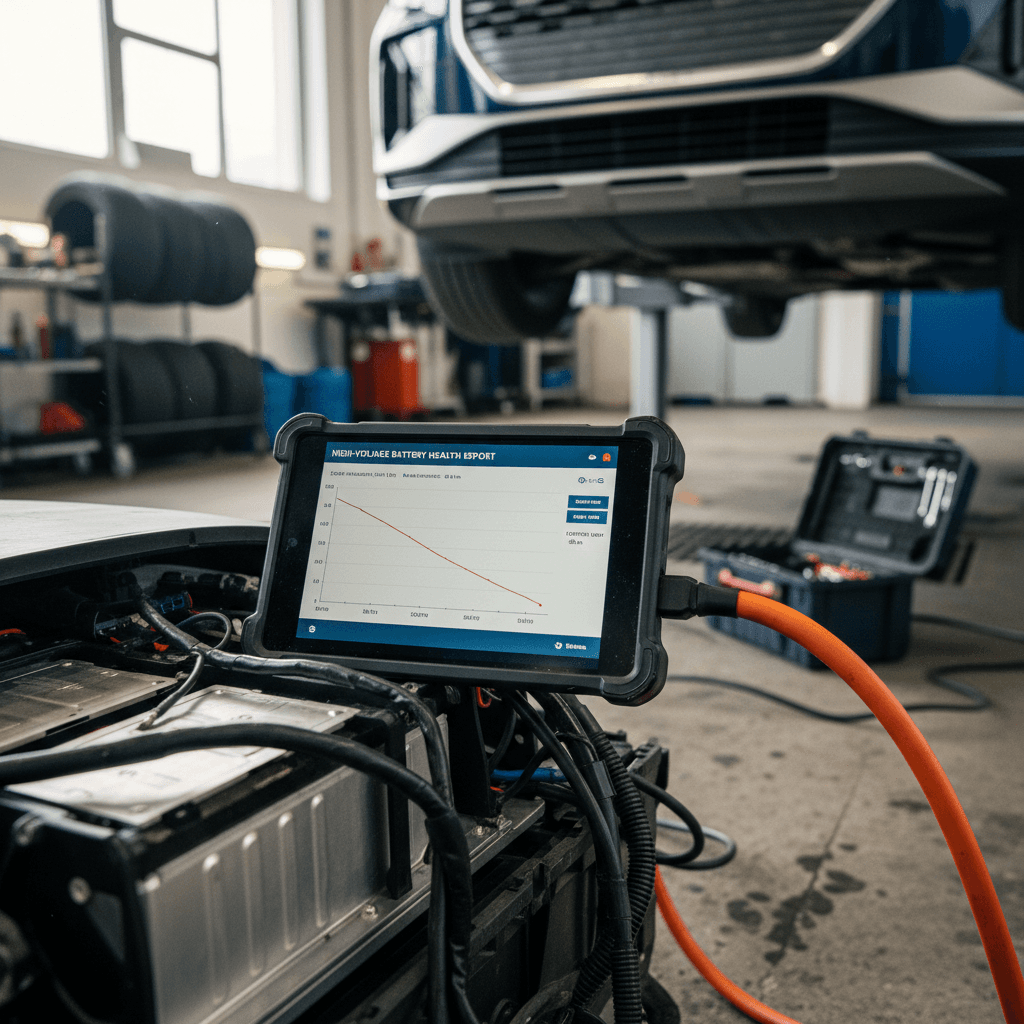
What a good pro report looks like
Advanced checks: OBD tools and data-nerd level detail
If you’re the kind of person who reads spec sheets for fun, you can dig deeper using an OBD‑II adapter and third‑party apps that understand VW Group EVs. Done right, this can get you close to the same raw data the dealer sees, though it won’t replace an official warranty‑grade test.
- Use a reputable, EV‑friendly OBD‑II dongle that supports CAN access and doesn’t drop connections.
- Choose an app known to decode MEB‑platform data (the Q4 shares its platform with VW ID.4 and others).
- With the car safely parked, ignition on, and parking brake set, read battery management system (BMS) values: state of health, total energy in/out, and cell voltages.
- Avoid changing any coding or adaptation channels unless you know exactly what you’re doing, reading data is fine; writing can void warranties or brick modules.
Serious caution on DIY coding
How much battery degradation is normal on a Q4 e-tron?
Lithium‑ion batteries age. The Q4 e-tron is no exception. The goal isn’t to avoid any degradation, it’s to stay within the gentle, predictable curve the chemistry promises.
Rough expectations for Q4 e-tron battery aging
These are ballpark figures for a well‑treated pack in a temperate climate, not a guarantee. Real‑world experience varies.
| Vehicle age / mileage | What many owners see | When to get concerned | What to do |
|---|---|---|---|
| Year 1–2 / under 25k miles | 2–5% apparent loss vs. brand‑new | More than ~8–10% drop with gentle use | Request a formal battery health check. |
| Year 3–5 / 25k–60k miles | 5–10% total loss | 15–20% or big step change in one year | Get a dealer or third‑party diagnostic report. |
| Year 6–8 / 60k–100k miles | 10–20% total loss | Approaching or below ~70% of original capacity | Check warranty status and document everything. |
| Beyond 8 years / over 100k miles | Wide variation, care and climate dominate | Sudden big drops, HV fault codes, slow charging | Budget for repair, replacement, or negotiate price if buying used. |
Use these numbers as context, not as hard warranty thresholds.
Warranty vs. reality
Battery health when buying a used Audi Q4 e-tron
For a used EV, the battery isn’t just another line item, it’s the whole thesis. A clean Carfax and shiny paint mean very little if the pack is tired. If your search history includes “Audi Q4 e-tron battery health check how to,” you’re already ahead of most buyers.
Used Audi Q4 e-tron: battery questions to ask
Ask for a recent battery health report
Request dealer service records that show an HV battery test or state‑of‑health reading within the last 6–12 months. If the seller can’t produce anything, treat that as a negotiation point.
Confirm warranty start date and mileage
The 8‑year/100,000‑mile battery warranty starts from the original in‑service date, not model year. A 2021 Q4 sold in late 2022 has different coverage remaining than one sold in early 2021.
Study real‑world range, not just EPA numbers
On a test drive, note projected range at a given SoC and compare it to what other Q4 owners report online at similar speeds and temperatures. Massive gaps deserve follow‑up.
Check DC fast‑charge history (if available)
Some service reports or connected‑car logs show how often the car has fast‑charged. Occasional road‑trip use is fine; constant 100% DC charging in hot climates is harder on the pack.
Get an independent inspection
If you’re buying from a private party or non‑EV‑specialist dealer, pay for an EV‑savvy shop, or a marketplace like <strong>Recharged</strong>, to perform a battery inspection and full vehicle check.
Leverage professional marketplaces
Shopping through <a href="/">Recharged</a> means every Q4 e-tron includes a Recharged Score with verified battery health and fair pricing, plus EV‑specialist support if you have questions before signing anything.
How Recharged de-risks used Q4 e-trons
Ready to find your next EV?
Browse VehiclesHabits that protect your Audi Q4 e-tron battery
The upside to all this hand‑wringing about degradation is that your daily choices actually matter. The Q4 e-tron’s pack is well‑engineered, but it’s not magic. Treat it kindly and you tilt the odds strongly in your favor.
Everyday habits that keep your Q4 battery healthy
Small decisions, big effect over 8+ years
Live between 20–80%
For daily driving, keep the pack mostly between roughly 20% and 80% SoC.
- Use the charge limiter in the myAudi app or MMI.
- Reserve 100% charges for road trips or occasional calibration.
Favor AC over DC fast charging
Level 2 AC charging at home or work is gentler on the cells than constant high‑power DC fast charging.
- DCFC is fine for trips; it’s not great as your only fueling plan.
Mind temperature extremes
High heat ages batteries. Whenever possible:
- Park in shade or a garage.
- Avoid leaving the car at 100% SoC in scorching heat.
- Use pre‑conditioning to warm or cool the cabin while plugged in.
Drive smoothly
Hard launches are fun; constant abuse isn’t.
- Smoother acceleration and braking reduce peaks in current draw.
- Less heat and stress generally mean slower degradation.
Avoid long storage at 0% or 100%
If you’re parking the Q4 for weeks:
- Leave it around 40–60% SoC.
- Keep it plugged in with a reasonable charge limit.
Stay on top of software and service
Battery management software updates and EV‑specific inspections matter.
- Follow Audi’s maintenance schedule.
- Ask service advisors to include HV battery checks where recommended.
Don’t obsess over every percent
FAQ: Audi Q4 e-tron battery health check how to
Frequently asked questions about Q4 e-tron battery health
Bottom line on Audi Q4 e-tron battery health checks
You can’t peel back the floorpan and count electrons, but you can build a clear picture of your Audi Q4 e-tron’s battery health. Start with simple, repeatable at‑home checks, range, efficiency, and how the car charges. Layer in a proper diagnostic from an Audi dealer or EV‑savvy shop, especially as the car approaches its 8‑year/100,000‑mile battery warranty limits or before you buy used.
If all of this feels like a lot of homework for one vehicle, that’s exactly why companies like Recharged exist. When you shop a used Q4 e-tron through Recharged, you get a Recharged Score with verified battery health, transparent pricing, financing options, and EV‑specialist support from the first click to the delivery truck. Whether you’re testing the Q4 in your driveway or considering one sight‑unseen from across the country, the right battery health check turns a leap of faith into a rational decision.