If you’re cross-shopping the Audi Q4 e-tron with gas-powered luxury SUVs, the big question is what you’ll actually spend every year to keep it on the road. The Audi Q4 e-tron annual maintenance cost looks very different from a Q5 or X3, because you’re trading oil changes and engine work for tires, brake fluid and software updates. This guide breaks down typical yearly costs, how they change over time, and what to expect if you’re buying used.
At a glance
Why Audi Q4 e-tron maintenance costs look different from gas SUVs
- No engine oil, spark plugs, fuel filters or timing belts to service.
- Fewer fluids overall, no transmission fluid changes, no exhaust system maintenance.
- Regenerative braking reduces mechanical brake wear in daily driving.
- Software and high-voltage system checks replace a lot of traditional under-hood work.
The Q4 e-tron is built on Volkswagen Group’s MEB electric platform, which removes dozens of traditional maintenance items. That said, it’s still an Audi SUV. You’re paying for premium parts and labor rates, and the vehicle is heavy, which affects tire and suspension wear. Understanding what’s gone and what remains is the first step to predicting your annual spend.
Audi Q4 e-tron maintenance by the numbers (typical owner experience)
Typical Audi Q4 e-tron annual maintenance cost
Audi publishes a maintenance schedule for the Q4 e-tron, and U.S. dealer pricing fills in the rest. When you average out inspections, brake fluid changes, filters, and likely tire and brake work, most owners will land in a $500–$900 per year window during the early years of ownership. That assumes about 12,000–15,000 miles a year and no collision damage or unusual abuse.
Estimated Audi Q4 e-tron annual maintenance cost (typical U.S. usage)
These are ballpark ranges for planning purposes, not quotes. Dealer labor rates and parts pricing vary by region.
| Cost category | Low estimate (per year) | High estimate (per year) | Notes |
|---|---|---|---|
| Scheduled inspections & basic service | $200 | $350 | Multi-point inspections, cabin filter every 2 years, brake fluid every ~2–3 years |
| Tires (averaged annually) | $200 | $350 | Premium 20–21" tires often last 25k–35k miles; cost spread over years |
| Brakes (averaged annually) | $60 | $140 | Pads/rotors last longer than on gas SUVs; cost averaged over life |
| Misc. (wipers, bulbs, alignments) | $40 | $60 | Small wear items and occasional alignment |
| Total estimated annual maintenance | $500 | $900 | Typical range in the first 5–7 years |
Routine maintenance only, does not include insurance, registration, or electricity.
Dealer vs independent shop pricing
Audi Q4 e-tron maintenance schedule: what happens when
Audi structures Q4 e-tron maintenance mainly around mileage- or time-based inspections plus a short list of recurring items. Oil changes never appear, but brake fluid, cabin filters and coolant checks do. Here’s a simplified look at the major touchpoints you should plan for.
Key Q4 e-tron service touchpoints
High-level look at the jobs that actually show up on your service invoice.
Every 1 year / ~10,000 miles
- Multi-point inspection
- Tire rotation (if not done separately)
- Software / control unit updates
- Visual check of brakes, suspension, steering and cooling system
Every 2 years (time-based)
- Brake fluid replacement
- Cabin air filter replacement (often every 2 years)
- More detailed inspection of high-voltage components and seals
Coolant & battery checks
- Coolant for the battery and power electronics checked regularly
- Coolant replacement on a long interval, often around 10 years or high mileage
- Battery health checks can be requested or included in inspections
As-needed items
- Wheel alignment after pothole hits or uneven wear
- Wiper blades annually in harsher climates
- 12-volt battery replacement after several years
What about the big high-voltage battery?
Major cost buckets: tires, brakes, coolant and more
Tires: your biggest recurring expense
The Q4 e-tron is a heavy, high-torque EV on wide, performance-oriented tires. That’s a recipe for quicker wear than you might see on a lighter compact SUV. Expect:
- 25,000–35,000 miles out of a set under typical mixed driving.
- Replacement costs often in the $900–$1,400 range for four quality tires, including mounting and balancing.
- An annualized cost of roughly $200–$350 per year if you’re driving around 12,000–15,000 miles.
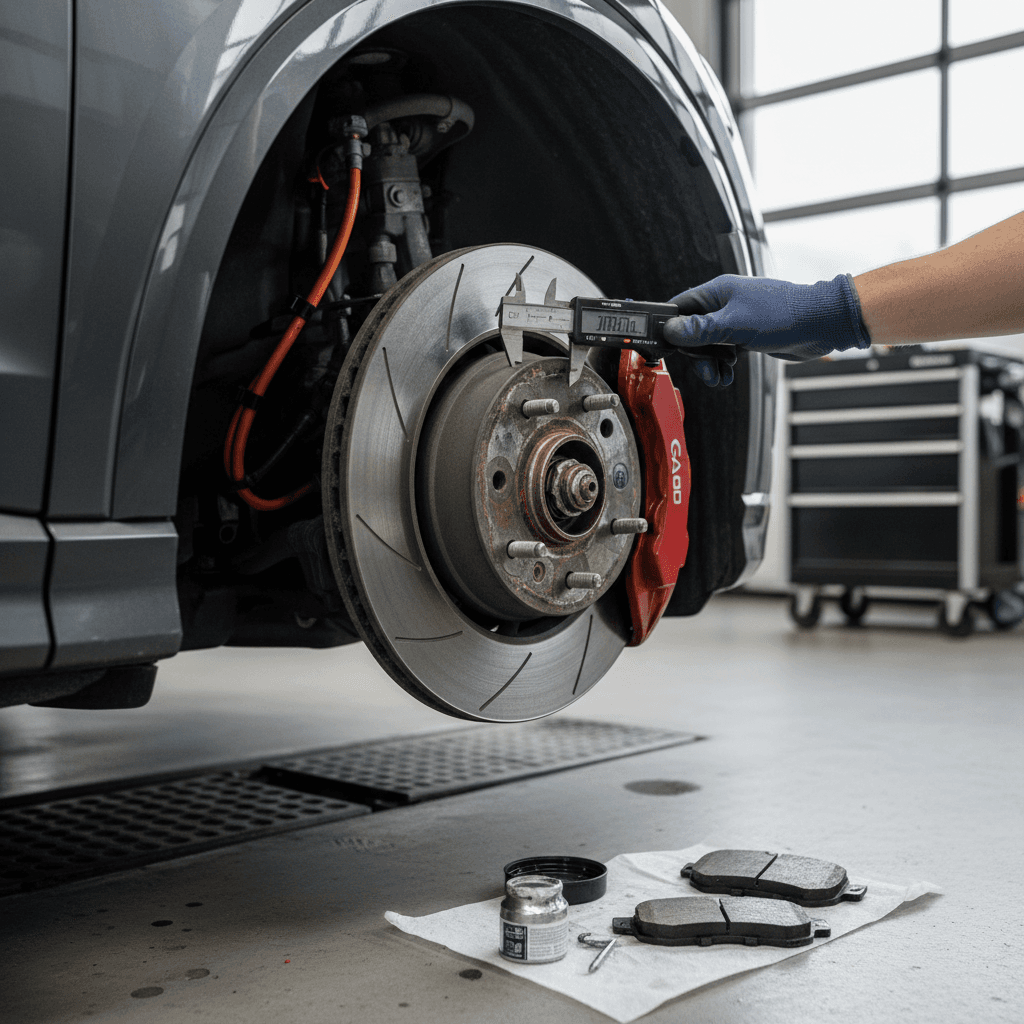
Brakes: less frequent, but still matter
Thanks to regenerative braking, the Q4 e-tron’s friction brakes usually last longer than those on a comparable gas SUV.
- Front pads and rotors often make it well past 50,000 miles in mostly city/suburban driving.
- A full axle brake job on a luxury EV can easily run $600–$1,000+ depending on parts and labor rates.
- Spread over several years, that’s roughly $60–$140 per year in your maintenance budget.
Beyond tires and brakes, your other recurring costs are relatively modest. Brake fluid changes every couple of years, cabin filters, and the occasional wheel alignment or wiper set add smaller line items to your annual total. High-voltage coolant replacement is a rare, long-interval job, more like a once-per-decade expense than something you’ll see every year.
How annual costs change as the Q4 e-tron ages
How Audi Q4 e-tron annual maintenance costs evolve over time
Estimated averages for routine maintenance and wear items, assuming typical U.S. driving patterns.
| Vehicle age | Typical annual spend | What usually drives costs |
|---|---|---|
| Years 1–3 | $400–$700 | Inspections, tire rotations, maybe first set of tires by year 3 |
| Years 4–6 | $600–$900 | Second set of tires, brake fluid, cabin filters, possible minor brake work |
| Years 7–10 | $700–$1,100+ | More frequent tires, first major brake job, 12V battery, occasional suspension or alignment work |
These figures exclude accident repairs and out-of-warranty one-off failures.
Leasing vs buying and maintenance
Audi Q4 e-tron vs gas luxury SUV maintenance costs
The easiest way to understand Q4 e-tron maintenance is to compare it with something like an Audi Q5, BMW X3 or Mercedes GLC. Those vehicles carry all the same tire, brake and suspension costs, and then layer engine, transmission, exhaust and emissions systems on top.
Audi Q4 e-tron vs comparable gas luxury SUV: maintenance comparison
High-level comparison of typical maintenance needs and where EVs save you money.
| Item | Audi Q4 e-tron | Comparable gas luxury SUV | Owner impact |
|---|---|---|---|
| Engine oil & filter | Not applicable | Change every ~7,500–10,000 miles | EV skips a common $80–$150 recurring bill |
| Spark plugs, fuel system | Not applicable | Required at long intervals | EV avoids tune-ups and fuel system cleaning |
| Transmission service | Single-speed reduction gear, no regular fluid change | Automatic transmission fluid changes on schedule | One less major service item with an EV |
| Exhaust & emissions | None | Exhaust, catalytic converter, O2 sensors | EV has fewer rust and emissions-related repairs |
| Brakes | Regenerative braking reduces wear | Heavier use of friction brakes | EV often needs pads/rotors less frequently |
| Tires & suspension | Similar or slightly higher wear due to weight/torque | Similar, sometimes slightly longer life | Comparable cost in both cases |
“Gas SUV” here represents a typical all-wheel-drive luxury compact SUV with a turbocharged engine.
Put simply, the Audi Q4 e-tron shifts your annual maintenance cost toward tires, basic inspections and occasional brake work, while largely eliminating engine- and exhaust-related expenses. Over a 5–10 year window, that can translate into meaningful savings versus a similarly priced gas SUV, especially if dealer oil changes and transmission services are your baseline comparison.
How to save on Audi Q4 e-tron maintenance
Practical ways to keep Q4 e-tron maintenance costs in check
1. Rotate tires on schedule
EV torque can chew through front tires if you skip rotations. Keeping to a 5,000–7,500 mile rotation interval spreads wear evenly and can delay that $1,000+ tire bill.
2. Watch alignment after potholes
If the Q4 e-tron starts pulling to one side or you see uneven tire wear, schedule an alignment. Catching it early is cheaper than burning through a set of premium tires.
3. Use regen wisely, not obsessively
Maximizing regenerative braking helps pads last longer, but don’t be afraid to use the friction brakes. Let the car blend stopping power naturally, brake jobs are still infrequent.
4. Price shop for routine work
Brake fluid changes, cabin filters and alignments don’t always require a franchised Audi dealer. An independent shop with EV experience can trim your annual cost without sacrificing quality.
5. Keep software up to date
Accepting software updates and following recall or service campaign notices can prevent bigger problems later. Many updates are free and done during regular service visits.
6. Consider an extended service contract carefully
On higher-mileage or older Q4 e-trons, a reputable service contract can smooth out surprise repair bills. Run the numbers against your expected ownership period, not just the monthly payment.
Where Recharged fits in
Ready to find your next EV?
Browse VehiclesBuying a used Audi Q4 e-tron: maintenance risks and safeguards
The Audi Q4 e-tron is still relatively new, which means a lot of the used inventory is coming off short leases or early ownership. That can be good news for buyers, but you still need to understand what you’re inheriting in terms of tires, brakes and battery health.
Key maintenance questions for a used Q4 e-tron
These are the items that can swing your annual cost up or down right away.
Battery health & warranty
Ask for any documented battery health reports and confirm how much of the original high-voltage battery warranty remains. A healthy pack under warranty keeps your long-term risk lower.
Tires & wheels
Check tread depth across the full width of each tire and look for uneven wear or sidewall damage. A set of near-worn 21" tires is an instant multi-hundred-dollar expense.
Brakes & rotors
Have a technician measure pad thickness and inspect rotors. Rust ridges from light use can accelerate rotor replacement even if pads still look good.
Service history
Review records to confirm brake fluid changes, cabin filters and recall work were handled on time. Gaps don’t automatically mean trouble, but they should factor into your offer.
Suspension & steering
On rough roads, heavy EVs can go through bushings and suspension components faster. Listen for clunks over bumps and ask for an underbody inspection if you’re concerned.
Third-party inspection
An independent pre-purchase inspection from a shop that understands EVs can highlight near-term maintenance needs so you can budget, or negotiate, accordingly.
Don’t skip the inspection on a used Q4 e-tron
FAQ: Audi Q4 e-tron annual maintenance cost
Frequently asked questions about Q4 e-tron maintenance
Bottom line: is the Audi Q4 e-tron expensive to maintain?
When you strip away the complexity of a gas engine and transmission, the Audi Q4 e-tron annual maintenance cost looks more manageable than many buyers expect. You’ll spend real money on tires, occasional brake work and basic inspections, but oil changes, exhaust problems and transmission services are off the table. Over a typical ownership window, that often puts the Q4 e-tron ahead of comparable gas luxury SUVs on maintenance alone.
If you’re considering a used Q4 e-tron, getting clear answers on battery health, tires and brakes is the key to predicting your annual spend. That’s exactly what tools like the Recharged Score Report are built for, so you’re not buying blind. Combine that insight with realistic budgeting, and the Q4 e-tron can be a compelling way to step into premium EV ownership without premium-sized maintenance surprises.