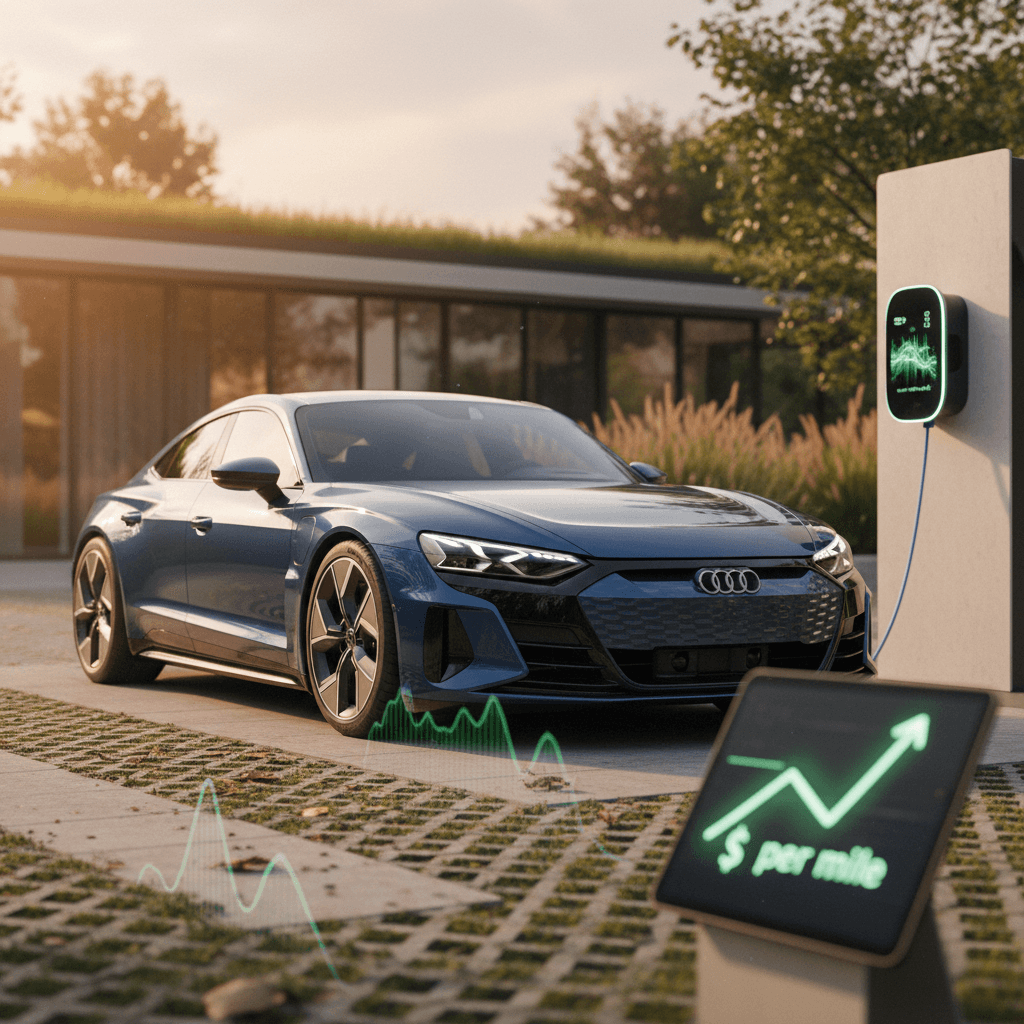
If you’re eyeing an Audi e-tron GT, new or used, the obvious question is what it actually **costs per mile to drive**. You know it’s quick, glamorous, and not cheap to buy. But does it make financial sense to run day-to-day compared with a gas performance sedan?
Quick answer
How efficient is the Audi e-tron GT?
Before you talk about cost per mile, you need efficiency. For EVs, the key metric is **kWh (kilowatt‑hours) per 100 miles**. The Audi e-tron GT’s official EPA efficiency rating is about 41 kWh/100 miles (roughly 2.4–2.5 miles per kWh) in mixed driving, depending on trim and wheel choice.
Audi e-tron GT efficiency at a glance
In plain English, that means every 100 miles in an e-tron GT uses about 41 units of electricity. Once you know what you pay per kWh, the cost-per-mile math becomes straightforward.
The core math: cost-per-mile explained
Here’s the basic formula you’ll use for any electric vehicle, including the e-tron GT:
- Find your efficiency in kWh/100 miles (for the Audi e-tron GT, figure about 41 kWh/100 miles).
- Find your electricity price in $/kWh from your bill or charging provider.
- Multiply: (kWh/100 miles) × ($/kWh) = cost for 100 miles.
- Divide that by 100 to get cost per mile.
Rule‑of‑thumb shortcut
Home charging vs DC fast charging costs
Most Americans pay somewhere in the mid‑teens per kWh for residential electricity. Recent federal data for 2024–2025 puts the **average U.S. residential rate around 16–18¢/kWh**, with wide variation by state. Public DC fast charging often runs much higher, commonly in the **35–55¢/kWh** range, or even more on some networks and on-peak plans.
Estimated Audi e-tron GT electricity cost per mile
Using 41 kWh/100 miles efficiency and typical 2025–2026 U.S. electricity prices.
| Charging type | Example rate (¢/kWh) | Cost per 100 miles | Approx. cost per mile |
|---|---|---|---|
| Efficient home charging (solar / cheap off‑peak) | 12¢ | $4.92 | $0.05 |
| Typical U.S. home charging | 17¢ | $6.97 | $0.07 |
| Expensive home market (e.g., parts of CA/NE) | 25¢ | $10.25 | $0.10 |
| Moderate DC fast charging | 35¢ | $14.35 | $0.14 |
| Pricey DC fast charging | 50¢ | $20.50 | $0.21 |
Your actual numbers will depend on your local rate plan, fees, and how you drive.
Why relying on DC fast charging hurts your wallet
Real-world scenarios: monthly driving costs
To make the “cost per mile” idea more concrete, let’s look at common U.S. driving patterns. We’ll assume the car averages 41 kWh/100 miles, and we’ll use 17¢/kWh for home charging and 40¢/kWh for DC fast charging, which are realistic mid‑range assumptions for 2025–2026.
What you’ll spend per month in an Audi e-tron GT
Three typical driving profiles, each with different charging habits.
City commuter
800 miles/month (about 200 miles/week)
- Energy used: 328 kWh
- Home only @ 17¢/kWh: about $56/month
- DC only @ 40¢/kWh: about $131/month
Home charging cuts your monthly “fuel” bill by more than half.
Typical U.S. driver
1,200 miles/month
- Energy used: 492 kWh
- Home only @ 17¢/kWh: about $84/month
- DC only @ 40¢/kWh: about $197/month
Even with mixed use, you’ll often beat a thirsty gas sports sedan.
Heavy driver / road-tripper
1,800 miles/month
- Energy used: 738 kWh
- Home only @ 17¢/kWh: about $125/month
- DC only @ 40¢/kWh: about $295/month
A home Level 2 charger pays for itself quickly at this mileage.
Compare that with gas
Factors that change your cost per mile
The numbers above are averages. Your real Audi e-tron GT cost per mile will shift up or down based on how, where, and when you drive and charge. Here are the big levers you control.
Key drivers of your e-tron GT cost per mile
1. Your electricity rate
A driver paying 12¢/kWh off‑peak can spend <strong>half as much per mile</strong> as someone paying 25¢/kWh or more. Check your utility’s time‑of‑use plans; many offer cheaper overnight rates perfect for EV charging.
2. Home Level 2 vs public DC fast charging
Home Level 2 is usually the cheapest and gentlest on your battery. Fast charging is more expensive per kWh, and if it’s your primary energy source, your cost per mile can jump into the teens or low 20‑cent range.
3. Driving style and speed
The Audi e-tron GT is a rocket ship. Treat it that way all the time, hard launches, 80+ mph cruising, and you’ll see efficiency fall well below 2 mi/kWh, raising your cost per mile sharply. Smooth driving keeps you near EPA figures.
4. Climate and cabin use
Cold weather, lots of short trips, and heavy HVAC use can all increase consumption. In winter, it’s not unusual for EVs to use 10–30% more energy, temporarily nudging your per‑mile cost up.
5. Wheel and tire choices
Big 21‑inch wheels and performance tires look great, but they add rolling resistance and aerodynamic drag. If efficiency matters, the smaller, more aero wheel/tire packages are your friend.
6. Battery health over time
As the pack ages, you may see slight efficiency changes and less usable range. A healthy battery helps you stay closer to the original EPA consumption numbers, preserving your cost‑per‑mile advantage.
How battery health affects efficiency and cost
Battery health doesn’t show up line‑by‑line on your electricity bill, but it absolutely shapes your long‑term cost per mile, especially if you’re considering a used Audi e-tron GT.
Degradation and cost per mile
Over time, lithium‑ion packs lose some usable capacity. If your e‑tron GT started with ~84–97 kWh usable and is now effectively working with less, you’ll have to charge more often to go the same distance.
That typically shows up as shorter range more than a big jump in kWh per mile, but if the pack is out of balance or some modules are weak, the car’s energy management might become less efficient, nudging your cost per mile upward.
Why a battery health report matters
When you’re buying used, guessing about battery condition is a fast way to overpay. A data‑driven battery assessment tells you how much capacity remains, whether the pack has been heavily fast‑charged, and how it compares with similar cars.
Every EV sold by Recharged includes a Recharged Score Report with verified battery health, so you’re not guessing about the single most expensive component in the car.

Saving money with a used Audi e-tron GT
The Audi e-tron GT is an expensive car to buy new, but the used market can offer substantial savings while leaving your per‑mile running costs nearly identical, if you choose carefully.
Where used Audi e-tron GT buyers save, and where they don’t
Energy costs stay similar, but other ownership costs can change a lot.
Biggest savings: purchase price & depreciation
Luxury EVs like the e-tron GT tend to depreciate faster than mass‑market models. That’s bad news for the first owner, but it can be great for you.
- You may save tens of thousands versus new.
- Your electricity cost per mile will be similar to a new car’s, assuming healthy battery and similar driving.
- Insurance can sometimes be lower on an older model, but always price it out.
What stays similar: energy and maintenance
Your electricity cost per mile doesn’t care whether the car is one year old or five, it cares about efficiency and your kWh price.
- Routine maintenance is still lower than a gas V8 sports sedan, no oil changes, fewer moving parts.
- Out‑of‑warranty repairs can be expensive, so it pays to buy a car with a clean service history and proven battery health.
- Recharged offers expert EV support, trade‑ins, and financing to help you manage the full cost of ownership.
How Recharged helps used e-tron GT shoppers
Ready to find your next EV?
Browse VehiclesOverview: Audi e-tron GT cost per mile
Let’s pull the key numbers together in one place so you can gut‑check whether an Audi e-tron GT fits your budget.
Audi e-tron GT cost per mile – quick reference
Using 41 kWh/100 miles efficiency and typical 2025–2026 electricity prices.
| Scenario | Assumed rate (¢/kWh) | Approx. cost per mile | How it feels day-to-day |
|---|---|---|---|
| Best‑case home charging (cheap TOU or solar) | 12¢ | ≈ $0.05 | Very low running costs, cheaper than many hybrids. |
| Typical U.S. home charging | 16–18¢ | ≈ $0.07–0.08 | Solid savings vs. a 20‑mpg performance sedan. |
| High‑cost electricity markets | 23–28¢ | ≈ $0.09–0.12 | Closer to gas costs, but still competitive with performance cars. |
| Moderate DC fast charging mix | 30–40¢ | ≈ $0.12–0.16 | Still OK, but you’ll feel it on long road‑trip months. |
| Mostly DC fast charging at high rates | 45–60¢ | ≈ $0.18–0.24 | You’ll spend gas‑like money without gas‑station smells. Best avoided. |
These are ballpark ranges for most U.S. drivers; plug in your own kWh price for precise numbers.
FAQ: Audi e-tron GT cost per mile
Frequently asked questions about Audi e-tron GT running costs
Bottom line: Is an e-tron GT cheap to run?
The Audi e-tron GT will never be a bargain‑bin car, it’s a high‑performance luxury EV. But if you charge mostly at home, it can be surprisingly affordable to run day‑to‑day. For many U.S. drivers, you’re looking at roughly $0.07–$0.13 per mile on electricity, firmly under what a comparable gas performance sedan would cost at today’s fuel prices.
Where you really win is when you stack that lower per‑mile energy cost with the right purchase price. That’s where a well‑chosen used Audi e-tron GT shines: you avoid the steepest early depreciation, keep the thrill, and enjoy EV‑level running costs, as long as the battery checks out. Shopping with Recharged gets you a Recharged Score battery health report, fair market pricing, financing options, and EV‑savvy support so you can enjoy the grand‑touring experience without dreading your monthly bills.