When you compare the Acura RDX vs Acura ZDX total cost of ownership, you’re really asking a bigger question: does it make financial sense to go electric, or should you stick with a familiar gas luxury SUV? Upfront prices only tell part of the story; energy, maintenance, insurance, and resale value can easily swing the math by thousands of dollars over a typical 5–8 year ownership window.
Context for 2026 shoppers
Acura RDX vs Acura ZDX: why total cost of ownership matters
On paper, the 2026 Acura RDX and the all‑electric 2024–2025 Acura ZDX live in the same neighborhood: midsize premium SUVs with similar space, power, and brand cachet. But from a cost perspective, they live in different worlds. The RDX burns premium gasoline; the ZDX trades fuel stops for home charging and public fast charging. The RDX has a lower sticker price; the ZDX tends to claw back money in fuel and maintenance.
To make this comparison practical, we’ll assume a typical U.S. driver putting 15,000 miles per year on the odometer, keeping the vehicle for at least five years. We’ll lean on national averages from industry cost‑of‑ownership studies and then narrow down to how those averages apply specifically to a gas RDX and an electric ZDX.
Assumptions vs your reality
Quick specs: Acura RDX vs Acura ZDX
Before you get into dollars and cents, it helps to know what you’re comparing. The latest RDX is a turbocharged gas crossover. The ZDX is a battery‑electric SUV built on GM’s Ultium platform and assembled in Tennessee. Here’s a simplified spec snapshot focused on the factors that matter for ownership costs.
Key specs that influence ownership costs
Approximate U.S. 2024–2026 specs for mainstream trims; exact numbers vary by configuration.
| Model | Powertrain | Combined efficiency | Energy source | Approx. starting MSRP (new) | EPA range / tank |
|---|---|---|---|---|---|
| Acura RDX | 2.0L turbo gas, 10‑speed auto, AWD or FWD | ≈23 mpg combined (real‑world premium gas) | Gasoline (premium recommended) | ≈$45,000–$53,000 | ≈410 mi per tank |
| Acura ZDX A‑Spec | Single‑ or dual‑motor battery electric | ≈90 MPGe combined (≈2.7 mi/kWh) | Electricity (home + public charging) | ≈$64,000–$70,000 after end of most federal credits | 304–313 mi range |
| Acura ZDX Type S | Dual‑motor performance EV | ≈83 MPGe combined (a bit less efficient) | Electricity | ≈$70,000+ | ≈278 mi range |
Acura RDX vs Acura ZDX fundamentals
Don’t over‑weight the sticker price
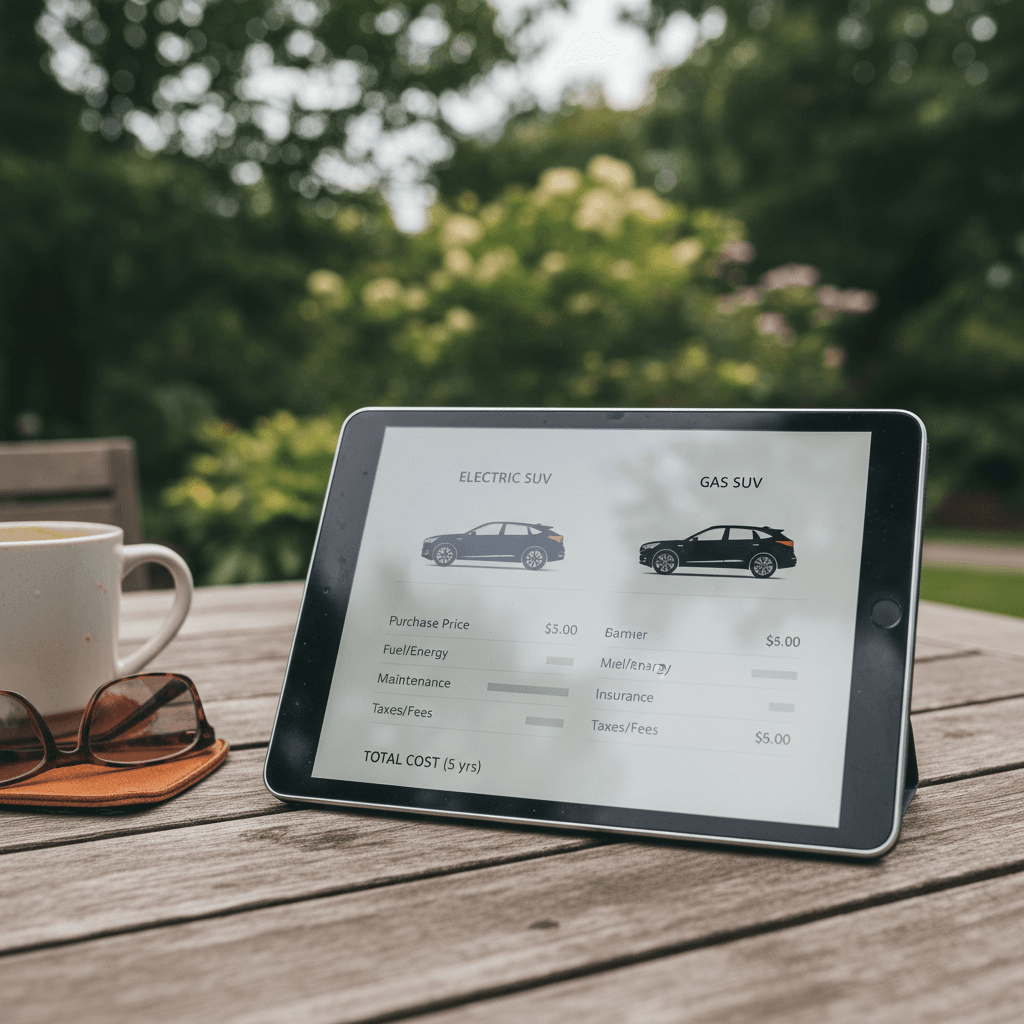
Energy costs: gas vs electricity for RDX and ZDX
Energy is where electric SUVs like the ZDX really start to separate from gas competitors over time. To keep things apples‑to‑apples, we’ll stick with U.S. national averages as of 2025–2026 and a 15,000‑mile‑per‑year driving pattern.
Acura RDX: fuel cost snapshot
- Real‑world efficiency: around 23 mpg combined for a turbo 2.0L RDX on premium fuel.
- Gas price assumption: $3.50 per gallon for premium (national ballpark, your state may be higher or lower).
- Annual fuel use: 15,000 miles ÷ 23 mpg ≈ 652 gallons.
- Annual fuel cost: 652 × $3.50 ≈ $2,280 per year.
Acura ZDX: electricity cost snapshot
- Efficiency: roughly 2.6–2.8 mi/kWh (A‑Spec), a bit less for the Type S.
- Electricity price assumption: blended 70% home at $0.17/kWh, 30% public DC fast charging at an equivalent of $0.35/kWh.
- Energy use: 15,000 miles ÷ 2.7 mi/kWh ≈ 5,555 kWh per year.
- Annual energy cost: home: 3,888 kWh × $0.17 ≈ $661; public: 1,667 kWh × $0.35 ≈ $583; total ≈ $1,250 per year.
Estimated annual energy cost: Acura RDX vs ZDX
When ZDX energy savings get bigger
Maintenance and repairs: where EVs usually win
Modern gas crossovers like the RDX are pretty reliable, but they still carry the complexity of a turbocharged engine, transmission, exhaust, and associated fluids. By contrast, the ZDX’s electric drivetrain cuts out oil changes, spark plugs, timing chains, transmission service, and a lot of other traditional maintenance touchpoints.
Typical maintenance experience: RDX vs ZDX
National studies consistently find that EVs cost less to maintain over time than comparable gas vehicles.
Acura RDX (gas)
- Regular oil and filter changes.
- Engine air filter, spark plugs, fuel system service over time.
- Transmission fluid service in many maintenance schedules.
- More moving parts = more potential wear items.
Industry cost‑of‑ownership data for compact and midsize SUVs suggest maintenance and repairs commonly run around $1,400–$1,600 per year on average over the first 5 years.
Acura ZDX (EV)
- No engine, transmission, or exhaust to service.
- Brake pads last longer thanks to regenerative braking.
- Still needs tires, cabin filters, brake fluid, and suspension work.
Recent EV cost studies often put maintenance and repairs closer to $900–$1,200 per year for electric SUVs, typically saving $4,000–$5,000 over eight years versus similar gas models.
The big EV wild card: battery health
Insurance, taxes, and fees
EVs like the ZDX often carry slightly higher insurance premiums than comparable gas SUVs. Higher MSRPs, heavier curb weights, and more complex body and electronics repairs all contribute. At the same time, registration fees in some states are higher for EVs, while others offer discounts or local incentives.
- For a luxury compact/midsize SUV, full‑coverage insurance often lands around $1,700–$2,100 per year for a typical driver profile.
- EVs sometimes add $100–$300 per year to that premium compared with a cheaper gas sibling, largely because of higher replacement cost.
- Several states charge extra annual registration fees for EVs (often $100–$250) to replace lost gas‑tax revenue, while others still offer perks like HOV lane access or reduced registration costs.
- These differences matter, but they’re usually smaller than the spreads you see in fuel and maintenance costs.
Quote both before you decide
Depreciation and resale value
Depreciation, the pace at which a vehicle loses value, is usually the single largest cost of ownership, especially in the first three to five years. Here, the story is more nuanced than “gas bad, EV good” or vice versa.
Acura RDX depreciation
- Premium gas crossovers from established brands typically hold value reasonably well, especially if they’re well‑optioned and serviced on schedule.
- Historically, a new luxury compact SUV like the RDX might lose roughly 45–55% of its value over the first five years.
- If you buy new and sell around year five, depreciation will likely dwarf your fuel savings either way.
Acura ZDX depreciation
- The ZDX is a new nameplate in a rapidly evolving EV market, built on GM’s Ultium platform. Early resale values are still forming.
- New EVs have seen sharper price cuts and faster depreciation than gas rivals in 2024–2025 as battery costs fall and competition intensifies.
- That’s bad news for first owners, but good news for second owners shopping used, they can often buy a low‑mile EV for far less than its original MSRP.
Where Recharged fits in
Ready to find your next EV?
Browse Vehicles5‑year ownership example: Acura RDX vs Acura ZDX
Let’s put the pieces together into a simplified five‑year example for a U.S. driver buying new and driving 15,000 miles per year. These are directional estimates, not guarantees, but they illustrate how the RDX vs ZDX math tends to work.
Illustrative 5‑year ownership cost (new purchase, 75,000 miles)
Rounded national‑average style estimates for a well‑equipped RDX vs a ZDX A‑Spec. Actual numbers vary by state, lender, and trim.
| Cost component (5 years) | Acura RDX (gas) | Acura ZDX (EV) | What it means |
|---|---|---|---|
| Fuel / electricity | ≈$11,400 | ≈$6,250 | ZDX saves roughly $5,000 on energy over 5 years. |
| Maintenance & repairs | ≈$7,500 | ≈$5,250 | EV’s simpler drivetrain trims ≈$2,000–$2,500 vs gas RDX. |
| Insurance | ≈$9,000 | ≈$9,750 | Assumes about $150 more per year for the EV. |
| Taxes & fees | ≈$4,000 | ≈$4,500 | Extra EV registration fees in many states; varies widely. |
| Depreciation | ≈$24,000 | ≈$31,000 | Assumes RDX loses ~50% and ZDX ~55–60% of value from a higher starting price. |
| Estimated 5‑year total | ≈$55,900 | ≈$56,800 | In this scenario, total 5‑year costs are surprisingly close. |
Acura RDX vs Acura ZDX 5‑year cost comparison (directional)
Interpreting the 5‑year math
Looking out 8 years & the used EV angle
Most new‑car buyers underestimate how dramatically the economics shift once you stretch the horizon beyond five years or let someone else eat the early depreciation.
- By years 6–8, the RDX’s fuel and maintenance tab keeps growing linearly, while the early depreciation hit has already happened.
- The ZDX continues to save money on energy and maintenance every year. The longer you own it and the more you drive, the stronger its total cost of ownership story becomes.
- If you buy a used ZDX after the initial 3–4‑year depreciation cliff, you often get the best of both worlds: a much lower purchase price than new, plus years of lower operating costs.
- On Recharged, every used ZDX listing includes a Recharged Score battery health report so you can see how much usable capacity remains and how the prior owner actually drove and charged it. That’s the missing puzzle piece in most used‑EV cost comparisons.
How ownership horizon changes the RDX vs ZDX math
Short‑term (3–4 years)
RDX’s lower MSRP and strong residuals can make it cheaper to own if you trade in early.
ZDX’s energy and maintenance savings don’t have enough time to fully offset higher depreciation.
If you lease, OEM lease offers and money factors matter more than pure running costs.
Medium‑term (5–6 years)
Total cost of ownership between RDX and ZDX often looks <strong>very similar</strong> in this window.
Your personal energy prices and mileage become the biggest swing factors.
If you buy used around year 3 and keep to year 8, a ZDX can pull ahead financially.
Long‑term (7–10+ years)
ZDX’s ongoing savings on electricity and maintenance can outweigh its higher initial price for many owners.
Battery longevity and out‑of‑warranty repair risk become the main questions, this is where real battery health data matters.
RDX remains predictable and easy to service almost anywhere, but long‑term fuel and maintenance bills stack up.
Which Acura is cheaper to own?
When you distill everything down, there isn’t a one‑size‑fits‑all answer to which is cheaper to own, the Acura RDX or Acura ZDX. Instead, the winner depends on your driving profile, energy prices, and how long you keep your vehicle.
Who should pick the RDX vs the ZDX?
Use this as a starting point, then run your own numbers with local prices.
Choose the Acura RDX if…
- You prefer lower upfront cost and don’t want to think about charging infrastructure.
- You drive fewer than 10,000–12,000 miles per year, so fuel savings are modest.
- You live in an area with expensive electricity or cheap gas, muting the EV advantage.
- You plan to own the car for 3–4 years and care most about residual value and simplicity.
Choose the Acura ZDX if…
- You’re comfortable with a higher purchase price in exchange for lower running costs.
- You drive at least 12,000–15,000 miles per year or more.
- You can charge at home or work at reasonable electricity rates.
- You plan to keep the vehicle for 6–10 years, or you’re buying a used ZDX where someone else already paid the early depreciation.
Run the numbers with your own data
Checklist: should you choose an Acura RDX or ZDX?
Key questions before you commit
1. How many miles do you really drive each year?
If you’re closer to 8,000 miles than 18,000, ZDX energy savings will be smaller. Heavy drivers see the biggest payback from going electric.
2. Can you charge at home reliably?
Home charging at a reasonable kWh rate is the backbone of the ZDX cost advantage. If you rely almost entirely on expensive DC fast charging, the savings shrink.
3. What are your local gas vs electricity prices?
Pull your last utility bill and check local fuel prices. In high‑gas, low‑electricity markets, the ZDX looks great. In cheap‑gas, expensive‑electricity states, the RDX can be more compelling.
4. How long do you keep vehicles?
Short‑term ownership (3–4 years) favors the RDX’s lower sticker and predictable resale. Longer ownership horizons give the ZDX more time to earn back its price premium through lower running costs.
5. Are you open to buying used?
A used ZDX bought after its steepest depreciation can undercut the total cost of a new RDX while still delivering low operating costs. Just make sure you have objective battery health data, like the Recharged Score, in hand.
6. How important is driving feel and tech?
Total cost of ownership is crucial, but so is enjoying the thing you drive. Instant EV torque, quietness, and updated software are part of the ZDX’s value proposition; the RDX counters with familiarity and widespread serviceability.
FAQ: Acura RDX vs ZDX ownership costs
Frequently asked questions about Acura RDX vs ZDX total cost of ownership
When you take a sober look at Acura RDX vs Acura ZDX total cost of ownership, the electric ZDX doesn’t magically erase the laws of economics, but it does quietly chip away at them, mile after mile. For high‑mileage or long‑term owners, especially those who can charge at home and are open to buying used, the ZDX can become the smarter financial play even before you factor in its smoother, quieter driving experience. For low‑mileage or short‑term buyers, the RDX’s lower sticker price and predictable depreciation still carry a lot of weight. The key is to align the numbers with how you actually live and drive, and if you’re EV‑curious, to let real battery health data and transparent pricing, like you’ll find on Recharged, guide the decision rather than guesswork.