If you’re driving a 2025 Volkswagen ID.4 and thinking about switching EVs, your first question is simple: what’s my ID.4 trade‑in value? With EV prices and incentives shifting fast, it can be hard to tell if a dealer’s offer is fair or if you’re leaving thousands on the table. This guide breaks down how ID.4 values really work in 2025, what’s realistic in today’s used‑EV market, and how to get the strongest offer when you’re ready to sell or trade.
Context: why ID.4 values feel “all over the place”
Quick overview: 2025 VW ID.4 values today
Snapshot: where VW ID.4 values sit in 2025
For a brand‑new 2025 Volkswagen ID.4, there isn’t yet a long resale history the way there is for 2021–2024 models. But by looking at current new‑car MSRPs and what nearly‑new ID.4s are reselling and trading for, you can make educated assumptions about where a 2025 will land over the next 1–3 years. The important thing is to treat any single online estimate as a starting point, not the final number.
Don’t anchor to your out‑the‑door price
How 2025 Volkswagen ID.4 trade‑in value is actually calculated
Whether you walk into a VW store, a traditional franchise dealer, or an EV‑focused retailer like Recharged, your 2025 ID.4 trade‑in value is built from the same core inputs. The real differences are how honestly those inputs are interpreted, and how transparent the buyer is about fees, recon costs, and margin.
6 factors that drive your ID.4 trade‑in offer
Dealers use software and auction data, but it all rolls up to these basics.
Model year & trim
Mileage & usage
Condition & history
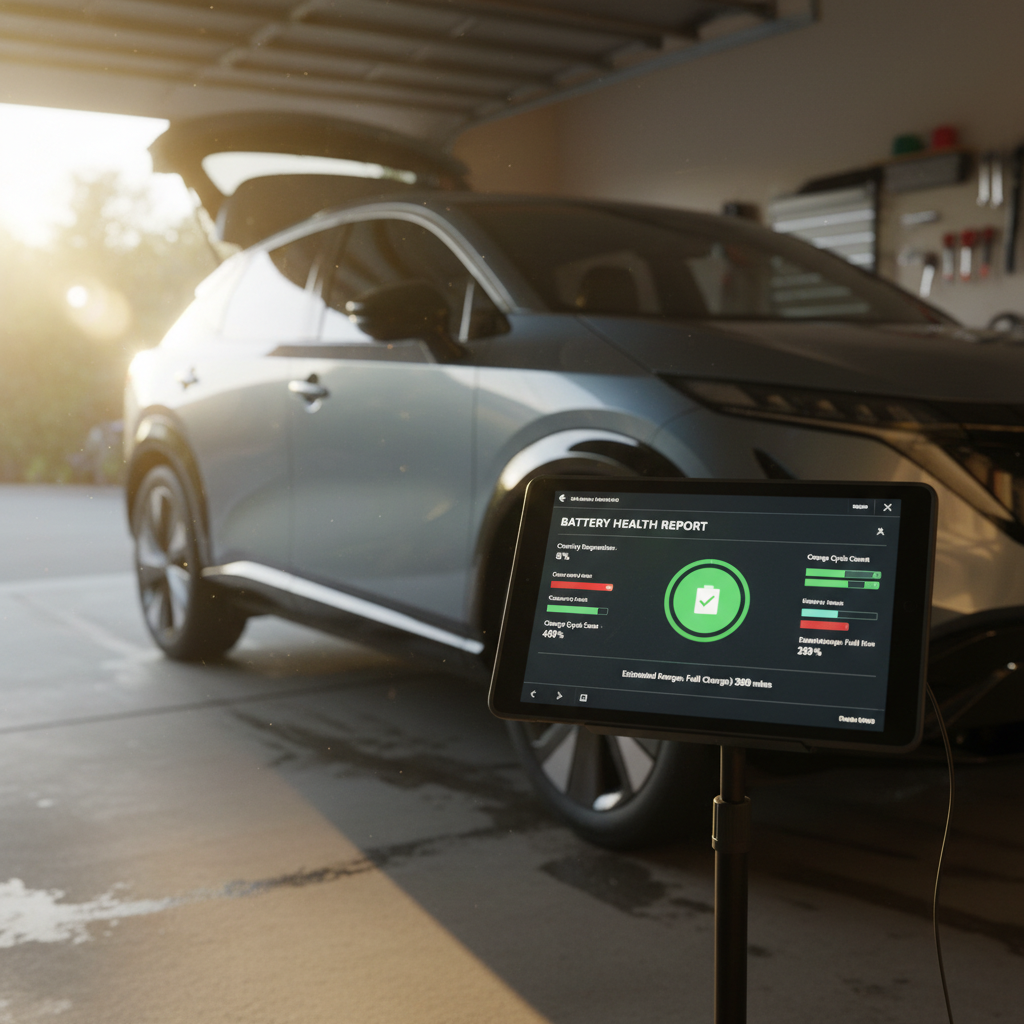
Battery health
Region & demand
Auction & retail data
How Recharged looks at your ID.4
Real‑world price range for 2025 ID.4 trade‑ins
Because 2025 ID.4s are still new, the most useful way to talk about trade‑in value today is in percentages of MSRP and by looking at how nearly‑new 2024s are being valued. Then you can adjust based on your specific trim, miles, and battery health.
Illustrative trade‑in ranges for a 2025 VW ID.4 (U.S.)
These example bands assume a roughly 12–24‑month‑old 2025 ID.4, normal use, and an original MSRP in the mid‑$40Ks to mid‑$50Ks. They’re not offers, just a way to contextualize what you might see on screen or at a store.
| Scenario | Condition & miles | Typical % of original MSRP | Illustrative trade‑in band |
|---|---|---|---|
| Best‑case early trade | Like‑new, <10,000 mi, clean history, strong battery | 70–75% | On a $50,000 MSRP ID.4, roughly $35,000–$37,500 |
| Average real‑world | Normal wear, 12,000–20,000 mi/year, no major damage | 60–68% | Same $50,000 MSRP example: about $30,000–$34,000 |
| Hard‑use or damage | High miles, visible wear, accidents or open recalls | 50–58% | More like $25,000–$29,000, sometimes less in weak markets |
Your actual 2025 ID.4 trade‑in value will depend on local market conditions and your specific vehicle details.
Why online tools disagree by thousands
Depreciation trends: where the ID.4 sits vs other EVs
Across recent model years, the VW ID.4 has settled into a middle‑of‑the‑pack depreciation story for compact electric SUVs. It’s not a resale superstar like the very hottest Tesla configurations, but it’s also not at the bottom of the heap. The bigger story is that EVs in general depreciated faster from 2022–2024 as tax rules shifted and new EV supply surged.
- Most ID.4s lose roughly 40–45% of their value in the first 3–4 years.
- By around year five, total loss typically lands around 60–62% of original MSRP.
- Early‑build 2021–2022 ID.4s were hit harder after Volkswagen discounted later models and lease deals flooded the market.
- Depreciation has started to flatten for older ID.4s as used EV prices stabilize and buyers look for value plays under new‑EV sticker shock.
How this applies to a 2025 ID.4
Why battery health matters more than trim on an ID.4
With gasoline cars, trim and options do much of the work in explaining differences in trade‑in value. With EVs like the ID.4, battery health is the new mileage. A well‑specced Pro S that shows noticeable degradation can be worth less than a lower‑trim ID.4 with a clean, strong pack and better fast‑charging behavior.
What appraisals should look at
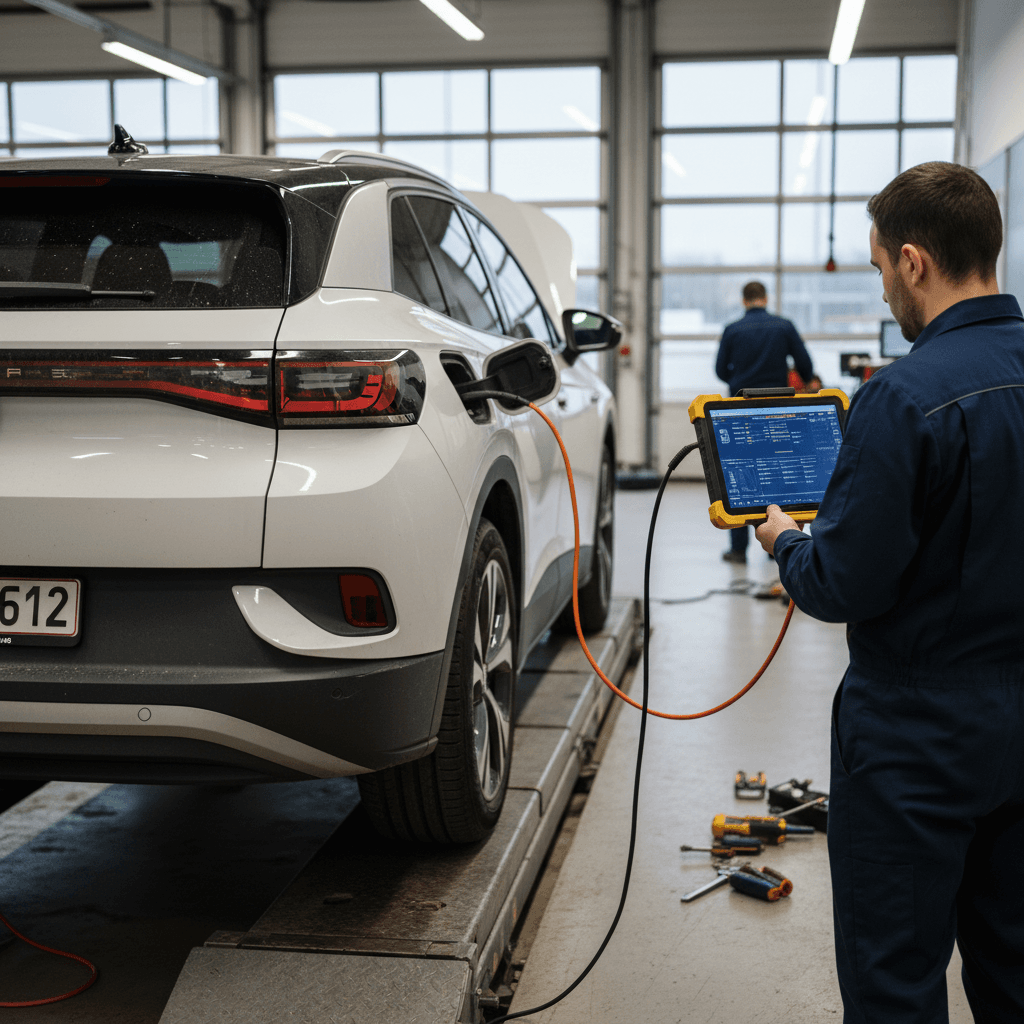
- State of health (SoH): How much usable capacity remains versus when the pack was new.
- DC fast‑charge performance: If your ID.4 tapers aggressively early, it’s a red flag.
- Error codes: Any high‑voltage faults or repeated charging errors in the logs.
- Thermal management: Evidence the pack is staying in a healthy temperature window.
How Recharged bakes this into value
Every ID.4 that goes through Recharged gets a Recharged Score battery diagnostic. That score is surfaced on your report and used directly in pricing, so a healthier pack can meaningfully improve your offer compared with tools that only see VIN and mileage.
This is especially valuable for 2021–2023 ID.4s, where software updates and usage patterns create bigger differences between individual cars.
Good news for careful owners
7 ways to maximize your 2025 ID.4 trade‑in offer
Practical steps before you request an ID.4 offer
1. Pull real comps, not just book values
Search for used ID.4s with the same year, battery, and mileage as yours on major listing sites. Look at actual asking prices and how long they’ve been sitting. A realistic trade is usually a few thousand below what a similar car is retail‑listed for, not MSRP minus a guess.
2. Gather your service & charging history
Export service records, note warranty work, and, if possible, pull logs from your primary charging apps. Showing consistent, mostly home Level 2 charging and timely maintenance supports a stronger value story.
3. Fix inexpensive cosmetic issues
Touch‑up deep scratches, repair obvious curb rash, and remove personal stickers or wraps. Spending $200–$400 on minor cosmetic reconditioning can easily add $500–$1,000 to a trade‑in offer.
4. Resolve open recalls or software updates
Check for open recalls and get them handled before you appraise the car. A vehicle that’s fully up to date is easier for a buyer to certify and retail, which means they can be more aggressive on price.
5. Get a battery health report in hand
If your buyer doesn’t automatically run one, ask if they can or provide third‑party results. With Recharged, the <strong>Recharged Score Report</strong> includes this by default, so you’re not negotiating blind on the most important component in the car.
6. Request at least two real offers
Use one or two national instant‑offer tools, but also get a written appraisal from an EV‑savvy buyer. When you compare, pay attention to fees and how long each offer is guaranteed, not just the headline number.
7. Time your move around incentives & model changes
Big new‑car incentives or a major refresh can blunt your trade‑in overnight. If VW rolls out heavy discounts or a facelift, used values will sag. If you’re close to the next model‑year cutover, it can pay to move a few months earlier.
Leverage consignment when you have time
Trade‑in vs consign vs private sale for an ID.4
Once you have a sense of your 2025 VW ID.4 trade‑in value, the next decision is how to sell. Different paths trade time and effort against money. For EVs, where battery health questions and charging education are real factors, the gap between these options can be bigger than with gas cars.
Ways to sell your 2025 ID.4: pros and cons
How trade‑ins, instant offers, consignment, and private sales usually stack up for an ID.4.
| Option | Typical value vs trade‑in | Time & effort | Best for |
|---|---|---|---|
| Dealer trade‑in | Baseline (100%) | Very low – done in one visit | You’re buying another car the same day and value convenience. |
| Online instant offer | Roughly similar or +$500–$1,000 | Low – quick photos & pickup | You want speed and a clean, simple transaction. |
| Consignment with Recharged | Often +$1,000–$3,000 vs trade‑in | Moderate – more time, but handled for you | Your ID.4 is well‑optioned and you want more money without selling alone. |
| Private sale | Highest potential, but not guaranteed | +10–20% if you find the right buyer | You’re patient, can manage listings and calls, and understand EV questions. |
Your best option depends on how quickly you need to move, your payoff balance, and your comfort with direct buyer interactions.
Watch for junk fees on “high” offers
Tax credits, loans, and being “underwater” on an ID.4
Because the ID.4 has been eligible for different federal clean‑vehicle credits depending on year, trim, and how it was purchased or leased, two owners with identical 2025 ID.4s can have radically different payoff balances. That’s why so many threads from 2021–2024 ID.4 owners mention being “upside‑down”, owing more than the car is worth, when they try to trade.
Why you might be upside‑down
- You financed with a long loan (72–84 months).
- You rolled negative equity from a previous vehicle into the ID.4.
- You didn’t capture a tax credit up front, or you leased on terms that didn’t pass savings through cleanly.
- Market depreciation outpaced the amortization schedule in your loan or lease.
What you can do about it
- Request payoff from your lender and compare it directly to real offers, not estimates.
- Consider waiting 6–12 months if possible; the curve often flattens and you keep paying principal.
- Look at consignment or a carefully priced private sale to squeeze more out of the car.
- Talk to an EV‑savvy advisor (Recharged offers this) before rolling negative equity into another long loan.
Tax credit nuance for resale
FAQ: 2025 VW ID.4 trade‑in value
Common questions about 2025 Volkswagen ID.4 trade‑ins
Key takeaways before you trade your ID.4
Your 2025 Volkswagen ID.4 trade‑in value isn’t a mystery, it’s the product of battery health, real market data, and how efficiently a buyer can recondition and resell your car. The fastest way to a fair number is to treat online estimates as a range, then get at least one appraisal that includes a proper battery diagnostic and a clear line‑item explanation of fees and recon.
If you want to keep the process simple but avoid leaving money on the table, consider starting with an EV specialist. Recharged can evaluate your ID.4’s battery with a Recharged Score Report, show you what similar cars are really selling for, and walk you through options: instant offer, trade‑in toward another used EV, or higher‑yield consignment. That way, when you do hand over the keys, you’ll know you squeezed the most value you could out of your electric VW without turning the sale into a second job.